8.4Unit 8: Energy changes and reactions of metals
Reactions of metals with water — Question Bank (Cambridge) — HIA International - Grade 7 Revision Notes & Topical Questions
10 min read Lesson 9 of 12 3 quizzes
Cambridge Past Paper Bank
8.4 Reactions of metals with water
7 Multiple-Choice Questions with Official Mark Schemes
Question 1
0620/22_Summer_2024_Q24
Question 2
5129/12_Summer_2024_Q25
Question 3
5129/12_Summer_2021_Q22

Question 4
0620/13_Winter_2025_Q24

Question 5
5129/11_Summer_2023_Q24
Question 6
5129/11_Summer_2022_Q25

Question 7
0620/21_Summer_2020_Q28
Cambridge Lower Secondary Stage 8
8.4 Reactions of metals with water – Complete Question Bank & Mark Scheme
Total Questions7 Questions with Verified Solutions & Past Paper Mark Schemes
Multiple Choice Questions (Exam Practice)
Question 1
Paper Ref: 0620/22_Summer_2024_Q24
Paper Ref: 0620/22_Summer_2024_Q24
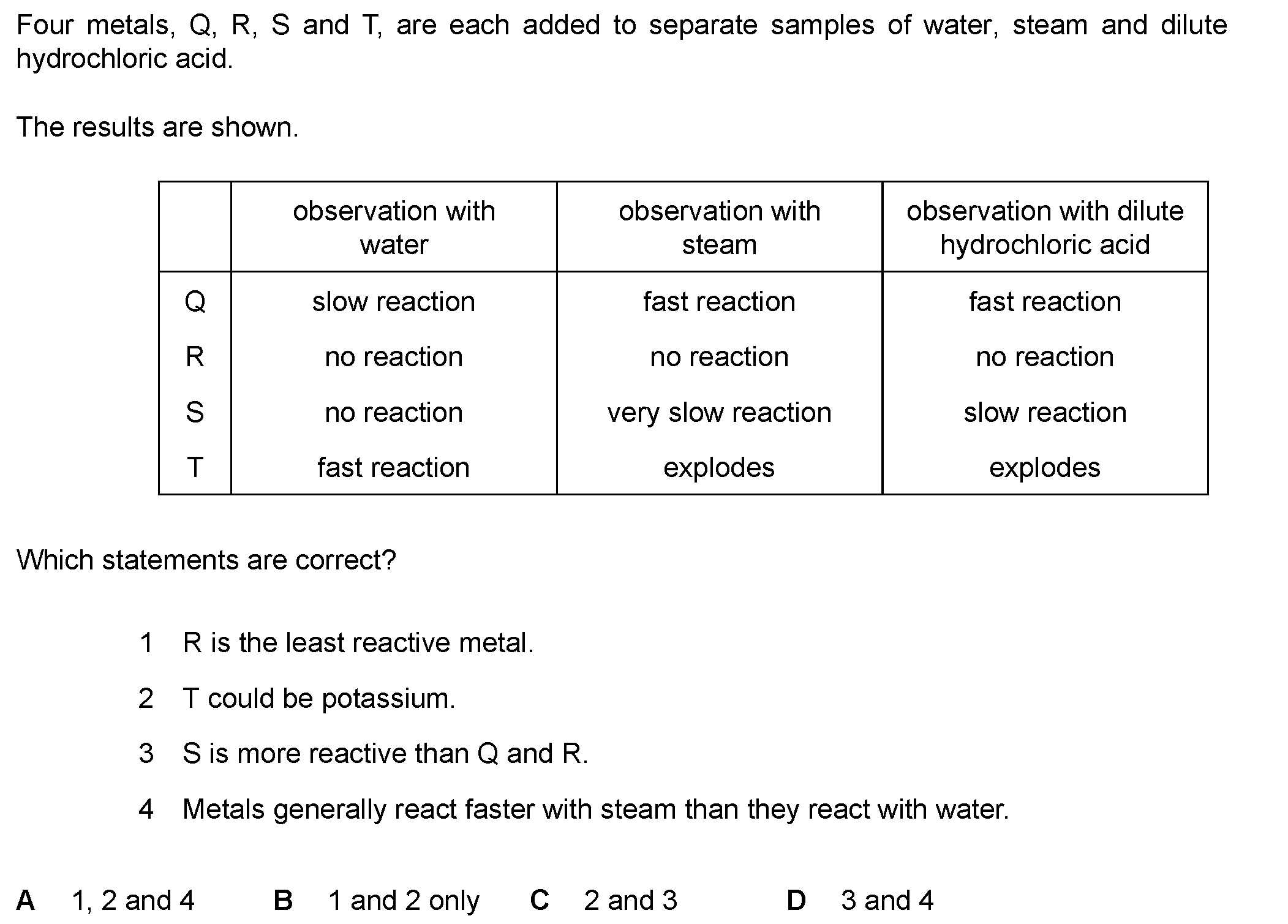
Four metals, Q, R, S and T, are each added to separate samples of water, steam and dilute
hydrochloric acid.
The results are shown.
observation with observation with observation with dilute
water steam hydrochloric acid
slow reaction fast reaction fast reaction
no reaction no reaction no reaction
no reaction very slow reaction slow reaction
fast reaction explodes explodes
Which statements are correct?
—_
R is the least reactive metal.
T could be potassium.
S is more reactive than Q and R.
KR WwW ND
Metals generally react faster with steam than they react with water.
A 1,2and4 B tdand2only C 2and3 D 3and4
Options:
A
B
C
D
Correct Key: A
A
B
C
D
Correct Key: A
Question 2
Paper Ref: 5129/12_Summer_2024_Q25
Paper Ref: 5129/12_Summer_2024_Q25
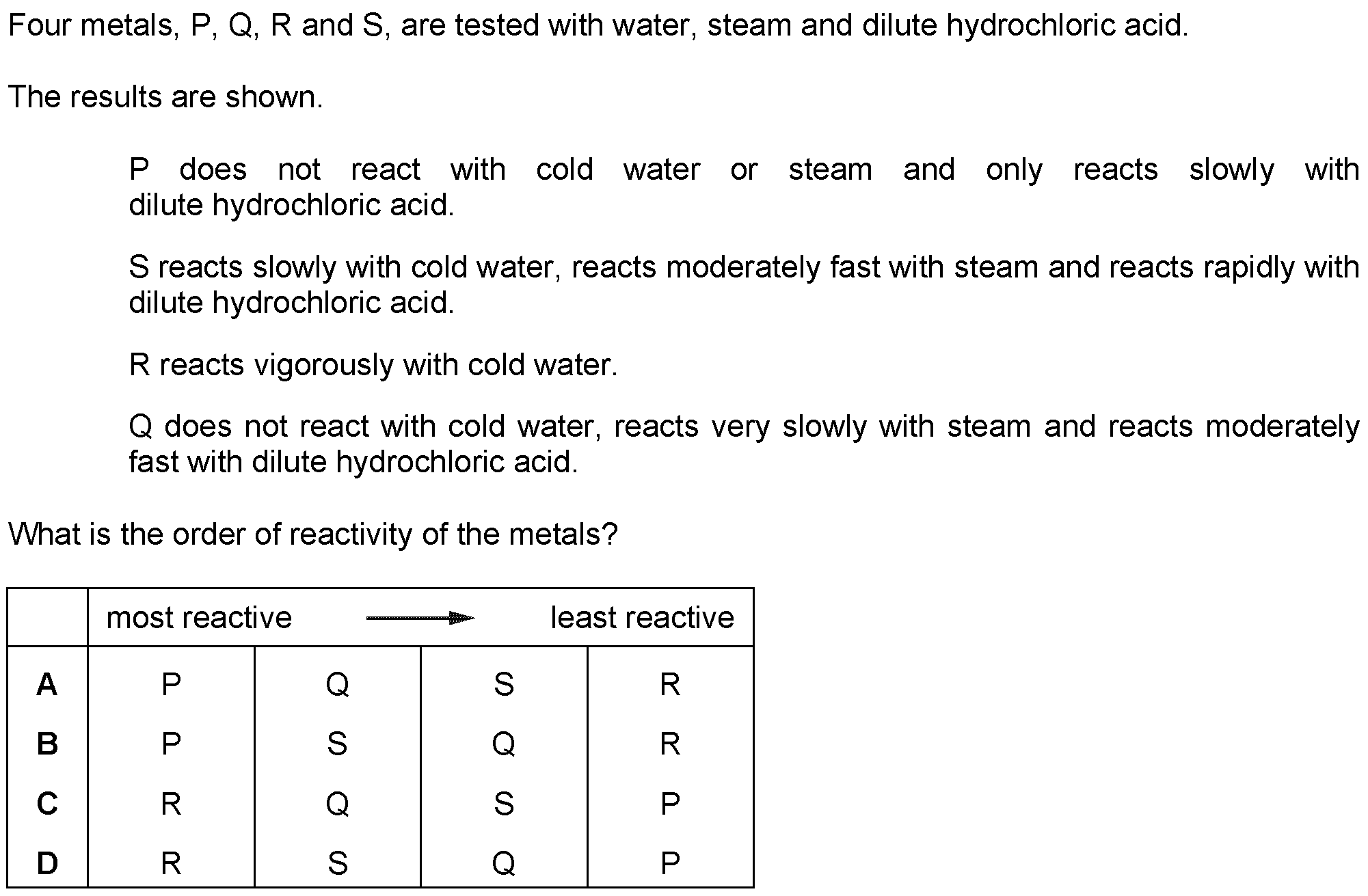
Four metals, P, Q, R and S, are tested with water, steam and dilute hydrochloric acid.
The results are shown.
P does not react with cold water or steam and only reacts slowly with
dilute hydrochloric acid.
S reacts slowly with cold water, reacts moderately fast with steam and reacts rapidly with
dilute hydrochloric acid.
R reacts vigorously with cold water.
Q does not react with cold water, reacts very slowly with steam and reacts moderately
fast with dilute hydrochloric acid.
What is the order of reactivity of the metals?
| | most reactive ——— least reactive
A P
R
Options:
A
B
C
D
Correct Key: D
A
B
C
D
Correct Key: D
Question 3
Paper Ref: 5129/12_Summer_2021_Q22
Paper Ref: 5129/12_Summer_2021_Q22
Four metals, W, X, Y and Z, are tested with water, steam and dilute hydrochloric acid.
The results are shown.
W does not react with cold water or steam and only reacts slowly with
dilute hydrochloric acid.
Z reacts slowly with cold water, reacts moderately fast with steam and reacts rapidly with
dilute hydrochloric acid.
Y reacts vigorously with cold water.
X does not react with cold water, reacts very slowly with steam and reacts moderately
fast with dilute hydrochloric acid.
What is the order of reactivity of the metals?
| | most reactive —— least reactive
A
Ww Y
Y
Ww
Ww
Options:
A
B
C
D
Correct Key: D
A
B
C
D
Correct Key: D
Question 4
Paper Ref: 0620/13_Winter_2025_Q24
Paper Ref: 0620/13_Winter_2025_Q24
The properties of four metals, E, F, G and H, are shown.
E does not react with cold water, but reacts with steam.
F does not react with water or dilute acid, but the oxide of F is reduced by carbon.
The oxide of G is not reduced by carbon, but G reacts vigorously with cold water.
H does not react with water or steam, but reacts with dilute acid.
What is the order of reactivity of the metals starting with the most reactive?
most least
reactive reactive
A F E H G
B F H E G
Cc G E H F
D G H E F
Options:
A
B
C
D
Correct Key: C
A
B
C
D
Correct Key: C
Question 5
Paper Ref: 5129/11_Summer_2023_Q24
Paper Ref: 5129/11_Summer_2023_Q24
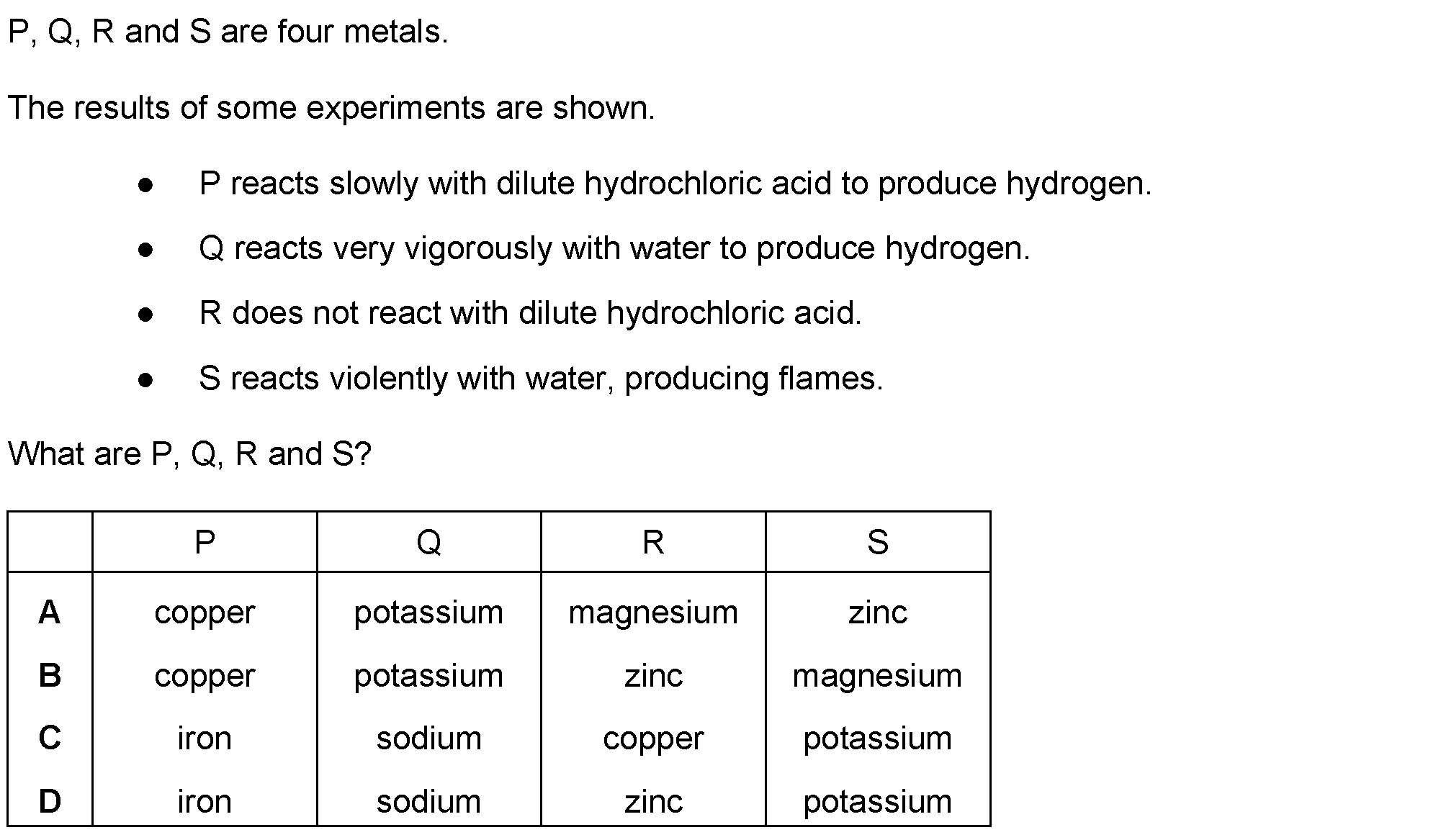
P, Q, R and S are four metals.
The results of some experiments are shown.
e P reacts slowly with dilute hydrochloric acid to produce hydrogen.
e Qreacts very vigorously with water to produce hydrogen.
e R does not react with dilute hydrochloric acid.
® Sreacts violently with water, producing flames.
What are P, Q, R and S$?
copper potassium magnesium
copper potassium zinc magnesium
iron sodium copper potassium
iron sodium zinc potassium
Options:
A
B
C
D
Correct Key: C
A
B
C
D
Correct Key: C
Question 6
Paper Ref: 5129/11_Summer_2022_Q25
Paper Ref: 5129/11_Summer_2022_Q25
Two reactions of hydrogen are shown.
reaction 1 2H, + O2 > 2H,O0
reaction2 H. + CoHy > CoH,
Which row describes the two reactions?
— reaction 1 reaction 2
combustion of H2 combustion of CoH,
combustion of H2 oxidation of CoH,
oxidation of H» reduction of CoH,
reduction of H. oxidation of CoH,
reaction 1 2H, + O2 > 2H,O0
reaction2 H. + CoHy > CoH,
Which row describes the two reactions?
— reaction 1 reaction 2
combustion of H2 combustion of CoH,
combustion of H2 oxidation of CoH,
oxidation of H» reduction of CoH,
reduction of H. oxidation of CoH,
Options:
A
B
C
D
Correct Key: C
A
B
C
D
Correct Key: C
Question 7
Paper Ref: 0620/21_Summer_2020_Q28
Paper Ref: 0620/21_Summer_2020_Q28
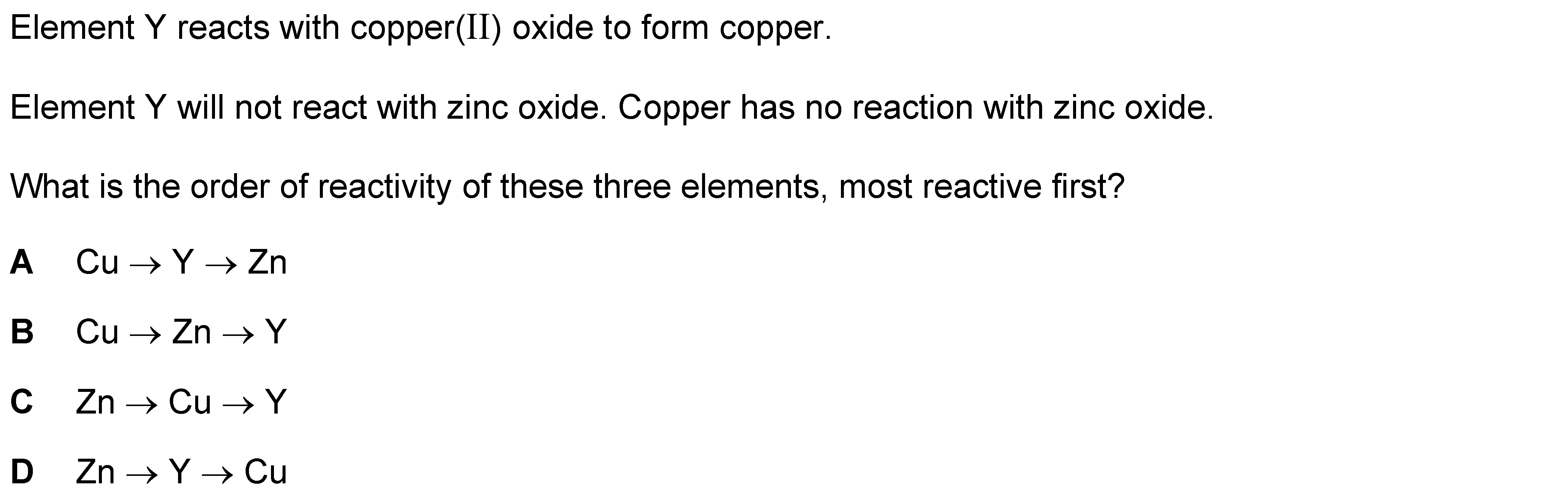
Element Y reacts with copper(II) oxide to form copper.
Element Y will not react with zinc oxide. Copper has no reaction with zinc oxide.
What is the order of reactivity of these three elements, most reactive first?
A Cu>Y → Zn
B Cu>2Zn>Y
C Zn>Cu>Y
D
Zn → Y— → Cu
Element Y will not react with zinc oxide. Copper has no reaction with zinc oxide.
What is the order of reactivity of these three elements, most reactive first?
A Cu>Y → Zn
B Cu>2Zn>Y
C Zn>Cu>Y
D
Zn → Y— → Cu
Options:
A
B
C
D
Correct Key: D
A
B
C
D
Correct Key: D
Structured Questions Mark Scheme & Answers
•1•.• • • •[•▍• •P•T• •S•9• •2•0•2•5• •P•2• • •·• • •Q•6• • •P•a•r•t• •(•b•)• • •·• • •2•0•2•5• • •·• • •L•o•w•e•r• •S•e•c• •0•8•9•3•]• • • • • • •n•o• •(•n•o• •m•a•r•k•)• •1• •y•e•s• •t•i•c•k•e•d• •=• •0• •m•a•r•k•s• •f•o•r• •t•h•e• •q•u•e•s•t•i•o•n• •(•i•d•e•a• •t•h•a•t•)• •c•o•p•p•e•r• •i•s• •l•e•s•s• •r•e•a•c•t•i•v•e• •t•h•a•n• •m•a•g•n•e•s•i•u•m• •o•r•a• •••c•c•e•p•t• •c•o•p•p•e•r• •i•s• •b•e•l•o•w• •m•a•g•n•e•s•i•u•m• •i•n• •t•h•e• •r•e•a•c•t•i•v•i•t•y• •s•e•r•i•e•s• •o•r•a• •N•o•t•e• •c•o•p•p•e•r• •i•s• •l•e•s•s• •r•e•a•c•t•i•v•e• •i•s• •n•o•t• •s•u•f•f•i•c•i•e•n•t• •D•o• •n•o•t• •a•c•c•e•p•t• •c•o•p•p•e•r• •i•s• •l•e•s•s• •r•e•a•c•t•i•v•e• •t•h•a•n• •m•a•g•n•e•s•i•u•m• •s•u•l•f•a•t•e•
•2•.• • • •[•▍• •P•T• •S•9• •2•0•2•5• •P•2• • •·• • •Q•6• • •P•a•r•t• •(•c•)• • •·• • •2•0•2•5• • •·• • •L•o•w•e•r• •S•e•c• •0•8•9•3•]• • • • • • •y•e•s• •(•n•o• •m•a•r•k•)• •1• •n•o• •t•i•c•k•e•d• •=• •0• •m•a•r•k•s• •f•o•r• •t•h•e• •q•u•e•s•t•i•o•n• •(•i•d•e•a• •t•h•a•t•)• •i•r•o•n• •i•s• •m•o•r•e• •r•e•a•c•t•i•v•e• •t•h•a•n• •s•i•l•v•e•r• •o•r•a• •••c•c•e•p•t• •i•r•o•n• •i•s• •a•b•o•v•e• •s•i•l•v•e•r• •i•n• •t•h•e• •r•e•a•c•t•i•v•i•t•y• •s•e•r•i•e•s• •o•r•a• •N•o•t•e• •i•r•o•n• •i•s• •m•o•r•e• •r•e•a•c•t•i•v•e• •i•s• •n•o•t• •s•u•f•f•i•c•i•e•n•t• •D•o• •n•o•t• •a•c•c•e•p•t• •i•r•o•n• •i•s• •m•o•r•e• •r•e•a•c•t•i•v•e• •t•h•a•n• •s•i•l•v•e•r• •n•i•t•r•a•t•e• •©• •U•C•L•E•S• •2•0•2•5• •P•a•g•e• •6• •o•f• •1•4• •S•9•/•0•2• •S•c•i•e•n•c•e• •S•t•a•g•e• •9• •P•a•p•e•r• •2• •M•a•r•k• •S•c•h•e•m•e• •2•0•2•5•
•3•.• • • •[•▍• •P•T• •S•9• •2•0•2•6• •P•1• • •·• • •Q•1•6• • •·• • •2•0•2•6• • •·• • •L•o•w•e•r• •S•e•c• •0•8•9•3•]• • • • • • •N•a•2•O• •2• •E•a•c•h• •c•o•r•r•e•c•t• •a•n•s•w•e•r• •=• •1• •m•a•r•k• •K•2•S•O•4• •••c•c•e•p•t• •O•N•a•2• •••c•c•e•p•t• •S•O•4•K•2• •o•r• •O•4•S•K•2• •o•r• •K•2•O•4•S• •©• •C•a•m•b•r•i•d•g•e• •U•n•i•v•e•r•s•i•t•y• •P•r•e•s•s• •&• •••s•s•e•s•s•m•e•n•t• •2•0•2•6• •P•a•g•e• •1•1• •o•f• •1•2• •S•9•/•0•1• •S•c•i•e•n•c•e• •S•t•a•g•e• •9• •P•a•p•e•r• •1• •M•a•r•k• •S•c•h•e•m•e• •2•0•2•6• •B•L•••N•K• •P•••G•E• •©• •C•a•m•b•r•i•d•g•e• •U•n•i•v•e•r•s•i•t•y• •P•r•e•s•s• •&• •••s•s•e•s•s•m•e•n•t• •2•0•2•6• •P•a•g•e• •1•2• •o•f• •1•2•
•4•.• • • •[•▍• •P•R•I• •2•0•0•8•D• •P•2• • •·• • •Q•9• • •P•a•r•t• •(•b•)• • •·• • •2•0•0•8• • •·• • •P•r•i•m•a•r•y• •0•8•4•6•]• • • • • • •(•n•o• •p•u•b•l•i•s•h•e•d• •m•a•r•k• •s•c•h•e•m•e• •f•o•r• •t•h•i•s• •p•a•p•e•r•)•
Last updated: