2.4Theme B — Form and function
Organelles & Compartmentalisation — IB Biology HL Revision Notes & Topical Questions
5 min read 11 parts Lesson 12 of 14 1 quiz
Lesson summary
2.4 Organelles & Compartmentalisation — HL Notes — IB BIOLOGY HL notes: Distinguish organelles from other cell structures and relate the structure of mitochondria, chloroplasts and protein-synthesis organelles to function.Organelle = a membrane-bound compartment of a eukaryotic c…
- Organelle adaptation
- Nature of science
- Order of pelleting
- Prokaryotes
- Eukaryotes
- Nuclear envelope
Section 1 of 11Organelles and compartmentalisation
Organelles and compartmentalisation
Organelle
Organelle a membrane-bound compartment of a eukaryotic cell with a single or double membrane.
- The cell wall, cytoskeleton and cytoplasm are not organelles because they lack a membrane.
- Ribosomes are discrete non-membrane-bound subunits of the cell that are counted among organelles.
Advantages of compartmentalisation
- Enzymes and substrates are localised at higher concentrations.
- Damaging substances are kept apart, such as digestive enzymes inside lysosomes.
- Optimal conditions such as pH are maintained for each process.
- The number and location of organelles can change to suit the cell.
Organelle adaptation
- Organelle adaptation each organelle is structurally adapted to its function, and its membrane lets it run its own reactions without interference.
Section 2 of 11Cell fractionation
Nature of science
- Nature of science ultracentrifuges and cell fractionation let scientists study organelles individually, showing that progress follows new techniques.
Stages
Cell fractionation
Homogenisation: break up the tissue in a blender-like homogeniser using cold, isotonic, buffered solution.
Filtration: pass the homogenate through gauze to remove debris.
Ultracentrifugation: spin the filtrate at increasing speeds so components separate by mass.
Order of pelleting
- Order of pelleting nuclei first, then mitochondria and chloroplasts, then ribosomes and membranes.
Conditions
- Cold reduces enzyme activity and self-digestion.
- Isotonic solution prevents osmotic bursting.
- Buffer prevents denaturation by pH change.
Section 3 of 11Nucleus and cytoplasm separation
Prokaryotes
- Prokaryotes transcription and translation occur together, which allows rapid responses to stimuli.
Eukaryotes
- Eukaryotes the nucleus keeps them separate.
- mRNA is modified in isolation in the nucleus before meeting a ribosome.
- This reduces errors in the mRNA and the protein.
Separating incompatible reactions
- Nitrogenase, the nitrogen-fixing enzyme, is sensitive to oxygen, so it is kept in an anaerobic region away from aerobic reactions.
- Lysosome membranes contain lytic enzymes that would harm the cell.
- A phagocytic vacuole holds engulfed bacteria away from the cytoplasm until a lysosome digests them.
Section 4 of 11Mitochondria
Mitochondria
Features
- Features rod-shaped, 0.5–1.0 µm in diameter, the site of aerobic respiration and ATP synthesis by oxidative phosphorylation.
Structure and function
- Outer membrane — smooth and permeable to small molecules.
- Inner membrane — folded into cristae, less permeable, and holds the electron transport chain and ATP synthase.
- Intermembrane space — small in volume and with low pH, so a proton gradient builds up quickly.
- Matrix — aqueous, with Krebs cycle and link reaction enzymes, ribosomes and circular DNA.
Adaptations
- Cristae give a large inner membrane area, so there are more electron carriers and ATP synthase enzymes and more ATP is made.
- Compartmentalised enzymes and substrates in the matrix make the Krebs cycle efficient.
- Active cells such as muscle have more mitochondria than fat cells, and they may be larger with longer, tighter cristae.
- Ribosomes and DNA let mitochondria make some of their own proteins, and their 70S ribosomes support endosymbiosis.
Section 5 of 11Chloroplasts
Chloroplasts
Features
- Features roughly 2–10 µm across, larger than mitochondria, with a double-membrane envelope and a site of photosynthesis.
Structure and function
- The outer membrane is permeable to ions and small molecules, and the inner membrane has transport proteins that control entry.
- The stroma holds the Calvin cycle enzymes including rubisco, CO2, sugars, and sometimes starch grains or lipid droplets.
- Thylakoids are flattened sacs with pigments, enzymes and electron carriers, stacked into grana and linked by stroma lamellae.
- Photosystems are funnel-shaped pigment clusters in thylakoid membranes passing energy to the reaction centre.
Adaptations
- Grana give a large area for many photosystems, electron carriers and ATP synthase.
- The small thylakoid space builds a proton gradient quickly.
- The stroma surrounds the grana, so products of the light-dependent stage reach the Calvin cycle rapidly.
- Chloroplast DNA and 70S ribosomes make some photosynthetic proteins.
Section 6 of 11Nucleus and ribosomes
Nuclear envelope
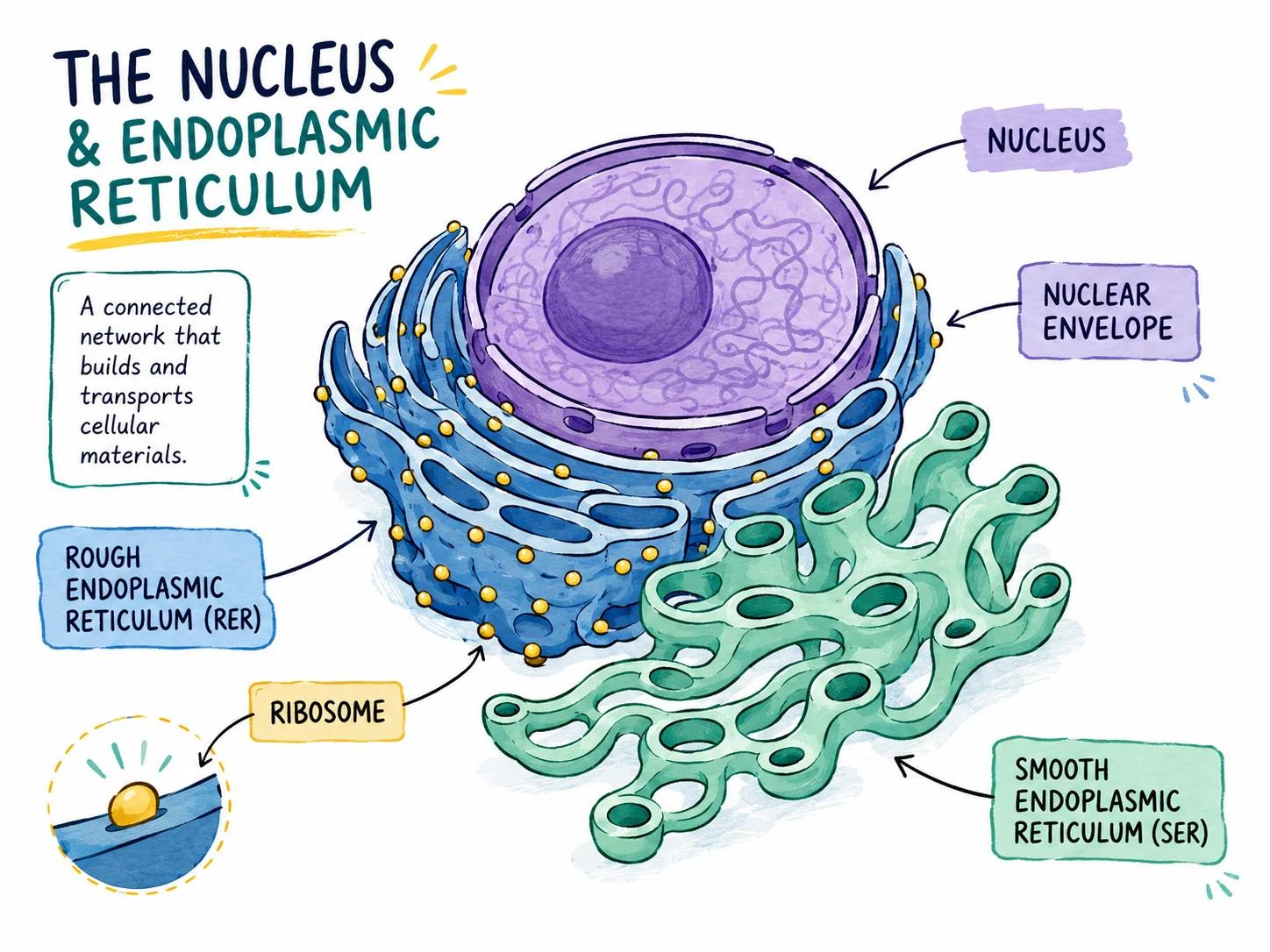
- Nuclear envelope a double membrane with pores, continuous with the endoplasmic reticulum.
- Pores let mRNA and ribosomes out and enzymes such as DNA polymerase and signalling molecules in.
- The outer membrane with ribosomes forms rough ER, and without ribosomes forms smooth ER.
- It breaks into vesicles in prophase of mitosis and meiosis and reforms in telophase.
Ribosome
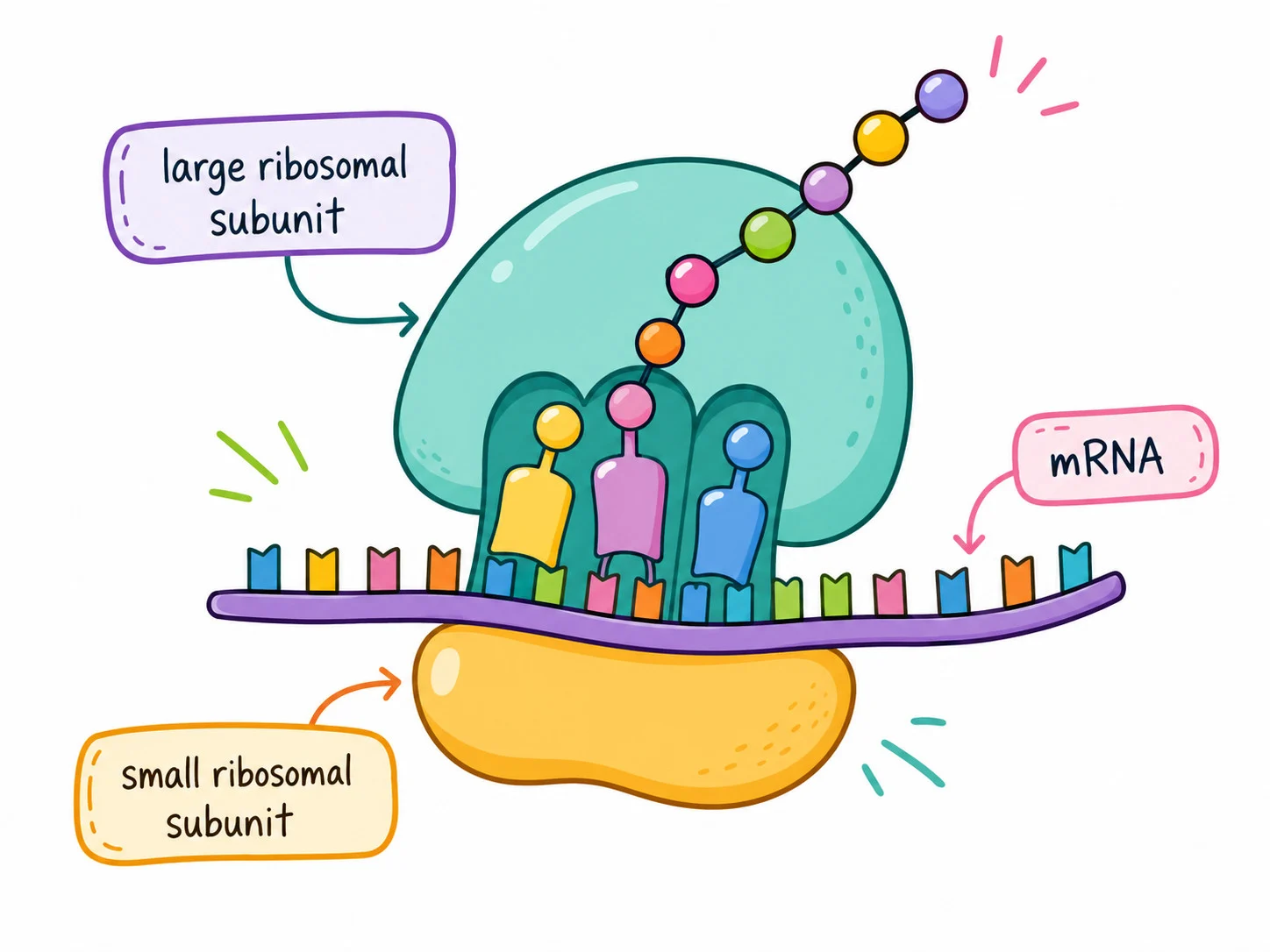
- Ribosome a large and small subunit of protein and rRNA, the site of protein synthesis.
- rRNA helps bind mRNA and tRNA and catalyses peptide bond formation.
- There are three tRNA binding sites and one mRNA site, and mRNA lies in a groove between the subunits.
- Eukaryotic ribosomes are 80S, while prokaryotic and organelle ribosomes are 70S.
Section 7 of 11Free and bound ribosomes
Free and bound ribosomes
Free ribosomes make proteins for use in the cytosol and for import into mitochondria and chloroplasts.
Bound ribosomes make proteins for lysosomes, secretion or membranes.
Signal sequence process
1
A signal sequence at the start of the polypeptide is made on a free ribosome.
2
A signal recognition protein binds and pauses translation.
3
The ribosome binds a receptor on the ER, forming rough ER.
4
Translation restarts and the polypeptide enters the ER lumen.
5
A vesicle carries the protein to the Golgi apparatus.
Section 8 of 11Golgi apparatus
Golgi apparatus
Structure
- Structure flattened sacs (cisternae).
- The cis side faces the ER and receives vesicles.
- The trans side faces the plasma membrane and sends out modified products.
Function
- Function it modifies proteins and lipids and packages them into vesicles for their destination.
Destinations
- Destinations export, lysosomes (hydrolytic enzymes) or membrane-bound organelles.
- (for example insulin)
Secretion pathway
1
The gene is transcribed and mRNA leaves via nuclear pores.
2
Translation on bound ribosomes feeds the polypeptide into the rough ER.
3
A vesicle carries it to the Golgi, which modifies and sorts it.
4
A secretory vesicle buds from the trans face and fuses with the plasma membrane, releasing the protein by exocytosis.
Section 9 of 11Vesicles
Vesicle
Vesicle a membrane-bound sac for transport and storage.
- Peroxisomes contain enzymes that digest fatty acids.
- Lysosomes contain lytic enzymes that digest waste or harmful material.
- Transport vesicles move molecules within the cell.
- Secretory vesicles carry substances out by exocytosis.
Clathrin
- Clathrin a protein that helps vesicles form.
1
A clathrin-coated pit forms on the plasma membrane.
2
Surface receptors bind target molecules.
3
Cytoskeletal proteins deepen the pit once enough molecules are bound.
4
The pit seals off, trapping the molecules in a vesicle.
- Vesicles compared with vacuoles
- vacuoles are larger and their membranes do not fuse with other compartments, unlike vesicle membranes.
Section 10 of 11Key terms
| Term | Meaning |
|---|---|
| Organelle | a membrane-bound compartment with a specific function in a eukaryotic cell. |
| Compartmentalisation | separating cell activities into membrane-bound regions. |
| Cell fractionation | breaking up cells and centrifuging to separate organelles. |
| Cristae | the folds of the inner mitochondrial membrane. |
| Thylakoid | a flattened membrane sac in a chloroplast that holds photosystems. |
| Signal sequence | a sequence at the start of a polypeptide that directs the ribosome to the ER. |
| Golgi apparatus | stacked cisternae that modify and package proteins and lipids. |
| Clathrin | a protein that helps form vesicles at the membrane. |
Section 11 of 11Exam technique
1
The cytoskeleton is an organelle — it has no membrane and is not a discrete subunit.
2
Cristae increase the surface area and that is enough — the larger area holds more electron carriers and ATP synthase so more ATP is made.
3
All proteins are made on the rough ER — proteins for use in the cytosol are made on free ribosomes.
4
Vesicles and vacuoles are the same — vacuoles are larger and their membranes do not fuse with other compartments.
Marked practiceQuizzes for this lesson
Last updated:
\n