2.5Theme B — Form and function
Cell Specialisation — IB Biology HL Revision Notes & Topical Questions
5 min read 12 parts Lesson 13 of 14 1 quiz
Lesson summary
2.5 Cell Specialisation — HL Notes — IB BIOLOGY HL notes: Explain how cell differentiation arises from gene expression and morphogens and how the size and shape of specialised cells relate to function.Stem cell = a cell that can divide by mitosis an unlimited number of times (sel…
- Stem cell niche
- Niche conditions
- Division of labour
- Structural adaptations
- Size effect
- Small cells
Part 1 of 10Stem cells and niches
Stem cell
Stem cell a cell that can divide by mitosis an unlimited number of times (self-renewal) and can differentiate.
- Each new cell may remain a stem cell or differentiate into a specialised cell such as a blood or muscle cell.
- After differentiation the cell is no longer a stem cell.
Stem cell niche
Stem cell niche a location where stem cells remain so that a tissue can regenerate and repair.
- Bone marrow supplies stem cells that replace red blood cells, white blood cells and platelets continually.
- The hair follicle root supplies stem cells for continual hair growth.
Niche conditions
- Niche conditions the environment must keep stem cells inactive and also be able to stimulate their division and differentiation.
Part 2 of 10Potency of stem cells
| Potency | Differentiation ability | Example |
|---|---|---|
| Totipotent | Any embryonic cell type plus extra-embryonic (placental) cells | Zygote and embryo cells up to the 16-cell stage |
| Pluripotent | Any embryonic cell type but not extra-embryonic cells | Embryonic stem cells of the blastocyst inner cell mass |
| Multipotent | Closely related cell types | Bone marrow stem cells forming blood cells |
| Unipotent | Only their own lineage | Cardiomyocytes replacing heart muscle; most animal cells |
- Therapy
- bone marrow transplants replace blood cells after cancer treatment.
- Ethical issues arise with embryonic stem cells because embryos are destroyed.
Part 3 of 10Differentiation and gene expression
Division of labour
- Division of labour after fertilisation the zygote divides by mitosis and cells specialise to form tissues, which makes them more efficient.
Gene expression
- Gene expression every cell has the same genes, and differentiation depends on which genes are expressed.
Morphogens
1
Source cells secrete a morphogen.
2
It diffuses to form a concentration gradient.
3
Cells bind the morphogen at different concentrations, which gives positional information.
4
Different transcription factors switch on different genes.
5
Cells differentiate into different types according to position.
- Structural adaptations
- specialisation changes cell shape and organelle content.
- Protein-making cells have many ribosomes.
Part 4 of 10Cell size and specialisation
| Cell | Size feature | Reason |
|---|---|---|
| Red blood cell | Small, about 7–8 µm | Passes narrow capillaries |
| Active white blood cell | Larger than inactive | Room for rER and Golgi for antibody synthesis |
| Sperm | Long, narrow streamlined head | Movement to the egg with low resistance |
| Egg | Largest volume | Stored food reserves |
| Nerve cell | Large cell body, long axon | Protein synthesis to maintain a long axon for rapid impulses |
| Muscle fibre | Large in length and diameter | Exerts force in contraction |
Part 5 of 10Surface area to volume ratio
Metabolic rate depends on cell volume, while exchange rate depends on surface area.
Size effect
- Size effect as a cell grows its volume rises faster than its surface area, so SA:V falls.
- For a cube, SA = 6 × L2, V = L3 and SA:V = 6 ÷ L.
- For a sphere, SA = 4πr2, V = (4/3)πr3 and SA:V = 3 ÷ r.
Small cells
- Small cells single-celled organisms have a high SA:V, low needs and a short diffusion distance, so diffusion alone suffices.
Large cells
- Large cells the SA:V is too low and the diffusion distance to the centre is long, so growth must stop and cells divide.
Multicellular organisms
- Multicellular organisms they evolved gas exchange systems, digestive systems and circulatory systems.
- Heat loss also depends on SA:V, so small animals lose heat faster.
Typical cell size is 10–100 µm.
Part 6 of 10Agar cube model of diffusion
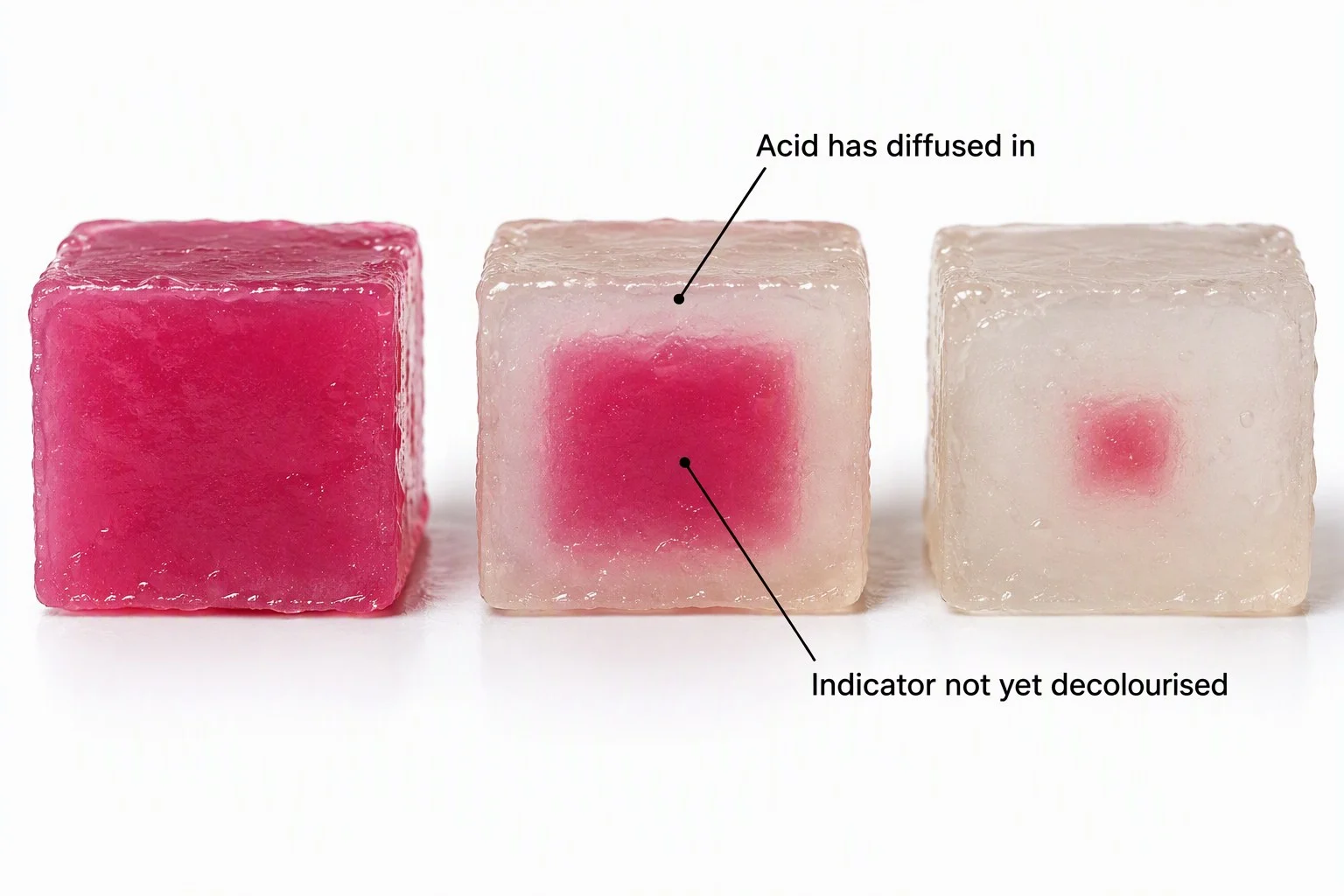
Nature of science
- Nature of science models simplify complex systems so that predictions can be tested.
Method
1
Make agar coloured with dilute sodium hydroxide and Universal Indicator, or with indicator only.
2
Cut cubes of different sizes, such as 0.5, 1 and 2 cm, and calculate SA, V and SA:V.
3
Place each in the same volume of dilute hydrochloric acid, which has a higher molarity than the sodium hydroxide.
4
Record the time for the indicator to change colour throughout, or the depth of change in a set time such as 5 minutes.
- Analysis
- convert times to rates and plot rate of diffusion against SA:V.
- Smaller cubes with larger SA:V change colour fully faster.
Part 7 of 10Cells with increased surface area
1Red blood cell
- Red blood cell flattened and biconcave to maximise surface area and minimise volume, so oxygen diffuses in and out quickly.
2Proximal convoluted tubule cell
- Proximal convoluted tubule cell reabsorbs glucose and mineral ions from filtrate.
- Microvilli on the apical membrane increase area.
- Invaginations (infoldings) of the basal membrane increase area.
Part 8 of 10Pneumocytes
Pneumocytes
Alveolar epithelium
- Alveolar epithelium millions of alveoli give a large area, and the wall is one cell thick for a short diffusion distance.
Type I pneumocytes
- Type I pneumocytes extremely thin cells making up most of the epithelium.
- Capillary walls are also one cell thick, so less than 0.5 µm separates air from blood.
Type II pneumocytes
- Type II pneumocytes rounded cells making about 5% of the epithelium, with many secretory vesicles.
- (lamellar bodies)
- They secrete pulmonary surfactant, which forms a monolayer with hydrophobic tails facing the air.
- Surfactant lowers surface tension, keeps alveolar shape and stops alveoli sticking together and collapsing.
- The moist film lets oxygen dissolve before diffusing into blood, and carbon dioxide diffuses out from it.
Part 9 of 10Muscle fibres
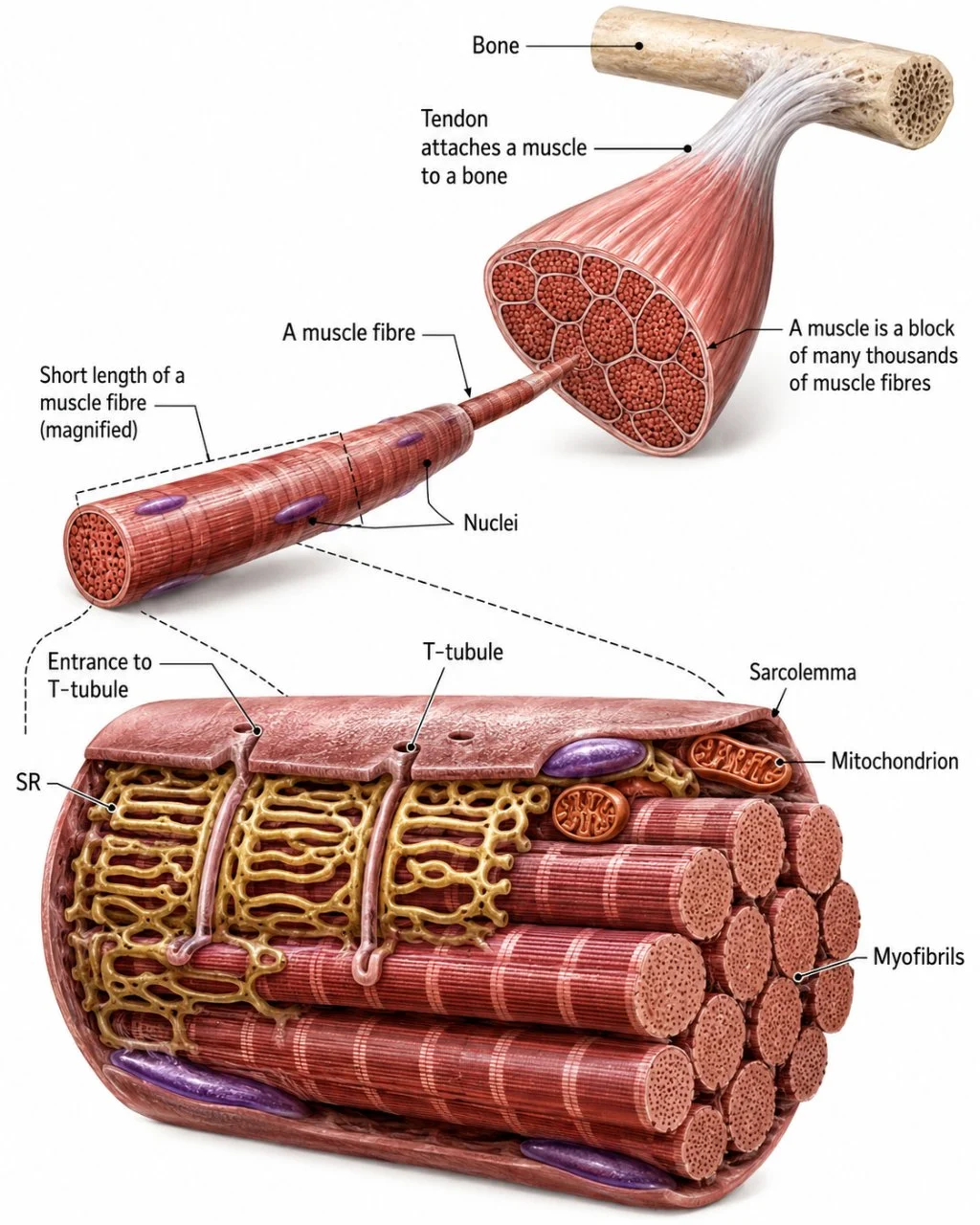
Skeletal muscle is striated, and cardiac muscle is in the heart, and smooth muscle is in vessels and organs.
Striated muscle fibre
- Striated muscle fibre it is cell-like and surrounded by the sarcolemma.
- It has many nuclei, so it challenges the idea that a cell has one nucleus.
- Contractile proteins are organised in myofibrils of actin and myosin that slide past each other.
- The sarcoplasmic reticulum stores calcium and sends signals to all parts of the fibre at once.
- T-tubules fold in from the sarcolemma close to the SR.
- Many mitochondria supply ATP by aerobic respiration.
Cardiac muscle
- Cardiac muscle it is striated and has one nucleus per cell.
- It is myogenic and contracts without nerve or hormone stimulation, although nerves and hormones adjust the rate.
- It does not fatigue and has many mitochondria.
- Branched fibres joined by intercalated discs let contraction spread quickly across the chambers.
- Myofibrils are present as in skeletal fibres.
Part 10 of 10Sperm and egg cells
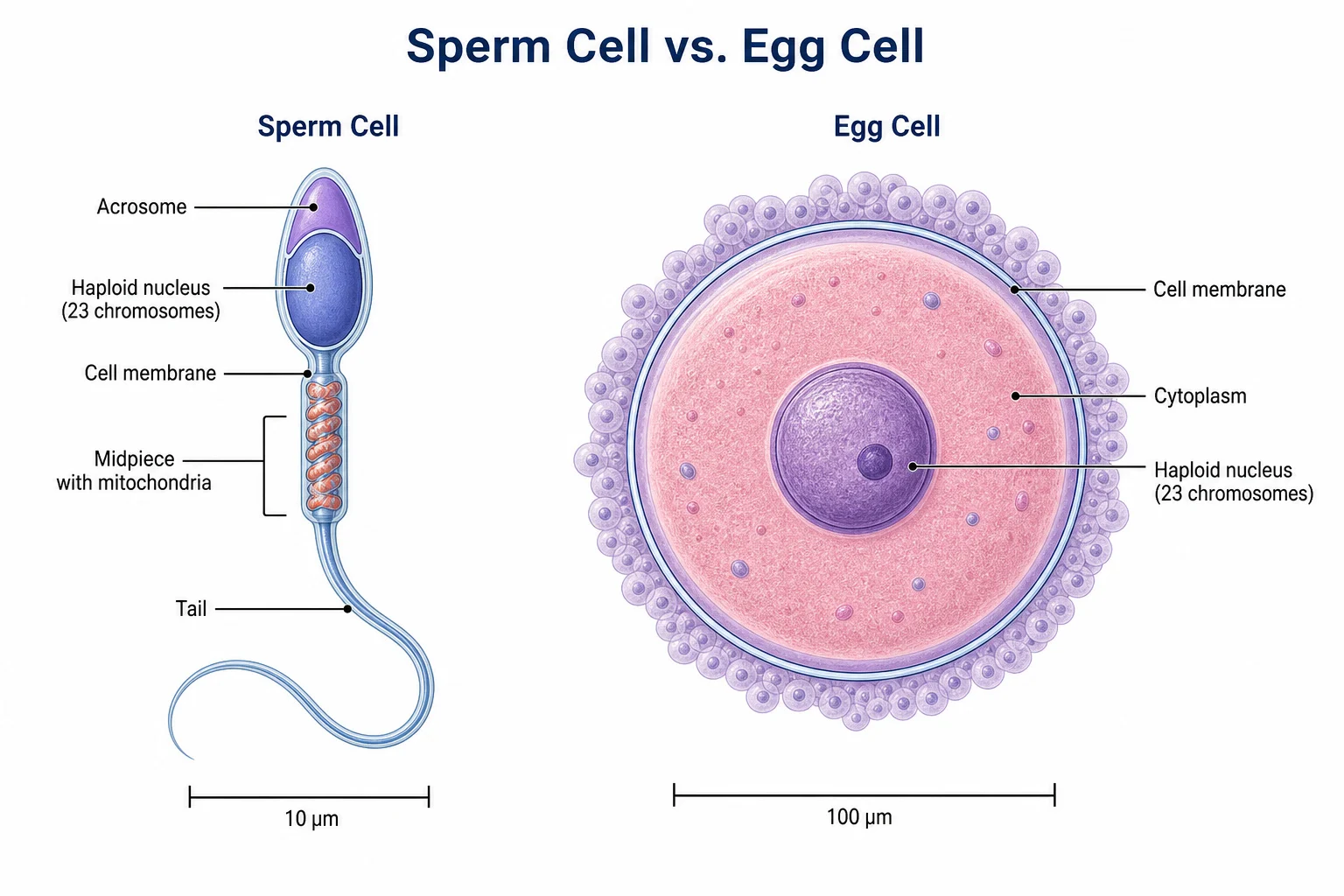
| Cell | Adaptation | Function |
|---|---|---|
| Sperm | Haploid nucleus in a streamlined head | Fuses with the egg nucleus to form a diploid zygote |
| Sperm | Acrosome with hydrolytic enzymes | Digests a path through the zona pellucida |
| Sperm | Many mitochondria in the middle piece | Supplies energy for movement |
| Sperm | Flagellum of microtubules | Propels the sperm |
| Egg | Haploid nucleus | Fuses with the sperm nucleus |
| Egg | Zona pellucida | Hardens to prevent polyspermy |
| Egg | Cortical granules | Release enzymes into the zona pellucida to prevent polyspermy |
| Egg | Follicle cells | Nourish and protect the egg |
| Egg | Nutrient-rich cytoplasm | Feeds the early embryo |
- Meiosis in the egg
- the final stage is completed only after fertilisation.
Key terms
| Term | Meaning |
|---|---|
| Stem cell niche | the location where stem cells are maintained in the body. |
| Potency | the range of cell types a stem cell can form. |
| Morphogen | a signalling chemical that forms a gradient and gives positional information. |
| Surface area to volume ratio | surface area divided by volume, which falls as size increases. |
| Pulmonary surfactant | a secretion of type II pneumocytes that lowers surface tension in alveoli. |
| Sarcolemma | the plasma membrane of a muscle fibre. |
| Intercalated disc | a branched connection between cardiac muscle cells that speeds contraction. |
| Acrosome | the sperm organelle containing hydrolytic enzymes. |
Avoid these mistakes
1
Specialised cells have lost genes — they keep the whole genome and express only some genes.
2
Totipotent and pluripotent are the same — only totipotent cells can form extra-embryonic cells.
3
Large cells are better at exchange — SA:V falls as cells grow, which limits diffusion.
4
Cardiac muscle needs nerves to contract — it is myogenic, and nerves only adjust the rate.
Marked practiceQuizzes for this lesson
Last updated:
Cambridge 9700 AS Biology
Core Formula
Magnification Triangle & Unit Conversion
Formula: M = I / A ⇔ A = I / M ⇔ I = M × A
Units: 1 mm = 1,000 μm = 1,000,000 nm.
Rule: Convert Image size (ruler mm) to μm by ×1,000 before dividing by Actual size.