5.1Theme A — Unity and diversity
Tool 1: Experimental Techniques — IB Biology HL Revision Notes & Topical Questions
10 min read 13 parts Lesson 2 of 14 Unit quiz
Lesson summary
5.1 Tool 1: Experimental Techniques — IB BIOLOGY HL notes: Select and use suitable apparatus and techniques to make measurements with stated uncertainty, and keep practical work safe, ethical and fair.Hazard = a feature of a procedure that has inherently harmful propertiesA chemi…
- Risk assessment
- Justified precautions
- Hazard warning symbols
- Human participants
- Field work
- Range and repeats
Part 1 of 11Hazard, risk and risk assessment
Hazard
Hazard a feature of a procedure that has inherently harmful properties
- A chemical may be an irritant to the skin.
- A rocky shore may have slippery rocks.
- A Bunsen burner may cause burns.
Risk
Risk the level of danger posed by a hazard, decided by how likely the harm is and how severe it would be
Risk assessment
- Risk assessment identifies the hazards, assesses the risk and changes the method to reduce it
- Rocky shore exampleslippery rocks are a hazard and slipping is quite likely.
- The procedure is altered so that footwear has good grip, students avoid seaweed-covered rocks and walk slowly.
Justified precautions
- Justified precautions name the hazard and explain why the precaution reduces the risk
- Exampleiodine is an irritant, so wear safety goggles and wash any skin it touches at once.
Part 2 of 11Hazard symbols, ethics and environment
Hazard symbols, ethics and environment
Hazard warning symbols
- Hazard warning symbols nine standard symbols, usually in a red-bordered diamond on labels and safety data sheets
- Examples are health hazard, corrosive, flammable, acute toxicity, oxidising and hazardous to the environment.
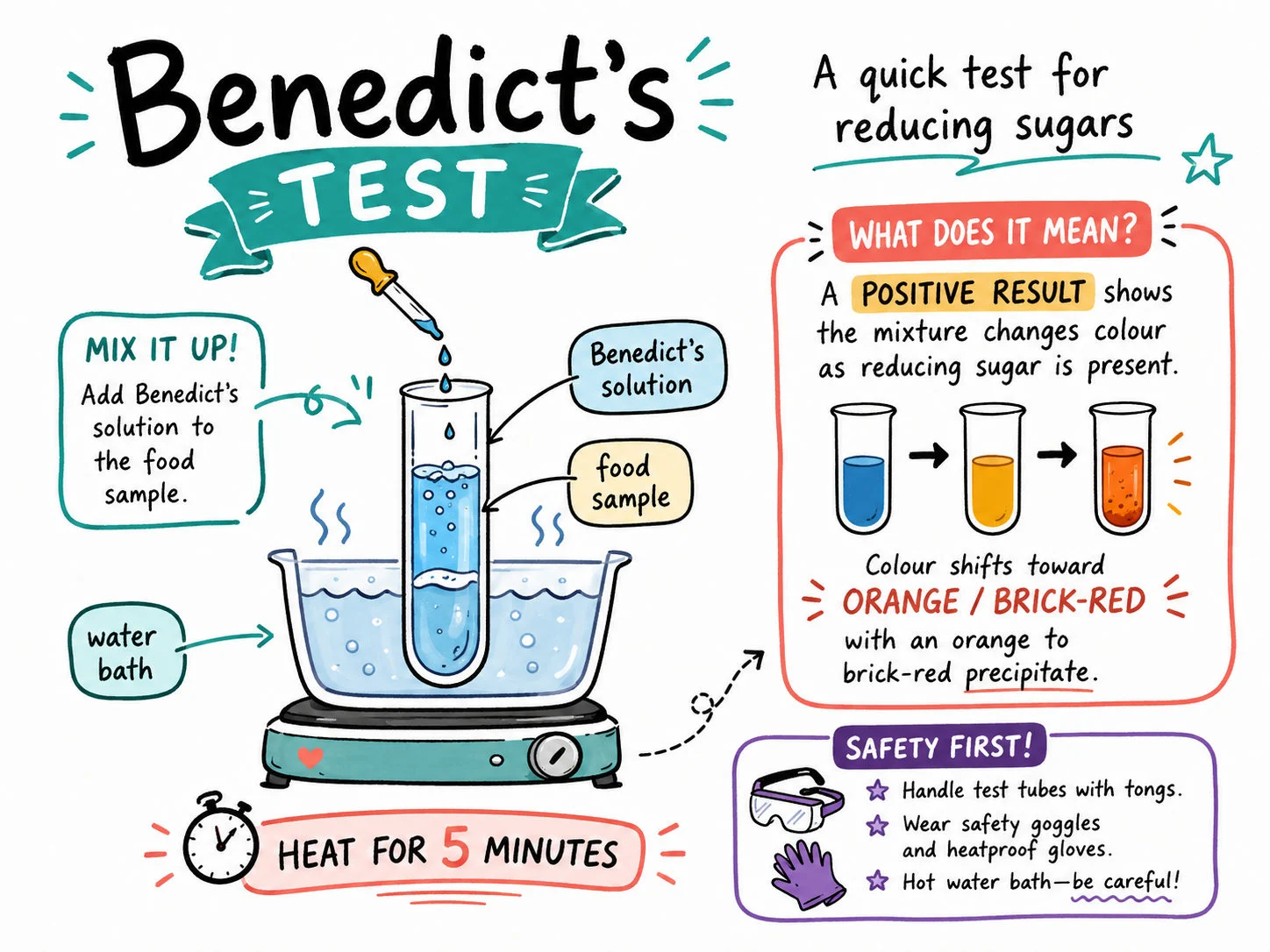
- Check them for stains, enzyme reagents and chromatography solvents.
Animals
- IB policy says to use animals only if no alternative exists
- Investigations must not be cruel and must remove causes of distress.
- Keep experiments short, handle animals as little as possible and release them to their habitat afterwards.
Human participants
- Human participants any investigation, such as measuring breathing with a spirometer, needs fully informed consent
Laboratory waste
- No toxic chemicals down the sink.
- Sharps go into a sharps bin.
- Biological waste, such as cultures or dissected organs, is sterilised or disposed of correctly.
Field work
- Field work work in small groups, avoid sensitive habitats and take away all equipment and litter
Part 3 of 11Designing a fair test
Fair test
- Fair test changes one independent variable, measures one dependent variable and keeps all other significant variables constant
- Name each controlled variable and the method used, such as a water bath at 30 °C.
Range and repeats
- Range and repeats use at least five values of the independent variable and at least three repeats of each
- This lets trends and anomalies be identified.
Control
Control a treatment identical to the others except that the independent variable is absent or at a baseline level
Independent variable
- Independent variable deliberately changed and plotted on the x-axis
Dependent variable
- Dependent variable measured in response and plotted on the y-axis
Part 4 of 11Uncertainty and error
- Instrument uncertainty
- Analogue scales are read to ± half the smallest division.
- Digital displays are read to ± the last digit.
- Record the uncertainty in the table heading, for example Volume / cm3 ± 0.05.
| Feature | Random error | Systematic error |
|---|---|---|
| Effect | Scatter about the true value | All values shifted one way |
| Affects | Precision | Accuracy |
| Reduced by | Repeats and a mean; a more sensitive instrument | Calibration, zeroing, improving the method |
| Example | Judging a colour end-point by eye | A balance not tared |
Accuracy
Accuracy how close a measurement is to the true value
Precision
Precision how close repeated measurements are to each other
Part 5 of 11Measuring instruments
| Quantity | Instrument | Units | Notes |
|---|---|---|---|
| Mass | Electronic balance | g, mg | Tare before use |
| Volume | Pipette, syringe, measuring cylinder, burette | cm3, ml | Read the bottom of the meniscus at eye level |
| Time | Stopwatch or data logger | s, min | Human reaction time adds about 0.2 s of random error |
| Temperature | Thermometer, probe or water bath | °C | Let solutions equilibrate before mixing |
| pH | pH meter or universal indicator | none | Calibrate the meter with buffers |
| Length | Ruler or eyepiece graticule | mm, µm | Recalibrate the graticule at each magnification |
| Concentration or colour | Colorimeter | Absorbance | Zero with a blank |
Choosing volume apparatus
- A measuring cylinder gives approximate volumes.
- A volumetric pipette gives one fixed volume, such as 25 cm3, most accurately.
- A burette gives accurate variable volumes up to 50 cm3 and reads from zero at the top.
Gases
- Gases collect in a gas syringe, or in an inverted cylinder of water if the gas is insoluble
Part 6 of 11Dilution and serial dilution
Dilution equation
- C1V1 = C2V2, where C is concentration and V is volume
Dilution factor
Dilution factor final volume divided by the volume of stock added
Serial dilution
- Serial dilution each step uses the same dilution factor and the concentrations change logarithmically
- It is useful for bacterial counts or sucrose solutions for osmosis.
1
Make a 1 mol dm-3 stock solution and label it.
2
Set out labelled tubes each holding 9.0 cm3 of distilled water.
3
Transfer 1.0 cm3 of stock to tube 1 with a clean pipette and mix; this gives 0.1 mol dm-3.
4
With a fresh pipette transfer 1.0 cm3 from tube 1 to tube 2 and mix to give 0.01 mol dm-3.
5
Repeat for further tubes to give 10-3, 10-4 mol dm-3.
6
Use each dilution in the investigation, with at least three repeats per concentration.
Part 7 of 11Microscopy and magnification
Temporary mount
- Temporary mount cut a thin section and add a drop of water or stain such as iodine or methylene blue
- Lower the coverslip at an angle to avoid air bubbles.
- Focus with low power first, then use only the fine focus on higher power.
Magnification
- M = I / A,
- so actual size A = I / MWhat the symbols mean: M = magnification (no unit) · I = image size · A = actual size; use the same unit for both (1 mm = 1000 μm)
- so actual size A = I / M
- I and A must be in the same units and M has no units.
- 1 mm = 1000 µm and 1 µm = 1000 nm.
Resolution
Resolution the minimum distance between two points that can still be seen as separate
- It is about 0.2 µm for a light microscope and 0.2 nm for an electron microscope.
1
Place the stage micrometer (1 division = 10 µm) on the stage and focus at the chosen objective.
2
Turn the eyepiece so the graticule scale lies alongside the micrometer scale.
3
Find two points where lines coincide and count the divisions on each scale between them.
4
Calculate 1 eyepiece division = (stage divisions × 10 µm) / eyepiece divisions.
5
Replace the micrometer with the specimen, measure in eyepiece divisions and multiply by the calibration value.
6
Recalibrate for every change of objective lens.
Part 8 of 11Chromatography and colorimetry
Chromatography
- Chromatography separates photosynthetic pigments by their solubility in the solvent and attraction to the paper or TLC plate
- Mark the origin in pencil and keep the spot above the solvent level.
- Mark the solvent front immediately when the paper is removed.
Rf
Rf distance moved by the pigment divided by distance moved by the solvent front
- It has no units and is always between 0 and 1.
Colorimetry
- Colorimetry measures the absorbance of light by a coloured solution
- Make a calibration curve from standards of known concentration.
- Read the unknown concentration from the curve.
- Zero the colorimeter with a blank of solvent.
Part 9 of 11Rates, counts and field sampling
Measuring rates
- Collect gas in a gas syringe or inverted measuring cylinder rather than counting bubbles.
- A respirometer with KOH or soda lime to absorb CO2 measures O2 uptake.
- A potometer measures water uptake as an estimate of transpiration.
- Rate = amount of product formed (or substrate used) divided by time.
Cell counts
- Cell counts a haemocytometer is a slide with a grid of known volume
- Counting cells in the grid allows the concentration of the whole culture to be calculated.
- Direct counts need no specialist equipment but are slow.
Random quadrats
- Random quadrats use random number coordinates to compare two areas
- Population density = mean number of individuals per quadrat divided by the area of one quadrat.
Transects
- Transects line or belt transects show change along a gradient
Mark-release-recapture
- Mark-release-recapture population size N = (M × C) / R
- M is the number first marked, C the total caught second time and R the number recaptured marked.
- It assumes no births, deaths or migration and that marks do not affect survival or get lost.
Part 10 of 11Aseptic technique and observation
Aseptic technique
- Aseptic technique procedures that prevent contamination of cultures and protect the worker
- Sterilise loops by flaming until red hot.
- Open lids as little as possible.
- Tape Petri dishes without sealing them fully.
- Incubate at 25 °C, not 37 °C, to avoid culturing human pathogens.
- Dispose of cultures by autoclaving.
Biological drawings
- Biological drawings labelled line drawings show the specific features seen in the specimen
Qualitative data
- Qualitative data describe attributes that are observed but not measured, such as fur colour, sex or number of limbs
- They are used when identifying and classifying organisms.
Required techniques
- Required techniques chromatography, colorimetry and serial dilution, modelling, light microscopy, temporary mounts, sampling, karyotyping and cladogram analysis
Part 11 of 11More from the specification
More from the specification
Environmental considerations in field investigations
- Environmental considerations in field investigations conducting biological field trials involves minimising habitat disruption and properly handling liquid chemical waste to prevent environmental issues.
Systematic observations in experimental trials
- Systematic observations in experimental trials making quantitative observations with calibrated liquid measuring apparatus reduces experimental uncertainty when applying standard biological techniques.
Ethical issues in animal protocols
- Ethical issues in animal protocols ethical considerations involve minimising animal distress and obtaining informed consent before human participants engage in physiological trials.
Safety and Hazard Evaluation
- Experimental biological investigations require identifying safety risks associated with chemical reagents, sharp instruments,
- and pathogenic cultures before commencing laboratory work.
Disposal of Chemical and Biological Waste
- Safe laboratory practice involves neutralizing toxic liquid solutions before disposal and autoclaving biological waste rather than disposing of it into municipal sinks.
Ethical and Environmental Considerations
- When conducting fieldwork, researchers must address ethical and environmental issues by minimizing habitat disturbance and treating living organisms humanely.
Objective Quantitative Observations
- Reliable scientific investigations depend on making precise quantitative measurements using calibrated apparatus alongside detailed qualitative observations.
Key terms
| Term | Meaning |
|---|---|
| Accuracy | How close a measured value is to the true value. |
| Precision | How close repeated measurements are to each other. |
| Controlled variable | A factor other than the independent variable that is kept constant. |
| Serial dilution | A stepwise series of dilutions that each use the same dilution factor. |
| Resolution | The minimum distance between two points at which they can still be seen as separate. |
| Retention factor (Rf) | Distance moved by the pigment divided by distance moved by the solvent front. |
| Quadrat | A square frame of known area used to sample organisms and estimate density. |
| Aseptic technique | Procedures that prevent unwanted microorganisms contaminating cultures. |
Avoid these mistakes
1
Confusing hazard and risk — a hazard is something that can cause harm and risk is the likelihood and severity of that harm
2
Stating only wear a lab coat and goggles as a precaution — name the hazard and justify the precaution
3
Mixing units in M = I / A — convert I and A to the same units first
4
Thinking repeats remove systematic error — repeats reduce random error and only calibration removes systematic error
Last updated:
\n