A1.1Theme A — Unity and diversity
Water — IB Biology HL Revision Notes & Topical Questions
5 min read 12 parts Lesson 5 of 14 2 quizzes
Curriculum Equation Key قوانين الرقم الهيدروجيني والاتزان الأيوني - pH & Acid-Base Equilibrium FormulasFast Exam Solution
pH = -log[H⁺] | pOH = -log[OH⁻] | pH + pOH = 14 | [H⁺][OH⁻] = 10⁻¹⁴
Word Equation & Conditions: الرقم الهيدروجيني = -لوغاريتم تركيز أيون الهيدروجين | pH + pOH = 14
Location & Specifications: الاتزان الأيوني، كيمياء 3 ثانوي، التحصيلي، و AP Chemistry.
Lesson summary
A1.1 Water — IB BIOLOGY HL notes: Explain how the polarity of water gives hydrogen bonding and how this produces the properties that make water the medium for life.First cells — they evolved in water, probably in deep oceans near hydrothermal vents.Water and solutes became trappe…
- Cell content
- Search for life
- Unequal sharing
- Polar molecule
- Combined effect
- Hydrophilic
Section 1 of 12Water as the medium for life
1First cells
- First cells they evolved in water, probably in deep oceans near hydrothermal vents.
- Water and solutes became trapped inside a membrane, so reactions began inside a membrane-bound structure.
- Liquid water lets dissolved molecules move, collide and react.
2Cell content
- 70–95% of the mass of a cell is water, and all metabolic reactions occur in it.
3Habitat
- 71% of Earth's surface is covered by water, so it is a major habitat.
4Search for life
- Search for life scientists look for water on other planets and moons as evidence that life could exist there.
Section 2 of 12Polarity of the water molecule
Polarity of the water molecule
Structure
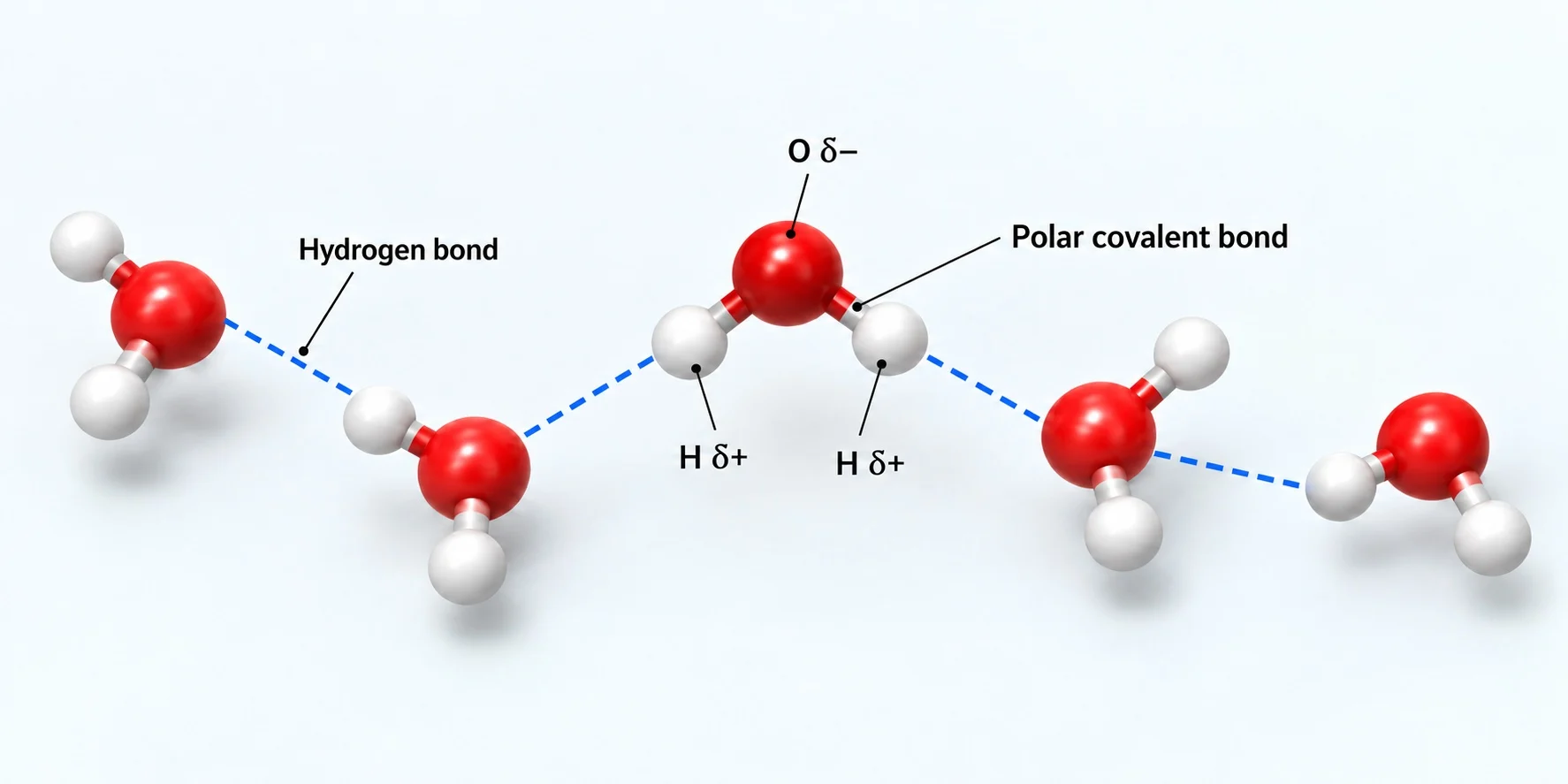
- Structure one oxygen atom shares electrons with two hydrogen atoms by covalent bonding, giving a bent (asymmetrical) molecule.
Unequal sharing
- Unequal sharing oxygen attracts the shared electrons more strongly than hydrogen does.
- Oxygen carries a weak negative charge (δ−) and each hydrogen a weak positive charge (δ+).
- The molecule as a whole is electrically neutral.
Dipole
Dipole a separation of charge caused by unevenly shared electrons.
Polar molecule
Polar molecule a molecule with one end negatively charged and the other end positively charged.
Section 3 of 12Hydrogen bonds
Formation
- Formation the δ+ hydrogen of one water molecule is attracted to the δ− oxygen of an adjacent molecule.
Strength
- Strength one hydrogen bond is weak and constantly breaks and reforms, but large numbers together form a strong structure.
Role
- Role hydrogen bonds cause the properties of water that matter to living organisms.
Hydrogen bonds in other molecules
- They link complementary bases between the two strands of DNA.
- They help form secondary and tertiary protein structure.
- They give cellulose and collagen their tensile strength.
- They link mRNA and tRNA in protein synthesis.
- They act between polar phosphate groups of membranes and water.
Section 4 of 12Cohesion and adhesion
| Property | Attraction | Biological effects |
|---|---|---|
| Cohesion | Water to water by hydrogen bonds | Columns of water move under tension in xylem; surface tension lets pond skaters walk on water |
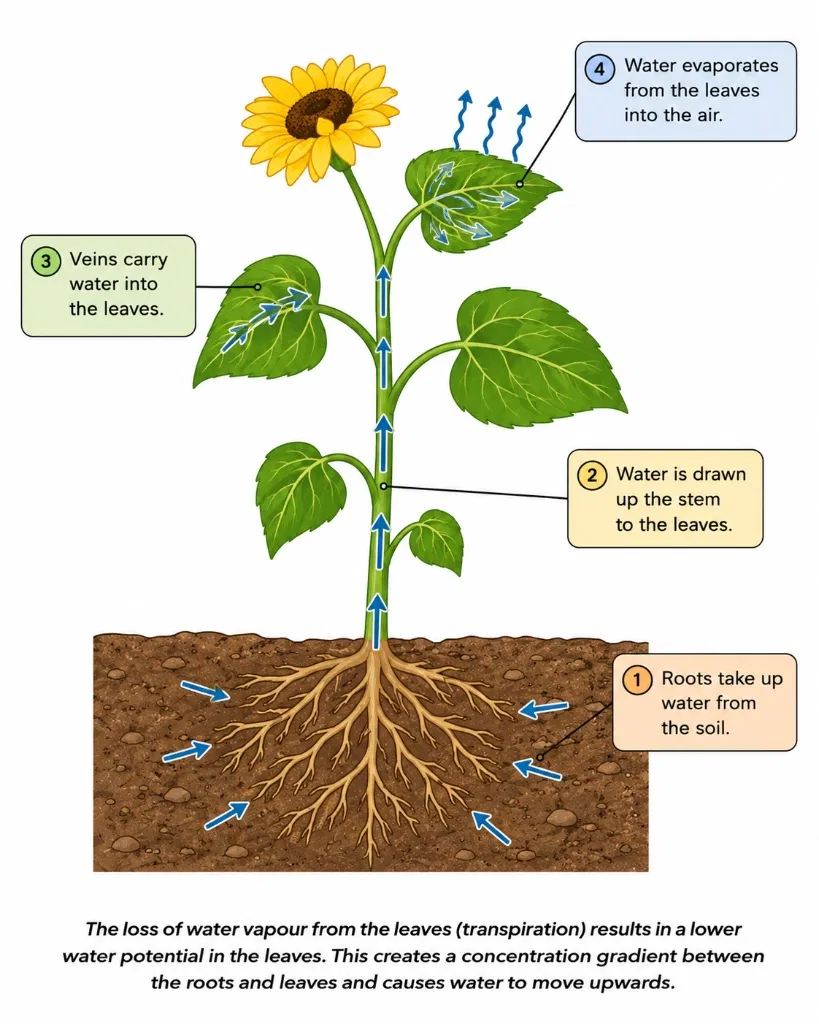
| Adhesion | Water to other polar or charged molecules such as cellulose | Water moves up xylem during transpiration; capillary action draws water up soil pores and between cellulose fibres in cell walls |
- Combined effect
- cohesion and adhesion keep water flowing through the plant as a continuous stream.
Section 5 of 12Water as a solvent
Hydrophilic
Hydrophilic polar or charged molecules that form hydrogen bonds with water and dissolve.
Hydrophobic
Hydrophobic non-polar molecules that cannot form hydrogen bonds with water and do not dissolve.
- Hydrophobic molecules group together because water molecules hydrogen-bond to each other and not to the non-polar molecules.
Universal solvent
- Universal solvent most biological molecules are hydrophilic, so water dissolves them.
Solubility differs between solutes.
- Highly soluble — sodium chloride, urea, salts, glucose and amino acids are transported easily in solution (even amino acids with hydrophobic R groups).
- Insoluble — fats and the hydrocarbon tails of phospholipids, which form the hydrophobic core of membranes.
- Less soluble — oxygen is sparingly soluble, and less soluble at 37 °C than at 20 °C.
Section 6 of 12Transport of poorly soluble substances and enzyme action
Oxygen
- Oxygen haemoglobin binds oxygen so that more is carried than could dissolve in plasma,
- while enough dissolves in oceans, rivers and lakes for aquatic animals.
Less soluble molecules
- Less soluble molecules special transport mechanisms have evolved to carry them.
Enzymes
- Enzymes most need water to keep their shape and stability, so they catalyse reactions in aqueous solution.
- Hydrogen bonds often help the active site bind the substrate to form an enzyme–substrate complex.
Section 7 of 12Physical properties of water and their effects on organisms
| Property | Water compared with air | Effect on organisms |
|---|---|---|
| Specific heat capacity | 4200 J kg−1 °C−1 in water against about 1000 in air | Aquatic habitats change temperature slowly and body temperature stays near the enzyme optimum |
| Thermal conductivity | Almost 30 times higher in water | Air trapped in feathers or fat (blubber) insulates animals in cold water |
| Buoyancy | Floating is easy in water | Animals must adapt to float or dive |
| Viscosity | Much higher in water | Streamlined shapes reduce drag |
Specific heat capacity
Specific heat capacity energy needed to raise the temperature of 1 kg of a substance by 1 °C.
- It is high because many hydrogen bonds must be broken to raise the temperature.
Ice
- Ice it is less dense than liquid water so it floats, forming a habitat on and under the ice.
- Ice has low thermal conductivity, so it insulates the water below and keeps the sea warmer under the ice.
Section 8 of 12Ringed seal and black-throated loon adaptations
Stable sea temperature
- Stable sea temperature lets the ringed seal (Pusa hispida) survive in Arctic seas all year.
Insulation
- Insulation the seal uses a layer of blubber and the loon (Gavia arctica) uses feathers that trap air.
Buoyancy
- The loon has solid bones, unlike the hollow bones of most birds, so it is heavier and air is squeezed from lungs and feathers when it dives.
- The seal's blubber increases its buoyancy as well as insulating it.
Viscosity and movement
- Viscosity and movement both animals are streamlined.
- The seal propels itself with flippers.
- The loon pushes with webbed feet set laterally, which reduces drag, and flies easily because air has low viscosity.
Section 9 of 12Origin of water on Earth
Problem
- Problem when Earth formed about 4.5 billion years ago it was too hot for water vapour to condense, so water must have come from elsewhere.
Asteroid hypothesis
- Asteroid hypothesis asteroids and meteorites containing ice and organic materials delivered water.
- Carbonaceous chondrites, among the oldest meteorites, contain hydrogen isotopes similar to those in seawater.
- Eucrite achondrites contain hydrogen isotope ratios similar to those on Earth.
- Water vapour released on impact was trapped by gravity and condensed once Earth had cooled.
Section 10 of 12Water and the search for extraterrestrial life
Goldilocks zone
Goldilocks zone the region around a star where temperatures allow liquid water, set by the planet's distance from the star.
Exoplanets
Exoplanets planets in the Goldilocks zones of other solar systems.
Transit spectroscopy
- Transit spectroscopy light passing through the atmosphere of a planet as it crosses its star is analysed.
- The wavelengths absorbed show which molecules are present.
- A sign of water is called a water signature.
Requirements for an exoplanet to support life
Water and the search for extraterrestrial life
A water signature.
A position in the Goldilocks zone of its solar system.
Enough size to hold an atmosphere.
Section 11 of 12Key terms
| Term | Meaning |
|---|---|
| Polar molecule | a molecule with a negative end and a positive end because electrons are shared unevenly. |
| Hydrogen bond | a weak attraction between a δ+ hydrogen and a δ− atom of a neighbouring molecule. |
| Cohesion | attraction between water molecules by hydrogen bonds. |
| Adhesion | attraction between water and other polar or charged surfaces. |
| Hydrophilic | water-loving; polar or charged and able to dissolve in water. |
| Hydrophobic | water-hating; non-polar and unable to dissolve in water. |
| Specific heat capacity | energy needed to raise 1 kg of a substance by 1 °C. |
| Goldilocks zone | region around a star where liquid water can exist on a planet. |
| Transit spectroscopy | analysis of starlight passing through a planet's atmosphere to find its molecules. |
Section 12 of 12Exam technique
1
Hydrogen bonds are covalent bonds — they are weak attractions between molecules that constantly break and reform.
2
Hydrophobic molecules are repelled by water — they are excluded because water molecules bond to each other instead.
3
Cohesion and adhesion are the same — cohesion is water to water, adhesion is water to another surface.
4
Oxygen dissolves better in warm water — it is less soluble at 37 °C than at 20 °C, hence the need for haemoglobin.
Marked practiceQuizzes for this lesson
Last updated:
\n