A3.1Theme A — Unity and diversity
Diversity of organisms — IB Biology HL Revision Notes & Topical Questions
10 min read 11 parts Lesson 10 of 14 2 quizzes
Curriculum Equation Key قوانين الرقم الهيدروجيني والاتزان الأيوني - pH & Acid-Base Equilibrium FormulasFast Exam Solution
pH = -log[H⁺] | pOH = -log[OH⁻] | pH + pOH = 14 | [H⁺][OH⁻] = 10⁻¹⁴
Word Equation & Conditions: الرقم الهيدروجيني = -لوغاريتم تركيز أيون الهيدروجين | pH + pOH = 14
Location & Specifications: الاتزان الأيوني، كيمياء 3 ثانوي، التحصيلي، و AP Chemistry.
Lesson summary
A3.1 Diversity of organisms — IB BIOLOGY HL notes: Explain variation, the species concepts, chromosome number, genomes and the tools used to identify and compare species.Variation = differences between organisms, in appearance, behaviour or biochemistry.Causes — variation results…
- Between species
- Within a species
- Morphological species concept
- Binomial system
- Biological species concept
- Horizontal gene transfer
Part 1 of 9Variation between organisms
Variation
Variation differences between organisms, in appearance, behaviour or biochemistry.
Causes
- Causes variation results from genes and the environment together.
- Genes decide which proteins an organism can make.
- Genetic variation arises by mutation and by new allele combinations in sexual reproduction.
- Environmental factors such as temperature, nutrients and oxygen concentration affect gene expression and resources.
Between species
- Between species differences, historically morphological, are used to classify organisms.
Within a species
- Within a species individuals have different allele combinations, so no two are identical.
| Type | Features | Cause |
|---|---|---|
| Discontinuous | Distinct categories with no intermediates, shown on bar charts | Mainly genetic |
| Continuous | A range of values, shown on a histogram with a bell shape | Genes and environment |
Part 2 of 9Naming and the morphological species concept
Naming and the morphological species concept
Taxonomy
Taxonomy the science of classification, and a taxon is a group, with the species as the smallest.
Morphological species concept
Morphological species concept a species is a group of organisms that are morphologically unique.
- It often leads to mistakes because species with similar appearance are not always closely related.
Linnaeus
- Linnaeus the 18th century Swedish botanist replaced long descriptive names with two-part Latin names used worldwide.
- The tomato became Solanum lycopersicum instead of a long descriptive phrase.
Binomial system
Binomial system a two-part name of genus then species, in Latin or Latinised words.
- Species in the same genus share characteristics, for example the wolf Canis lupus, coyote Canis latrans and dog Canis familiaris.
Conventions
- The genus begins with a capital letter and the species with a lower-case letter.
- Names are italic when typed and underlined when handwritten.
- After the first full use the genus may be abbreviated, for example T. aestivum.
Part 3 of 9Biological species concept and its limits
1Biological species concept
Biological species concept a species is a group of organisms that can interbreed to produce fertile offspring.
2Basis
- Basis reproductive characteristics such as compatible mating rituals and seasons, compatible sex organs,
- and gametes with the same haploid number that fuse to a viable zygote.
3
Limits
- Asexual organisms such as bacteria cannot be tested.
- Fertile hybrids such as the wholphin (melon-headed whale and bottlenose dolphin) occur, but hybridisation must be frequent to form a new species.
- Extinct species such as the woolly mammoth cannot be crossed to test fertility.
4
Asexual methods that challenge the concept
- Parthenogenesis — a female reproduces alone,
- as in some sharks, Komodo dragons and aphids,
- and the offspring are clones or have shuffled maternal alleles.
- Binary fission in bacteria produces clones.
- Vegetative propagation in strawberry runners and daffodil bulbs produces clones.
5Horizontal gene transfer
- Horizontal gene transfer genes pass between cells of the same generation,
- as in bacterial conjugation,
- and also from viruses to bacteria or eukaryotes or from bacteria to eukaryotes.
- This blurs species boundaries.
6
Other characteristics used when the concept fails
- Morphology.
- DNA sequence similarity.
- Biochemistry, such as bacteria producing carbon dioxide or methane.
- Ecological niche.
- Evolutionary lineage from fossils.
Part 4 of 9Speciation and defining species
Speciation
Speciation the process by which one species gives rise to two or more new species.
Mechanism
- Mechanism isolated populations have no gene flow,
- and natural selection or genetic drift acts differently on each until they are reproductively isolated.
Gradual change
- Gradual change the ability to interbreed declines gradually, so the point of separate species status is often subjective.
- Killer whales (Orcinus orca) are described as ecotypes, but some scientists propose several species.
Part 5 of 9Chromosome number
Diploid (2n) cells have two sets of chromosomes, usually in body cells, and haploid (n) cells have one set, usually gametes.
Fertilisation
- Fertilisation two haploid gametes fuse to give a diploid zygote, so both gametes need the same chromosome number.
Red blood cells have no nucleus and so no chromosomes.
Species values
- Species values the number is constant in a species and does not show how 'advanced' it is.
| Species | Diploid number | Haploid number |
|---|---|---|
| Human | 46 | 23 |
| Chimpanzee | 48 | 24 |
| Rice | 24 | 12 |
| Dog | 78 | 39 |
| Horse threadworm | 4 | 2 |
The diploid number is always even, and the number of chromosome pairs equals the haploid number.
Cross-breeding
- Cross-breeding different chromosome numbers stop species producing fertile offspring.
- Gametes may not fuse, or the zygote may not be viable.
- A zygote may survive but have an odd number of chromosomes that cannot pair in meiosis, giving a sterile hybrid.
- A mule has 63 chromosomes from a horse gamete (32) and a donkey gamete (31).
Part 6 of 9Karyograms and chromosome evidence
Chromosome
Chromosome a strand of DNA carrying genes, and a gene is a section of DNA coding for one polypeptide.
Replicated chromosomes are X-shaped, joined at the centromere.
- Metacentric chromosomes have a central centromere and arms of equal length.
- Acrocentric chromosomes have a near-terminal centromere and unequal arms.
Karyogram
Karyogram an image of all chromosomes in homologous pairs arranged by size, shape and banding, showing the karyotype.
Making a karyogram
Karyograms and chromosome evidence
Stain cells and view them under a light microscope.
Photograph chromosomes in metaphase.
Cut out and arrange them by size, shape and banding.
Pair 23 holds the sex chromosomes and often does not fit the size order.
Human chromosome 2
- Human chromosome 2 humans have 46 chromosomes but chimpanzees, gorillas and bonobos have 48, and a whole pair must have been lost.
- Loss of a pair is unlikely, so the fusion hypothesis states that ancestral chromosomes 12 and 13 fused to form human chromosome 2.
- Supporting evidence — chimp 12 and 13 end to end match the length of human 2, the centromere position of chimp 12 matches, satellite DNA marks the remnant centromere of 13, banding matches,
- and telomeric DNA lies in the middle of human 2.
- Evidence against — the lengths do not match perfectly, and the centromere position of chimp 13 does not match.
Nature of science
- Nature of science a testable hypothesis needs evidence available to support or refute it and must be a statement that can be accepted or rejected.
- It should not use vague words such as 'may' or 'could', make predictions or draw causal conclusions.
Part 7 of 9Genomes and sequence comparison
1Genome
Genome all the genetic information of an organism,
- including coding and non-coding DNA, mitochondrial and chloroplast DNA,
- and plasmids in prokaryotes.
2Sequence similarity
- Sequence similarity humans share about 99.9% of their DNA with other humans and about 99% with chimpanzees.
- Humans share all coding genes with each other and differ in alleles produced by mutation.
- A single nucleotide polymorphism (SNP) is a single base difference and is used to study ancestry and disease risk, though most SNPs do not change the protein.
3
Eukaryotic genomes vary in size and in base sequence, which is why plants have photosynthesis genes that humans lack.
4
Databases such as GenBank and NCBI let users choose a gene, species and DNA or amino acid sequence to compare.
- Closely related individuals have more similar genomes than distantly related ones.
5C-value
C-value haploid nuclear DNA content, in picograms (1 pg = 978 Mb) or megabases (1 Mb = 106 bases).
| Organism | Genome size (million base pairs) |
|---|---|
| Enterobacteria phage T2 | 0.17 |
| E. coli | 5 |
| Fruit fly | 140 |
| Human | 3000 |
| Japanese canopy plant | 150 000 |
- Genome size does not follow complexityhuman 3 100 Mb, hagfish 4 200 Mb, common wheat 17 000 Mb and red wild einkorn wheat 5 000 Mb.
- Genomes include non-coding DNA, plants can be polyploid, and our view of complexity may be wrong.
Part 8 of 9Uses of genome sequencing
Sequencing
- Sequencing automated and faster and cheaper with next-generation sequencing, with data analysed by computer.
Phylogenetics
Phylogenetics classifying species by evolutionary origin and shared ancestry rather than appearance.
- DNA, mRNA and amino acid sequences are used, and the more similar they are, the more recently the species separated.
- Several proteins or genome regions give a more accurate relationship, and the protein must be widespread yet variable, as cytochrome c is.
- Sequences produce phylogenetic trees, and the method suits extinct species (ancient DNA) and look-alike species.
Personalised medicine
- Personalised medicine the Human Genome Project data allow genomic medicine.
- Drugs target specific proteins, such as enzyme inhibitors, causing fewer side effects.
- Genetic screening identifies disease risk, for example mutations raising breast cancer risk lead to preventive surgery.
- Lifestyle choices can be based on genetic risk of cancers and heart disease.
- Treatments can be chosen according to genotype.
Part 9 of 9Identification tools: dichotomous keys, barcodes and eDNA
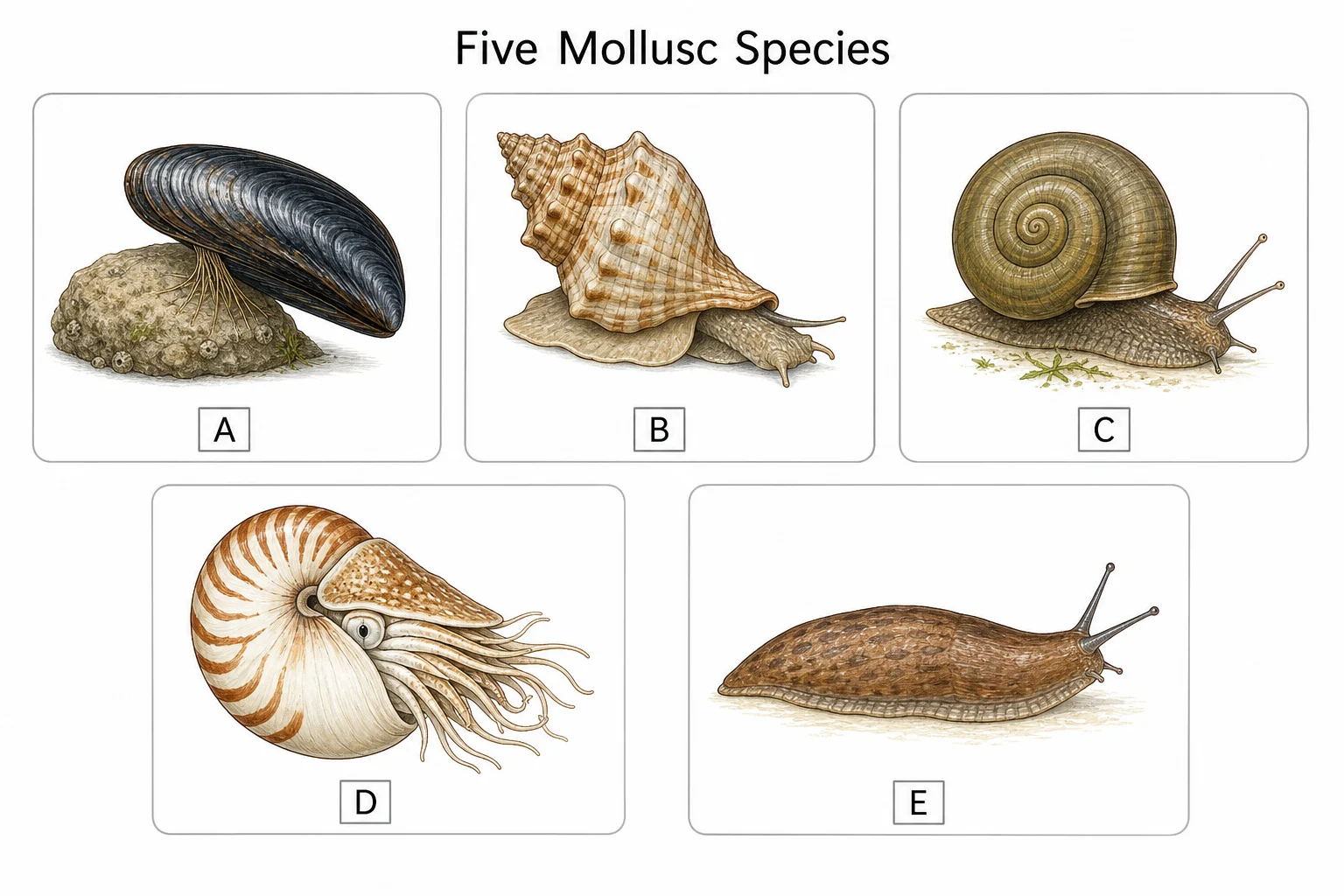
Dichotomous key
Dichotomous key a series of paired statements, where the true statement leads to the next pair or to the species name.
Constructing a key
- Use clearly identifiable, objective features such as 3 pairs of legs, not 'small'.
- Make statements yes or no in style.
- Each pair splits the organisms into two distinct groups, with later pairs making smaller groups.
- Each statement ends in a number or a name.
- A branched diagram is easier to read but limited in size.
DNA barcode
DNA barcode a short sequence of a few hundred base pairs, usually from mitochondrial DNA in eukaryotes or ribosomal RNA in prokaryotes, used to identify a species.
eDNA
DNA from traces such as skin cells, fur, feathers, waste and fallen leaves, used for biodiversity surveys, development impact and land use assessment.
- It is quicker than observation and helps when plants lack flowers, larvae look alike or species cannot be captured.
eDNA sampling
1
Take several samples from the habitat, such as water or soil.
2
Amplify the DNA by PCR.
3
Sequence the DNA.
4
Compare the barcode with a database such as the Barcode of Life Data System (BOLD).
5
A strong match confirms the species, and a weak match means more sampling is needed.
Key terms
| Term | Meaning |
|---|---|
| Biological species concept | a species is a group that can interbreed to produce fertile offspring. |
| Binomial | a two-part Latin name of genus then species. |
| Karyogram | an image of homologous chromosome pairs arranged by size, shape and banding. |
| Genome | all the genetic information in an organism. |
| SNP | a single nucleotide polymorphism, a difference in one base between individuals. |
| C-value | the haploid nuclear DNA content of an organism. |
| DNA barcode | a short DNA sequence used to identify a species. |
| Horizontal gene transfer | passing genes between cells of the same generation. |
Avoid these mistakes
1
Morphology alone defines species — it can mislead because similar-looking species may not be closely related.
2
The biological species concept works for all organisms — it fails for asexual organisms, fertile hybrids and extinct species.
3
More chromosomes means a more advanced species — chromosome number is unrelated to complexity.
4
Larger genome means a more complex organism — genome size varies widely, for example wheat is larger than the human genome.
Marked practiceQuizzes for this lesson
Last updated:
\n