B1.1Theme B — Form and function
Carbohydrates and lipids — IB Biology HL Revision Notes & Topical Questions
5 min read 11 parts Lesson 2 of 14 2 quizzes
Curriculum Equation Key قوانين الرقم الهيدروجيني والاتزان الأيوني - pH & Acid-Base Equilibrium FormulasFast Exam Solution
pH = -log[H⁺] | pOH = -log[OH⁻] | pH + pOH = 14 | [H⁺][OH⁻] = 10⁻¹⁴
Word Equation & Conditions: الرقم الهيدروجيني = -لوغاريتم تركيز أيون الهيدروجين | pH + pOH = 14
Location & Specifications: الاتزان الأيوني، كيمياء 3 ثانوي، التحصيلي، و AP Chemistry.
Lesson summary
B1.1 Carbohydrates and lipids — IB BIOLOGY HL notes: Explain the properties of carbon, how macromolecules form and break, and the structure and functions of carbohydrates and lipids.Covalent bond = a pair of electrons shared between two atoms, forming strong bonds in compounds.Ca…
- Carbon-based life
- Four bonds
- Nature of science
- Condensation
- Hydrolysis
- Monosaccharide
Part 1 of 9Properties of carbon
Covalent bond
Covalent bond a pair of electrons shared between two atoms, forming strong bonds in compounds.
Carbon-based life
- Carbon-based life carbon is in carbohydrates, lipids, proteins and nucleic acids.
Four bonds
- Four bonds a carbon atom has four outer electrons, so it forms four covalent bonds.
- (single, or a mix of single and double bonds)
- Carbon dioxide has two double bonds and methane has four single bonds.
- The tetrahedral arrangement gives varied 3-D shapes and so different properties.
Variety of structures
- Long branched chains such as glycogen.
- Long straight chains such as cellulose.
- Single rings such as the pyrimidines.
- Multiple rings such as starch units and the purines.
Functional groups give organic compounds their properties: hydroxyl (OH), carboxyl (COOH), amino (NH2) and phosphate (H2PO4).
Nature of science
- SI unit prefixes are internationally agreedkilo 103, centi 10−2, milli 10−3, micro 10−6 and nano 10−9.
Part 2 of 9Macromolecules, condensation and hydrolysis
Monomer
Monomer a small repeating unit, and a polymer = many monomers joined in a chain by polymerisation.
Macromolecule
Macromolecule a molecule with 1000 or more atoms.
- Not all macromolecules are polymers; lipids have no repeating monomers.
| Macromolecule | Monomer |
|---|---|
| Polysaccharides | Monosaccharides |
| Lipids | Fatty acids, glycerol and phosphate groups |
| Polypeptides | Amino acids |
| Nucleic acids | Nucleotides |
Condensation
Condensation joining molecules by a covalent bond with removal of water.
- Glycosidic bonds join monosaccharides.
- Peptide bonds join amino acids.
- Phosphodiester bonds join nucleotides (a phosphate and two ester bonds).
Hydrolysis
Hydrolysis breaking covalent bonds by adding water, used in digestion.
- Glycosidic bonds are broken to give monosaccharides.
- Peptide bonds are broken to give amino acids.
- Ester bonds in triglycerides are broken to give glycerol and three fatty acids.
Part 3 of 9Monosaccharides and glucose
Monosaccharide
Monosaccharide a carbohydrate monomer with the formula CnH2nOn, colourless, crystalline and soluble.
- Triose has 3 carbons (glyceraldehyde), pentose has 5 (ribose) and hexose has 6 (glucose).
- Pentoses have five-point rings and hexoses have six-point rings.
Disaccharides form by condensation, with glycosidic bonds.
- Maltose is glucose and glucose, sucrose is glucose and fructose, and lactose is glucose and galactose.
Glucose (C6H12O6)
- Glucose (C6H12O6) it is the main respiratory substrate for ATP and is made in photosynthesis.
- It has two isomers, α-glucose and β-glucose, differing in the position of the OH on carbon 1.
- The OH is below the ring in α-glucose and above it in β-glucose.
Properties of glucose
- Stable because covalent bonds are strong.
- Soluble because it is polar, so it is easily transported.
- A source of chemical energy when its bonds are broken.
Part 4 of 9Polysaccharides: starch and glycogen
Storage properties
- Storage properties starch and glycogen are compact so a lot is stored in a small space,
- and insoluble so they do not lower water potential or draw water into cells.
Starch
- Starch the plant storage polysaccharide, held as granules in chloroplasts and made of α-glucose.
- Amylose is 10–30% of starch, an unbranched helix with 1,4 glycosidic bonds that is compact and resistant to digestion.
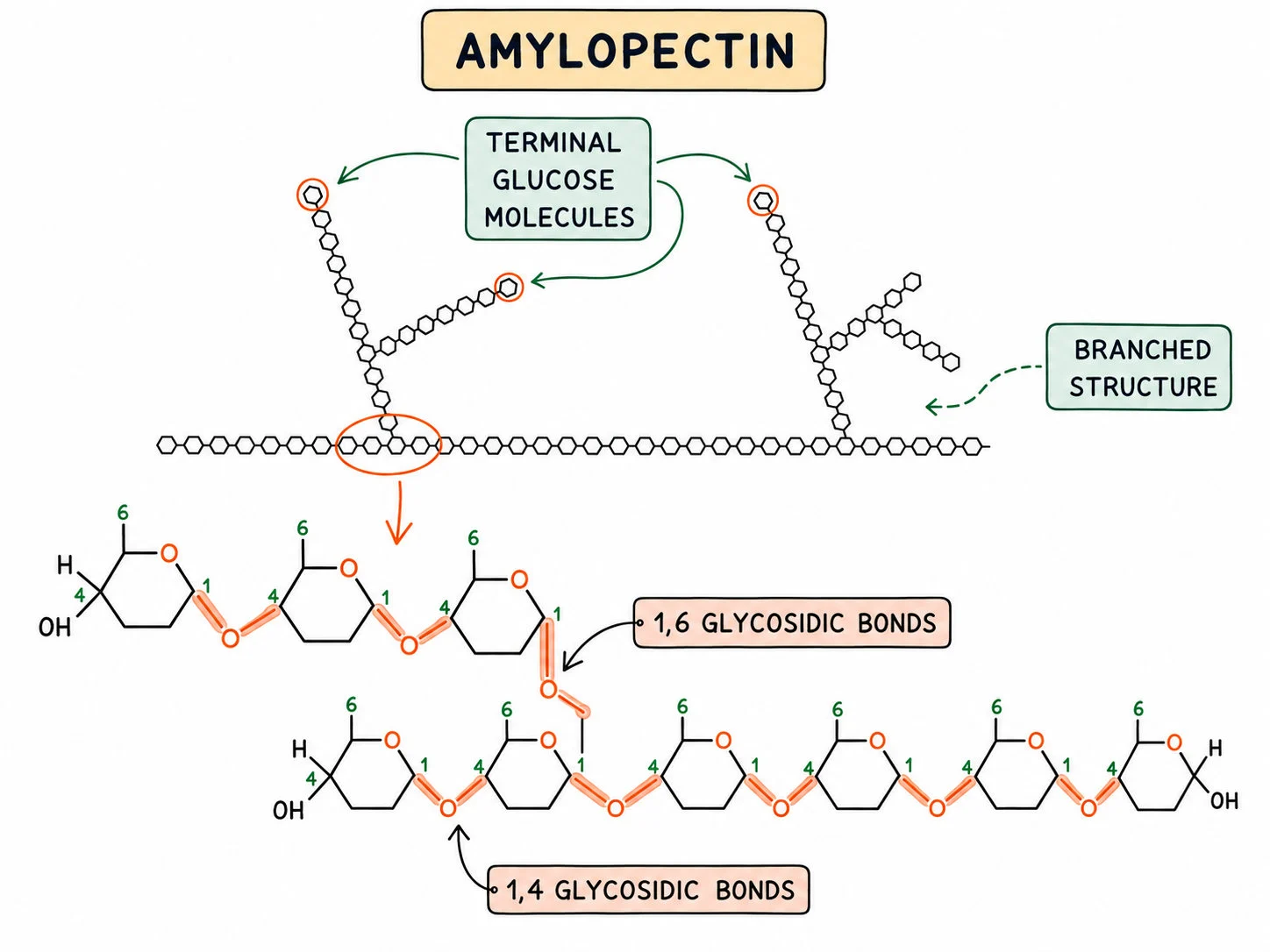
- Amylopectin is 70–90%, branched with 1,4 and 1,6 bonds, and its many ends are hydrolysed or added to quickly.
Glycogen
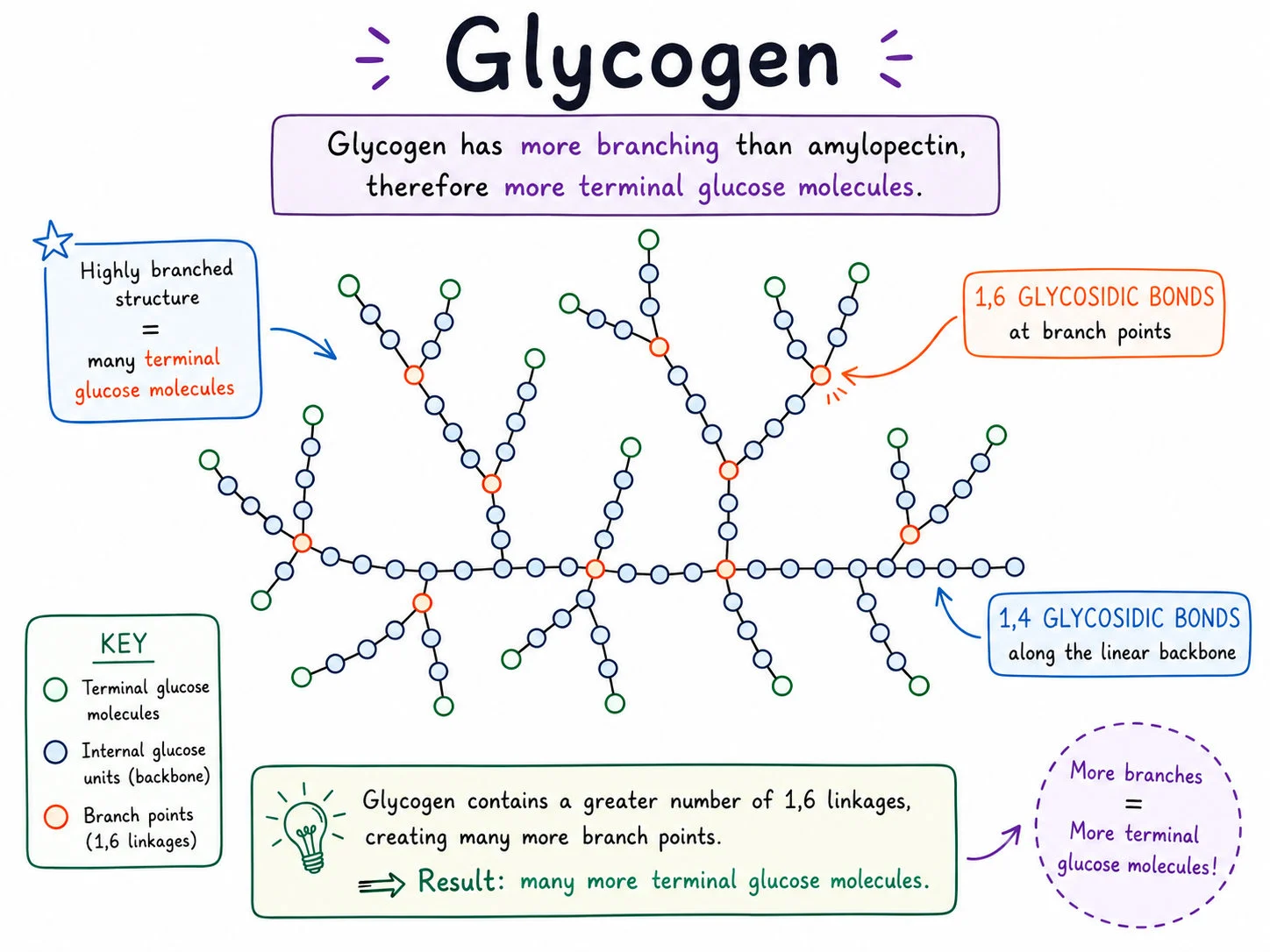
- Glycogen the animal and fungal storage polysaccharide, made of α-glucose with 1,4 and 1,6 bonds.
- It is more branched than amylopectin, so glucose is released quickly to meet high metabolic needs.
- It forms visible granules in liver and muscle cells.
Part 5 of 9Cellulose and structural carbohydrates
- Cellulose
- a structural polysaccharide in plant cell walls made of straight, unbranched chains of β-glucose.
- Alternate β-glucose molecules invert so that glycosidic bonds can form.
- Hydrogen bonds link parallel chains into microfibrils, giving great tensile strength.
- It is strong, durable, insoluble, slightly elastic and inert because few organisms have enzymes to hydrolyse it.
| Feature | Amylose | Amylopectin | Glycogen | Cellulose |
|---|---|---|---|---|
| Monomer | α-glucose | α-glucose | α-glucose | β-glucose |
| Branches | None | About every 20 monomers | About every 10 monomers | None |
| Helix | Yes | No | No | No |
| Bonds | 1,4 | 1,4 and 1,6 | 1,4 and 1,6 | 1,4 |
| Found in | Plants | Plants | Animals | Plants |
Part 6 of 9Glycoproteins
Glycoproteins
Glycoprotein
Glycoprotein a carbohydrate covalently bonded to a polypeptide, classed as a protein.
Functions in the cell surface membrane, together with glycolipids
- Cell recognition and identification.
- Receptors for hormones and neurotransmitters.
- Endocytosis.
- Cell adhesion and stabilisation.
- Antigens that mark cells as self or non-self, so non-self cells trigger an immune response.
ABO blood groups
- ABO blood groups the type depends on glycoprotein antigens on red blood cells.
| Blood type | Antigens on red cells | Antibodies in plasma | Can receive from |
|---|---|---|---|
| A | A | Anti-B | A and O |
| B | B | Anti-A | B and O |
| AB | A and B | None | A, B, AB and O |
| O | None | Anti-A and anti-B | O |
- Transfusion
- wrong blood is attacked by antibodies, which clump the cells and block vessels.
Part 7 of 9Lipids and triglycerides
Lipids
Lipids fats, oils, waxes and steroids, made of carbon, hydrogen and oxygen.
Solubility
- Solubility lipids have many non-polar covalent bonds, so they are insoluble in water.
- Glycolipids and lipoproteins improve solubility.
Triglyceride formation
- Triglyceride formation three fatty acids join one glycerol by esterification.
- The hydroxyl of glycerol bonds with the carboxyl of a fatty acid in a condensation reaction.
- One water molecule is released for each ester bond, so three are released.
Lipid storage
- Lipid storage triglycerides suit long-term energy storage.
- They hold about 37 kJ g−1, over twice the 17 kJ g−1 of carbohydrate, because of many C–H bonds.
- They are insoluble so they stay in storage cells.
- Respiration produces much metabolic water, which camels get from their lipid-rich humps and chicks get from egg yolk.
Adipose tissue
- Subcutaneous fat is below the skin and visceral fat is around the organs, held in adipose cells that shrink as fat is used.
- Blubber in seals and walruses insulates against cold.
- Seeds such as olives, sunflowers, nuts, coconuts and oilseed rape store oil for the seedling.
Body mass index
Body mass index mass (kg) ÷ height2 (m2), in kg m−2; 18.5–24.9 is normal, 25–29.9 overweight and 30 or more obese.
Part 8 of 9Fatty acids
- Structure
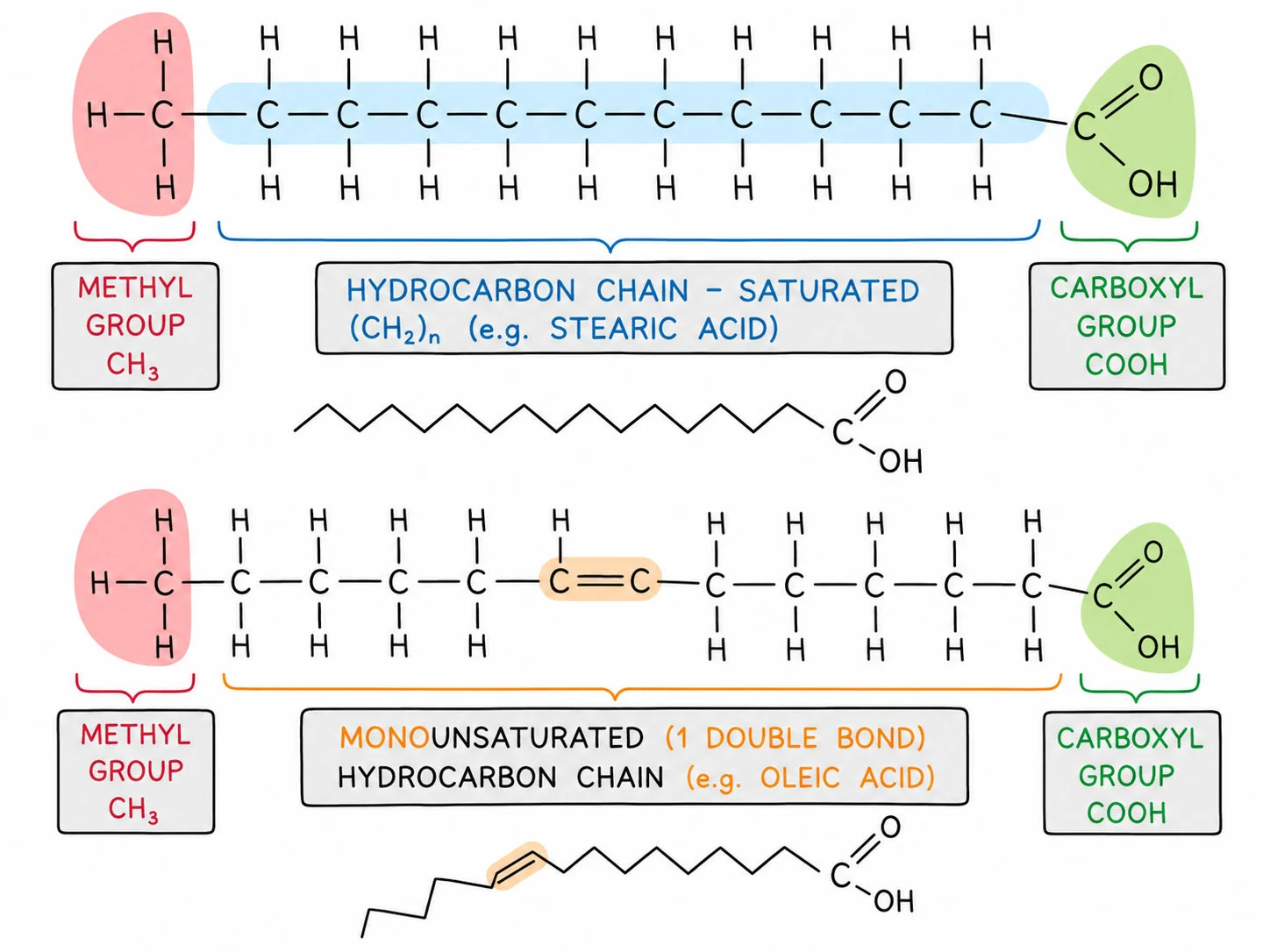
- fatty acids have a long hydrocarbon tail, and may be saturated or unsaturated.
| Type | Bonds | Shape | Properties |
|---|---|---|---|
| Saturated | Only single C–C bonds, full of hydrogen | Straight, packing tightly | High melting point, solid at room temperature, as in meat fat and butter |
| Monounsaturated | One C=C double bond | Kinked | Lower melting point, liquid oils |
| Polyunsaturated | Several C=C double bonds | Kinked | Low melting point, plant storage oils |
Cis and trans
- Cis and trans cis double bonds cause kinks, so they pack loosely and melt at lower temperatures.
- Trans fatty acids are made by partial hydrogenation and are linked to coronary heart disease.
Recognition
- Recognition a fatty acid is unsaturated if its diagram shows any carbon–carbon double bond.
Part 9 of 9Phospholipids and membranes
Phospholipids and membranes
Structure
- Structure glycerol with two fatty acid tails and a phosphate head in place of the third fatty acid.
- The phosphate head is polar and hydrophilic.
- The tails are non-polar and hydrophobic.
Amphipathic
Amphipathic having both hydrophilic and hydrophobic regions.
In water
- In water phospholipids form monolayers at the surface, and bilayers with tails facing inwards and heads facing outwards.
Barrier
- Barrier the non-polar tails stop polar molecules and ions crossing, so sugars, amino acids and proteins cannot leak out.
Diffusion through the bilayer
- Small non-polar molecules such as oxygen and carbon dioxide cross quickly without proteins.
- Steroid hormones such as oestradiol and testosterone are made from cholesterol, are non-polar and enter cells and nuclei to alter transcription.
Key terms
| Term | Meaning |
|---|---|
| Glycosidic bond | the covalent bond formed between two monosaccharides. |
| Condensation reaction | a reaction joining molecules with the release of water. |
| Hydrolysis | a reaction that breaks bonds by adding water. |
| Amphipathic | having a hydrophilic region and a hydrophobic region. |
| Triglyceride | a lipid of one glycerol joined to three fatty acids by ester bonds. |
| Saturated fatty acid | a fatty acid with only single carbon–carbon bonds. |
| Glycoprotein | a protein with a covalently attached carbohydrate, used in recognition. |
| Metabolic water | water produced in respiration, notably from lipids. |
Avoid these mistakes
1
Starch and cellulose differ only in size — starch has α-glucose and cellulose has β-glucose with inverted alternate units.
2
Lipids are polymers — they have no repeating monomer so they are not polymers.
3
Camel humps hold water — they store lipid whose respiration yields metabolic water.
4
Hydrolysis removes water — hydrolysis adds water to break bonds, and condensation removes it.
Marked practiceQuizzes for this lesson
Last updated:
\n