B2.1Theme B — Form and function
Membranes and membrane transport — IB Biology HL Revision Notes & Topical Questions
5 min read 12 parts Lesson 4 of 14 2 quizzes
Curriculum Equation Key قوانين الرقم الهيدروجيني والاتزان الأيوني - pH & Acid-Base Equilibrium FormulasFast Exam Solution
pH = -log[H⁺] | pOH = -log[OH⁻] | pH + pOH = 14 | [H⁺][OH⁻] = 10⁻¹⁴
Word Equation & Conditions: الرقم الهيدروجيني = -لوغاريتم تركيز أيون الهيدروجين | pH + pOH = 14
Location & Specifications: الاتزان الأيوني، كيمياء 3 ثانوي، التحصيلي، و AP Chemistry.
Lesson summary
B2.1 Membranes and membrane transport — IB BIOLOGY HL notes: Explain membrane structure, the fluid mosaic model, membrane fluidity and the methods of transport across membranes.Phospholipid — a glycerol with two hydrophobic fatty acid tails and a hydrophilic phosphate head, so it…
- Integral proteins
- Peripheral proteins
- Glycoprotein
- Glycolipid
- Components
- Fatty acid composition
Section 1 of 12Phospholipid bilayer
Phospholipid
- Phospholipid a glycerol with two hydrophobic fatty acid tails and a hydrophilic phosphate head, so it is amphipathic.
In water
- In water heads face the water and tails face away, forming a monolayer, and at sufficient concentration a bilayer with tails inwards.
Barrier
- Barrier the hydrophobic core is tightly packed.
- Large molecules cannot cross.
- Polar molecules and ions do not interact with the fatty acid tails, so they cannot cross.
- The bilayer therefore controls which molecules enter and leave.
Section 2 of 12Membrane proteins
Integral proteins
- Integral proteins they are amphipathic and embedded in one or both layers.
Peripheral proteins
- Peripheral proteins they are hydrophilic and attached to the surface of integral proteins or to the membrane by a hydrocarbon chain, inside or outside the cell.
Protein content varies, and the membranes of mitochondria and chloroplasts have the most because of electron carriers.
| Function | Description |
|---|---|
| Transport | Channel proteins form pores and carrier proteins change shape; each is specific to an ion or molecule |
| Receptors | Bind peptide hormones such as insulin, neurotransmitters or antibodies and trigger reactions inside the cell |
| Immobilised enzymes | Integral proteins with the active site exposed on the membrane surface, inside or outside the cell |
| Cell adhesion | Attach cells to neighbours in a tissue |
| Cell-to-cell recognition | Glycoproteins act as antigens, as in ABO blood groups |
Section 3 of 12Glycoproteins and glycolipids
Glycoprotein
Glycoprotein a membrane protein with a carbohydrate chain on the extracellular side.
Glycolipid
Glycolipid a lipid with a carbohydrate chain on the outer surface of the membrane.
Functions
- Receptors for hormones and neurotransmitters.
- Receptors for endocytosis.
- Cell adhesion and stabilisation to form tissues.
- Cell markers (antigens) that let the immune system tell body cells from pathogens.
Section 4 of 12Fluid mosaic model
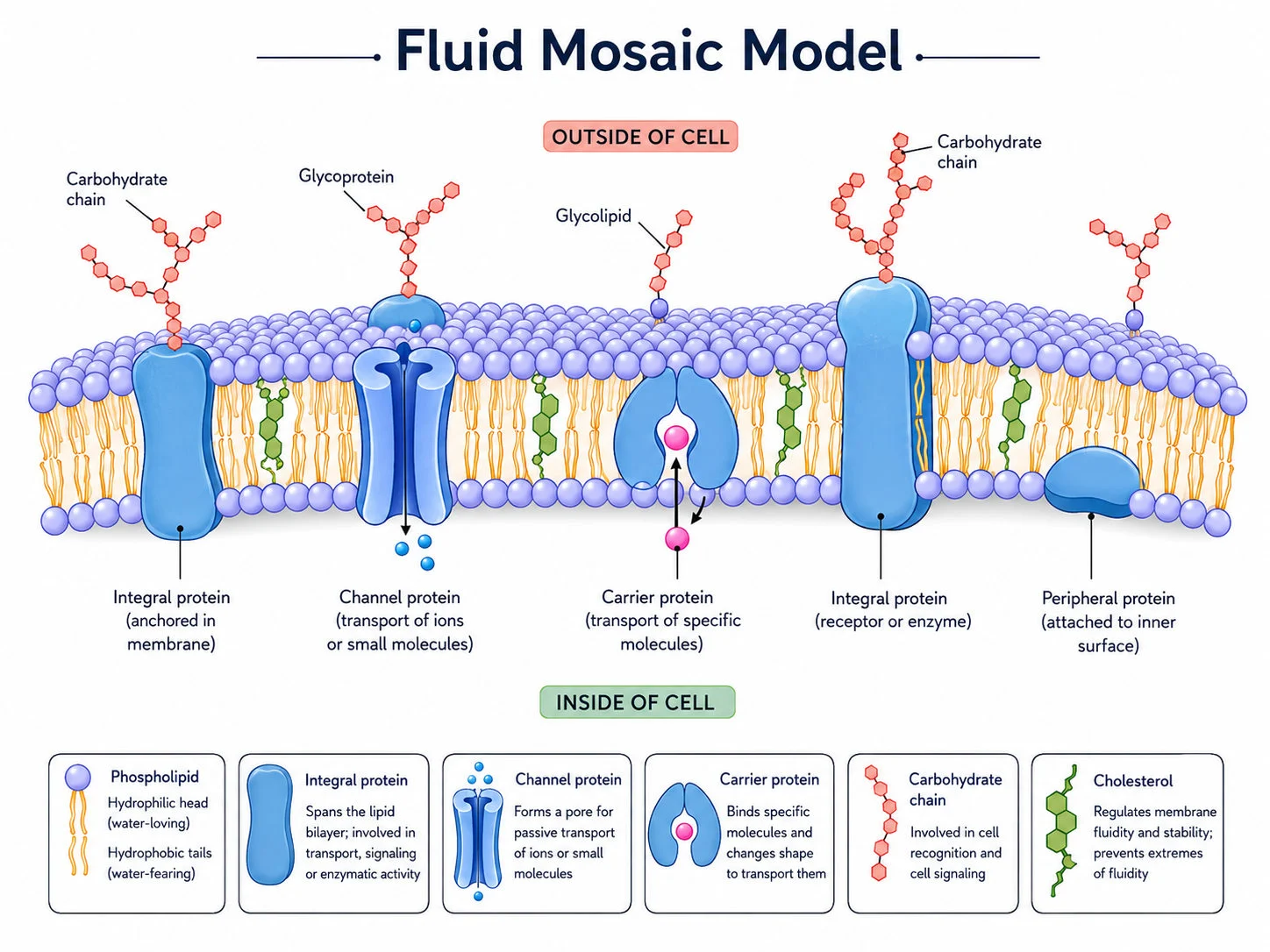
Fluid mosaic model
Membranes
- Membranes they form partially permeable barriers between the cell and environment, between cytoplasm and organelles and inside organelles.
- Substances cross by diffusion, facilitated diffusion, osmosis and active transport.
- Membranes act as interfaces for cell signalling and compartmentalise the cell.
Singer and Nicolson (1972) proposed the model.
- Fluid — phospholipids and proteins move within their own layers.
- Mosaic — the scattered proteins look like a mosaic from above.
Components
- Components phospholipids, cholesterol, glycoproteins and glycolipids, and integral and peripheral proteins.
Drawing the model
- Show the phospholipid bilayer with labelled heads and tails.
- Show integral proteins such as channels or carriers and peripheral proteins that do not reach the hydrophobic region.
- Show glycoproteins with a carbohydrate chain.
- Show cholesterol with its OH group beside the heads and the rest beside the tails.
Section 5 of 12Membrane fluidity
- Fatty acid composition
- chain length and saturation vary.
| Type | Packing | Effect on membrane |
|---|---|---|
| Saturated | Straight, tight packing | Higher melting point, more stable at high temperature |
| Unsaturated | Kinked, loose packing | Lower melting point, fluid and flexible |
Fatty acid desaturases
- Fatty acid desaturases some bacteria add double bonds to keep fluidity in the cold, since they cannot regulate their temperature.
- Deep-sea organisms show a correlation between sea temperature and fluidising polyunsaturated fatty acids.
- Plants such as Arabidopsis thaliana use fatty acid unsaturation pathways to acclimatise to high temperature.
Cholesterol
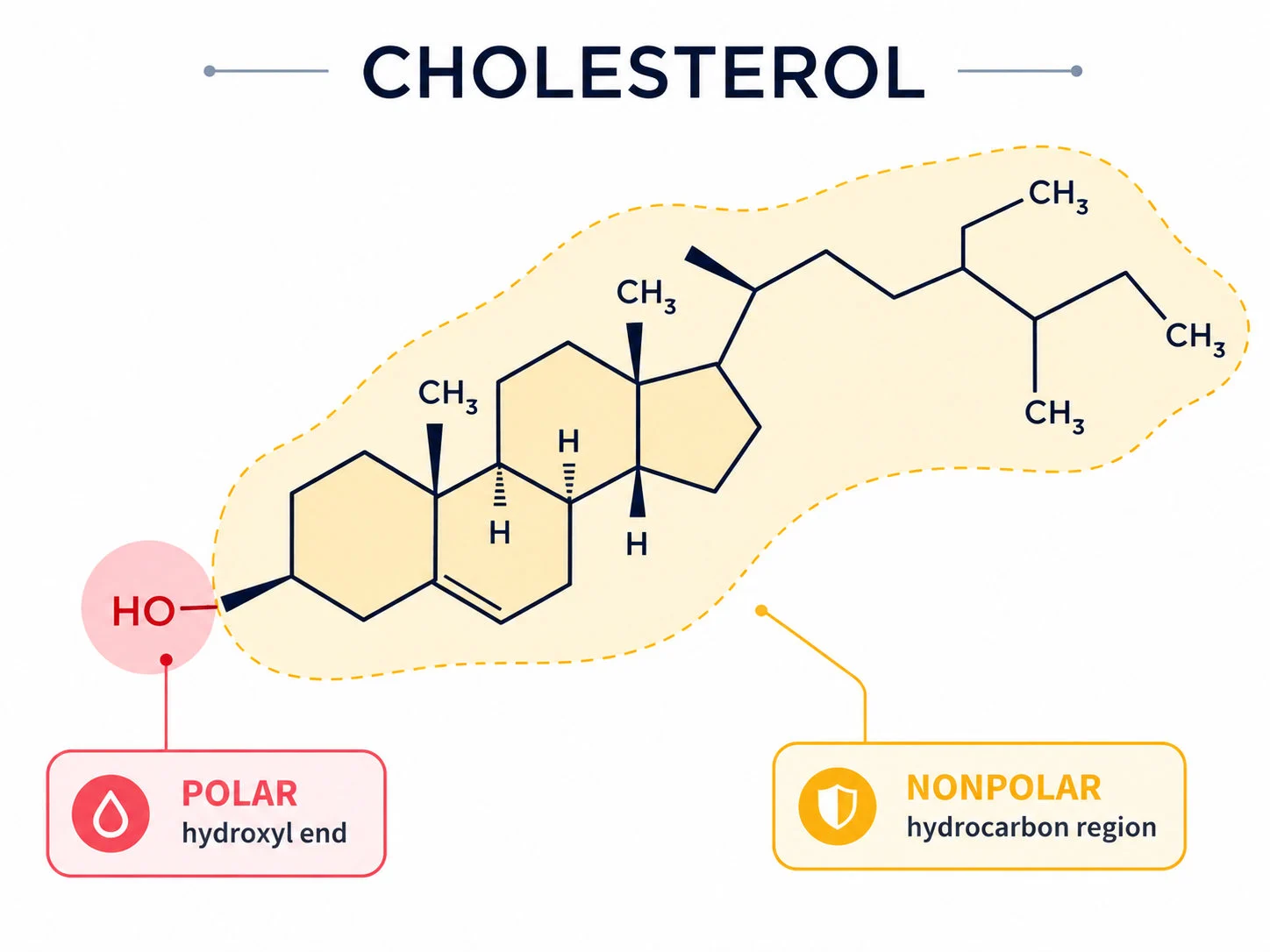
- Cholesterol it has hydrophobic and hydrophilic regions and sits in the bilayer.
- It stops close packing, keeping flexibility at low temperature.
- It holds the tails together, giving stability at high temperature.
- It fills spaces between phospholipids, blocking water-soluble substances.
Section 6 of 12Simple diffusion and osmosis
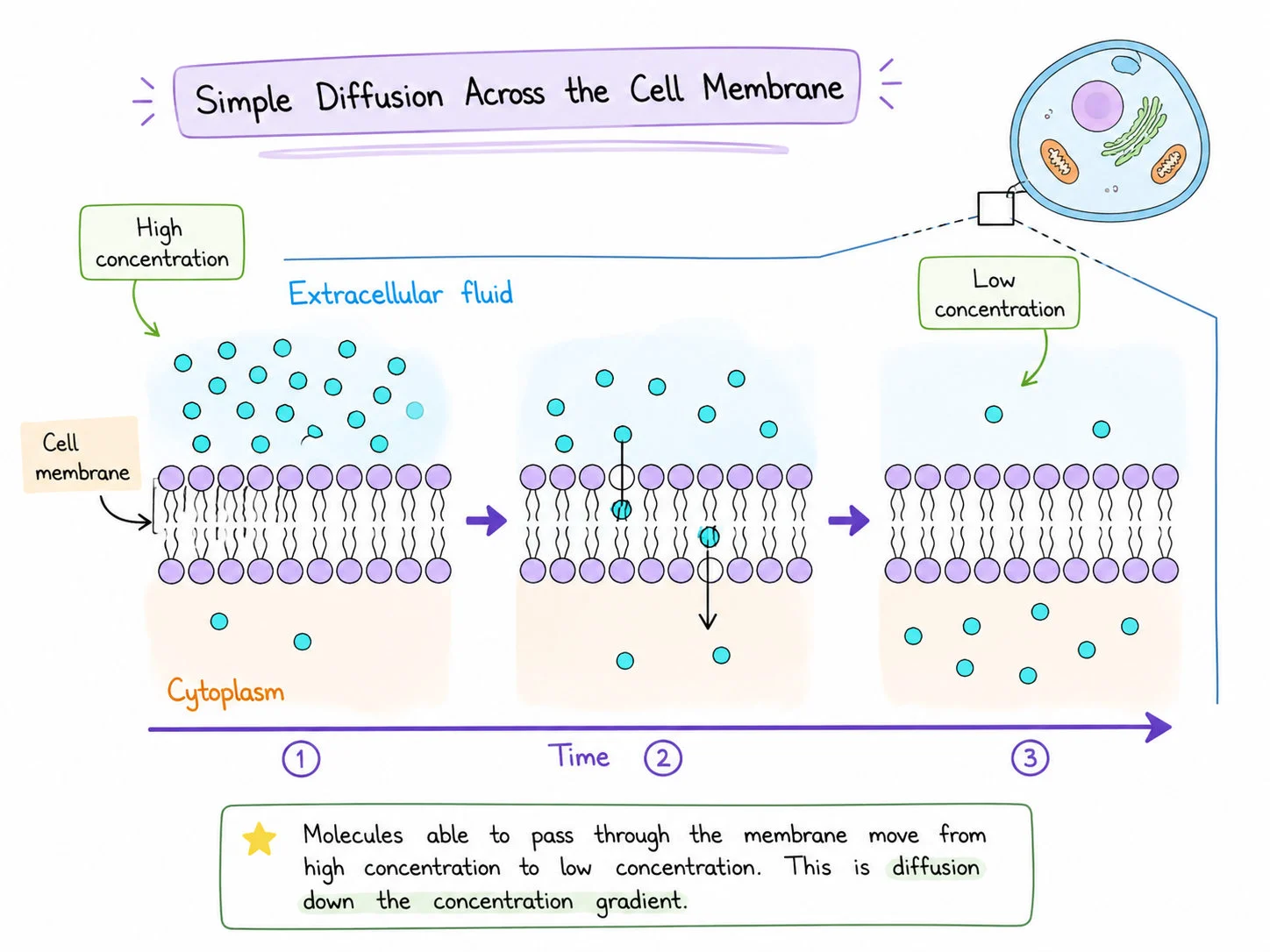
Simple diffusion
Simple diffusion net movement of a substance down its concentration gradient by random motion, directly between phospholipids.
- Oxygen enters cells because respiration keeps its concentration low inside.
- Carbon dioxide leaves because respiration makes its concentration high inside.
Factors affecting rate
- A steeper concentration gradient increases the rate.
- A higher temperature gives more kinetic energy.
- A larger surface area increases the rate.
- Small, uncharged, non-polar molecules diffuse faster, and large molecules diffuse slower;
- small polar molecules such as urea diffuse slowly.
Osmosis
Osmosis the net diffusion of water across a partially permeable membrane from a dilute solution (higher water potential) to a more concentrated solution (lower water potential).
- Water passes between phospholipids, and aquaporins let it pass more freely.
- Water potential avoids confusion between water concentration and solute concentration.
Section 7 of 12Facilitated diffusion and active transport
| Feature | Facilitated diffusion | Active transport |
|---|---|---|
| Direction | Down the concentration gradient | Against the concentration gradient |
| Energy | None, passive | ATP from respiration, hydrolysed |
| Proteins | Channels or carriers | Carrier proteins (pumps) |
Facilitated diffusion
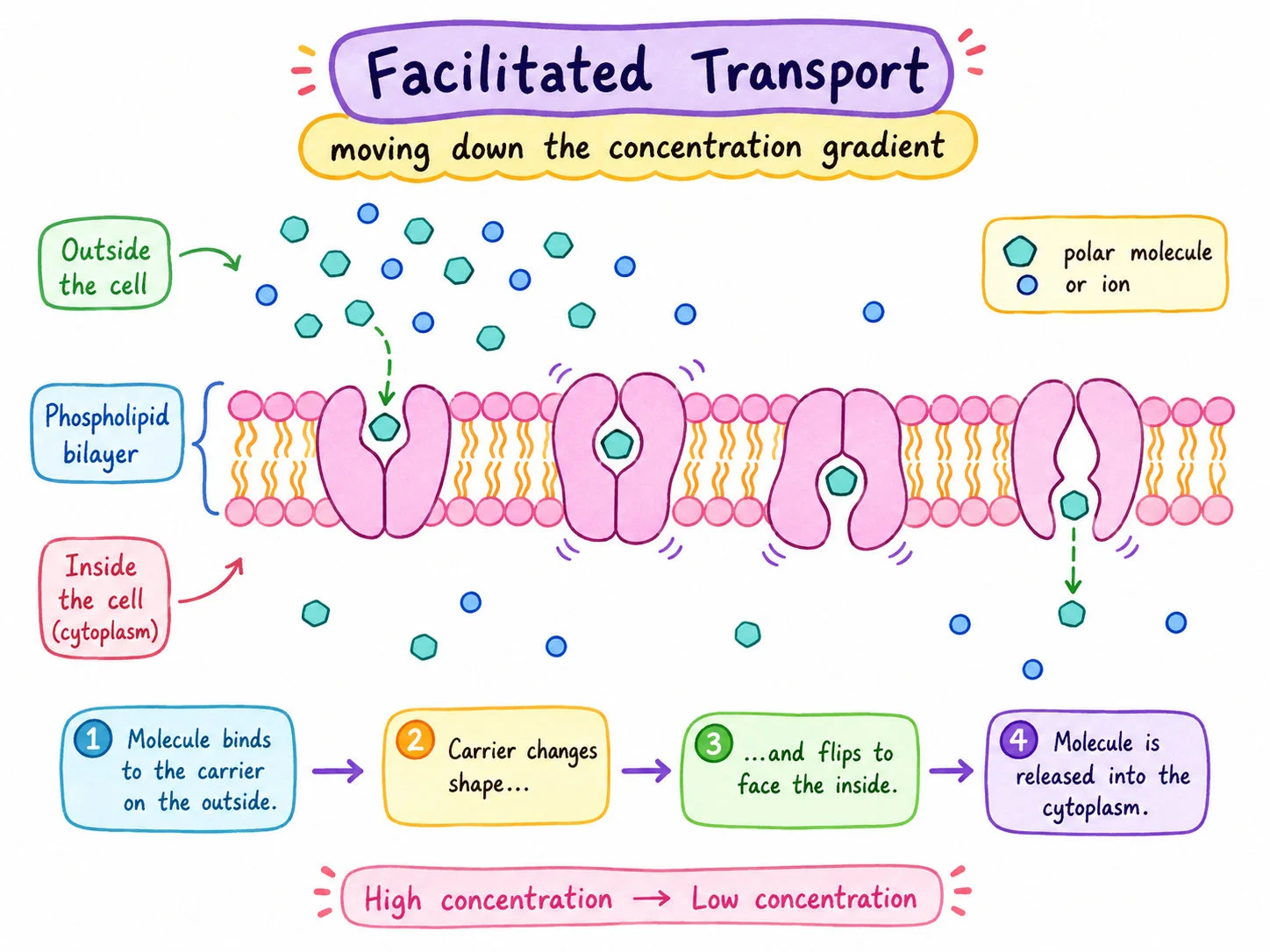
- Facilitated diffusion large molecules, polar molecules and ions cross with the help of highly specific transport proteins.
- Channel proteins are fixed pores, and some are gated and can open or close.
- Carrier proteins switch between two shapes after the substance binds.
Selective permeability
Selective permeability the membrane lets some molecules through and blocks others.
- Simple diffusion depends only on size and polarity, so it is not selective for small molecules.
- Large or polar molecules need transport proteins, which gives control.
Section 8 of 12Bulk transport
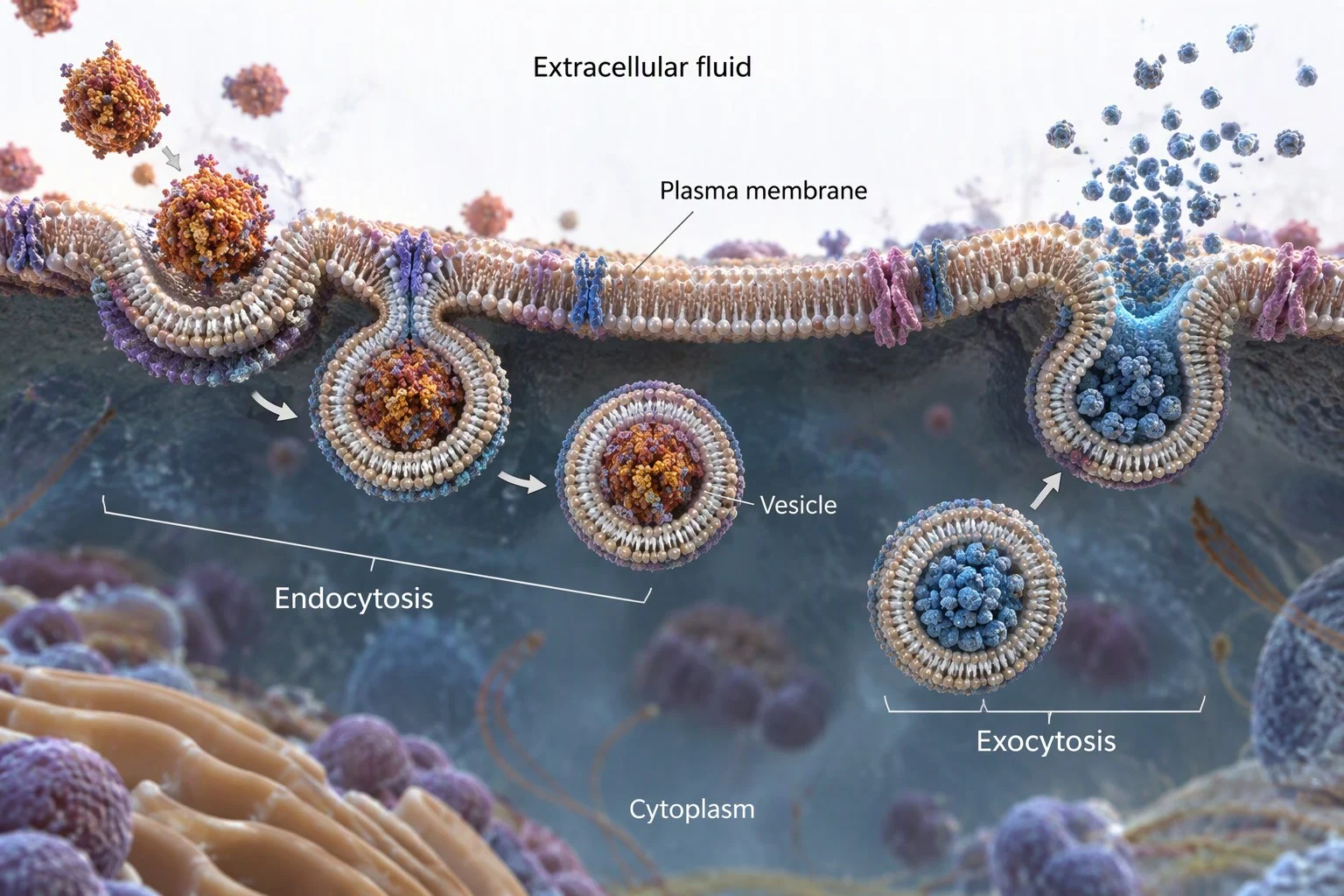
Endocytosis
Endocytosis bulk transport into the cell, by engulfing material in a membrane sac.
- Phagocytosis takes in solids, such as phagocytes engulfing bacteria into phagocytic vacuoles.
- Pinocytosis takes in liquids.
Exocytosis
Exocytosis bulk transport out of the cell, as secretory vesicles fuse with the surface membrane.
- An example is the secretion of digestive enzymes from pancreatic cells.
Requirements
- Requirements both need energy and are active, and vesicle formation and fusion need a fluid, flexible membrane.
Section 9 of 12Gated channels and the sodium-potassium pump
Gated channels and the sodium-potassium pump
Gated ion channels respond to chemical or electrical stimuli.
Nicotinic acetylcholine receptor
- Nicotinic acetylcholine receptor acetylcholine binding opens it so Ca2+ or Na+ enters.
- The ion influx changes membrane potential and can start an action potential, at the neuromuscular junction.
Sodium-potassium pump
- Sodium-potassium pump an integral protein that uses one ATP to move 3 Na+ out and 2 K+ in against gradients.
1
Three Na+ from inside the axon bind to the pump.
2
ATP phosphorylates the pump, which changes shape and opens to the outside.
3
The three Na+ are released outside.
4
Two K+ from outside bind.
5
The phosphate is released, changing the shape again.
6
The K+ are released inside.
- Result
- more positive charge leaves than enters,
- so the inside is negative, and stimulation opens sodium channels so Na+ rushes in and can generate an impulse.
Section 10 of 12Cotransport and cell adhesion
Cotransport
Cotransport coupled movement of two substances through one carrier protein, combining facilitated diffusion and indirect active transport.
- ATP sets up the initial gradient and the second substance moves using the energy released by the first moving down its gradient.
Sodium-dependent glucose cotransport in the ileum epithelium and kidney
1
The sodium-potassium pump moves Na+ into the blood, lowering Na+ inside the cell.
2
Na+ moves down its gradient into the cell through the cotransporter.
3
Glucose is drawn in with Na+ against its gradient.
4
Glucose moves down its gradient into the blood.
- Cell adhesion
- cell adhesion molecules (CAMs) are surface proteins binding cells to each other or to the extracellular matrix,
- which holds supporting structures such as collagen.
- Cell junctions with different CAMs include tight junctions, adherens junctions, desmosomes and gap junctions.
Section 11 of 12Key terms
| Term | Meaning |
|---|---|
| Amphipathic | having both a hydrophilic region and a hydrophobic region. |
| Integral protein | a protein embedded in the phospholipid bilayer. |
| Osmosis | net diffusion of water across a partially permeable membrane. |
| Facilitated diffusion | passive movement through a channel or carrier protein. |
| Active transport | movement against a gradient using ATP and a carrier protein. |
| Endocytosis | bulk transport into a cell using a membrane vesicle. |
| Exocytosis | bulk transport out of a cell by vesicle fusion with the membrane. |
| Cotransport | coupled movement of two substances through one carrier protein. |
| Selective permeability | the ability of a membrane to allow only certain substances through. |
Section 12 of 12Exam technique
1
Water crosses membranes only through channels — it also passes between phospholipids, and aquaporins increase the rate.
2
Facilitated diffusion needs ATP — it is passive and uses only the concentration gradient.
3
Cholesterol only makes membranes stiffer — it keeps membranes flexible at low temperature and stable at high temperature.
4
Glucose cotransport uses ATP directly — ATP builds the sodium gradient and glucose follows indirectly.
Marked practiceQuizzes for this lesson
Last updated:
\n