B3.1Theme B — Form and function
Gas exchange — IB Biology HL Revision Notes & Topical Questions
10 min read 11 parts Lesson 7 of 14 2 quizzes
Curriculum Equation Key قوانين الرقم الهيدروجيني والاتزان الأيوني - pH & Acid-Base Equilibrium FormulasFast Exam Solution
pH = -log[H⁺] | pOH = -log[OH⁻] | pH + pOH = 14 | [H⁺][OH⁻] = 10⁻¹⁴
Word Equation & Conditions: الرقم الهيدروجيني = -لوغاريتم تركيز أيون الهيدروجين | pH + pOH = 14
Location & Specifications: الاتزان الأيوني، كيمياء 3 ثانوي، التحصيلي، و AP Chemistry.
Lesson summary
B3.1 Gas exchange — IB BIOLOGY HL notes: Explain gas exchange surfaces, lung structure, ventilation, leaf gas exchange and transpiration, and oxygen transport by haemoglobin.Gas exchange = diffusion of oxygen and carbon dioxide between an organism and its environment, which diffe…
- Airway path
- Spirometer
- Calculate area
- Limitations
- Nature of science
- Partial pressure (pO2)
Part 1 of 9Gas exchange and exchange surfaces
Gas exchange
Gas exchange diffusion of oxygen and carbon dioxide between an organism and its environment,
- which differs from respiration, the chemical release of energy in cells.
- Aerobic respiration uses oxygen and gives carbon dioxide, and in the day plants absorb carbon dioxide and release oxygen.
Rate of diffusion depends on the size of the respiratory surface, the concentration gradient and the diffusion distance.
Small unicellular organisms such as amoeba have a large SA:V and a short diffusion distance, so diffusion suffices.
Large organisms have a smaller SA:V, a greater diffusion distance, more active cells and a protective outer surface,
- so they need specialised gas exchange organs.
Properties of gas exchange surfaces
- Permeable.
- Thin, for a short diffusion distance.
- Moist, so that gases dissolve.
- Large surface area.
Maintaining a steep gradient
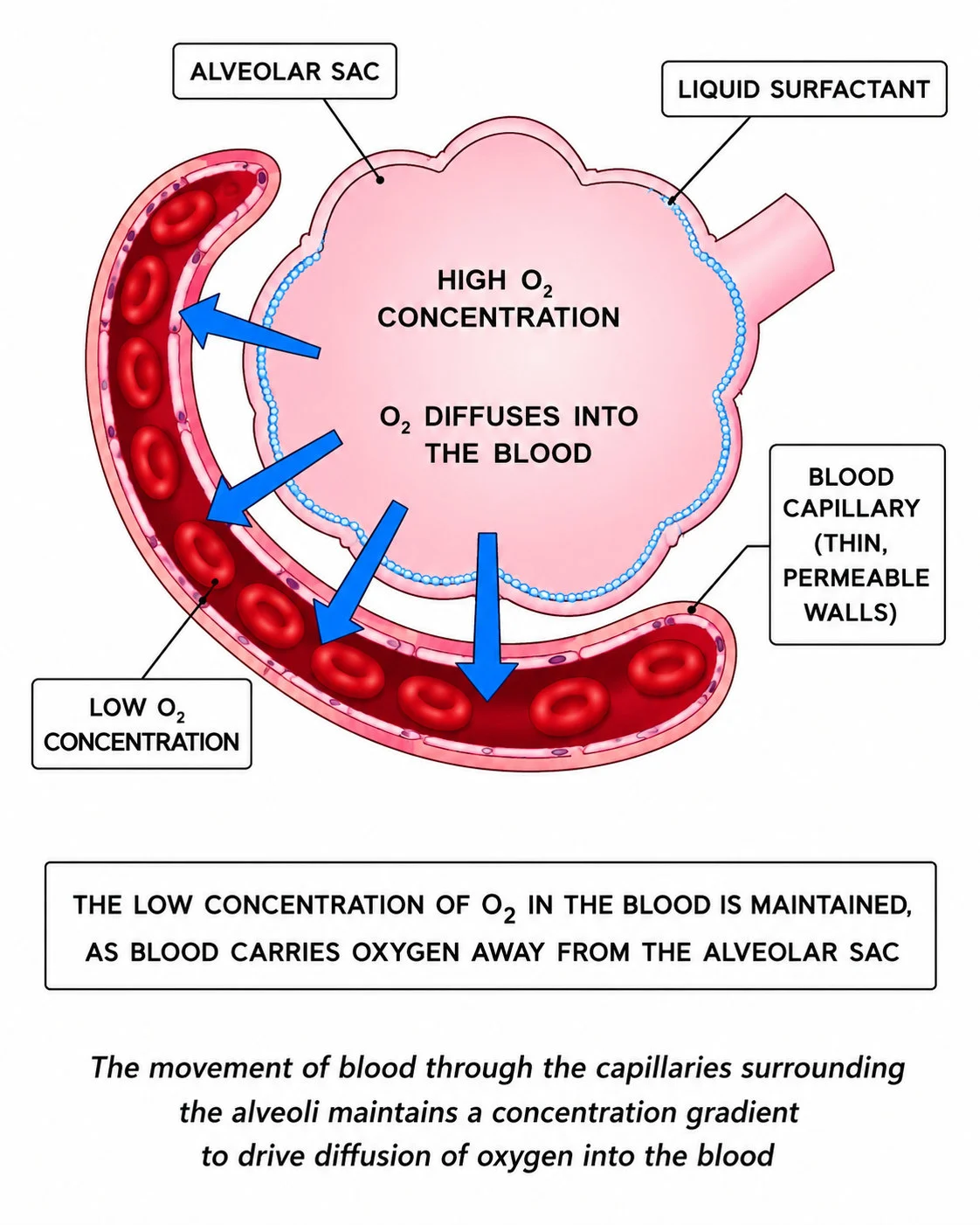
- A dense network of blood vessels gives a large area.
- Blood transports oxygen and carbon dioxide.
- Continuous blood flow removes oxygen from, and brings carbon dioxide to, the surface.
- Ventilation with air in lungs and water in gills brings oxygen close and removes carbon dioxide.
Part 2 of 9Structure of the mammalian gas exchange system
Structure of the mammalian gas exchange system
Airway path
- Airway path nose and mouth, trachea, two bronchi, bronchioles and then alveoli.
- The trachea is supported by rings of cartilage that keep it open while it flexes.
- The bronchi have cartilage and smooth muscle, and one leads to each lung.
- The trachea and bronchi are lined with ciliated epithelium that moves mucus with trapped particles.
- Bronchioles have smooth muscle that dilates when more air is needed and constricts when an allergen is present.
Adaptations of the lungs
- Many small alveoli give a large surface area, evenly spread around the ends of bronchioles.
- An extensive capillary bed round each alveolus is supplied with deoxygenated blood from the pulmonary artery and drained by the pulmonary vein,
- which maintains the gradient.
- The alveolar wall is a single layer of epithelial cells and is not a cell wall.
- Cells of the wall secrete surfactant, which lowers surface tension and stops alveoli collapsing and sticking together.
Part 3 of 9Mechanism of ventilation
Role
- Role ventilation replaces old air with fresh air and maintains the gradient between alveoli and blood.
Inspiration
1
The diaphragm contracts and flattens.
2
The external intercostal muscles contract and move the ribcage up and out.
3
Chest volume increases and pressure falls below atmospheric pressure.
4
Air flows in down the pressure gradient.
- Passive expiration
1
The external intercostal muscles relax and the ribcage moves down and in.
2
The diaphragm relaxes and becomes dome-shaped.
3
Elastic fibres in the alveolar walls recoil.
4
Chest volume falls and pressure rises, so air is forced out.
- Forced expiration, as when blowing out a candle
- Internal intercostal muscles contract and pull the ribs down and in.
- Abdominal muscles contract and push organs up against the diaphragm.
Part 4 of 9Measuring lung volumes
Spirometer
- Spirometer a water-filled chamber with a hinged lid, with a person breathing through a mouthpiece.
- Filled with air it measures lung volumes, and filled with oxygen and soda lime (which absorbs carbon dioxide) it measures oxygen consumption.
- A trace is drawn on a revolving drum or by computer.
Measurements from a trace
- Tidal volume = air inhaled and exhaled in normal breathing, which rises with exercise.
- Inspiratory reserve volume = maximum inspiratory level minus tidal volume.
- Expiratory reserve volume = maximum expiratory level minus tidal volume.
- Vital capacity = TV + IRV + ERV, the total exhaled after a deep breath.
- Ventilation rate = breaths per minute, which rises with exercise.
Part 5 of 9Leaf structure and gas exchange
- Tissues
- epidermis, mesophyll and vascular tissue.
- The epidermis is a single layer of tightly packed cells with a waxy cuticle, and the lower epidermis has stomata.
- Each stoma has two guard cells, which become turgid and open it when water enters and flaccid and close it when water leaves.
- Palisade mesophyll lies below the upper epidermis and has many chloroplasts.
- Spongy mesophyll has large air spaces.
- Xylem brings water and minerals to the leaf, and phloem carries products of photosynthesis away.
| Adaptation | Function |
|---|---|
| Waxy cuticle | Prevents gas and water loss through the epidermis so exchange is through stomata |
| Stomata in the lower epidermis | Allow gas diffusion, and the lower temperature reduces water loss |
| Air spaces | Maintain a gas gradient with spongy mesophyll cells |
| Spongy mesophyll | Large surface area for exchange |
| Guard cells | Control gas exchange and water loss |
| Veins | Xylem supplies water for photosynthesis and transpiration |
- Plan diagram of a leaf
- Label chloroplasts, cuticle, guard cells, stomata, upper and lower epidermis, palisade and spongy mesophyll, air spaces and vascular bundles.
- Draw tissue layers only, with no individual cells, in clear unshaded lines at a large size.
- Use ruled, horizontal label lines that do not cross and have no arrowheads.
Part 6 of 9Transpiration
- Transpiration = loss of water vapour through open stomata, which is an unavoidable consequence of gas exchange.
- Closing stomata reduces water loss but also reduces photosynthesis.
- Benefits are cooling by evaporation, mineral ion uptake and turgor that supports leaves and stems.
- Water vapour leaves by diffusion, not osmosis.
| Factor | Effect on rate |
|---|---|
| Air movement | Wind removes water vapour from the surface, steepening the gradient and raising the rate |
| Temperature | Higher temperature raises evaporation until stomata close and the rate falls |
| Light intensity | Light opens stomata and raises the rate until all are open, and the rate is low in the dark |
| Humidity | High humidity reduces the gradient and the rate, until there is no net loss |
Part 7 of 9Measuring transpiration and stomatal density
Potometer
- Potometer it measures water uptake, which represents the transpiration rate because little water is used in photosynthesis.
- A bubble potometer measures the movement of an air bubble in a water-filled tube attached to a shoot.
- A mass potometer measures the loss of mass of a water-filled tube with a shoot.
- Vary air movement with a fan, humidity with a plastic bag or humidifier, light with a lamp at different distances and temperature with a heater,
- and control all other variables.
Stomatal density method
Paint clear nail varnish on the underside of a leaf and let it dry for about 5 minutes.
Peel off the varnish with sellotape to make a leaf cast.
Place the cast flat on a slide and focus the microscope.
Count stomata in a field of view with 15–100 stomata, counting partial ones at the edge as one.
Count at least 3 fields and take the mean.
Measure the diameter of the field of view with a stage micrometer.
Calculate area
πr2 and density = mean stomata ÷ area, in stomata per mm2.
Limitations
- Limitations some plants give a poor imprint, solvent-based varnish can damage cells, and water-based varnish dries more slowly.
Nature of science
- Nature of science repeating measurements raises reliability, identifies anomalies and allows a mean.
Part 8 of 9Haemoglobin and oxygen binding
Haemoglobin and oxygen binding
Haemoglobin
- Haemoglobin a globular protein of four polypeptide subunits, each with a haem group binding one oxygen, so it carries four oxygen molecules.
Partial pressure (pO2)
Partial pressure (pO2) the pressure exerted by oxygen in a gas mixture, a measure of its concentration.
Cooperative binding
- Cooperative binding the first oxygen binds with difficulty, then the molecule changes shape, which makes later oxygen molecules bind more easily.
Affinity
Affinity the ease with which haemoglobin binds and releases oxygen.
- At high pO2 (alveoli) affinity is high and oxygen binds.
- At low pO2 (respiring muscle) affinity is low and oxygen is released.
Allosteric protein
- Allosteric protein haemoglobin changes conformation, and carbon dioxide is an allosteric inhibitor that lowers its oxygen affinity.
Foetal haemoglobin has a higher affinity for oxygen and binds it at low pO2, so the foetus takes oxygen from the mother's blood at the placenta.
- Carbon dioxide affects it less.
- Its curve lies to the left of adult haemoglobin, and adult haemoglobin gradually replaces it after birth.
Part 9 of 9Oxygen dissociation curve and the Bohr shift
Oxygen dissociation curve and the Bohr shift
Oxygen dissociation curve
Oxygen dissociation curve a graph of percentage saturation of haemoglobin against pO2, S-shaped because affinity changes with pO2.
Reading the curve
- At low pO2, binding is slow because the first oxygen binds with difficulty.
- At medium pO2 the curve is steep, so a small change gives a large change in saturation, matching respiring tissues where oxygen is released readily.
- At high pO2 the curve levels off, as in the lungs, because few binding sites remain.
- The final oxygen is released with difficulty at very low pO2.
Bohr shift
- Bohr shift high carbon dioxide shifts the curve to the right, so saturation at any pO2 is lower.
1
Respiring tissues make carbon dioxide.
2
Carbon dioxide combines with water to form carbonic acid.
3
Carbonic acid dissociates into hydrogen carbonate ions and hydrogen ions, lowering pH.
4
Hydrogen ions bind to haemoglobin and oxygen is released.
- Benefit
- haemoglobin gives up oxygen more readily where it is needed.
Key terms
| Term | Meaning |
|---|---|
| Gas exchange | diffusion of oxygen and carbon dioxide across a respiratory surface. |
| Tidal volume | the volume of air moved in and out in normal breathing. |
| Vital capacity | tidal volume plus the inspiratory and expiratory reserve volumes. |
| Transpiration | loss of water vapour from leaves through stomata. |
| Cooperative binding | binding of one oxygen making binding of the next easier. |
| Affinity | how readily haemoglobin binds oxygen. |
| Bohr shift | the shift of the dissociation curve to the right when carbon dioxide levels rise. |
| Potometer | apparatus that measures water uptake by a shoot. |
| Stomatal density | the number of stomata per unit area of leaf. |
Avoid these mistakes
1
Respiration and gas exchange are the same — respiration is a chemical process in cells and gas exchange is diffusion across a surface.
2
Transpiration is osmosis — water vapour diffuses out through stomata without crossing a membrane.
3
Expiration at rest is active — it is mainly passive through elastic recoil.
4
The Bohr shift moves the curve left — high carbon dioxide moves it right, lowering oxygen affinity.
Marked practiceQuizzes for this lesson
Last updated:
\n