B3.3Theme B — Form and function
Muscle and motility — IB Biology HL Revision Notes & Topical Questions
5 min read 11 parts Lesson 9 of 14 2 quizzes
Curriculum Equation Key قوانين الرقم الهيدروجيني والاتزان الأيوني - pH & Acid-Base Equilibrium FormulasFast Exam Solution
pH = -log[H⁺] | pOH = -log[OH⁻] | pH + pOH = 14 | [H⁺][OH⁻] = 10⁻¹⁴
Word Equation & Conditions: الرقم الهيدروجيني = -لوغاريتم تركيز أيون الهيدروجين | pH + pOH = 14
Location & Specifications: الاتزان الأيوني، كيمياء 3 ثانوي، التحصيلي، و AP Chemistry.
Lesson summary
B3.3 Muscle and motility — IB BIOLOGY HL notes: Explain muscle contraction by the sliding filament model, antagonistic muscles, the skeleton and joints, and locomotion.Motile organisms can move from place to place (locomotion), such as most animals and many bacteria, for example …
- Striated fibres
- Myofibrils
- Cross-bridge
- Percentage shortening
- Neuromuscular junction
- Motor unit
Part 1 of 9Motile and sessile organisms
Motile and sessile organisms
Motile organisms can move from place to place (locomotion), such as most animals and many bacteria, for example a dolphin.
- They also show internal movements, such as peristalsis.
Sessile organisms cannot move from place to place but move body parts in response to stimuli,
- such as stems turning towards the sun or cytoplasm streaming.
- Examples are sponges, corals, anemones, most fungi and all plants, such as the Venus flytrap or sea anemone.
Part 2 of 9Structure of skeletal muscle
Structure of skeletal muscle
Striated fibres
- Striated fibres the fibres are cell-like, with many nuclei.
Sarcoplasmic reticulum (SR) stores calcium and conveys signals to all parts of the fibre at once.
Sarcoplasm contains mitochondria for ATP from aerobic respiration, and myofibrils.
Myofibrils
- Myofibrils bundles of two filament types.
- Thick filaments are myosin, a fibrous protein with a globular head.
- Thin filaments are two chains of globular actin twisted together, with tropomyosin twisted round them and troponin attached at intervals.
| Part | Description |
|---|---|
| Sarcomere | The section of myofibril between two Z lines, which shortens in contraction (resting about 2.5 µm) |
| A band | Whole length of the thick filaments, including the overlap with thin filaments |
| I band | Only thin actin filaments |
| H band | Only thick myosin filaments |
| M line | Attachment for myosin filaments |
| Z line | Attachment for actin filaments |
- Myosin molecules lie side by side in the thick filament with heads pointing away from the M line.
Part 3 of 9Sliding filament model
Cross-bridge
Cross-bridge myosin head bound to an actin site, and the power stroke = the head changing angle and pulling actin past myosin.
Effect
- Z lines move closer and the sarcomere shortens, while filament lengths do not change.
- Overlap increases, so the sarcomere, I band and H band shorten and the A band stays constant.
Percentage shortening
(initial length − final length) ÷ initial length × 100.
Part 4 of 9Roles of Ca<sup>2+</sup> and ATP
Calcium
- Ca2+ from the sarcoplasmic reticulum binds troponin, which moves tropomyosin and exposes binding sites on actin.
- Contraction stops when Ca2+ is pumped back by active transport using ATP.
ATP
- ATP myosin ATPase hydrolyses ATP to ADP and Pi.
- Binding of ATP detaches the head from actin, and hydrolysis re-cocks the head.
- Without ATP the heads stay bound, which causes rigor mortis.
Cross-bridge cycle
1
Ca2+ exposes binding sites on actin.
2
The cocked myosin head (holding ADP and Pi) binds actin, forming a cross-bridge.
3
ADP and Pi are released and the power stroke pulls actin towards the M line.
4
A new ATP binds and the head detaches.
5
ATP is hydrolysed and the head is re-cocked.
- Stimulation sequence
Roles of Ca<sup>2+</sup> and ATP
A motor neurone impulse releases acetylcholine at the neuromuscular junction, depolarising the fibre membrane.
Depolarisation spreads along T-tubules.
Ca2+ is released from the SR.
Part 5 of 9Relaxation, titin and antagonistic action
Muscles can only contract and pull, so they work in antagonistic pairs, one pulling each way at a joint.
- Isometric contraction = both muscles of a pair contracting to hold a joint at one angle without movement (posture).
Titin
- Titin a large folded protein joining the ends of myosin filaments to the Z line.
- In relaxed muscle the sarcomere lengthens and titin stretches, storing energy.
- It prevents overstretching.
- In contraction, titin recoils and releases stored energy, which adds to the force and helps the sarcomere return to resting length.
Antagonistic contraction stretches the other muscle and titin in it, as with biceps (flexor) and triceps (extensor).
Part 6 of 9Motor units and skeletal muscle control
Neuromuscular junction
- Neuromuscular junction it works like a synapse between a motor neurone and a muscle cell.
Motor unit
Motor unit one motor neurone with the muscle fibres and neuromuscular junctions it controls, and all fibres in a unit contract together.
Intensity
- Intensity a low-intensity contraction activates few motor units and a high-intensity one activates more.
Control
- Control small units with few fibres give fine control (eye, fingers) and large units give strong force (thigh).
Part 7 of 9Skeleton, levers and synovial joints
Skeleton
- Skeleton an incompressible skeleton gives muscles anchorage and acts as levers, with the joint as the fulcrum.
- Levers have an effort point, a load point and a pivot (fulcrum).
- Moment = force × perpendicular distance from the pivot.
Endoskeleton
- Endoskeleton vertebrates have internal bones with muscles attached on the outside via tendons.
Exoskeleton
- Exoskeleton arthropods and molluscs have external skeletons of chitin, with muscles attached inside in antagonistic pairs on jointed legs and body parts,
- and it also protects soft tissues.
Synovial joint
- Synovial joint most common joint, with a cavity of lubricating synovial fluid made by the synovial membrane.
- Movements are flexion, extension, rotation, abduction (away from the body) and adduction (towards it).
| Joint | Type | Movements |
|---|---|---|
| Knee and elbow | Hinge | Flexion and extension in one plane |
| Hip | Ball and socket | Flexion, extension, rotation and sideways and backwards movement |
| Shoulder | Ball and socket | Abduction, adduction, flexion and extension |
Hip joint
- Hip joint the femur (ball) fits into the pelvis (socket).
- Cartilage covers the bones to stop them rubbing.
- Synovial fluid inside a membrane lubricates the joint.
- Ligaments of tough connective tissue encircle the joint and hold the bones in place.
- Muscles attach to bones through tendons, which are flexible but do not stretch when muscle contracts.
Range of motion
- Range of motion it is measured in degrees with a goniometer, joint-angle images or software such as ImageJ and phone apps.
Part 8 of 9Intercostal muscles
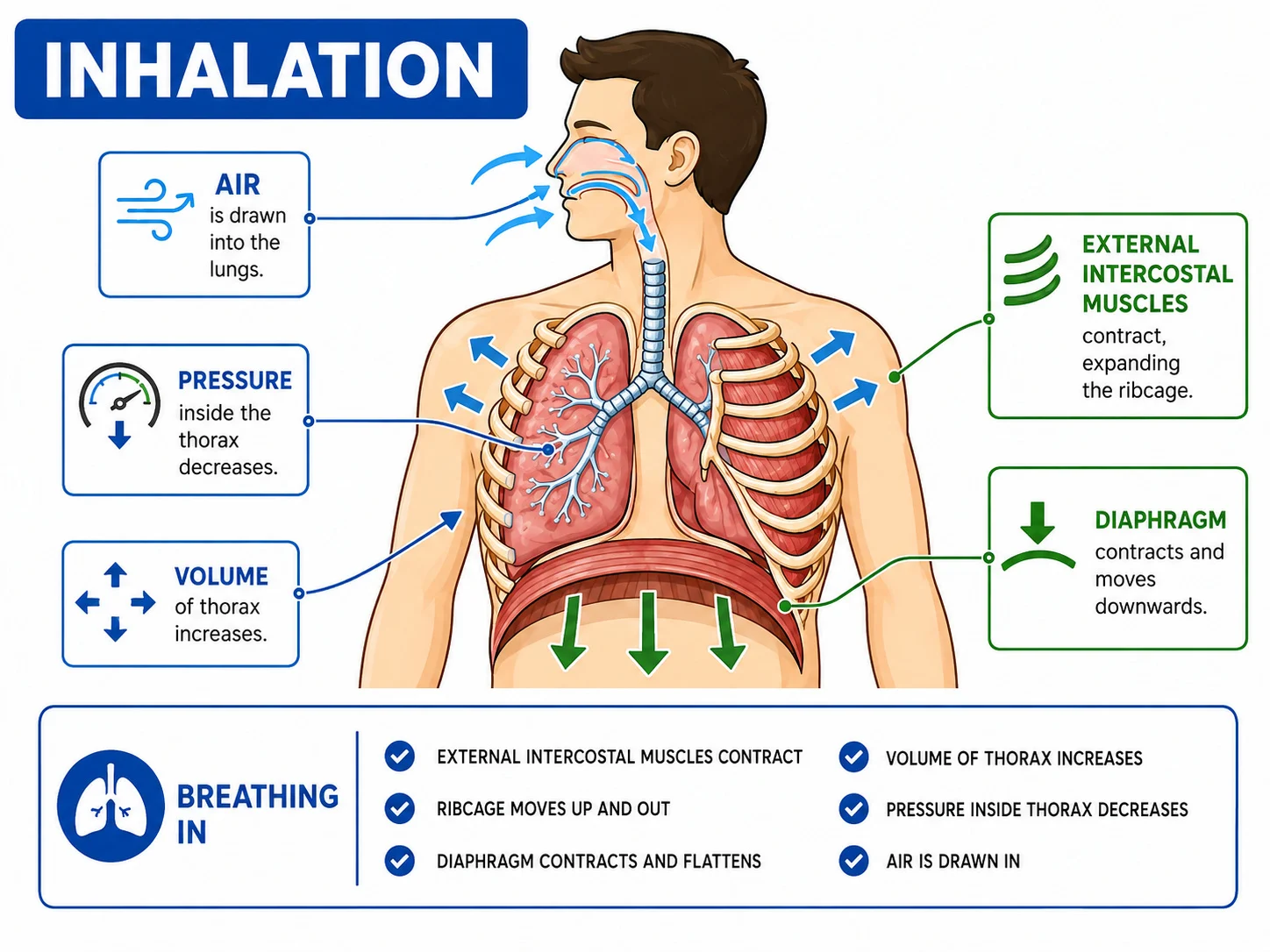
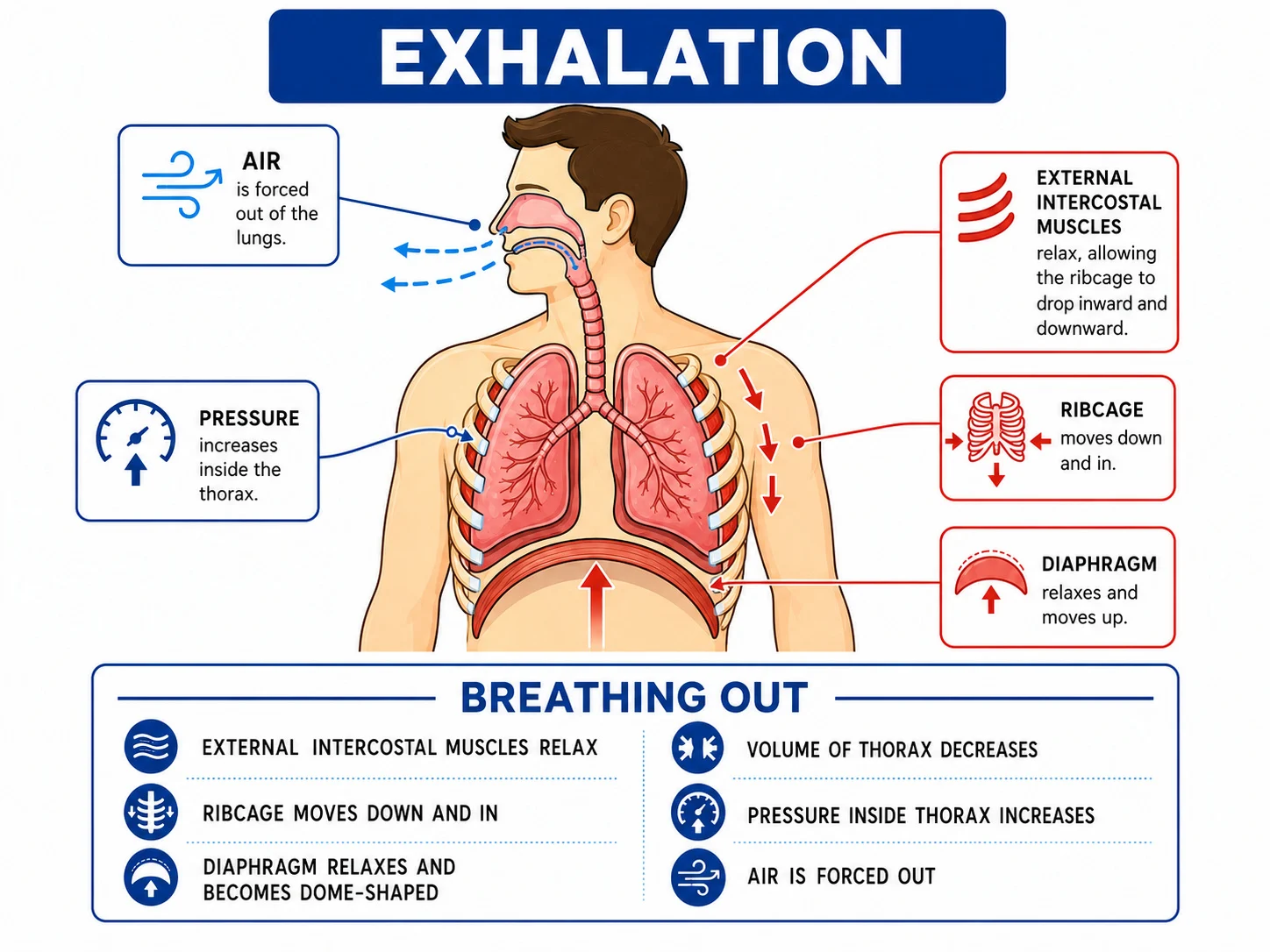
Muscles are effectors stimulated by motor neurones, and there are over 600 skeletal muscles.
Inhalation
- Inhalation the external intercostals contract, pulling the ribs up and out.
- Thoracic volume rises, lung pressure falls below outside pressure and air is drawn in.
Exhalation
- Exhalation the external intercostals relax and the ribs drop down and in.
- Volume falls, pressure rises and air is forced out; in forced exhalation the internal intercostals contract.
Antagonism
- Antagonism fibre orientation differs in the internal and external layers.
- Contraction of one set stretches the other and stores energy in the titin of its sarcomeres.
The diaphragm also contracts and relaxes in ventilation but is not part of an antagonistic pair.
Part 9 of 9Locomotion and swimming
| Reason | Example |
|---|---|
| Foraging | Guinea pigs spend at least 70% of waking time searching for and eating plants |
| Escaping danger | Jumping spiders (Salticidae) jump away from predators |
| Searching for a mate | Salmon swim from the ocean to freshwater rivers to spawn |
| Migration | Caribou travel over 3000 miles a year between winter ranges and calving grounds |
- Marine mammal adaptations, from ancestral land animals
- Streamlined body for fast movement through viscous water.
- Front limbs formed flippers used mainly for steering, and rear legs were lost.
- The tail forms a fluke that moves up and down for propulsion.
- A blowhole allows periodic breathing and seals between dives.
- Blubber gives insulation and buoyancy, and hair is reduced.
Key terms
| Term | Meaning |
|---|---|
| Sarcomere | the repeating contractile unit of a myofibril between two Z lines. |
| Cross-bridge | the link formed when a myosin head binds actin. |
| Titin | an elastic protein that stores energy when stretched and prevents overstretching. |
| Motor unit | one motor neurone and the muscle fibres it stimulates. |
| Antagonistic muscles | a pair of muscles that pull in opposite directions at a joint. |
| Synovial joint | a joint with a cavity of lubricating synovial fluid. |
| Sessile | unable to move from place to place. |
| Isometric contraction | muscle contraction without movement. |
Avoid these mistakes
1
Filaments shorten during contraction — the filaments keep their length and slide, so the sarcomere shortens.
2
ATP is only needed to start the power stroke — ATP binding detaches the head and its hydrolysis re-cocks it.
3
Muscles push as well as pull — they only contract, so antagonistic pairs are needed.
4
Sessile organisms do not move at all — they move body parts but not from place to place.
Marked practiceQuizzes for this lesson
Last updated:
\n