D1.1Theme D — Continuity and change
DNA replication — IB Biology SL Revision Notes & Topical Questions
5 min read 12 parts Lesson 2 of 14 2 quizzes
Curriculum Equation Key قوانين الرقم الهيدروجيني والاتزان الأيوني - pH & Acid-Base Equilibrium FormulasFast Exam Solution
pH = -log[H⁺] | pOH = -log[OH⁻] | pH + pOH = 14 | [H⁺][OH⁻] = 10⁻¹⁴
Word Equation & Conditions: الرقم الهيدروجيني = -لوغاريتم تركيز أيون الهيدروجين | pH + pOH = 14
Location & Specifications: الاتزان الأيوني، كيمياء 3 ثانوي، التحصيلي، و AP Chemistry.
Lesson summary
D1.1 DNA replication — IB BIOLOGY SL notes: Explain semi-conservative DNA replication and the uses of PCR, gel electrophoresis and DNA profiling.Purpose — each daughter cell needs a full copy of the genomeGrowth: new cells in a developing body each need identical DNA.Repair: worn…
- Parent cell compared with parent organism
- Semi-conservative replication
- DNA polymerase
- Hypothesis
- Conclusion
- Thermal cycler
Part 1 of 10Why DNA is replicated
Why DNA is replicated
Purpose
- Purpose each daughter cell needs a full copy of the genome
- Growthnew cells in a developing body each need identical DNA.
- Repairworn or damaged cells such as skin and gut lining are replaced.
- Reproductioncopies are needed before cell division in single-celled organisms and before gamete formation.
Timing
- Timing replication occurs in S phase of interphase, in the nucleus in eukaryotes, before mitosis
Parent cell compared with parent organism
- Parent cell compared with parent organism a parent cell is any cell that divides, whereas a parent organism is the individual
Part 2 of 10Semi-conservative replication
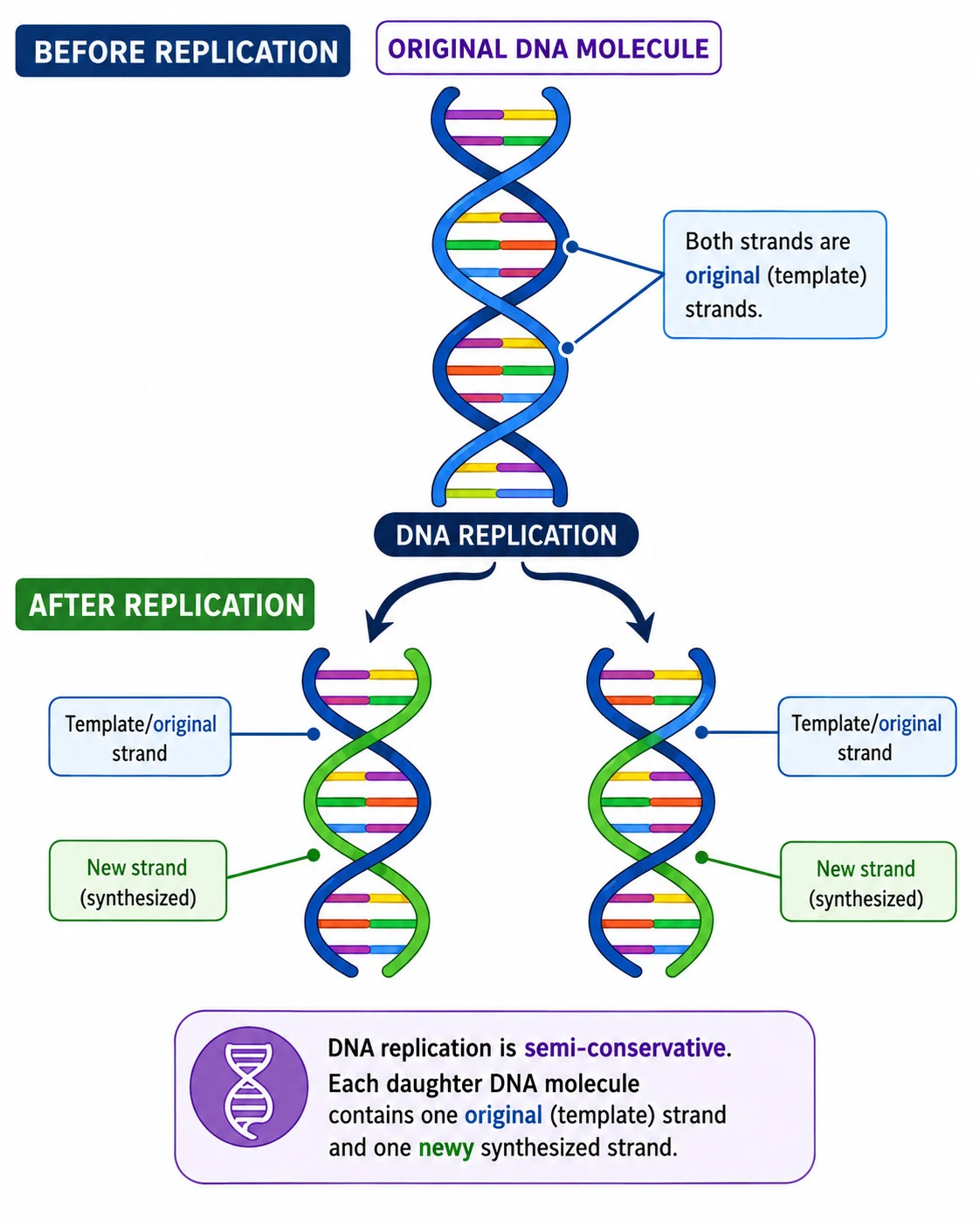
1Semi-conservative replication
Semi-conservative replication each new DNA molecule keeps one original strand and has one newly built strand
- The kept strand is the template strand.
- Free nucleotides from the nucleus are added one by one by complementary base pairing.
- Adenine pairs with thymine and cytosine pairs with guanine.
- Hydrogen bonds form only if the bases are correctly paired.
2Accuracy
- Accuracy the original strand guides the new one, so copies are almost identical
- It keeps genetic continuity between generations of cells.
- Rare errors are mutations, and an uncorrected mispaired base is copied into later generations.
Part 3 of 10Helicase and DNA polymerase
1
Helicase unwinds the double helix, using energy from ATP, and breaks the hydrogen bonds between bases.
2
Each strand is exposed as a template at the replication fork.
3
Free nucleotides pair with the exposed template bases.
4
DNA polymerase joins the nucleotides by condensation reactions into a new strand.
5
Two identical DNA molecules result.
- DNA polymerase
- forms covalent bonds between the deoxyribose and phosphate of adjacent nucleotides, making the sugar-phosphate backbone
- It always builds the new strand in the 5′ to 3′ direction.
- It reads the template strand in the 3′ to 5′ direction.
- The strands are antiparallel, so the new strands are built in opposite directions.
Part 4 of 10Evidence for semi-conservative replication
Hypothesis
- Watson and Crick proposed semi-conservative replication when they described the double helix
Test by Meselson and Stahl
1
Bacteria were grown in heavy 15N and then moved to light 14N.
2
DNA was spun in a density gradient so it formed bands by density.
3
After one generation there was one intermediate band.
4
After two generations there were intermediate and light bands.
- Conclusion
- the results rule out conservative replication and support the semi-conservative model
Part 5 of 10Gel electrophoresis
- Gel electrophoresis = separation of molecules by size and charge using an electric current
- DNA is negatively charged because of its phosphate groups, so it moves towards the anode, the positive pole.
- Smaller fragments move faster and further through the pores of the gel.
- The type of gel affects the speed, with agarose for DNA and polyacrylamide for proteins.
1
Make an agarose gel in a tank with wells cut at the cathode end.
2
Submerge the gel in an electrolyte solution.
3
Load the DNA fragments into the wells with a micropipette.
4
Switch on the current so the DNA fragments move towards the anode.
5
Run a ladder of known sizes alongside to estimate fragment sizes.
6
Transfer the fragments to absorbent paper or nitrocellulose and add probes.
7
Show the bands with a radioactive label on X-ray film, or a fluorescent dye under UV light.
Part 6 of 10Polymerase chain reaction
1PCR
PCR an in vitro method of amplifying a specific DNA sequence from a very small sample, even one molecule
- It gives billions of copies in a few hours.
2
Requirements
- Target DNA, which may be a single molecule from hair or blood.
- Two primers, one for each strand end, that mark the target boundaries.
- Taq polymerase from the thermophilic bacterium Thermus aquaticus, which does not denature at high temperature.
- Free nucleotides.
- A buffer for the optimum pH.
3Thermal cycler
- Thermal cycler a machine that automatically sets the temperature and timing of each stage
Part 7 of 10One PCR cycle
1
Denaturation: heat to about 95 °C so the hydrogen bonds break and the strands separate.
2
Annealing: cool to about 50-60 °C so the primers bind to the ends of the single strands.
3
Extension: warm to 72 °C for at least a minute so Taq polymerase builds the complementary strands.
4
The amount of target DNA doubles.
1Amplification
- 20 cycles give about a million molecules and 30 cycles give about a billion copies
2
Comparison with cell replication
| Feature | Cell replication | PCR |
|---|---|---|
| Strand separation | Helicase | Heating to about 95 °C |
| Polymerase | The cell's own DNA polymerase | Taq polymerase |
| Region copied | Whole genome | Short target sequence |
| Location | Nucleus in S phase | Thermal cycler |
Part 8 of 10DNA profiling
- DNA profiling = comparing the patterns of VNTRs to identify people or relationships
- VNTRs are variable number tandem repeats, short non-coding regions 20-50 bases long.
- Everyone except identical twins has a unique combination.
1
Extract DNA from, for example, a hair root, blood, semen or saliva.
2
Amplify it by PCR.
3
Cut the DNA into fragments with restriction endonucleases.
4
Separate the fragments by size with gel electrophoresis.
5
Add radioactive or fluorescent probes that are complementary to the VNTRs.
6
Visualise the probes with X-ray film or UV light.
7
Analyse and compare the pattern of bands.
- Viral testing
- PCR detects viral sequences, as in COVID-19, and viral RNA is first copied into DNA and then amplified
Part 9 of 10Interpreting profiles
Paternity
- Paternity every band in the child must come from the mother or the father
- A band the mother lacks must come from the father, so men lacking it are excluded.
- A parent shares about 50% of the child's bands.
Forensic match
- Forensic match the suspect's bands must align with all the bands from the crime scene
- One clear mismatch rules a person out.
- Samples are compared with the victim, suspects and control samples, and contamination must be avoided.
Ancestry
- Ancestry profiles can identify parents or other ancestors
Reliability
- Reliability comparing more VNTRs lowers the chance of a false match
Ethics
- Ethics storing profiles raises privacy questions
Part 10 of 10More from the specification
1Semi-conservative replication
- DNA helicase unwinds the double helix, and DNA polymerase synthesizes a complementary strand alongside each pre-existing template strand.
2DNA polymerase directionality
- DNA polymerase links nucleotides exclusively in the 5' to 3' direction, forming covalent phosphodiester bonds.
3Polymerase chain reaction (PCR)
- A cyclic laboratory technique using heat-stable Taq polymerase and oligonucleotide primers to create millions of target DNA copies.
4Gel electrophoresis profiling
- Separation of fragmented DNA by electric charge and size to determine whether individuals possess matching parental allele bands.
Key terms
| Term | Meaning |
|---|---|
| Semi-conservative replication | Replication in which each new DNA molecule contains one original strand and one new strand. |
| Helicase | The enzyme that unwinds the DNA and breaks the hydrogen bonds between bases. |
| DNA polymerase | The enzyme that joins nucleotides to build a new DNA strand on a template. |
| PCR | The polymerase chain reaction, which amplifies a target DNA sequence in vitro. |
| Gel electrophoresis | A technique that separates charged molecules by size in a gel using an electric current. |
| Primer | A short DNA sequence that binds to the end of a target and starts DNA synthesis. |
| VNTR | A variable number tandem repeat, a short repeating non-coding DNA sequence used in DNA profiling. |
| Taq polymerase | A heat-stable DNA polymerase from Thermus aquaticus used in PCR. |
Avoid these mistakes
1
Saying DNA replication makes one old and one new molecule — each new molecule has one old and one new strand
2
Saying DNA polymerase unwinds the DNA — helicase unwinds it and polymerase builds the new strand
3
Saying DNA moves to the negative pole — it is negatively charged and moves to the positive pole
4
Saying Taq polymerase is used because it is fast — it survives the high temperature of denaturation
Marked practiceQuizzes for this lesson
Last updated:
—
- RNA: 5′ → 3′ 3′ → 5′.
- : AUG UAC .
- : UAA, UAG, UGA tRNA (Release Factor) .