D1.3Theme D — Continuity and change
Mutation and gene editing — IB Biology SL Revision Notes & Topical Questions
5 min read 12 parts Lesson 4 of 14 2 quizzes
Curriculum Equation Key قوانين الرقم الهيدروجيني والاتزان الأيوني - pH & Acid-Base Equilibrium FormulasFast Exam Solution
pH = -log[H⁺] | pOH = -log[OH⁻] | pH + pOH = 14 | [H⁺][OH⁻] = 10⁻¹⁴
Word Equation & Conditions: الرقم الهيدروجيني = -لوغاريتم تركيز أيون الهيدروجين | pH + pOH = 14
Location & Specifications: الاتزان الأيوني، كيمياء 3 ثانوي، التحصيلي، و AP Chemistry.
Lesson summary
D1.3 Mutation and gene editing — IB BIOLOGY SL notes: Describe types, causes and consequences of gene mutations and how gene knockout and CRISPR-Cas9 edit genes.Gene mutation = a change in the sequence of bases in DNA, which may result in a new alleleMutations occur all the time …
- Base substitution
- Silent mutation
- Missense mutation
- Nonsense mutation
- Frameshift mutation
- Multiples of three
Part 1 of 10Gene mutations
Gene mutation
Gene mutation a change in the sequence of bases in DNA, which may result in a new allele
- Mutations occur all the time and at random.
- They are more likely at certain points, such as copying errors during replication in S phase.
- A mutation can change the polypeptide the gene codes for.
Effects
- Effects most mutations are neutral or harmful and a few are beneficial
- Most do not alter the polypeptide, or alter it so little that function is unchanged.
- The degenerate code means some mutations do not change the amino acid sequence.
Part 2 of 10Substitutions
Base substitution
Base substitution one base is swapped for another, and it changes only the triplet where it occurs
- It has no knock-on effect further along the gene.
Silent mutation
- Silent mutation the amino acid is unchanged because the code is degenerate
Missense mutation
- Missense mutation one amino acid is changed
- The protein may still work or may fold badly.
- Sickle cell anaemia is an example.
Nonsense mutation
- Nonsense mutation a premature stop codon is created
- The polypeptide is truncated and usually non-functional.
- Some cystic fibrosis alleles are an example.
SNP
SNP a single nucleotide polymorphism, a common one-base difference between individuals
- They occur about once in every 300 nucleotides, giving roughly 10 million in the human genome.
- Most lie in non-coding regions between genes.
- They act as markers that help locate genes linked to disease.
Part 3 of 10Insertions and deletions
Insertion
- Insertion an extra nucleotide is added, and deletion — a nucleotide is removed
- Each changes the triplet at the site and the triplets that follow.
Frameshift mutation
- Frameshift mutation the reading frame shifts, so every later codon is read wrongly
- The wrong amino acids are added or an early stop codon is made.
- It is rare, about 10-5 to 10-7 per codon, but usually devastating.
- Frameshifts near the start of a gene usually cause the most damage.
Multiples of three
- Multiples of three adding or removing three bases adds or removes one amino acid and keeps the frame
- ΔF508 cystic fibrosis is a three-base loss.
| Feature | Substitution | Insertion | Deletion |
|---|---|---|---|
| Change to DNA | One base swapped | Base(s) added | Base(s) removed |
| Codons affected | Usually one | All after the site if a frameshift | All after the site if a frameshift |
| Possible outcomes | Silent, missense or nonsense | Many amino acids changed and an early stop likely | Many amino acids changed and an early stop likely |
| Usual severity | Often mild or none | Often severe | Often severe |
Part 4 of 10Causes of mutation
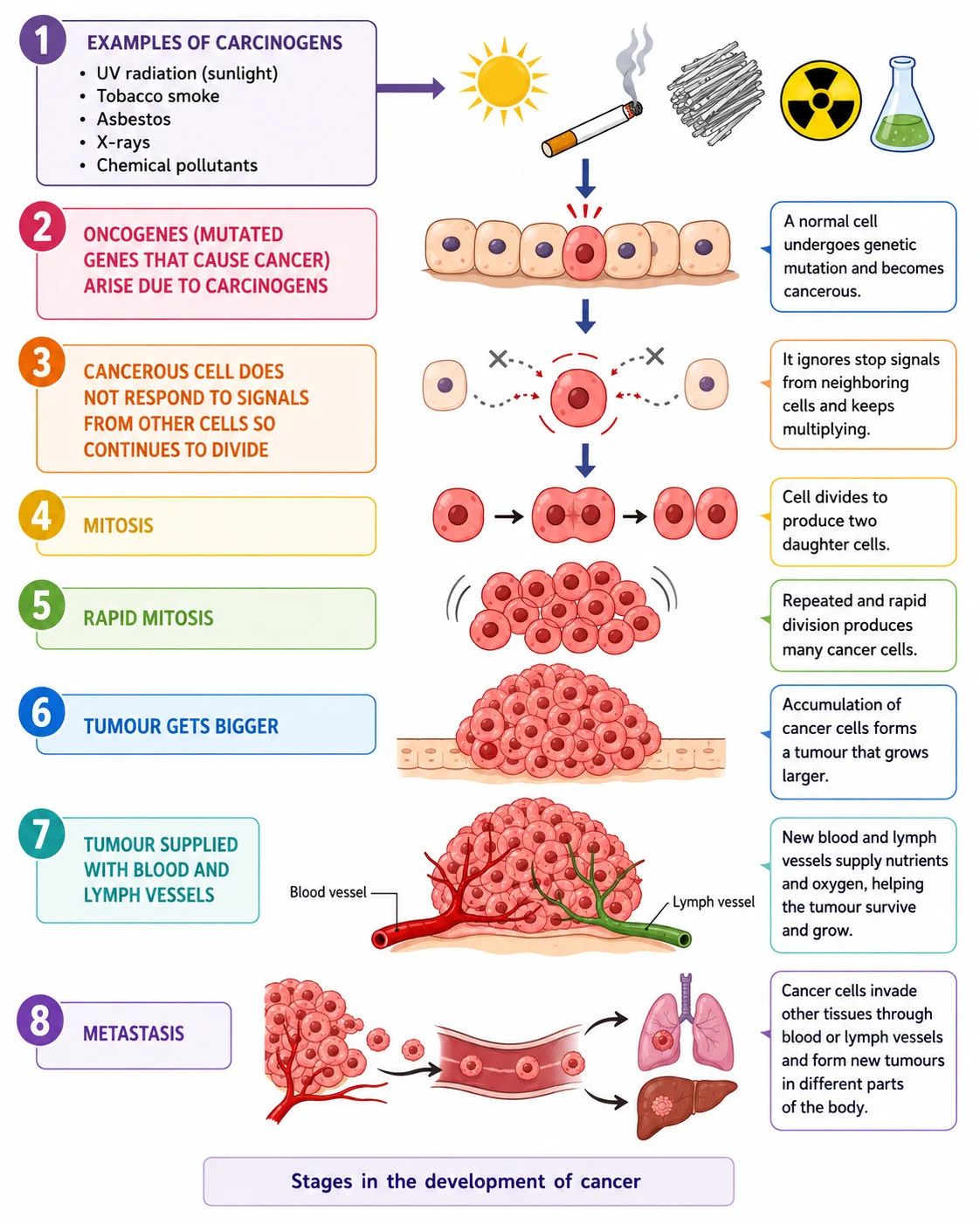
Replication errors
- Replication errors rare mistakes by DNA polymerase that proofreading does not fix
- If the polymerase detects a wrong nucleotide it removes and replaces it.
Mutagens
Mutagens environmental factors that increase the mutation rate
| Type | Examples | Effect on DNA |
|---|---|---|
| High-energy radiation | UV light | Chemical change to bases |
| Ionising radiation | X-rays, gamma rays, alpha particles | Base damage or strand breaks |
| Chemical mutagens | Benzo[a]pyrene and nitrosamines in tobacco smoke, mustard gas | Altered base structure |
| Internal sources | Some cellular enzymes | DNA broken down or mutagenic products made |
Part 5 of 10Randomness of mutation
Any base in any genome can mutate, which is how new strains of viruses and bacteria appear
- Mutations are not produced in response to need.
Likely sites
- Uncoiled DNA is more exposed than DNA wound on histones.
- Many fall in non-coding regions such as satellite DNA.
- At CpG sites methylated cytosine can change to thymine, and repeated changes at CpG islands are linked to cancers such as colorectal cancer.
No deliberate change
- No deliberate change proofreading can reverse errors, but no natural mechanism aims a mutation at a trait
Part 6 of 10Somatic and germ-line mutations
| Feature | Somatic | Germ-line |
|---|---|---|
| Cells affected | Body cells | Gamete-forming cells |
| Inherited? | No | Yes |
| Main risk | Cancer in that individual | Genetic disease in offspring |
| Role in evolution | None | Source of new alleles |
Germ line
- Germ line eggs, sperm and the zygote, so a mutation there appears in every cell of the offspring
Cancer
- Cancer uncontrolled mitosis forming a tumour
- It starts with mutations in genes that control cell division, and a mutated gene that causes cancer is an oncogene.
- Most mutant cells die early or are destroyed by the immune system.
- Cancer cells escape both and keep dividing.
Part 7 of 10Mutation and genetic variation
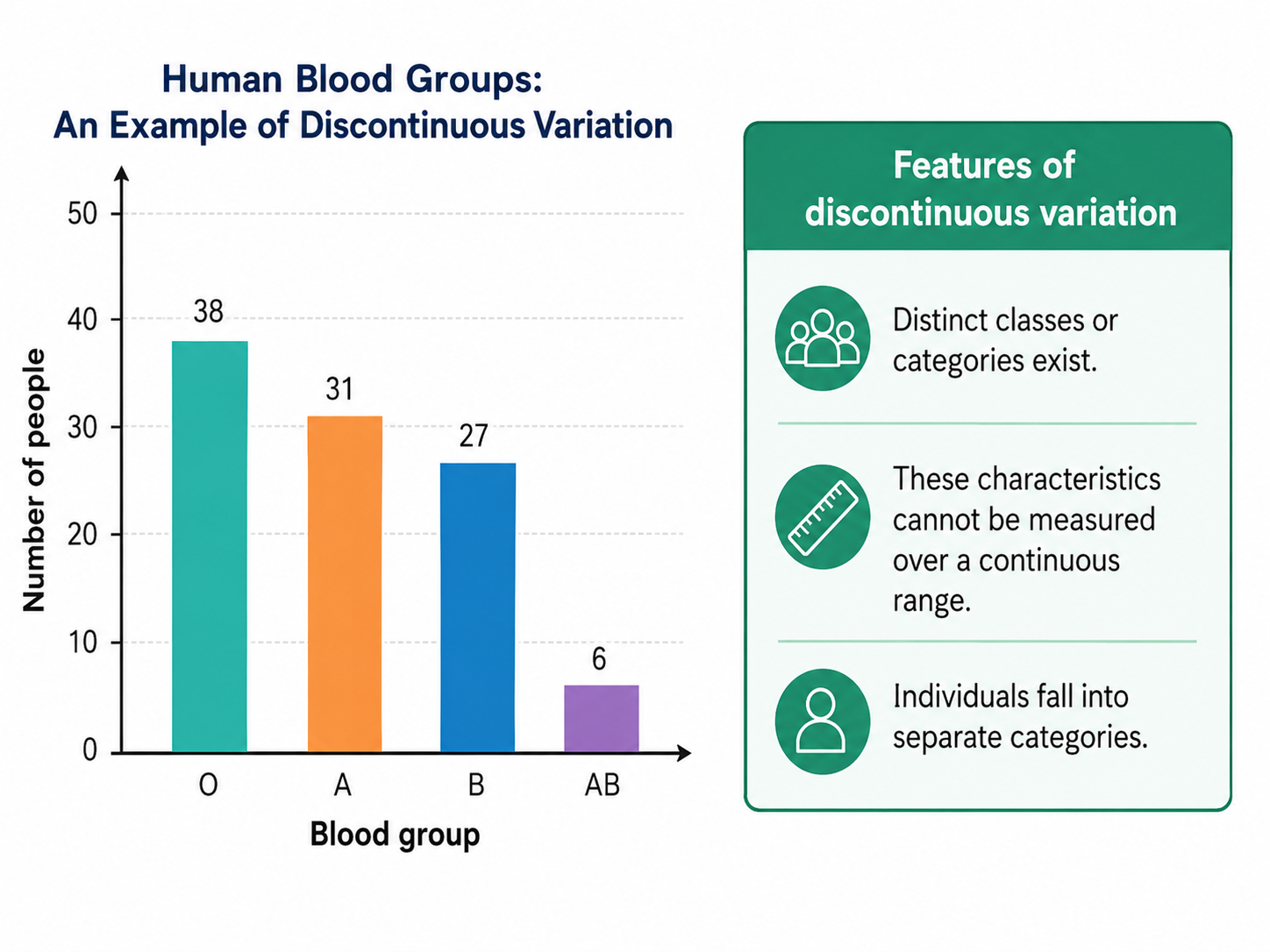
Variation
- Variation differences between individuals of a species, such as coat colour, body length and flower colour
Sources of variation
- Sources of variation mutation, meiosis and random fertilisation
- Mutation is the only process that creates new alleles.
- Meiosis reshuffles them by crossing over and random orientation.
- Any gamete may fuse with any other.
Asexual species
- Asexual species they rely on mutation alone for variation
Selection
- Selection advantageous alleles are more likely to be passed on and harmful ones tend to die out
- A somatic mutation has no effect on natural selection.
Part 8 of 10Gene knockout and CRISPR-Cas9
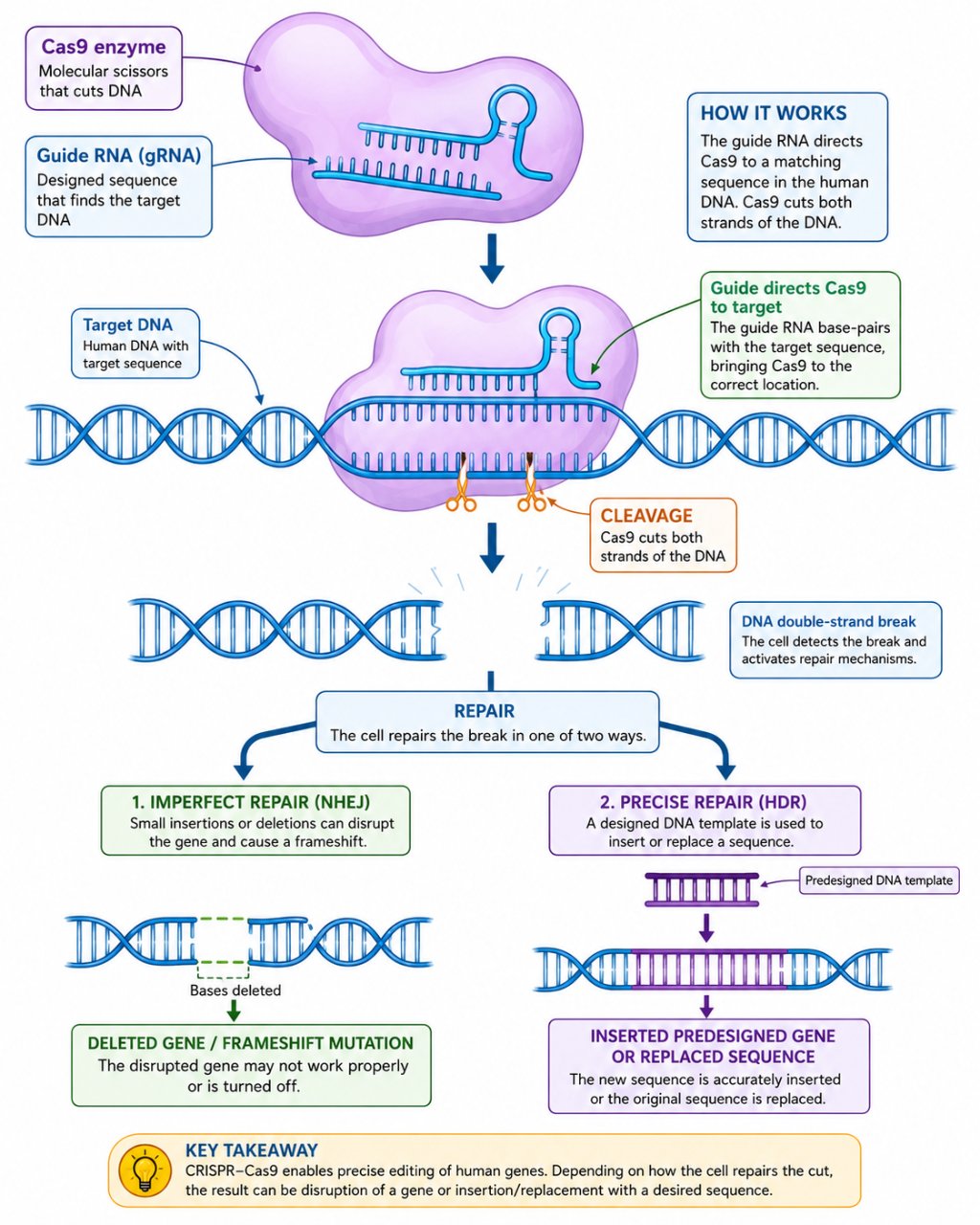
Gene knockout
- Gene knockout a target gene is disabled, and comparing the knockout organism with a normal one shows the gene's role
- Collections of lines each lacking one gene exist, for example knockout mice.
CRISPR-Cas9
- CRISPR-Cas9 originated as a bacterial defence against viruses
1
Scientists design a guide RNA that matches the target DNA sequence.
2
The guide RNA and the Cas9 enzyme form a complex that enters the cell.
3
The guide RNA base-pairs with the complementary target DNA.
4
Cas9 cuts both DNA strands at that site.
5
The cell repairs the break, often disabling the gene or inserting supplied DNA.
Uses
- Uses research, crop improvement and possible correction of genetic disease
Concerns
- Concerns off-target cuts and the ethics of editing human germ-line cells
Part 9 of 10Genetic testing
| Feature | Clinical testing | Commercial testing |
|---|---|---|
| Who orders it | Doctor or genetic counsellor | The customer directly |
| Validation | Scientifically validated laboratory | May be unvalidated and inaccurate |
| Results explained? | Yes, with counselling | Often not |
| Risks | Low | Stress, misunderstanding and poor health decisions |
- Concerns
- unexpected information about health, family or ancestry may be upsetting, and decisions may be made without expert advice
Part 10 of 10From base change to phenotype
1
A mutagen alters a base in DNA.
2
The change is copied during replication.
3
Transcription produces mRNA with an altered codon.
4
Translation inserts a different amino acid.
5
The protein folds differently.
6
The protein function changes, altering the phenotype.
Key terms
| Term | Meaning |
|---|---|
| Gene mutation | A change in the base sequence of DNA that may produce a new allele. |
| Frameshift mutation | An insertion or deletion that changes the reading frame of all later codons. |
| Mutagen | An environmental factor that increases the rate of mutation. |
| Germ-line mutation | A mutation in a cell that forms gametes, which can be inherited. |
| Somatic mutation | A mutation in a body cell that is not inherited. |
| SNP | A single nucleotide polymorphism, a one-base difference between individuals. |
| Gene knockout | Disabling a target gene to learn its function. |
| CRISPR-Cas9 | A system in which a guide RNA directs the Cas9 enzyme to cut a target DNA sequence. |
Avoid these mistakes
1
Saying mutations occur because the organism needs them — they are random
2
Saying a substitution changes every later amino acid — only a frameshift does that
3
Saying all mutations are inherited — only mutations in germ-line cells are
4
Saying proofreading prevents all mutations — a few errors are not detected
Marked practiceQuizzes for this lesson
Last updated:
\n