D3.1Theme D — Continuity and change
Reproduction — IB Biology SL Revision Notes & Topical Questions
10 min read 12 parts Lesson 7 of 14 2 quizzes
Curriculum Equation Key قوانين الرقم الهيدروجيني والاتزان الأيوني - pH & Acid-Base Equilibrium FormulasFast Exam Solution
pH = -log[H⁺] | pOH = -log[OH⁻] | pH + pOH = 14 | [H⁺][OH⁻] = 10⁻¹⁴
Word Equation & Conditions: الرقم الهيدروجيني = -لوغاريتم تركيز أيون الهيدروجين | pH + pOH = 14
Location & Specifications: الاتزان الأيوني، كيمياء 3 ثانوي، التحصيلي، و AP Chemistry.
Lesson summary
D3.1 Reproduction — IB BIOLOGY SL notes: Compare sexual and asexual reproduction, and describe human reproduction, the menstrual cycle, IVF, and reproduction in flowering plants.Sexual reproduction = two parents, with fusion of the nuclei of two haploid gametes to form a diploid …
- Gamete strategies
- Epididymis
- Route of sperm
- Cervix and vagina
- No fertilisation
- FSH and oestradiol
Part 1 of 10Sexual and asexual reproduction
Sexual reproduction
Sexual reproduction two parents, with fusion of the nuclei of two haploid gametes to form a diploid zygote
- Offspring are genetically different from each other and from the parents.
- In humans a body cell has 46 chromosomes and each gamete has 23.
Asexual reproduction
Asexual reproduction one parent, with no gametes, no fertilisation and no mixing of genetic information
- Offspring are genetically identical clones, as in binary fission in bacteria or strawberry runners.
| Feature | Asexual | Sexual |
|---|---|---|
| Parents | One | Usually two |
| Gametes | None | Two haploid gametes fuse |
| Nuclear division | Mitosis | Meiosis to make gametes |
| Offspring | Genetically identical clones | Genetically varied |
| Number and speed | Many offspring, quickly | Fewer offspring, slower and finding a mate costs energy |
| Advantage | Successful traits kept in stable habitats and no mate needed | Variation helps survival when conditions change |
| Disadvantage | The whole population is vulnerable to one disease or change | Only half of each parent's alleles pass to each offspring |
Part 2 of 10Gametes, variation and human reproductive systems
Gametes, variation and human reproductive systems
Meiosis
- Meiosis takes place in the testes and ovaries of animals, and in the anthers and ovaries of flowering plants
- It makes haploid gametes from diploid cells.
Sources of variation
- Crossing over exchanges alleles between non-sister chromatids in meiosis I.
- Independent assortment gives different allele combinations by random alignment of homologous pairs.
- Random fertilisation combines any sperm with any egg.
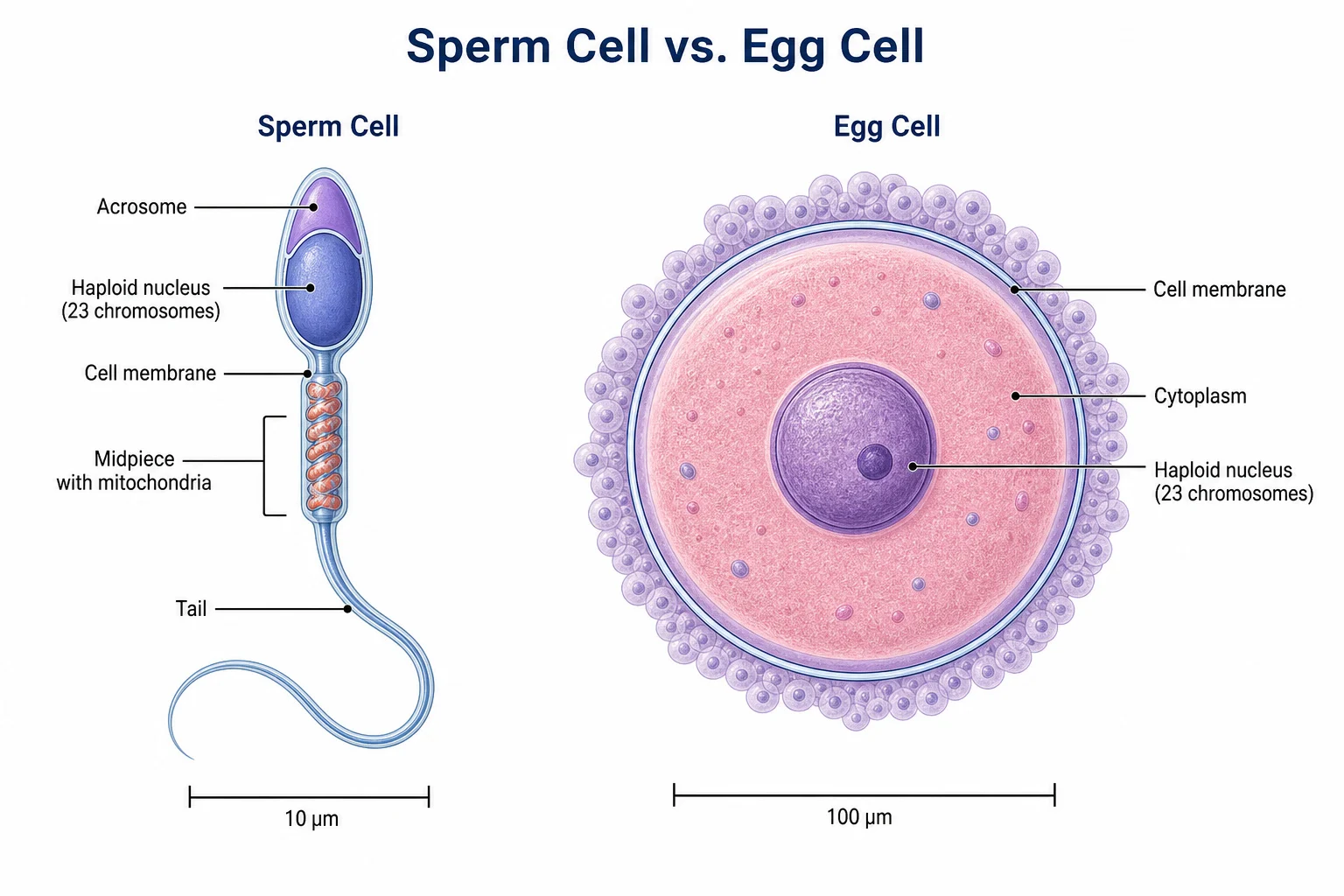
Gamete strategies
- Gamete strategies males release thousands of sperm because most never reach the egg, whereas a female usually releases one egg per cycle
| Feature | Sperm | Egg |
|---|---|---|
| Size | Very small | Large, about 0.1 mm |
| Movement | Swims using a flagellum | Moved by oviduct cilia |
| Numbers | Millions made daily | Usually one per cycle |
| Special features | Many mitochondria for swimming and little cytoplasm | Large food reserves in the cytoplasm |
Gametes, variation and human reproductive systems
Testes
- Testes make sperm and testosterone, and are held in the scrotum at a cooler temperature
Epididymis
- Epididymis stores maturing sperm
Route of sperm
- Route of sperm sperm duct, urethra and penis
Glands
- Glands the seminal vesicles and prostate add fluid, nutrients and alkali
Ovaries
- Ovaries follicles develop eggs and the ovaries secrete oestradiol and progesterone
Oviduct
- Oviduct the site of fertilisation, with cilia that move the egg towards the uterus
Uterus
- Uterus a muscular wall with the endometrium where an embryo implants
Cervix and vagina
- Cervix and vagina the cervix is the ring of muscle at the base of the uterus, and the vagina receives sperm and is the birth canal
Part 3 of 10The menstrual cycle
1Menstrual cycle
Menstrual cycle the series of changes in the female body around the release of an egg, controlled by hormones
- It starts in early adolescence and averages 28 days.
2Days 1-7
- Days 1-7 menstruation, in which the endometrium breaks down and is lost
3Days 7-28
- Days 7-28 the endometrium rebuilds and thickens in preparation for a fertilised egg
4Day 14
- Day 14 ovulation, the release of the egg from a follicle
- The empty follicle becomes the corpus luteum.
5No fertilisation
- No fertilisation the corpus luteum deteriorates, hormone levels fall and menstruation follows
1
FSH from the pituitary stimulates a follicle to develop.
2
The follicle secretes oestradiol, which thickens the endometrium.
3
High oestradiol triggers an LH surge by positive feedback.
4
LH causes ovulation and the follicle becomes the corpus luteum.
5
Progesterone maintains the lining and inhibits FSH and LH.
6
Without pregnancy the corpus luteum breaks down, progesterone falls and menstruation begins.
Part 4 of 10Hormones and feedback
| Feature | FSH | LH | Oestradiol | Progesterone |
|---|---|---|---|---|
| Source | Pituitary | Pituitary | Developing follicle and corpus luteum | Corpus luteum |
| Peak | Early cycle, with a small mid-cycle peak | Around day 14 | Just before ovulation | After ovulation |
| Main effect | Follicle development and oestradiol secretion | Ovulation and corpus luteum formation | Thickens the endometrium and matures the egg | Maintains the endometrium |
FSH and oestradiol
- FSH stimulates oestradiol production, and oestradiol adds FSH receptors to the follicle, which is positive feedback
- High oestradiol then inhibits FSH, which is negative feedback.
LH and oestradiol
- LH and oestradiol a high oestradiol level stimulates LH release from the pituitary, which is positive feedback
LH and progesterone
- LH and progesterone progesterone thickens the endometrium but inhibits FSH and LH, which is negative feedback
Transport
- Transport hormones travel in the blood and act only on target organs with receptors
Part 5 of 10In vitro fertilisation
- IVF = fertilising eggs with sperm outside the body in controlled laboratory conditions
- It is used when natural conception is difficult because of low hormone levels or reproductive system problems.
1
A drug stops the natural secretion of FSH and LH, and so of oestrogen and progesterone.
2
Large doses of FSH and LH are injected to cause superovulation, with many follicles maturing.
3
The eggs are collected and fertilised with sperm in sterile conditions.
4
The fertilised eggs develop into embryos.
5
About 48 hours after fertilisation, one or more embryos are inserted into the uterus.
6
Extra progesterone is given to maintain the endometrium.
- Success rate
- roughly 30%
Part 6 of 10Fertilisation
- Fertilisation the fusion of a sperm and an egg nucleus to give a diploid zygote
1
Chemical signals attract the sperm towards the egg.
2
The first sperm membrane fuses with the egg membrane.
3
The sperm nucleus enters the egg.
4
Egg vesicles destroy the sperm tail and its mitochondria.
5
The two haploid sets get temporary membranes as pronuclei, and DNA replicates.
6
The pronuclei come together and the membranes break down.
7
The first mitotic division follows, and later divisions form a blastocyst.
Part 7 of 10Flowering plants: structure and gametes
- Flower parts
| Structure | Function |
|---|---|
| Sepal | Protects the developing flower in the bud |
| Petal | Colourful to attract pollinators |
| Anther | Part of the stamen that makes male gametes (pollen) |
| Filament | The stalk of the stamen that holds up the anther |
| Stigma | The top of the carpel where pollen lands |
| Style | Supports the stigma |
| Ovary and ovule | The ovule is the chamber where the female gamete develops and it becomes a seed |
1Male gametes
- Male gametes a diploid mother cell in a pollen sac undergoes meiosis to form four haploid pollen grains
2Female gametes
- Female gametes a diploid cell in the ovule undergoes meiosis and one of the four products survives to give the egg
3Hermaphrodite flowers
- Hermaphrodite flowers contain both male and female parts, so self-pollination is possible
Part 8 of 10Pollination and fertilisation in plants
Pollination
Pollination the transfer of pollen from the anther of one flower to the stigma of another
- Self-pollination moves pollen between flowers of the same plant or within one flower.
- Cross-pollination moves pollen from one plant to another, and it increases genetic variation.
Pollen tube
- Pollen tube grows down the style to the ovary after pollination
- Two male nuclei travel down it.
- One fuses with the egg nucleus to form the zygote.
- The other helps form the food store of the seed.
After fertilisation
- After fertilisation the ovule becomes a seed and the ovary becomes the fruit
| Feature | Insect-pollinated | Wind-pollinated |
|---|---|---|
| Petals | Large, bright and scented | Small, dull or absent |
| Nectar | Present | Absent |
| Pollen | Sticky and fewer grains | Light, smooth and in huge numbers |
| Anthers and stigma | Inside the flower | Hang outside, with a feathery stigma |
| Reliability | Targeted by pollinator visits | Chance landing on a stigma |
Insect pollination
- Insect pollination an insect brushes the anthers while collecting nectar and then deposits pollen on the stigma of another flower
Pollinator decline
- Pollinator decline the loss of bees threatens crops that rely on cross-pollination
Part 9 of 10Avoiding self-pollination
Avoiding self-pollination
Disadvantage of self-pollination
- Disadvantage of self-pollination less genetic variation, which is a problem if conditions change
Methods
- Pollen and stigma of one flower mature at different times.
- Male-only and female-only flowers or plants.
- Self-incompatibility, where protein interactions stop pollen from the same plant growing a pollen tube.
Self-incompatibility stages
- A pollen grain fails to germinate.
- A pollen tube grows but does not enter the style.
- The pollen nucleus enters the ovule but degenerates.
- Fertilisation occurs but the embryo degenerates.
Part 10 of 10Seed dispersal and germination
1Seed dispersal
- Seed dispersal spreads seeds away from the parent to reduce competition
- Wind or waterlight, winged or parachute seeds.
- Animalsfleshy fruits are eaten and the seeds egested, and hooked seeds catch on fur.
- Explosive pods fling seeds away.
2Dispersal compared with pollination
- Dispersal compared with pollination pollination moves pollen and dispersal moves mature seeds
3Dormancy
- Dormancy a seed stays inactive until conditions suit growth
4Germination
Germination the start of growth in the seed, needing water, oxygen and warmth
- Water makes the seed swell and burst the testa, and activates enzymes by imbibition.
- Oxygen is needed for respiration.
- Warmth speeds enzyme reactions up to a point.
1
Water uptake activates the enzymes and raises respiration and protein synthesis.
2
Food reserves pass from the endosperm to the embryo through the cotyledons.
3
The radicle emerges first and grows down into the soil.
4
The hypocotyl arches upwards.
5
The first leaves open and photosynthesis begins.
Key terms
| Term | Meaning |
|---|---|
| Gamete | A haploid sex cell that fuses with another in fertilisation. |
| Ovulation | The release of an egg from a follicle in the ovary. |
| Corpus luteum | The structure formed from an empty follicle that secretes progesterone and oestradiol. |
| IVF | In vitro fertilisation, in which eggs are fertilised outside the body. |
| Pollination | The transfer of pollen from the anther to the stigma. |
| Self-incompatibility | A mechanism that stops pollen from the same plant fertilising an ovule. |
| Germination | The start of growth of a seed into a seedling. |
| Endometrium | The lining of the uterus where an embryo implants. |
Avoid these mistakes
1
Saying fertilisation happens in the uterus — it normally happens in the oviduct
2
Saying all pollination is by insects — it can also be by wind, other animals or water
3
Mixing up pollination and seed dispersal — pollination moves pollen and dispersal moves seeds
4
Saying the zygote is haploid — it is diploid after the gamete nuclei fuse
Marked practiceQuizzes for this lesson
Last updated:
\n