2.2Thermal Physics
Solutions and solubility — Question Bank (Cambridge) — Cambridge IGCSE Physics 0625 Revision Notes & Topical Questions
5 min read Lesson 15 of 45 Unit quiz
Cambridge Past Paper Bank
2.2 Solutions and solubility
6 Multiple-Choice Questions with Official Mark Schemes
Question 1
0620/23_Summer_2011_Q5
Question 2
0620/12_Summer_2019_Q3
Question 3
5129/11_Summer_2025_Q14
Question 4
5129/12_Summer_2021_Q15
Question 5
0620/23_Summer_2015_Q2
Question 6
0620/12_Summer_2017_Q4
Cambridge Lower Secondary Stage 8
2.2 Solutions and solubility – Complete Question Bank & Mark Scheme
Total Questions6 Questions with Verified Solutions & Past Paper Mark Schemes
Multiple Choice Questions (Exam Practice)
Question 1
Paper Ref: 0620/23_Summer_2011_Q5
Paper Ref: 0620/23_Summer_2011_Q5
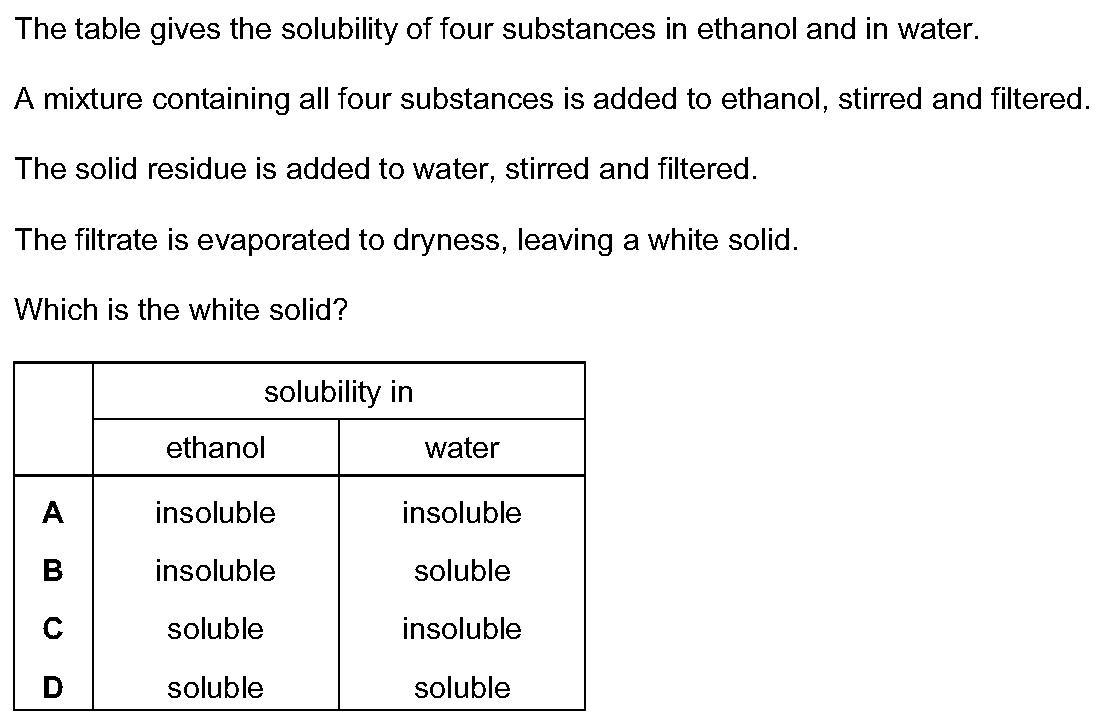
The table gives the solubility of four substances in ethanol and in water.
A mixture containing all four substances is added to ethanol, stirred and filtered.
The solid residue is added to water, stirred and filtered.
The filtrate is evaporated to dryness, leaving a white solid.
Which is the white solid?
solubility in
ethanol water
A insoluble insoluble
B insoluble soluble
Cc soluble insoluble
D soluble soluble
Options:
A
B
C
D
Correct Key: B
A
B
C
D
Correct Key: B
Question 2
Paper Ref: 0620/12_Summer_2019_Q3
Paper Ref: 0620/12_Summer_2019_Q3
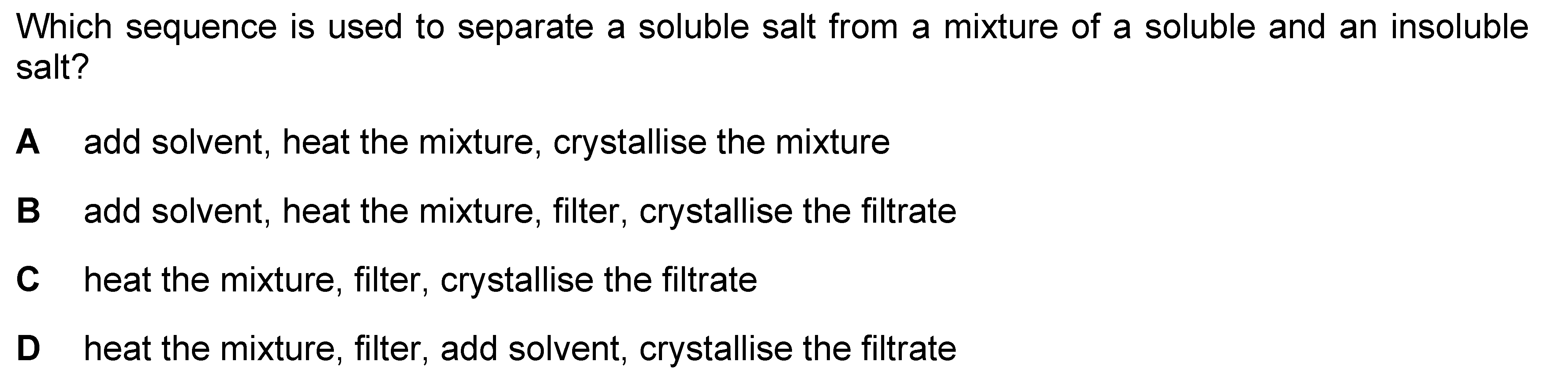
Which sequence is used to separate a soluble salt from a mixture of a soluble and an insoluble
salt?
A add solvent, heat the mixture, crystallise the mixture
B add solvent, heat the mixture, filter, crystallise the filtrate
C heat the mixture, filter, crystallise the filtrate
D
heat the mixture, filter, add solvent, crystallise the filtrate
salt?
A add solvent, heat the mixture, crystallise the mixture
B add solvent, heat the mixture, filter, crystallise the filtrate
C heat the mixture, filter, crystallise the filtrate
D
heat the mixture, filter, add solvent, crystallise the filtrate
Options:
A
B
C
D
Correct Key: B
A
B
C
D
Correct Key: B
Question 3
Paper Ref: 5129/11_Summer_2025_Q14
Paper Ref: 5129/11_Summer_2025_Q14
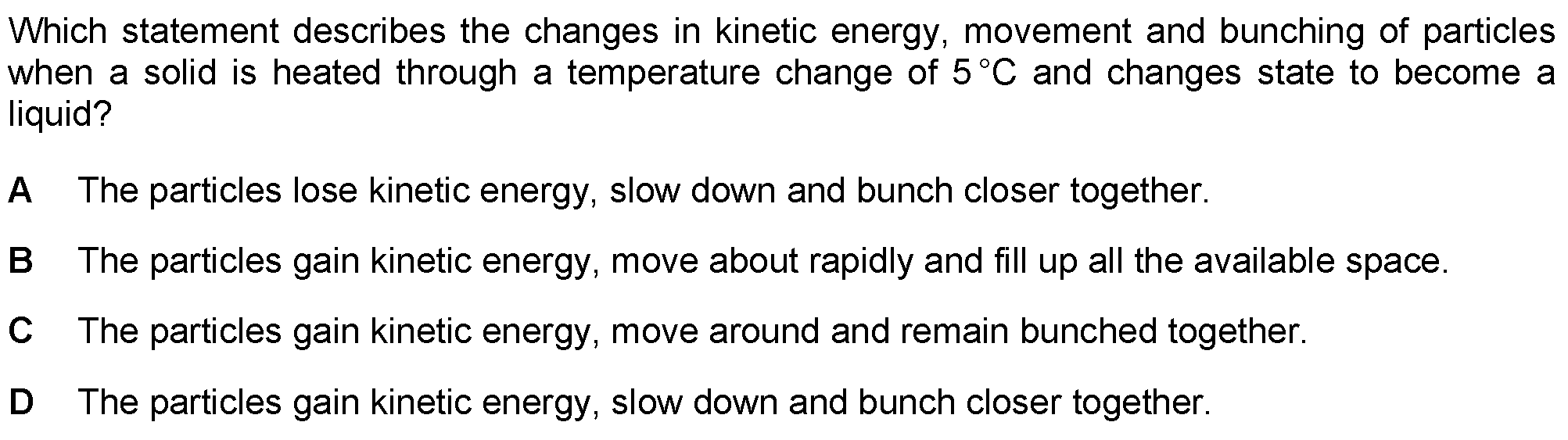
Which statement describes the changes in kinetic energy, movement and bunching of particles
when a solid is heated through a temperature change of 5°C and changes state to become a
liquid?
A
B
Cc
D
The particles lose kinetic energy, slow down and bunch closer together.
The particles gain kinetic energy, move about rapidly and fill up all the available space.
The particles gain kinetic energy, move around and remain bunched together.
The particles gain kinetic energy, slow down and bunch closer together.
Options:
A
B
C
D
Correct Key: C
A
B
C
D
Correct Key: C
Question 4
Paper Ref: 5129/12_Summer_2021_Q15
Paper Ref: 5129/12_Summer_2021_Q15
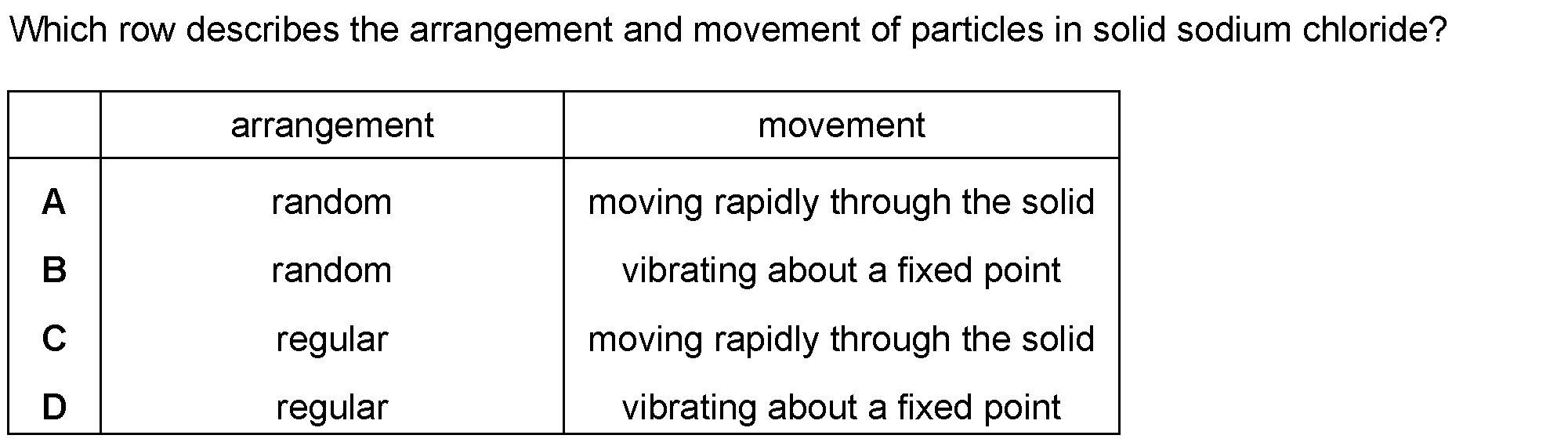
Which row describes the arrangement and movement of particles in solid sodium chloride?
— arrangement movement
random moving rapidly through the solid
random vibrating about a fixed point
regular moving rapidly through the solid
regular vibrating about a fixed point
— arrangement movement
random moving rapidly through the solid
random vibrating about a fixed point
regular moving rapidly through the solid
regular vibrating about a fixed point
Options:
A
B
C
D
Correct Key: D
A
B
C
D
Correct Key: D
Question 5
Paper Ref: 0620/23_Summer_2015_Q2
Paper Ref: 0620/23_Summer_2015_Q2
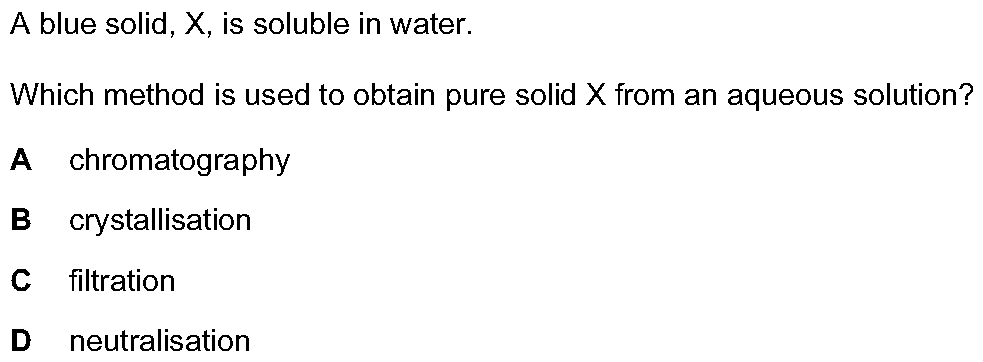
A blue solid, X, is soluble in water.
Which method is used to obtain pure solid X from an aqueous solution?
A chromatography
B crystallisation
C filtration
D
neutralisation
Which method is used to obtain pure solid X from an aqueous solution?
A chromatography
B crystallisation
C filtration
D
neutralisation
Options:
A
B
C
D
Correct Key: B
A
B
C
D
Correct Key: B
Question 6
Paper Ref: 0620/12_Summer_2017_Q4
Paper Ref: 0620/12_Summer_2017_Q4
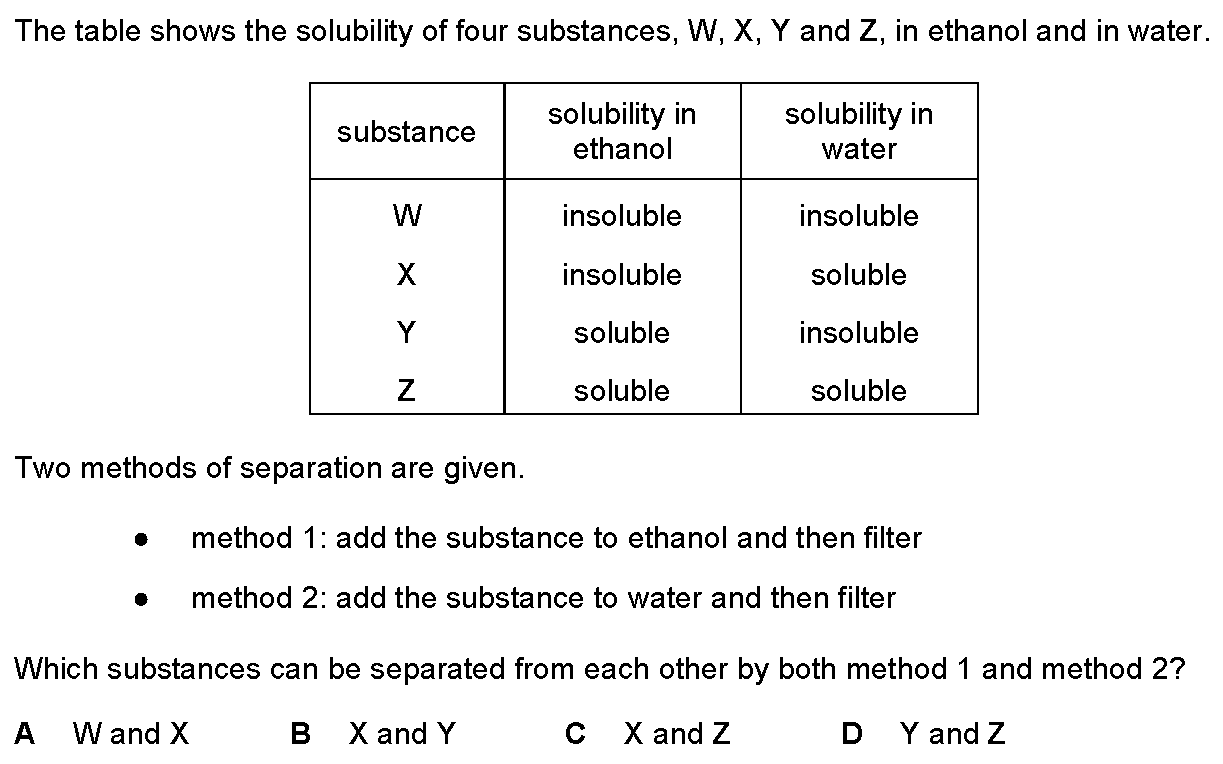
The table shows the solubility of four substances, W, X, Y and Z, in ethanol and in water.
substance solubility in solubility in
ethanol water
Ww insoluble insoluble
xX insoluble soluble
Y soluble insoluble
r4 soluble soluble
Two methods of separation are given.
e method 1: add the substance to ethanol and then filter
e method 2: add the substance to water and then filter
Which substances can be separated from each other by both method 1 and method 2?
A WandX B XandY C XandZ D YandZ
Options:
A
B
C
D
Correct Key: B
A
B
C
D
Correct Key: B
Structured Questions Mark Scheme & Answers
•1•.• • • •[•S•P• •S•8• •P•2• • •·• • •Q•5• • •P•a•r•t• •(•a•)• • •·• • •S•p•e•c•i•m•e•n• • •·• • •L•o•w•e•r• •S•e•c• •0•8•9•3•]• • • • • • •(•m•a•s•s•)• •i•n•c•r•e•a•s•e•s• •1•
•2•.• • • •[•S•P• •S•8• •P•2• • •·• • •Q•5• • •P•a•r•t• •(•b•)• • •·• • •S•p•e•c•i•m•e•n• • •·• • •L•o•w•e•r• •S•e•c• •0•8•9•3•]• • • • • • •1•0•5• •±• •1• •(•g•)• •1• •••c•c•e•p•t• •a• •r•a•n•g•e• •o•f• •a•n•s•w•e•r•s• •p•r•o•v•i•d•e•d• •t•h•e•y• •a•r•e• •i•n• •t•h•e• •g•i•v•e•n• •r•a•n•g•e• •e•.•g•.• •1•0•4• •–• •1•0•6•
•3•.• • • •[•S•P• •S•8• •P•2• • •·• • •Q•5• • •P•a•r•t• •(•c•)• • •·• • •S•p•e•c•i•m•e•n• • •·• • •L•o•w•e•r• •S•e•c• •0•8•9•3•]• • • • • • •6•9• •±• •1• •(•°•C•)• •1• •••c•c•e•p•t• •a• •r•a•n•g•e• •o•f• •a•n•s•w•e•r•s• •p•r•o•v•i•d•e•d• •t•h•e•y• •a•r•e• •i•n• •t•h•e• •g•i•v•e•n• •r•a•n•g•e• •e•.•g•.• •6•8• •–• •7•0• •6•a• •2• •a•t• •l•e•a•s•t• •t•w•o• •l•i•n•e•s• •g•o•i•n•g• •f•r•o•m• •N• •t•o• •S• •t•h•a•t• •d•o• •n•o•t• •c•r•o•s•s• •o•r• •t•o•u•c•h• •=• •1• •m•a•r•k• •a•t• •l•e•a•s•t• •o•n•e• •c•o•r•r•e•c•t• •a•r•r•o•w• •n•o•t• •c•o•n•t•r•a•d•i•c•t•e•d• •=• •1• •m•a•r•k• •6•b• •a•t• •l•e•a•s•t• •t•w•o• •l•i•n•e•s• •i•n• •t•h•e• •c•o•r•r•e•c•t• •p•a•t•t•e•r•n• •e•.•g•.• •1• •I•g•n•o•r•e• •d•i•r•e•c•t•i•o•n• •o•f• •a•r•r•o•w•s• •i•f• •d•i•r•e•c•t•i•o•n• •i•s• •i•n•c•o•r•r•e•c•t• •i•n• •(•a•)• •©• •U•C•L•E•S• •2•0•2•0• •P•a•g•e• •6• •o•f• •1•0• •S•8•/•0•2• •S•c•i•e•n•c•e• •S•t•a•g•e• •8• •P•a•p•e•r• •2• •M•a•r•k• •S•c•h•e•m•e• •F•r•o•m• •2•0•2•0•
•4•.• • • •[•P•R•I• •2•0•0•7••• •P•1• • •·• • •Q•7• • •P•a•r•t• •(•a•)• • •·• • •2•0•0•7• • •·• • •P•r•i•m•a•r•y• •0•8•4•6•]• • • • • • •(•n•o• •p•u•b•l•i•s•h•e•d• •m•a•r•k• •s•c•h•e•m•e• •f•o•r• •t•h•i•s• •p•a•p•e•r•)•
•5•.• • • •[•P•R•I• •2•0•0•7••• •P•1• • •·• • •Q•7• • •P•a•r•t• •(•b•)• • •·• • •2•0•0•7• • •·• • •P•r•i•m•a•r•y• •0•8•4•6•]• • • • • • •(•n•o• •p•u•b•l•i•s•h•e•d• •m•a•r•k• •s•c•h•e•m•e• •f•o•r• •t•h•i•s• •p•a•p•e•r•)•
•6•.• • • •[•P•R•I• •2•0•0•7••• •P•1• • •·• • •Q•7• • •P•a•r•t• •(•c•)• • •·• • •2•0•0•7• • •·• • •P•r•i•m•a•r•y• •0•8•4•6•]• • • • • • •(•n•o• •p•u•b•l•i•s•h•e•d• •m•a•r•k• •s•c•h•e•m•e• •f•o•r• •t•h•i•s• •p•a•p•e•r•)•
•7•.• • • •[•P•R•I• •2•0•0•9••• •P•1• • •·• • •Q•9• • •P•a•r•t• •(•c•)• • •·• • •2•0•0•9• • •·• • •P•r•i•m•a•r•y• •0•8•4•6•]• • • • • • •(•n•o• •p•u•b•l•i•s•h•e•d• •m•a•r•k• •s•c•h•e•m•e• •f•o•r• •t•h•i•s• •p•a•p•e•r•)•
•8•.• • • •[•P•R•I• •2•0•0•9•B• •P•1• • •·• • •Q•1•2• • •P•a•r•t• •(•a•)• • •·• • •2•0•0•9• • •·• • •P•r•i•m•a•r•y• •0•8•4•6•]• • • • • • •(•n•o• •p•u•b•l•i•s•h•e•d• •m•a•r•k• •s•c•h•e•m•e• •f•o•r• •t•h•i•s• •p•a•p•e•r•)•
Last updated:
\n