2.2Thermal Physics
Trends in Groups — Question Bank (Cambridge) — Cambridge IGCSE Physics 0625 Revision Notes & Topical Questions
10 min read Lesson 14 of 45 Unit quiz
Cambridge Past Paper Bank
2.2 Trends in Groups
19 Multiple-Choice Questions with Official Mark Schemes
Question 1
0620/23_Summer_2024_Q23
Question 2
0620/13_Winter_2024_Q23
Question 3
0620/12_Spring_2024_Q22
Question 4
5129/11_Summer_2023_Q23
Question 5
0620/21_Summer_2023_Q21
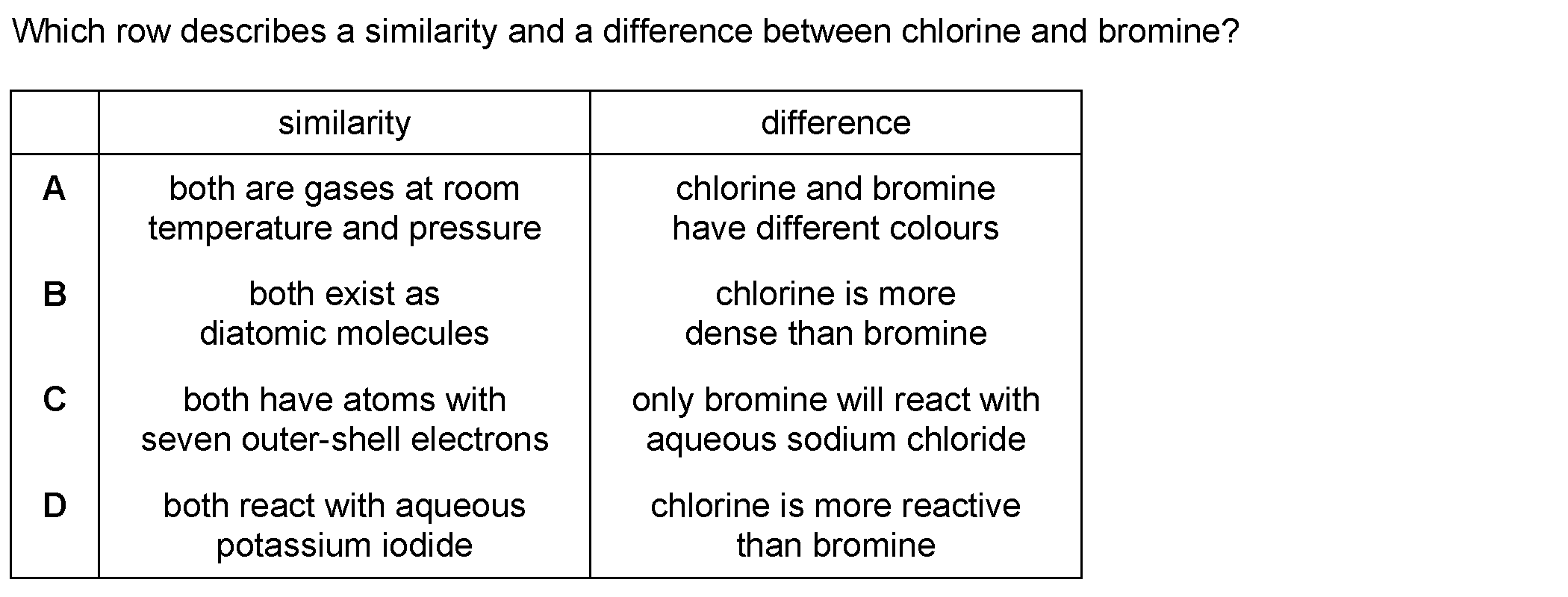
Question 6
0620/11_Summer_2023_Q20
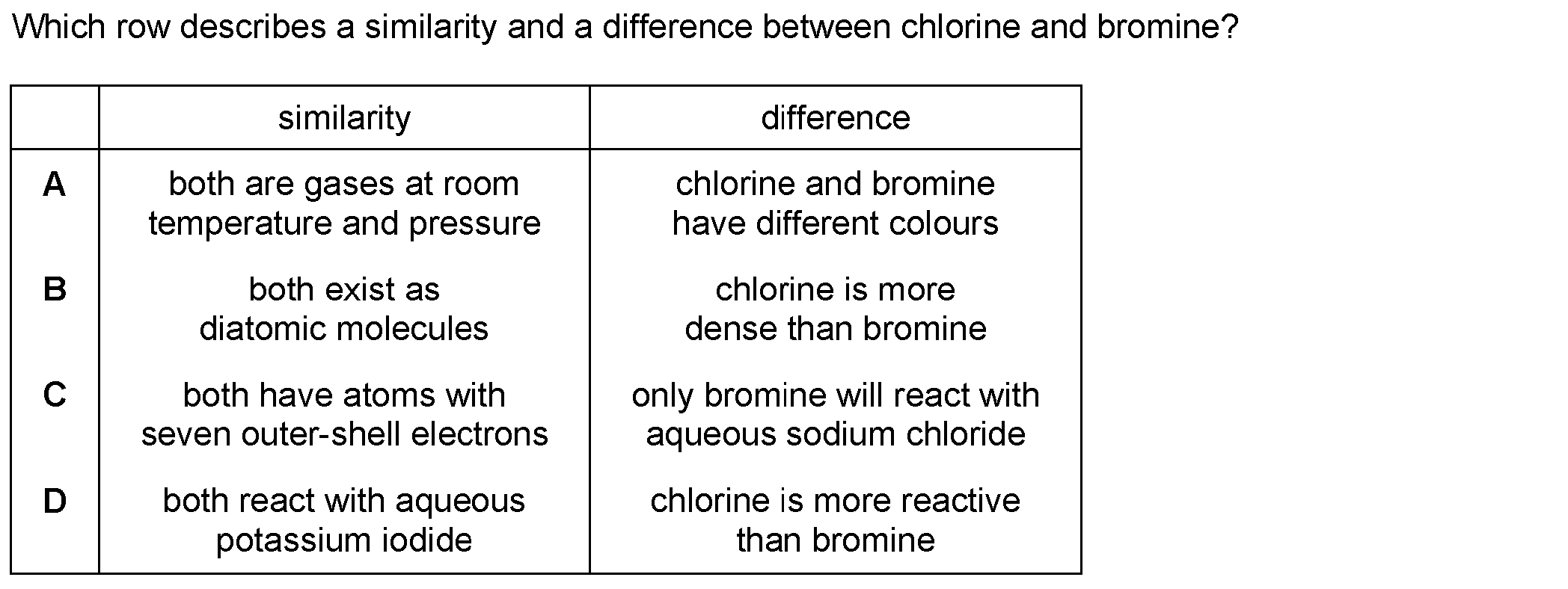
Question 7
0620/23_Summer_2022_Q25
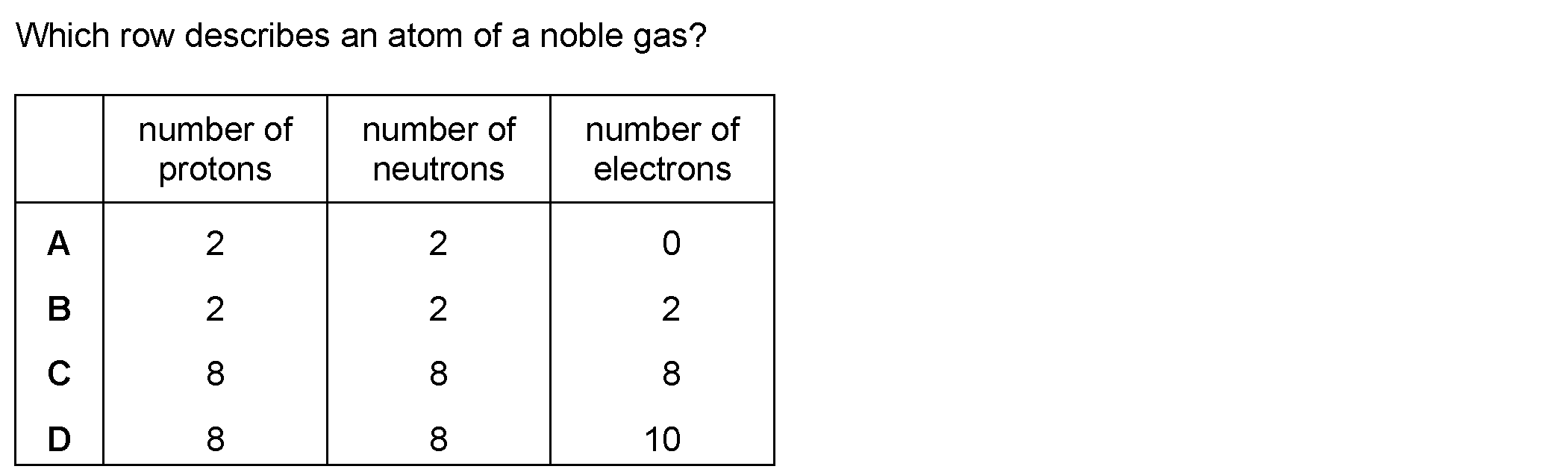
Question 8
0620/22_Summer_2026_Q24
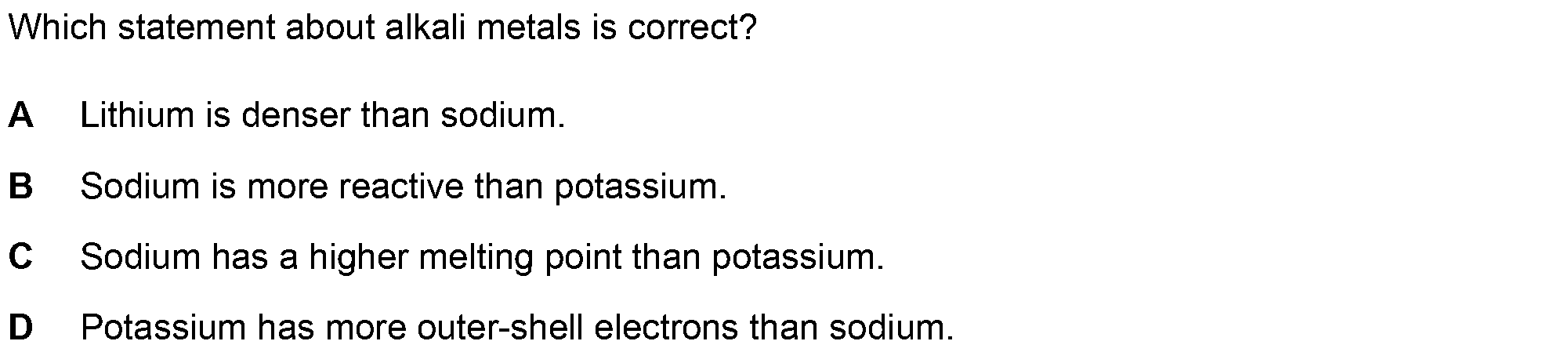
Question 9
0620/23_Winter_2020_Q25
Question 10
0620/22_Spring_2024_Q25
Question 11
0620/13_Summer_2024_Q24
Question 12
0620/23_Summer_2026_Q25
Question 13
0620/21_Summer_2025_Q24
Question 14
0620/22_Winter_2023_Q22
Question 15
0620/22_Summer_2025_Q21
Question 16
0620/22_Summer_2018_Q22
Question 17
0620/11_Summer_2017_Q22
Question 18
0620/13_Summer_2026_Q26
Question 19
5129/12_Summer_2026_Q24
Cambridge Lower Secondary Stage 9
2.2 Trends in Groups – Complete Question Bank & Mark Scheme
Total Questions19 Questions with Verified Solutions & Past Paper Mark Schemes
Multiple Choice Questions (Exam Practice)
Question 1
Paper Ref: 0620/23_Summer_2024_Q23
Paper Ref: 0620/23_Summer_2024_Q23
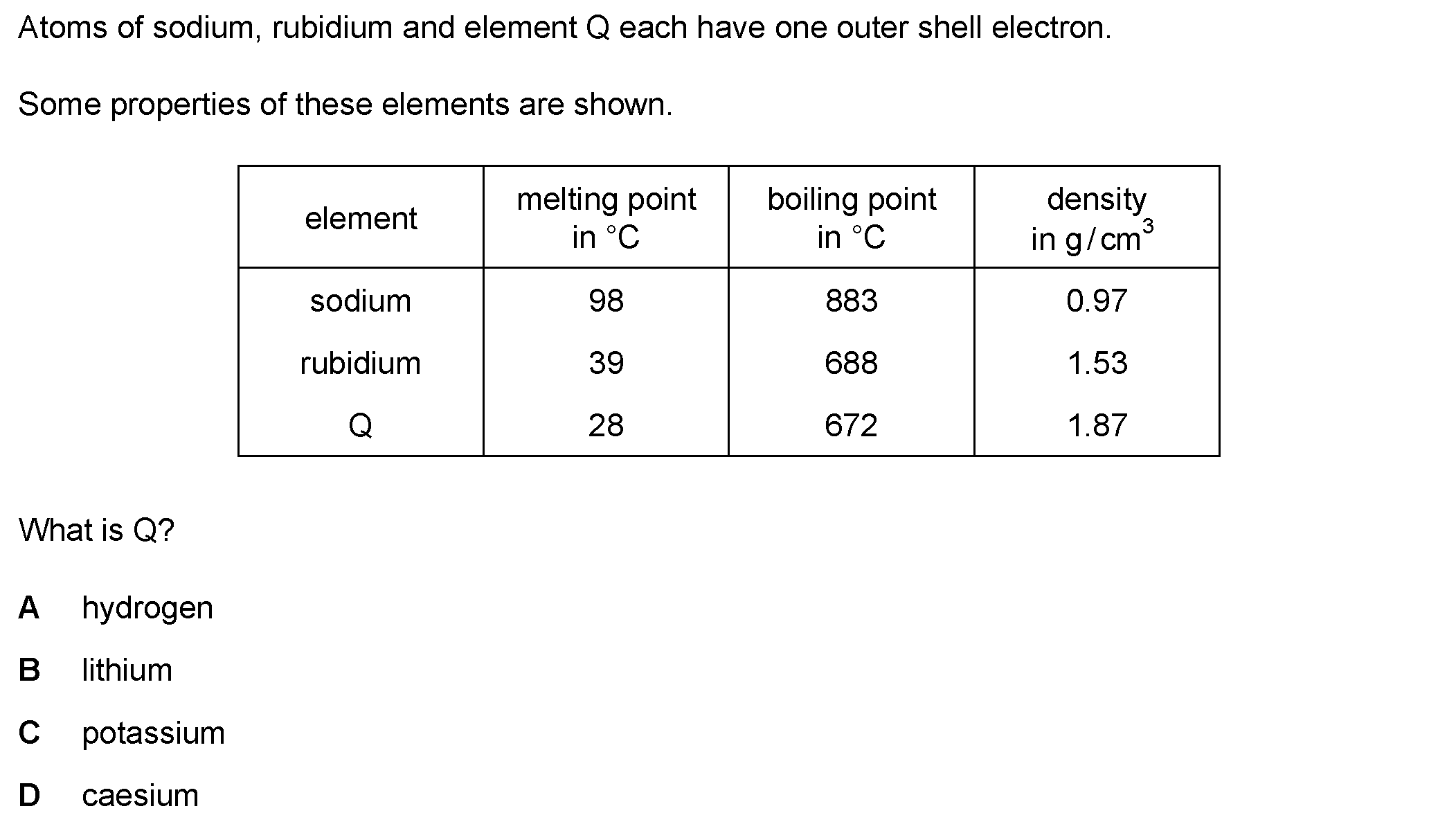
Atoms of sodium, rubidium and element Q each have one outer shell electron.
Some properties of these elements are shown.
element melting point boiling point. density
in°C in °C ing/cm
sodium 98 883 0.97
rubidium 39 688 1.53
Q 28 672 1.87
What is Q?
A hydrogen
B lithium
C potassium
D caesium
Some properties of these elements are shown.
element melting point boiling point. density
in°C in °C ing/cm
sodium 98 883 0.97
rubidium 39 688 1.53
Q 28 672 1.87
What is Q?
A hydrogen
B lithium
C potassium
D caesium
Options:
A
B
C
D
Correct Key: D
A
B
C
D
Correct Key: D
Question 2
Paper Ref: 0620/13_Winter_2024_Q23
Paper Ref: 0620/13_Winter_2024_Q23
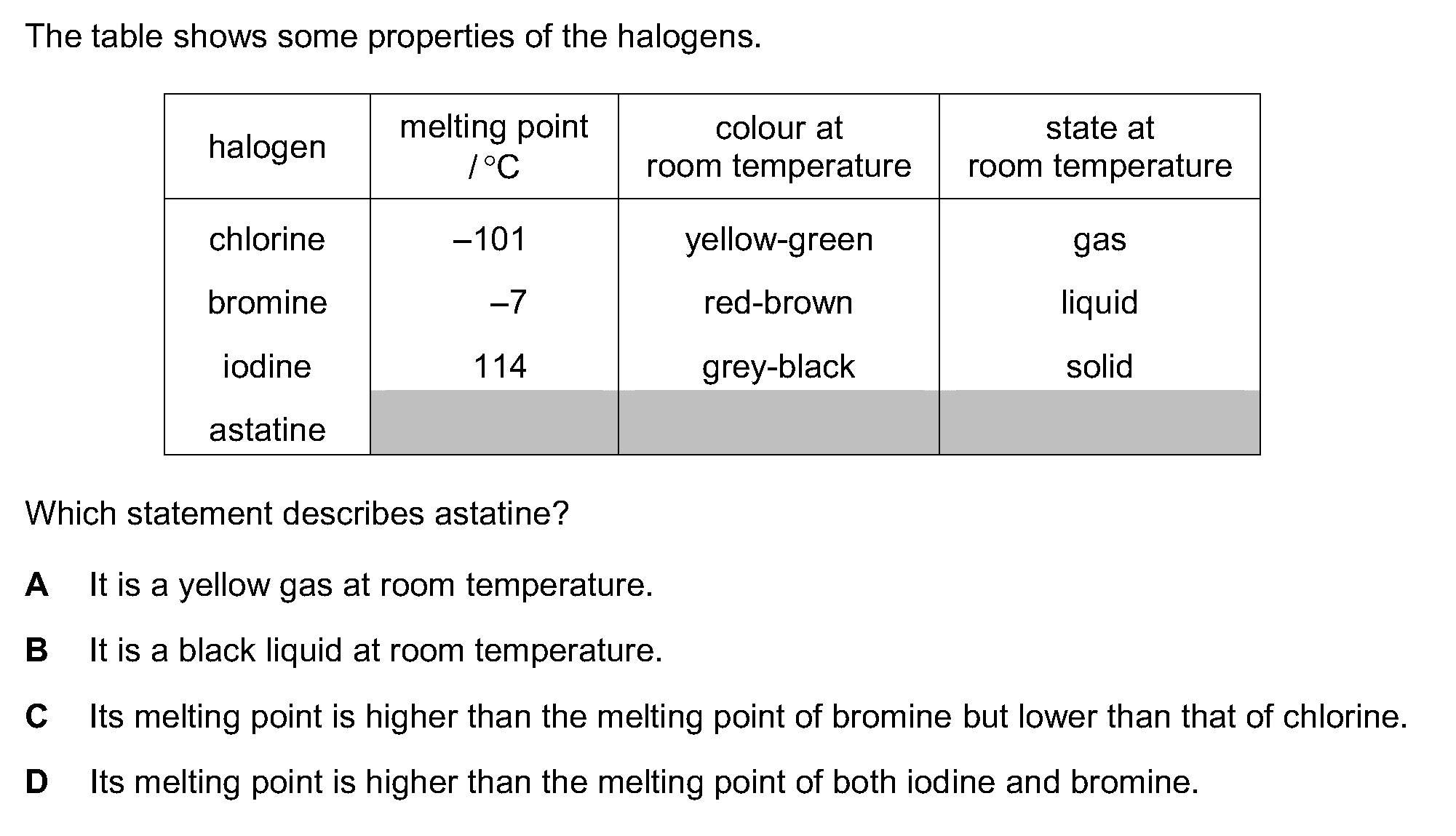
The table shows some properties of the halogens.
melting point colour at state at
halogen
1°C room temperature | room temperature
chlorine -101 yellow-green gas
bromine —7 red-brown liquid
iodine 114 grey-black solid
astatine
Which statement describes astatine?
AlItis a yellow gas at room temperature.
B_Itis a black liquid at room temperature.
C Its melting point is higher than the melting point of bromine but lower than that of chlorine.
D
lts melting point is higher than the melting point of both iodine and bromine.
Options:
A
B
C
D
Correct Key: D
A
B
C
D
Correct Key: D
Question 3
Paper Ref: 0620/12_Spring_2024_Q22
Paper Ref: 0620/12_Spring_2024_Q22
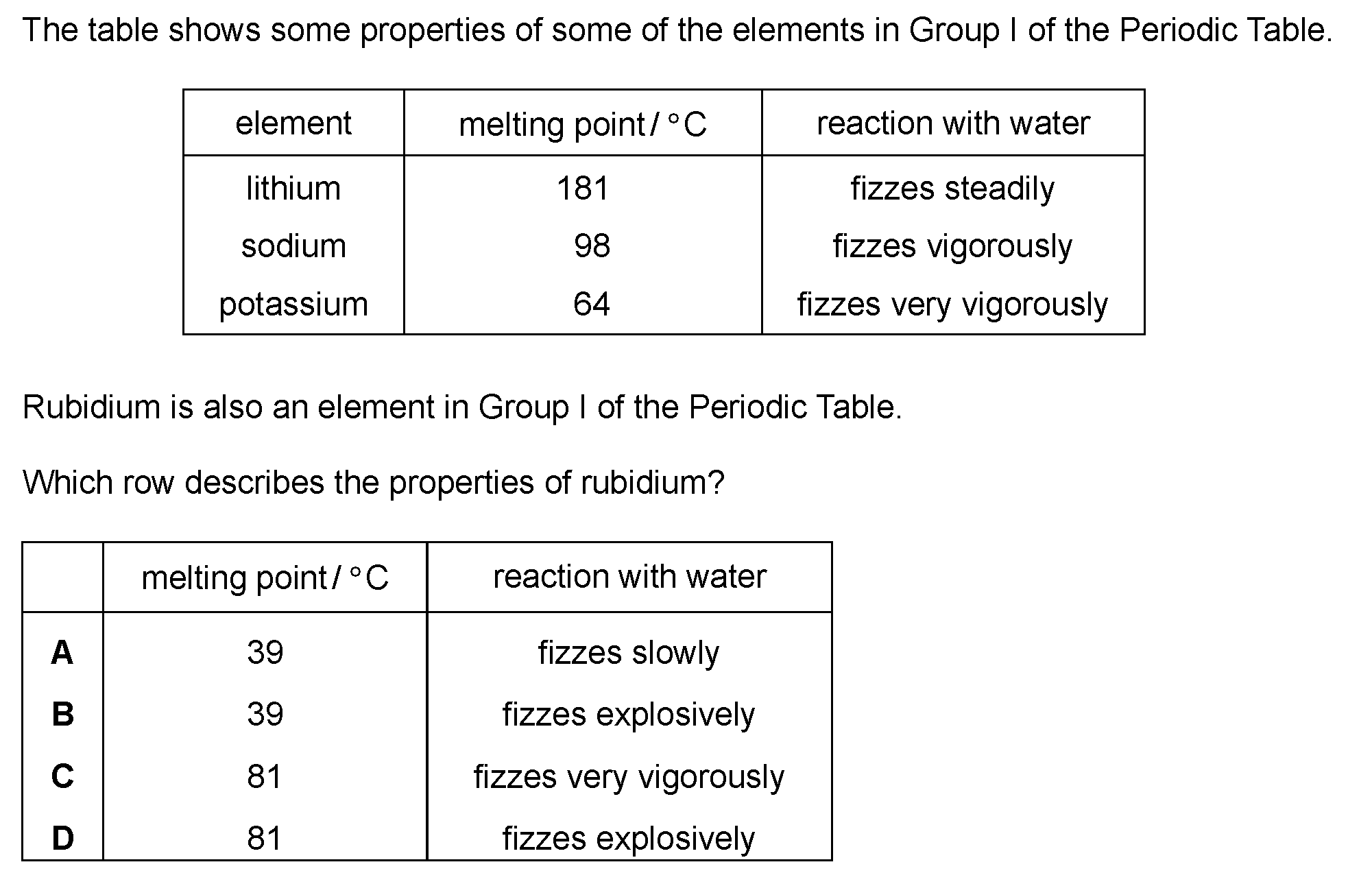
The table shows some properties of some of the elements in Group | of the Periodic Table.
melting point/°C reaction with water
lithium fizzes steadily
sodium fizzes vigorously
potassium fizzes very vigorously
Rubidium is also an element in Group | of the Periodic Table.
Which row describes the properties of rubidium?
= melting point/ °C reaction with water
fizzes slowly
fizzes explosively
fizzes very vigorously
fizzes explosively
Options:
A
B
C
D
Correct Key: B
A
B
C
D
Correct Key: B
Question 4
Paper Ref: 5129/11_Summer_2023_Q23
Paper Ref: 5129/11_Summer_2023_Q23
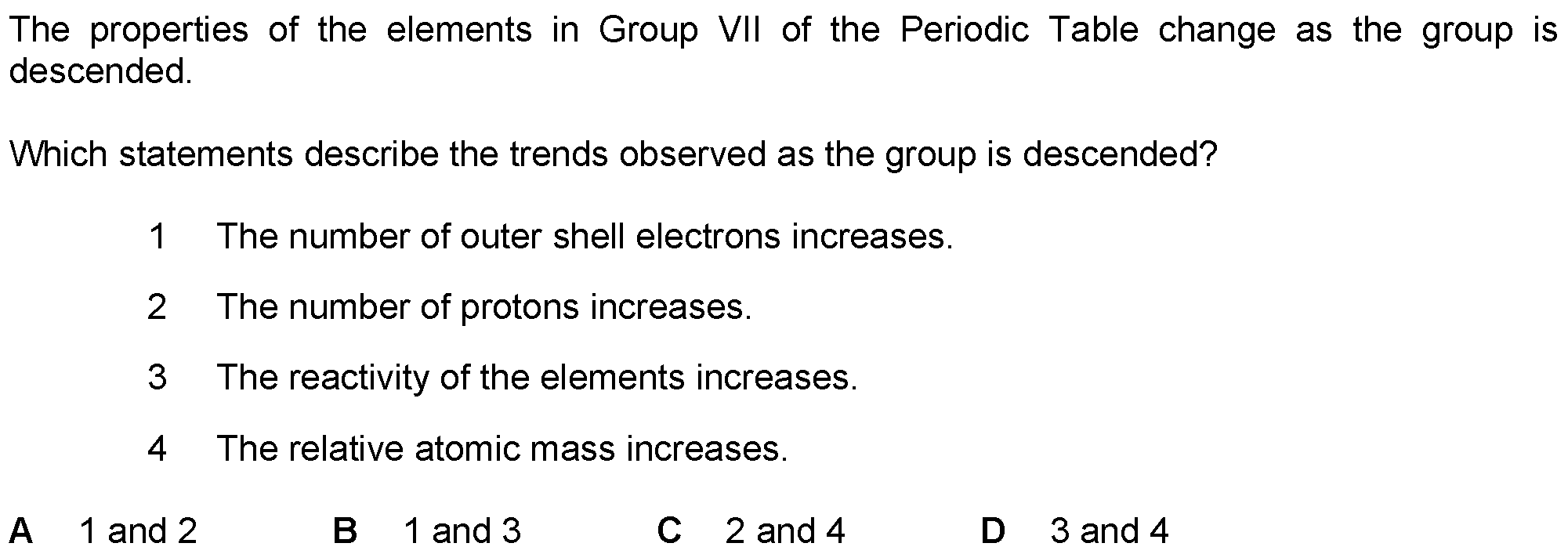
The properties of the elements in Group VII of the Periodic Table change as the group is
descended.
Which statements describe the trends observed as the group is descended?
1. The number of outer shell electrons increases.
2 The number of protons increases.
3 The reactivity of the elements increases.
4
The relative atomic mass increases.
A 1and2 B 1and3 C 2and4 D 3and4
descended.
Which statements describe the trends observed as the group is descended?
1. The number of outer shell electrons increases.
2 The number of protons increases.
3 The reactivity of the elements increases.
4
The relative atomic mass increases.
A 1and2 B 1and3 C 2and4 D 3and4
Options:
A
B
C
D
Correct Key: C
A
B
C
D
Correct Key: C
Question 5
Paper Ref: 0620/21_Summer_2023_Q21
Paper Ref: 0620/21_Summer_2023_Q21
Which row describes a similarity and a difference between chlorine and bromine?
[sary irc
both are gases at room chlorine and bromine
temperature and pressure have different colours
both exist as chlorine is more
diatomic molecules dense than bromine
both have atoms with only bromine will react with
seven outer-shell electrons aqueous sodium chloride
both react with aqueous chlorine is more reactive
potassium iodide than bromine
Options:
A
B
C
D
Correct Key: D
A
B
C
D
Correct Key: D
Question 6
Paper Ref: 0620/11_Summer_2023_Q20
Paper Ref: 0620/11_Summer_2023_Q20
Which row describes a similarity and a difference between chlorine and bromine?
ee
both are gases at room chlorine and bromine
temperature and pressure have different colours
both exist as chlorine is more
diatomic molecules dense than bromine
both have atoms with only bromine will react with
seven outer-shell electrons aqueous sodium chloride
both react with aqueous chlorine is more reactive
potassium iodide than bromine
Options:
A
B
C
D
Correct Key: D
A
B
C
D
Correct Key: D
Question 7
Paper Ref: 0620/23_Summer_2022_Q25
Paper Ref: 0620/23_Summer_2022_Q25
Which row describes an atom of a noble gas?
number of number of number of
protons neutrons electrons
2 2 0
2 2 2
8 8 8
8 8 10
number of number of number of
protons neutrons electrons
2 2 0
2 2 2
8 8 8
8 8 10
Options:
A
B
C
D
Correct Key: B
A
B
C
D
Correct Key: B
Question 8
Paper Ref: 0620/22_Summer_2026_Q24
Paper Ref: 0620/22_Summer_2026_Q24
Which statement about alkali metals is correct?
A Lithium is denser than sodium.
Sodium is more reactive than potassium.
Sodium has a higher melting point than potassium.
Oo ©} W
Potassium has more outer-shell electrons than sodium.
A Lithium is denser than sodium.
Sodium is more reactive than potassium.
Sodium has a higher melting point than potassium.
Oo ©} W
Potassium has more outer-shell electrons than sodium.
Options:
A
B
C
D
Correct Key: C
A
B
C
D
Correct Key: C
Question 9
Paper Ref: 0620/23_Winter_2020_Q25
Paper Ref: 0620/23_Winter_2020_Q25
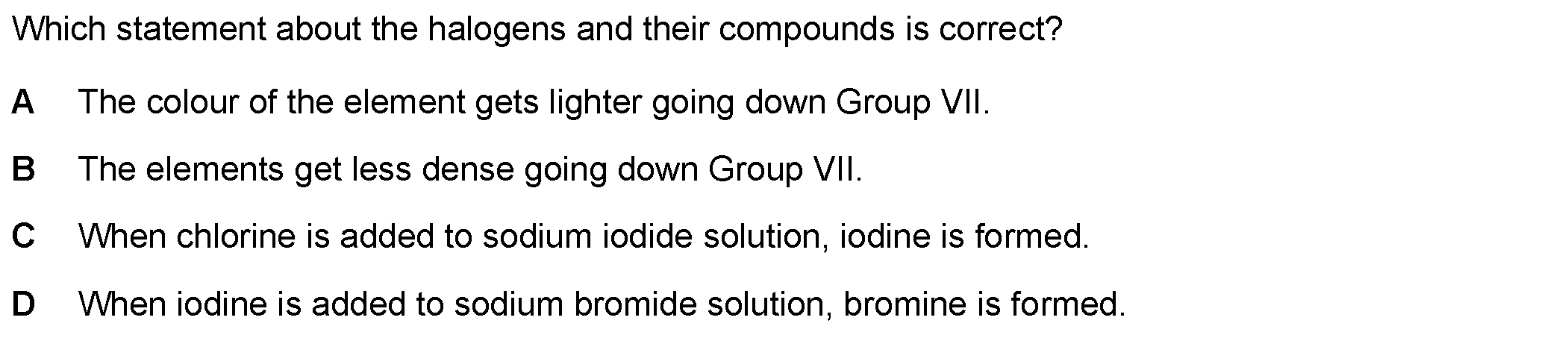
Which statement about the halogens and their compounds is correct?
A
B
Cc
D
The colour of the element gets lighter going down Group VII.
The elements get less dense going down Group VII.
When chlorine is added to sodium iodide solution, iodine is formed.
When iodine is added to sodium bromide solution, bromine is formed.
A
B
Cc
D
The colour of the element gets lighter going down Group VII.
The elements get less dense going down Group VII.
When chlorine is added to sodium iodide solution, iodine is formed.
When iodine is added to sodium bromide solution, bromine is formed.
Options:
A
B
C
D
Correct Key: C
A
B
C
D
Correct Key: C
Question 10
Paper Ref: 0620/22_Spring_2024_Q25
Paper Ref: 0620/22_Spring_2024_Q25
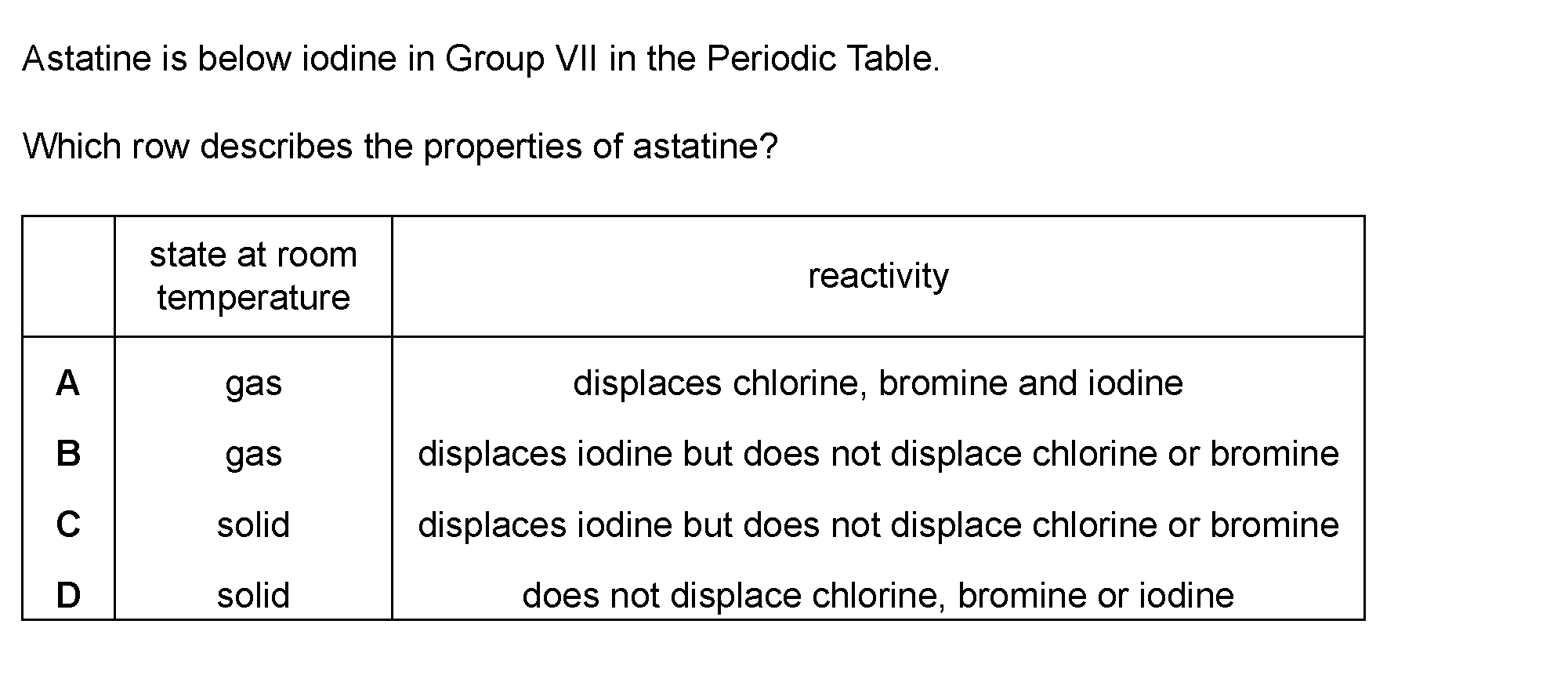
Astatine is below iodine in Group VII in the Periodic Table.
Which row describes the properties of astatine?
state at room
reactivity
temperature
displaces chlorine, bromine and iodine
displaces iodine but does not displace chlorine or bromine
displaces iodine but does not displace chlorine or bromine
does not displace chlorine, bromine or iodine
Which row describes the properties of astatine?
state at room
reactivity
temperature
displaces chlorine, bromine and iodine
displaces iodine but does not displace chlorine or bromine
displaces iodine but does not displace chlorine or bromine
does not displace chlorine, bromine or iodine
Options:
A
B
C
D
Correct Key: D
A
B
C
D
Correct Key: D
Question 11
Paper Ref: 0620/13_Summer_2024_Q24
Paper Ref: 0620/13_Summer_2024_Q24
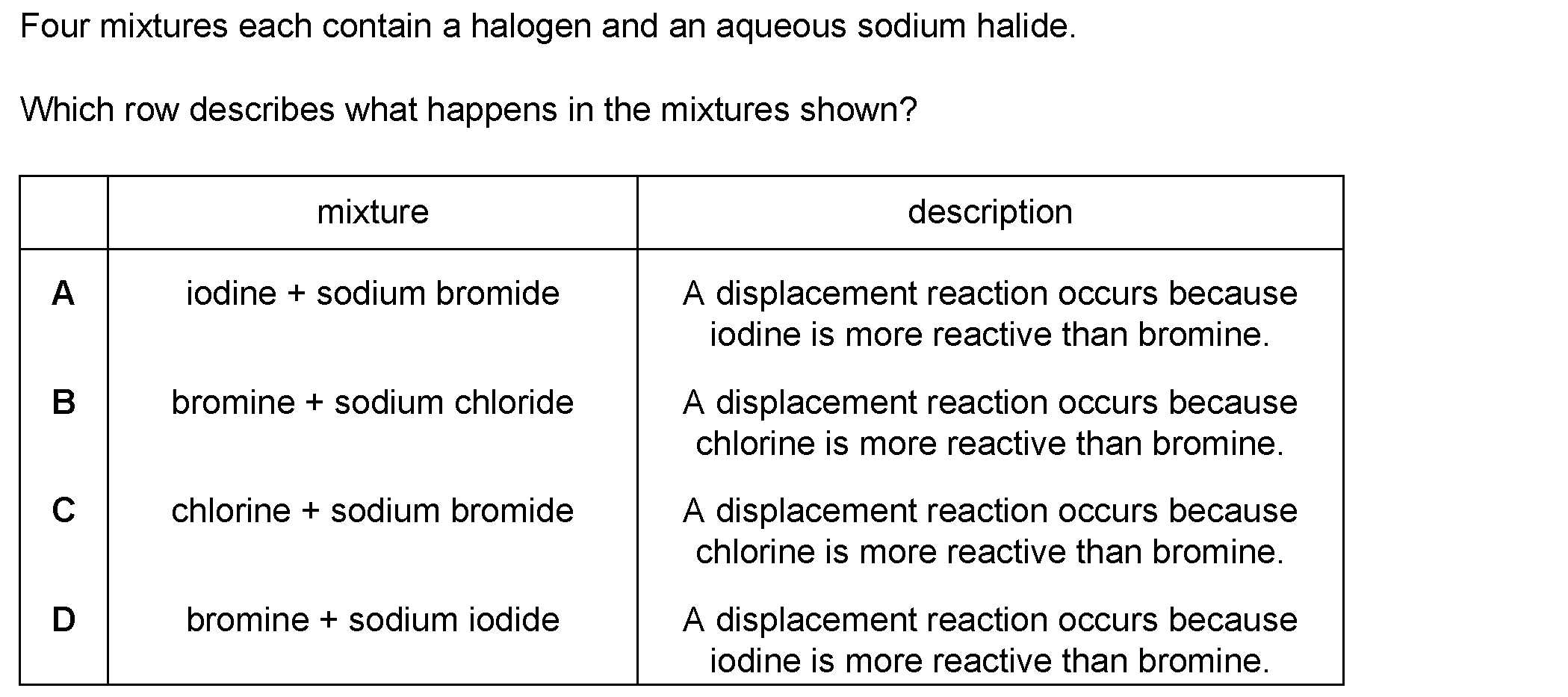
Four mixtures each contain a halogen and an aqueous sodium halide.
Which row describes what happens in the mixtures shown?
ee
iodine + sodium bromide A displacement reaction occurs because
iodine is more reactive than bromine.
bromine + sodium chloride A displacement reaction occurs because
chlorine is more reactive than bromine.
chlorine + sodium bromide A displacement reaction occurs because
chlorine is more reactive than bromine.
bromine + sodium iodide A displacement reaction occurs because
iodine is more reactive than bromine.
Options:
A
B
C
D
Correct Key: C
A
B
C
D
Correct Key: C
Question 12
Paper Ref: 0620/23_Summer_2026_Q25
Paper Ref: 0620/23_Summer_2026_Q25
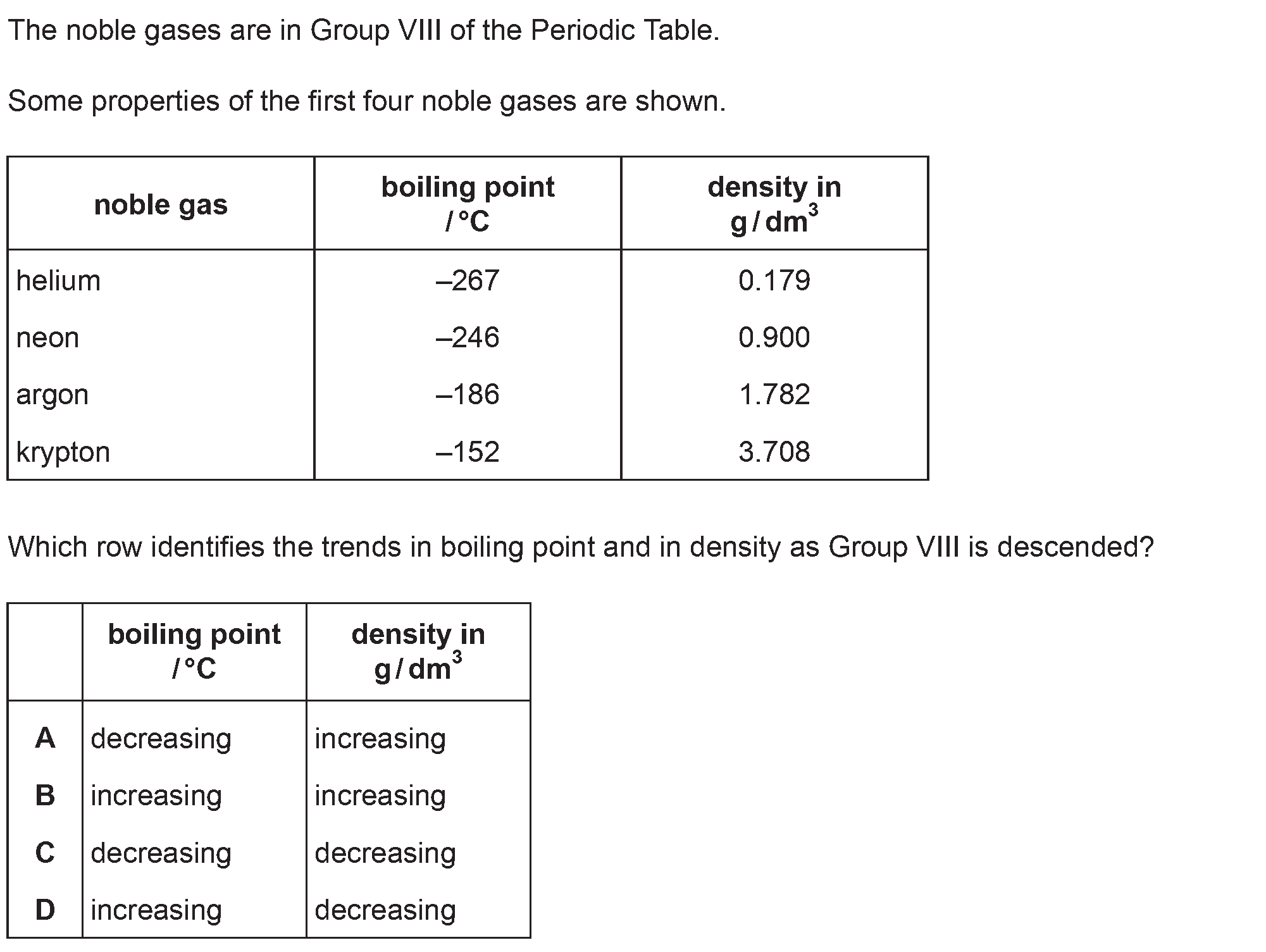
The noble gases are in Group VIII of the Periodic Table.
Some properties of the first four noble gases are shown.
boiling point density in
helium
neon
argon
krypton
Which row identifies the trends in boiling point and in density as Group VIII is descended?
boiling point density i in
°C g/dm°
decreasing increasing
increasing increasing
decreasing decreasing
increasing decreasing
Options:
A
B
C
D
Correct Key: B
A
B
C
D
Correct Key: B
Question 13
Paper Ref: 0620/21_Summer_2025_Q24
Paper Ref: 0620/21_Summer_2025_Q24
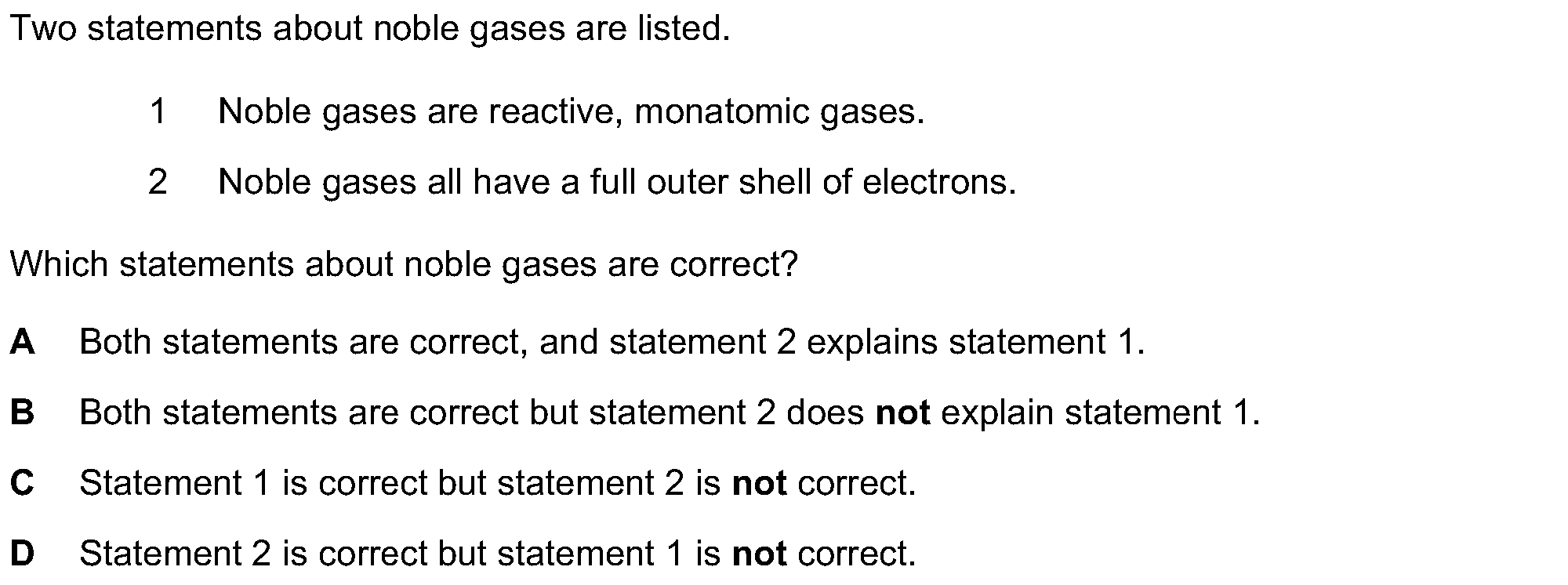
Two statements about noble gases are listed.
1 Noble gases are reactive, monatomic gases.
2 Noble gases all have a full outer shell of electrons.
Which statements about noble gases are correct?
A
B
Cc
D
Both statements are correct, and statement 2 explains statement 1.
Both statements are correct but statement 2 does not explain statement 1.
Statement 1 is correct but statement 2 is not correct.
Statement 2 is correct but statement 1 is not correct.
Options:
A
B
C
D
Correct Key: D
A
B
C
D
Correct Key: D
Question 14
Paper Ref: 0620/22_Winter_2023_Q22
Paper Ref: 0620/22_Winter_2023_Q22
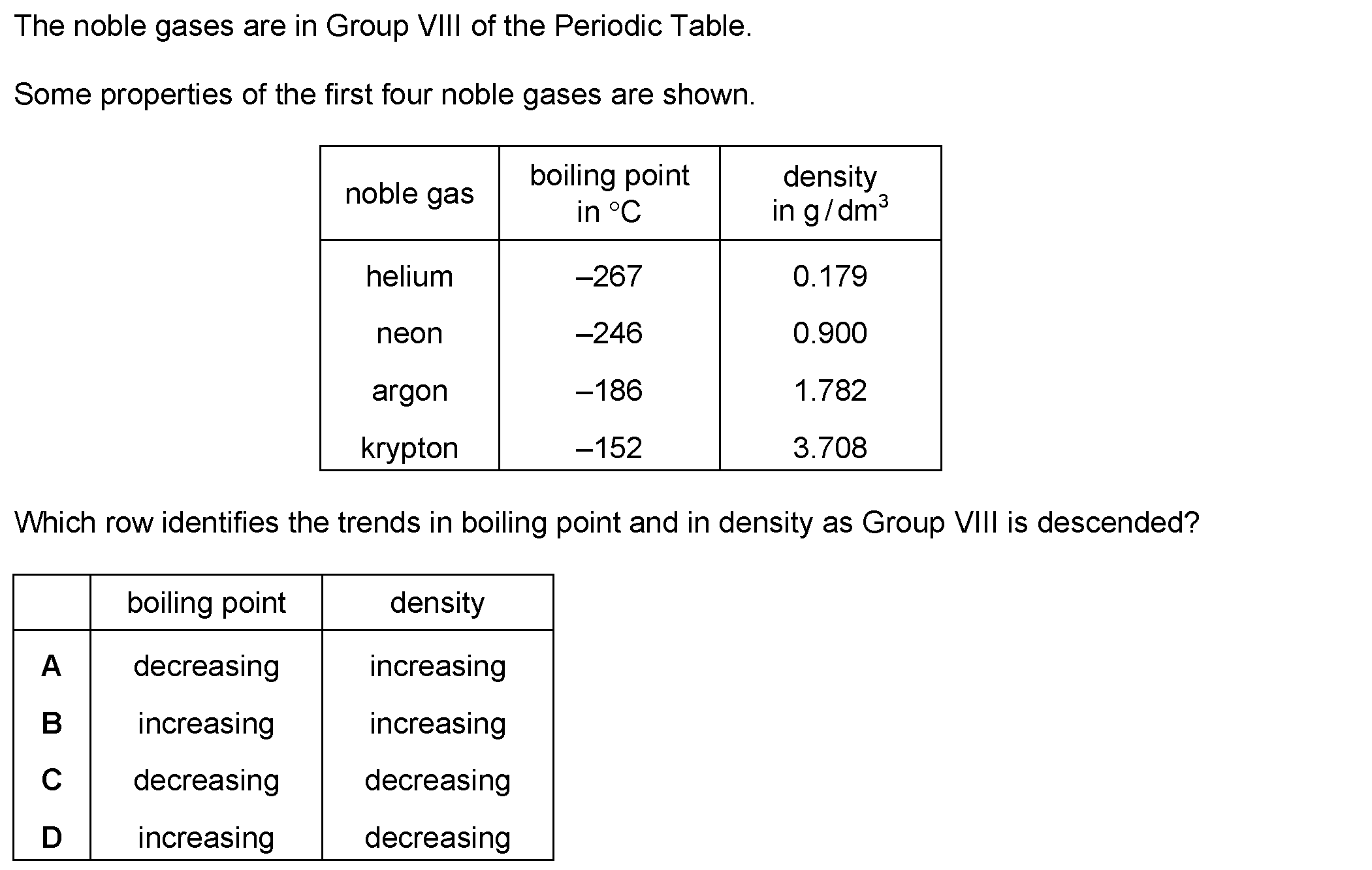
The noble gases are in Group VIII of the Periodic Table.
Some properties of the first four noble gases are shown.
boiling point density
helium
neon
argon
krypton
Which row identifies the trends in boiling point and in density as Group VIII is descended?
decreasing increasing
increasing increasing
decreasing decreasing
increasing decreasing
Some properties of the first four noble gases are shown.
boiling point density
helium
neon
argon
krypton
Which row identifies the trends in boiling point and in density as Group VIII is descended?
decreasing increasing
increasing increasing
decreasing decreasing
increasing decreasing
Options:
A
B
C
D
Correct Key: B
A
B
C
D
Correct Key: B
Question 15
Paper Ref: 0620/22_Summer_2025_Q21
Paper Ref: 0620/22_Summer_2025_Q21
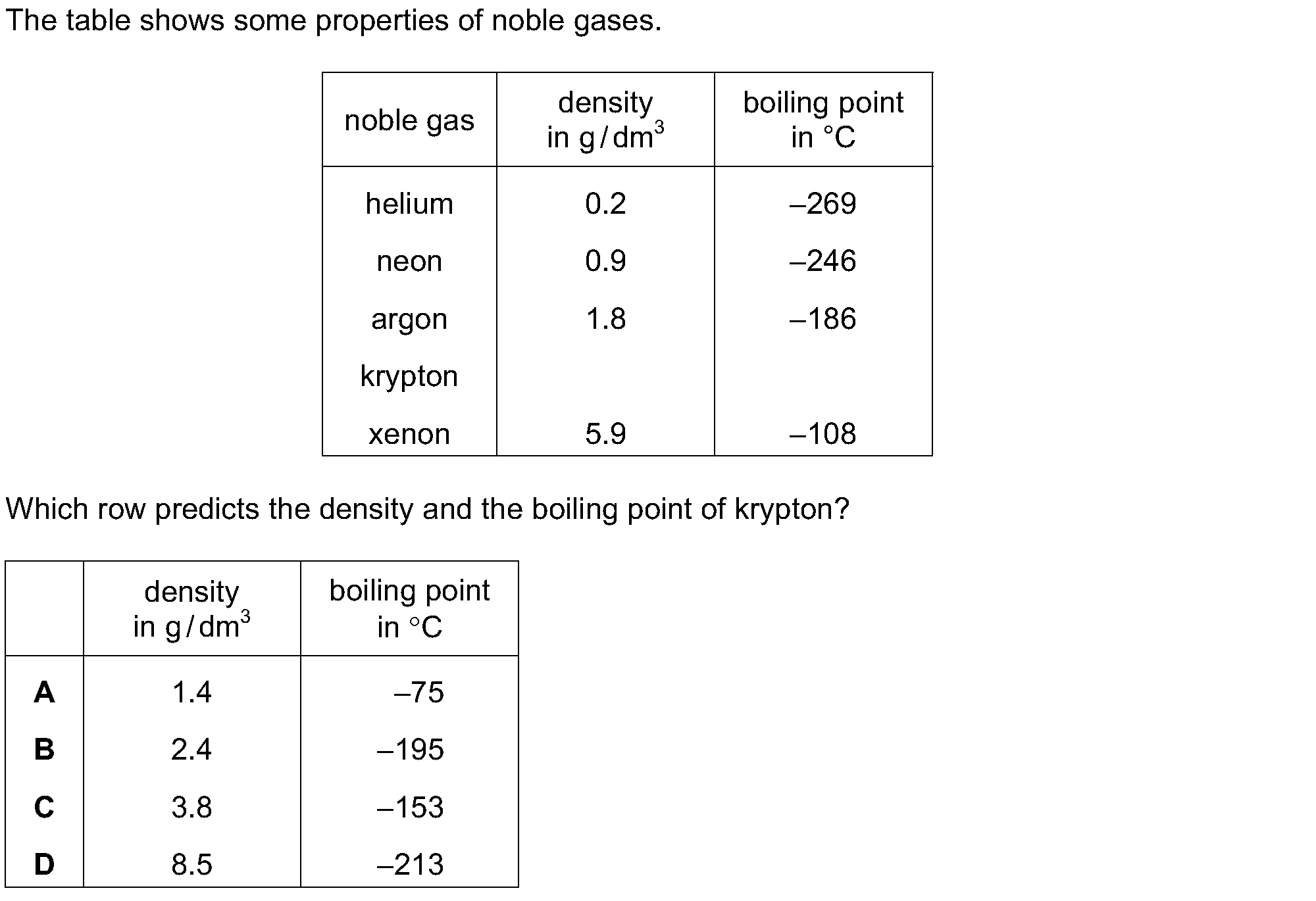
The table shows some properties of noble gases.
noble gas | narahy: botling point
helium 0.2 _269
neon 0.9 ~246
argon 1.8 _186
krypton
xenon 5.9 ~108
Which row predicts the density and the boiling point of krypton?
density boiling point
in g/dm* in °C
A 1.4 -75
B 2.4 -195
Cc 3.8 -153
D 8.5 —213
noble gas | narahy: botling point
helium 0.2 _269
neon 0.9 ~246
argon 1.8 _186
krypton
xenon 5.9 ~108
Which row predicts the density and the boiling point of krypton?
density boiling point
in g/dm* in °C
A 1.4 -75
B 2.4 -195
Cc 3.8 -153
D 8.5 —213
Options:
A
B
C
D
Correct Key: C
A
B
C
D
Correct Key: C
Question 16
Paper Ref: 0620/22_Summer_2018_Q22
Paper Ref: 0620/22_Summer_2018_Q22
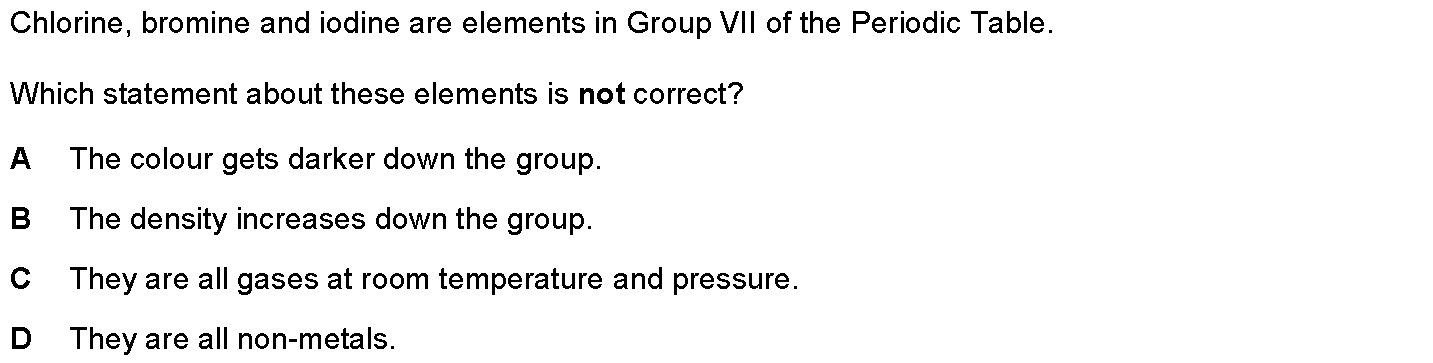
Chlorine, bromine and iodine are elements in Group VII of the Periodic Table.
Which statement about these elements is not correct?
A
B
c
D
The colour gets darker down the group.
The density increases down the group.
They are all gases at room temperature and pressure.
They are all non-metals.
Which statement about these elements is not correct?
A
B
c
D
The colour gets darker down the group.
The density increases down the group.
They are all gases at room temperature and pressure.
They are all non-metals.
Options:
A
B
C
D
Correct Key: C
A
B
C
D
Correct Key: C
Question 17
Paper Ref: 0620/11_Summer_2017_Q22
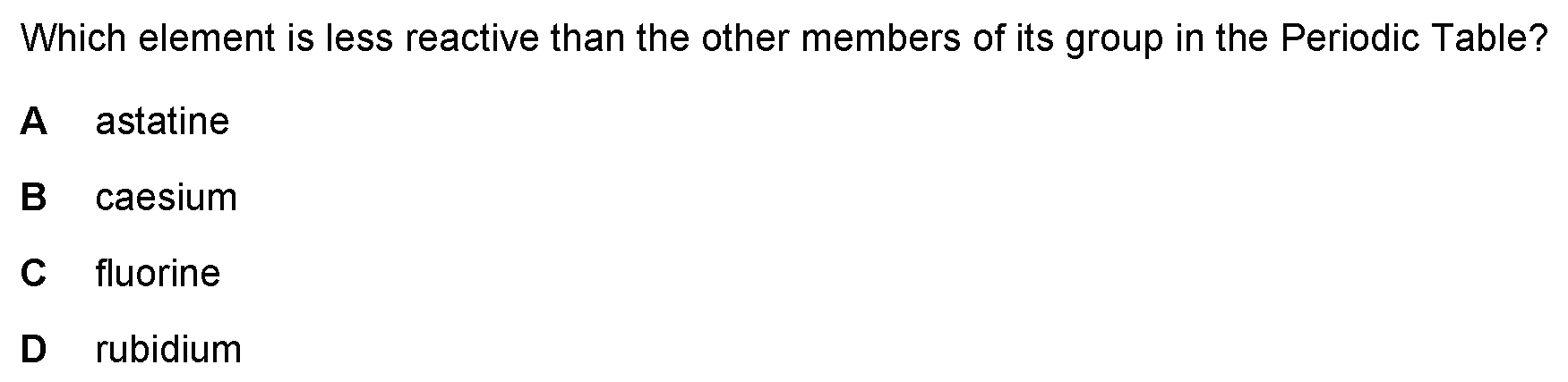
Paper Ref: 0620/11_Summer_2017_Q22
Which element is less reactive than the other members of its group in the Periodic Table?
Aastatine
B caesium
C fluorine
D
rubidium
Aastatine
B caesium
C fluorine
D
rubidium
Options:
A
B
C
D
Correct Key: A
A
B
C
D
Correct Key: A
Question 18
Paper Ref: 0620/13_Summer_2026_Q26
Paper Ref: 0620/13_Summer_2026_Q26
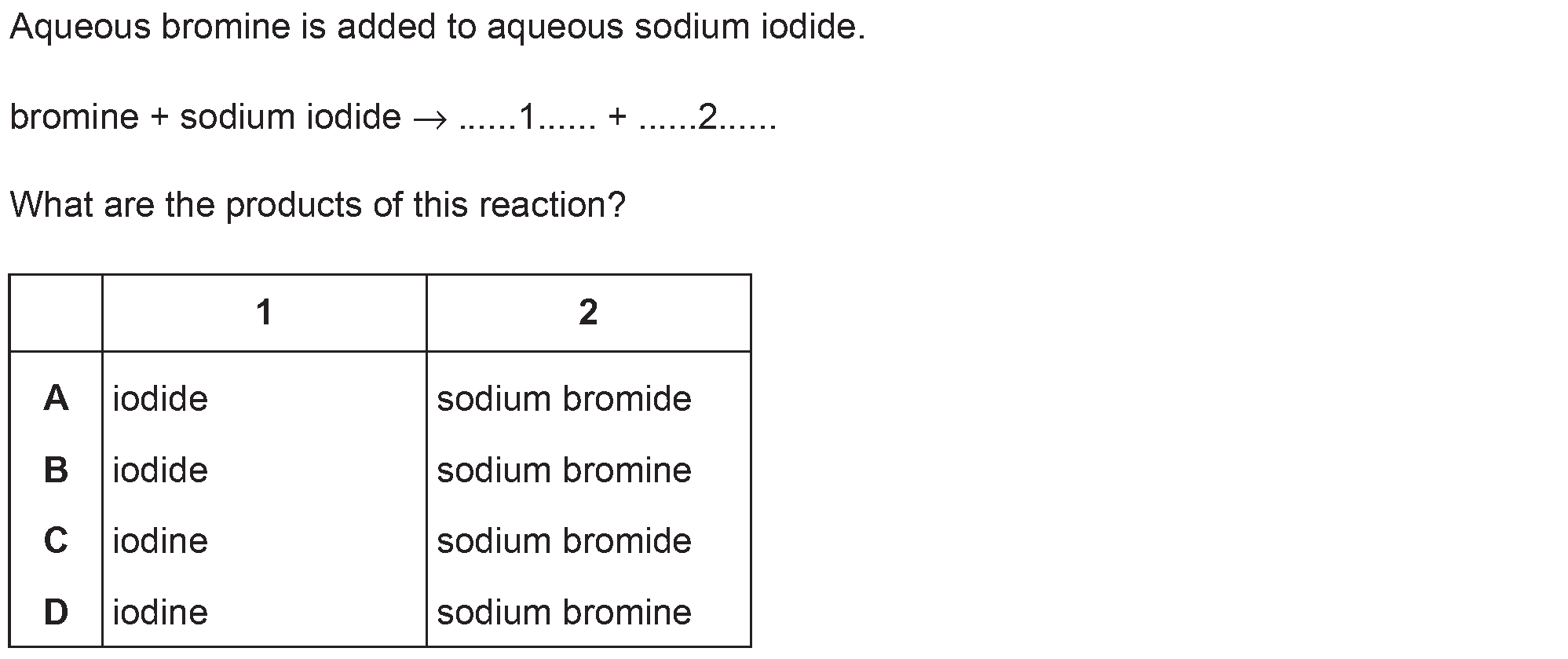
Aqueous bromine is added to aqueous sodium iodide.
bromine + sodium iodide — …… Ve… Fo 2.2…
What are the products of this reaction?
sodium bromide
sodium bromine
sodium bromide
sodium bromine
bromine + sodium iodide — …… Ve… Fo 2.2…
What are the products of this reaction?
sodium bromide
sodium bromine
sodium bromide
sodium bromine
Options:
A
B
C
D
Correct Key: C
A
B
C
D
Correct Key: C
Question 19
Paper Ref: 5129/12_Summer_2026_Q24
Paper Ref: 5129/12_Summer_2026_Q24
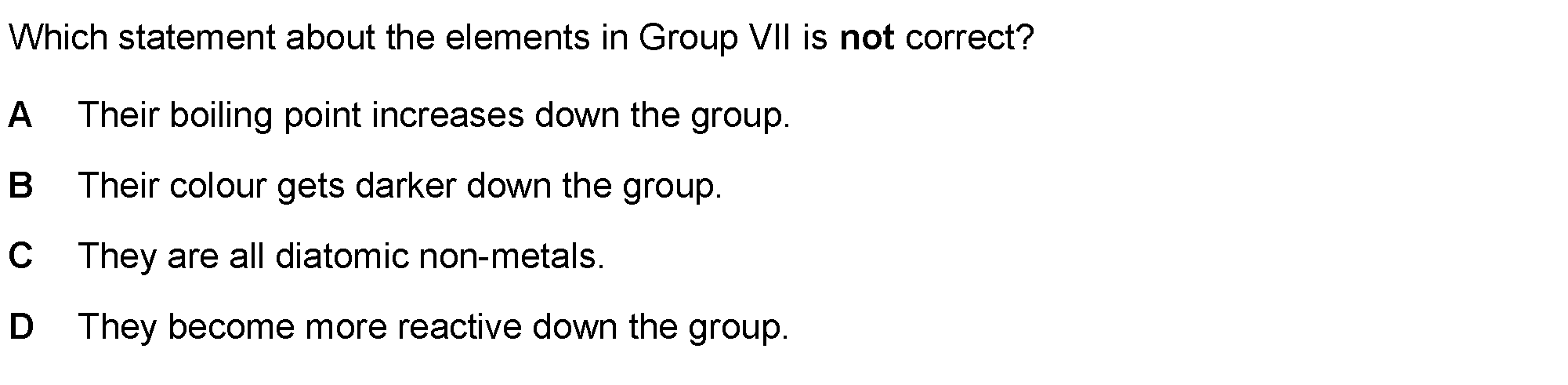
Which statement about the elements in Group VII is not correct?
A
B
Cc
D
Their boiling point increases down the group.
Their colour gets darker down the group.
They are all diatomic non-metals.
They become more reactive down the group.
A
B
Cc
D
Their boiling point increases down the group.
Their colour gets darker down the group.
They are all diatomic non-metals.
They become more reactive down the group.
Options:
A
B
C
D
Correct Key: D
A
B
C
D
Correct Key: D
Structured Questions Mark Scheme & Answers
•1•.• • • •[•S•P• •S•9• •P•1• • •·• • •Q•5• • •P•a•r•t• •(•c•)• • •·• • •S•p•e•c•i•m•e•n• • •·• • •L•o•w•e•r• •S•e•c• •0•8•9•3•]• • • • • • •a•n•y• •v•a•l•u•e• •b•e•t•w•e•e•n• •2•0• •a•n•d• •5•0• •(•°•C•)• •1• •••c•c•e•p•t• •a•n•s•w•e•r•s• •w•r•i•t•t•e•n• •i•n• •t•a•b•l•e• •b•u•t• •a•n•s•w•e•r• •l•i•n•e• •t•a•k•e•s• •p•r•e•c•e•d•e•n•c•e•
•2•.• • • •[•S•P• •S•9• •P•1• • •·• • •Q•5• • •P•a•r•t• •(•d•)• • •·• • •S•p•e•c•i•m•e•n• • •·• • •L•o•w•e•r• •S•e•c• •0•8•9•3•]• • • • • • •r•e•a•c•t•i•v•i•t•y• •i•n•c•r•e•a•s•e•s• •(•d•o•w•n• •t•h•e• •g•r•o•u•p•)• •1• •©• •U•C•L•E•S• •2•0•2•0• •P•a•g•e• •5• •o•f• •8• •S•9•/•0•1• •S•c•i•e•n•c•e• •S•t•a•g•e• •9• •P•a•p•e•r• •1• •M•a•r•k• •S•c•h•e•m•e• •F•r•o•m• •2•0•2•0•
•3•.• • • •[•C•P• •M•a•r•c•h• •2•0•2•6• •P•1• • •·• • •Q•6• • •P•a•r•t• •(•b•)• • •·• • •2•0•2•6• • •·• • •L•o•w•e•r• •S•e•c• •0•8•9•3•]• • • • • • •a•n•y• •v•a•l•u•e• •b•e•t•w•e•e•n• •6•3•5• •a•n•d• •7•2•0• •(•°•C•)• •1•
•4•.• • • •[•C•P• •M•a•y• •2•0•2•4• •P•2• • •·• • •Q•1•3• • •P•a•r•t• •(•a•)• • •·• • •2•0•2•4• • •·• • •L•o•w•e•r• •S•e•c• •0•8•9•3•]• • • • • • •c•a•e•s•i•u•m• •o•r• •f•r•a•n•c•i•u•m• •1• •••c•c•e•p•t• •C•s• •o•r• •F•r•,• •b•u•t• •n•a•m•e• •t•a•k•e•s• •p•r•e•c•e•d•e•n•c•e•.•
•5•.• • • •[•P•T• •S•9• •2•0•2•5• •P•1• • •·• • •Q•6• • •P•a•r•t• •(•a•)• • •·• • •2•0•2•5• • •·• • •L•o•w•e•r• •S•e•c• •0•8•9•3•]• • • • • • •l•i•t•h•i•u•m• •o•r• •f•r•a•n•c•i•u•m• •1• •••c•c•e•p•t• •L•i• •o•r• •F•r•,• •b•u•t• •n•a•m•e• •t•a•k•e•s• •p•r•e•c•e•d•e•n•c•e•
•6•.• • • •[•P•T• •S•9• •2•0•2•5• •P•1• • •·• • •Q•6• • •P•a•r•t• •(•c•)• • •·• • •2•0•2•5• • •·• • •L•o•w•e•r• •S•e•c• •0•8•9•3•]• • • • • • •(•i•d•e•a• •t•h•a•t•)• •i•n•c•r•e•a•s•e•s• •1•
•7•.• • • •[•P•T• •S•9• •2•0•2•6• •P•1• • •·• • •Q•6• • •P•a•r•t• •(•a•)• • •·• • •2•0•2•6• • •·• • •L•o•w•e•r• •S•e•c• •0•8•9•3•]• • • • • • •a•l•l• •h•a•v•e• •1• •e•l•e•c•t•r•o•n• •i•n• •o•u•t•e•r• •s•h•e•l•l• •1• •••c•c•e•p•t• •o•r•b•i•t• •f•o•r• •s•h•e•l•l•
•8•.• • • •[•P•T• •S•9• •2•0•2•6• •P•1• • •·• • •Q•6• • •P•a•r•t• •(•b•)• • •·• • •2•0•2•6• • •·• • •L•o•w•e•r• •S•e•c• •0•8•9•3•]• • • • • • •d•e•c•r•e•a•s•e•s• •1•
Last updated:
\n