2.1Thermal Physics
Atomic structure and the Periodic Table — Question Bank (Cambridge) — Cambridge IGCSE Physics 0625 Revision Notes & Topical Questions
10 min read Lesson 3 of 45 Unit quiz
Cambridge Past Paper Bank
2.1 Atomic structure and the Periodic Table
17 Multiple-Choice Questions with Official Mark Schemes
Question 1
0620/12_Winter_2020_Q6
Question 2
0620/21_Summer_2015_Q4
Question 3
0620/23_Summer_2021_Q20
Question 4
5129/11_Summer_2020_Q22
Question 5
0620/21_Summer_2020_Q4
Question 6
5129/11_Winter_2025_Q15
Question 7
0620/23_Summer_2022_Q22
Question 8
5129/11_Winter_2023_Q16
Question 9
0620/21_Summer_2022_Q3
Question 10
5129/11_Winter_2022_Q21
Question 11
0620/22_Summer_2017_Q4
Question 12
5129/11_Summer_2025_Q16
Question 13
0620/22_Summer_2021_Q23
Question 14
0620/13_Winter_2017_Q7
Question 15
0620/13_Summer_2024_Q25
Question 16
5129/12_Winter_2025_Q16

Question 17
5129/12_Summer_2021_Q17
Cambridge Lower Secondary Stage 9
2.1 Atomic structure and the Periodic Table – Complete Question Bank & Mark Scheme
Total Questions17 Questions with Verified Solutions & Past Paper Mark Schemes
Multiple Choice Questions (Exam Practice)
Question 1
Paper Ref: 0620/12_Winter_2020_Q6
Paper Ref: 0620/12_Winter_2020_Q6
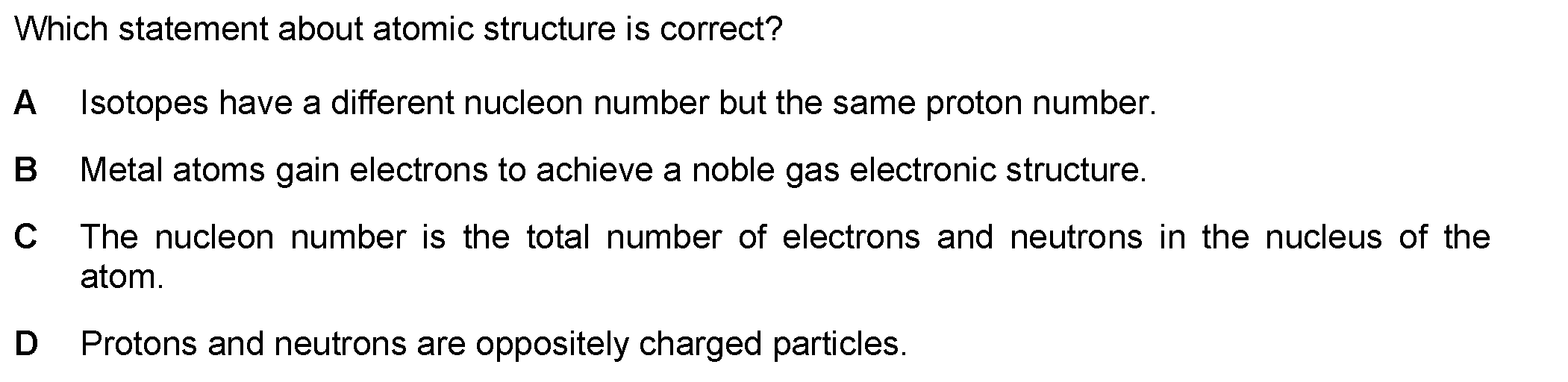
Which statement about atomic structure is correct?
A _|sotopes have a different nucleon number but the same proton number.
B- Metal atoms gain electrons to achieve a noble gas electronic structure.
C The nucleon number is the total number of electrons and neutrons in the nucleus of the
atom.
D_ Protons and neutrons are oppositely charged particles.
A _|sotopes have a different nucleon number but the same proton number.
B- Metal atoms gain electrons to achieve a noble gas electronic structure.
C The nucleon number is the total number of electrons and neutrons in the nucleus of the
atom.
D_ Protons and neutrons are oppositely charged particles.
Options:
A
B
C
D
Correct Key: A
A
B
C
D
Correct Key: A
Question 2
Paper Ref: 0620/21_Summer_2015_Q4
Paper Ref: 0620/21_Summer_2015_Q4
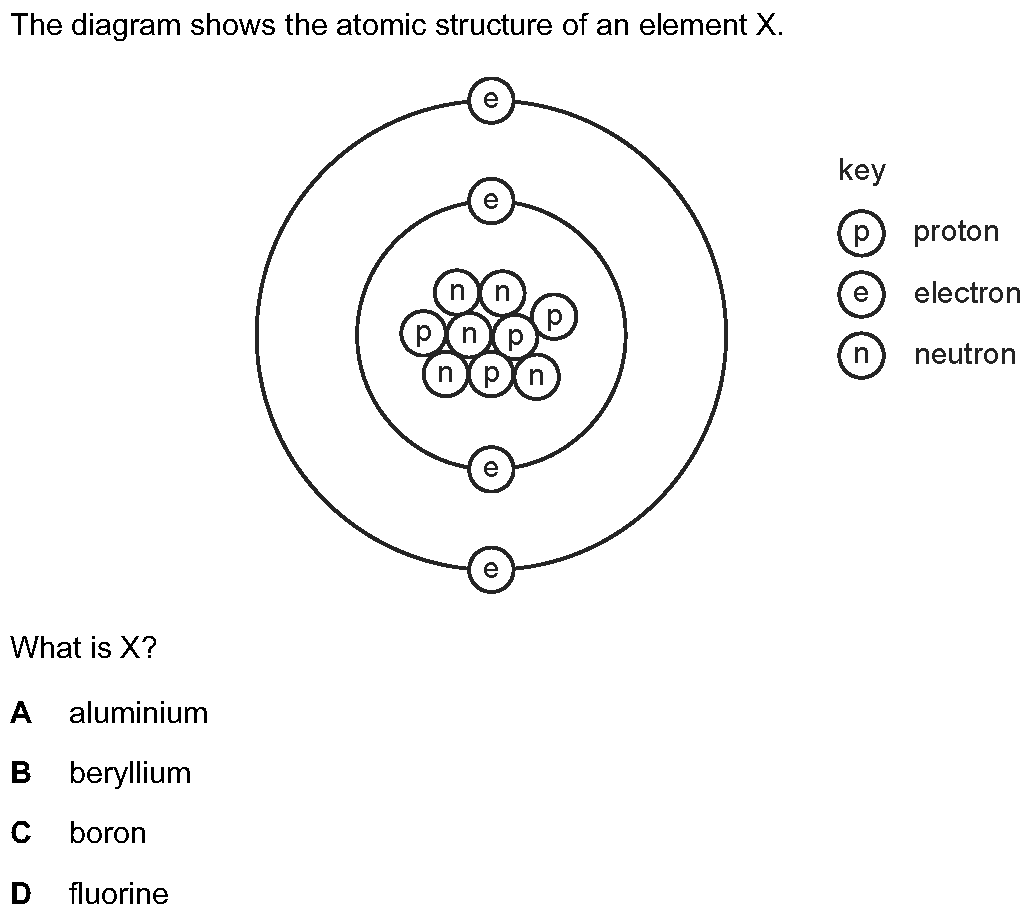
The diagram shows the atomic structure of an element X.
key
®) proton
© electron
@) neutron
What is X?
aluminium
B beryllium
C boron
i=]
fluorine
key
®) proton
© electron
@) neutron
What is X?
aluminium
B beryllium
C boron
i=]
fluorine
Options:
A
B
C
D
Correct Key: B
A
B
C
D
Correct Key: B
Question 3
Paper Ref: 0620/23_Summer_2021_Q20
Paper Ref: 0620/23_Summer_2021_Q20
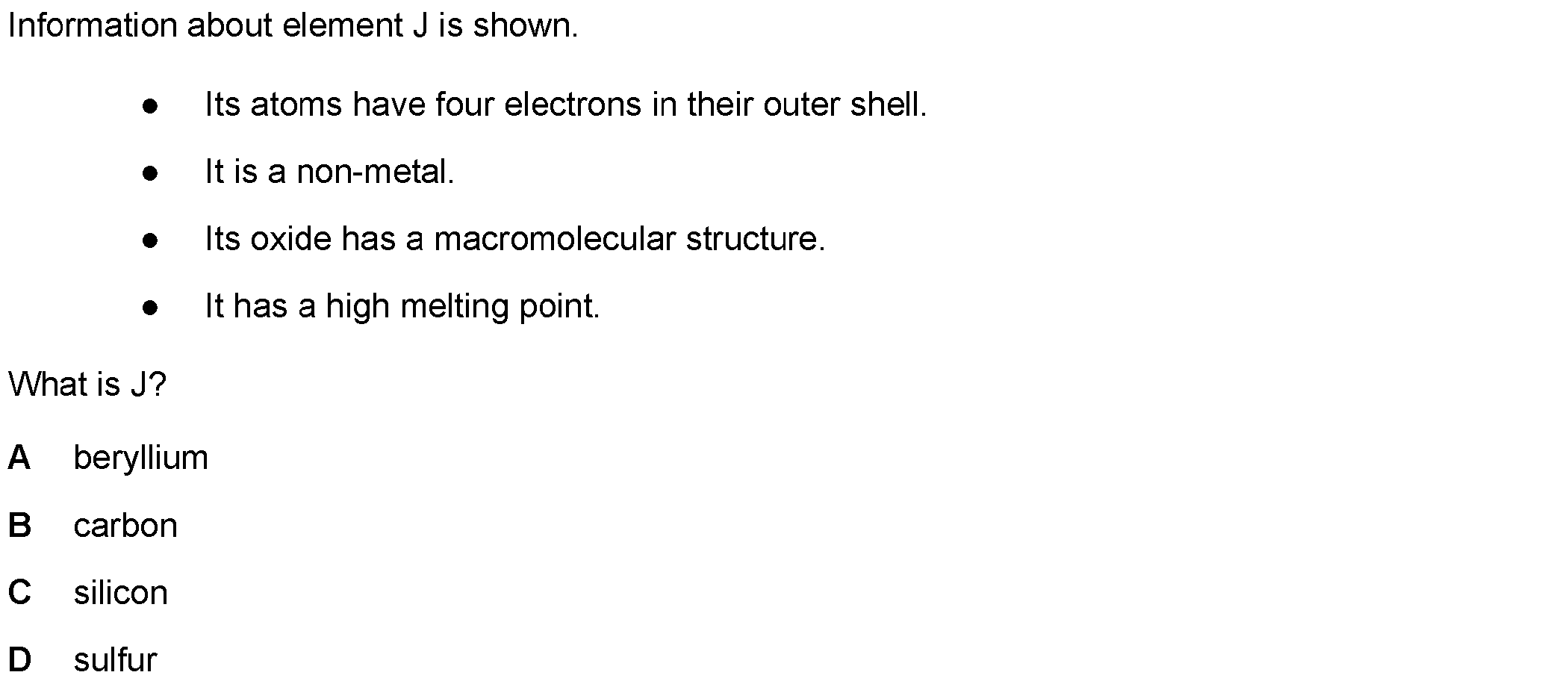
Information about element J is shown.
e Its atoms have four electrons in their outer shell.
e = Itis a non-metal.
e Its oxide has a macromolecular structure.
e Ithas a high melting point.
What is J?
>
beryllium
B- carbon
C silicon
D
sulfur
e Its atoms have four electrons in their outer shell.
e = Itis a non-metal.
e Its oxide has a macromolecular structure.
e Ithas a high melting point.
What is J?
>
beryllium
B- carbon
C silicon
D
sulfur
Options:
A
B
C
D
Correct Key: C
A
B
C
D
Correct Key: C
Question 4
Paper Ref: 5129/11_Summer_2020_Q22
Paper Ref: 5129/11_Summer_2020_Q22
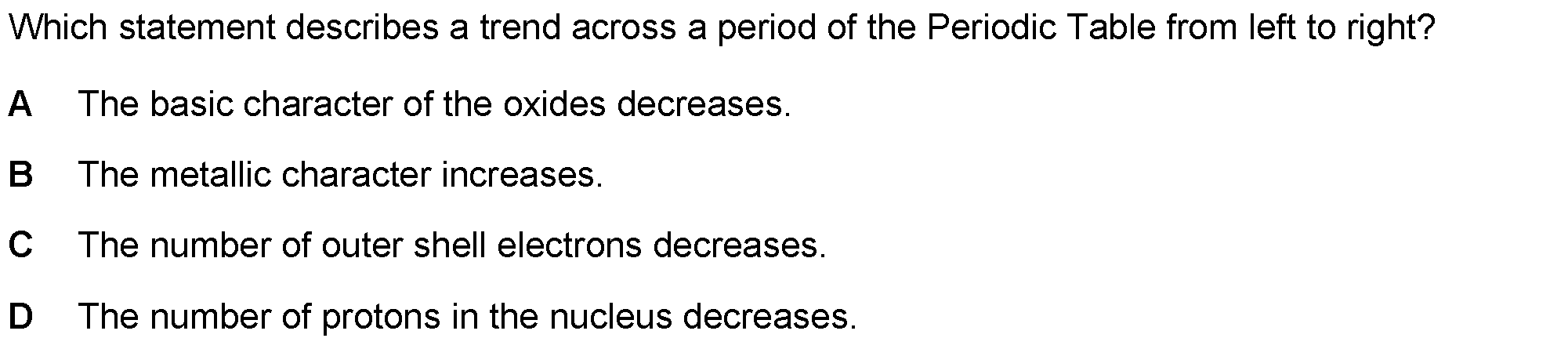
Which statement describes a trend across a period of the Periodic Table from left to right?
A _ The basic character of the oxides decreases.
B- The metallic character increases.
C The number of outer shell electrons decreases.
D
The number of protons in the nucleus decreases.
A _ The basic character of the oxides decreases.
B- The metallic character increases.
C The number of outer shell electrons decreases.
D
The number of protons in the nucleus decreases.
Options:
A
B
C
D
Correct Key: A
A
B
C
D
Correct Key: A
Question 5
Paper Ref: 0620/21_Summer_2020_Q4
Paper Ref: 0620/21_Summer_2020_Q4
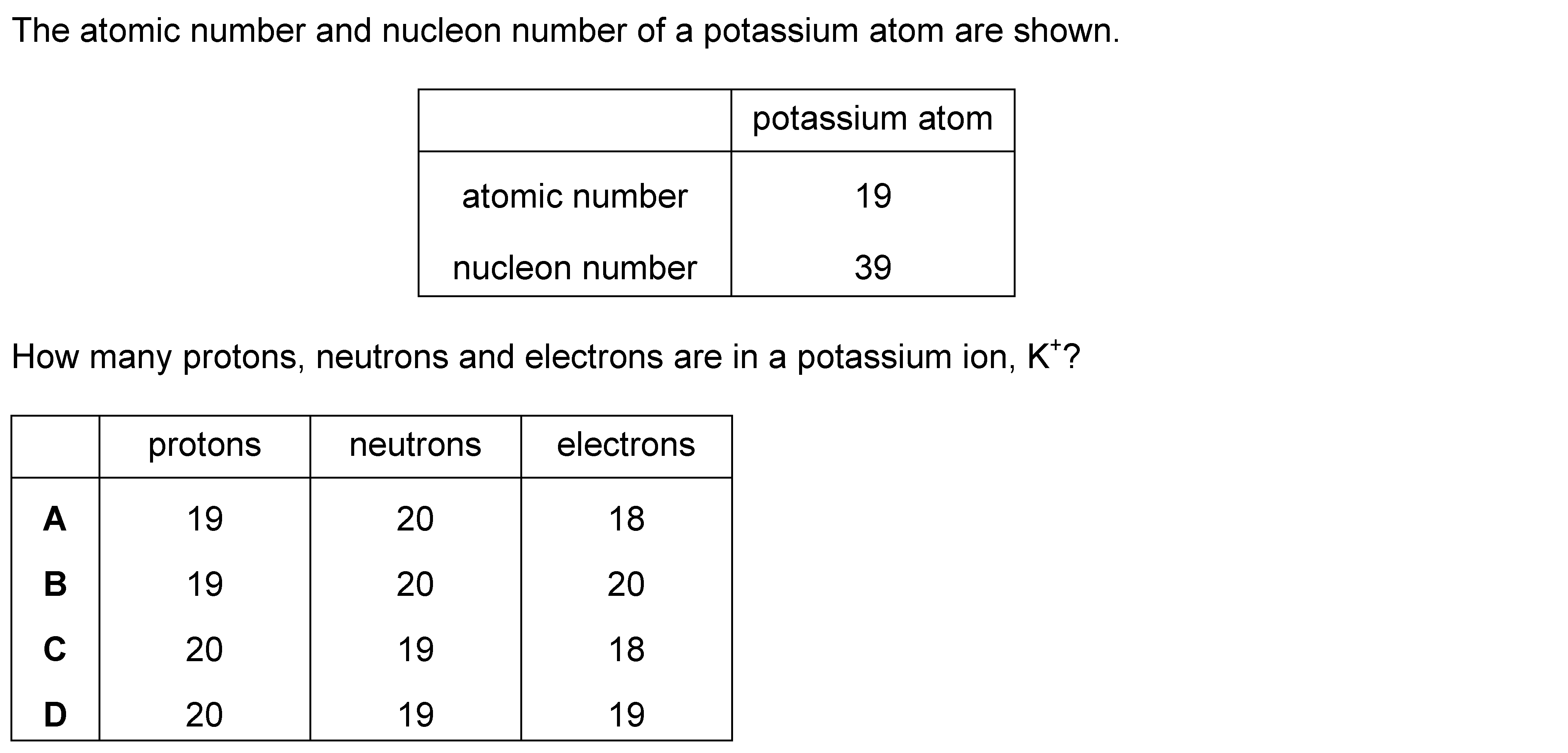
The atomic number and nucleon number of a potassium atom are shown.
atomic number 19
nucleon number 39
How many protons, neutrons and electrons are in a potassium ion, K"?
protons neutrons electrons
18
19 20
19 20 20
20 19 18
20 19 19
atomic number 19
nucleon number 39
How many protons, neutrons and electrons are in a potassium ion, K"?
protons neutrons electrons
18
19 20
19 20 20
20 19 18
20 19 19
Options:
A
B
C
D
Correct Key: A
A
B
C
D
Correct Key: A
Question 6
Paper Ref: 5129/11_Winter_2025_Q15
Paper Ref: 5129/11_Winter_2025_Q15
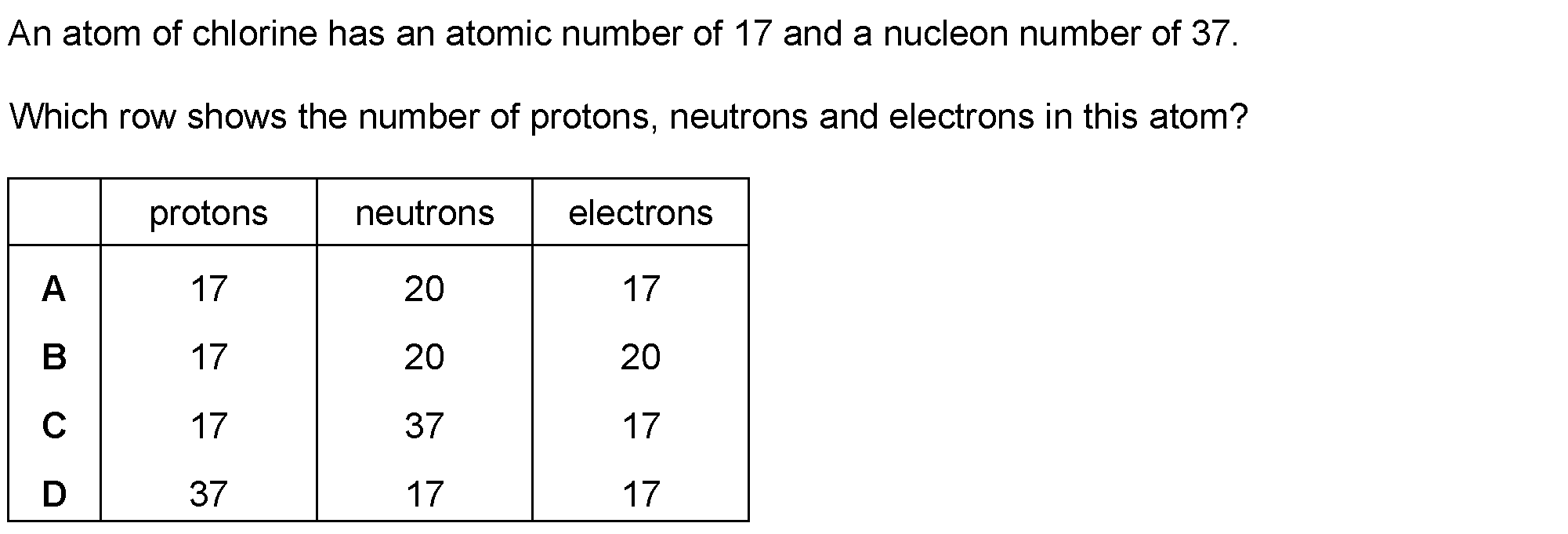
An atom of chlorine has an atomic number of 17 and a nucleon number of 37.
Which row shows the number of protons, neutrons and electrons in this atom?
protons neutrons electrons
17
17 20
17 20 20
17 37 17
37 17 17
Which row shows the number of protons, neutrons and electrons in this atom?
protons neutrons electrons
17
17 20
17 20 20
17 37 17
37 17 17
Options:
A
B
C
D
Correct Key: A
A
B
C
D
Correct Key: A
Question 7
Paper Ref: 0620/23_Summer_2022_Q22
Paper Ref: 0620/23_Summer_2022_Q22
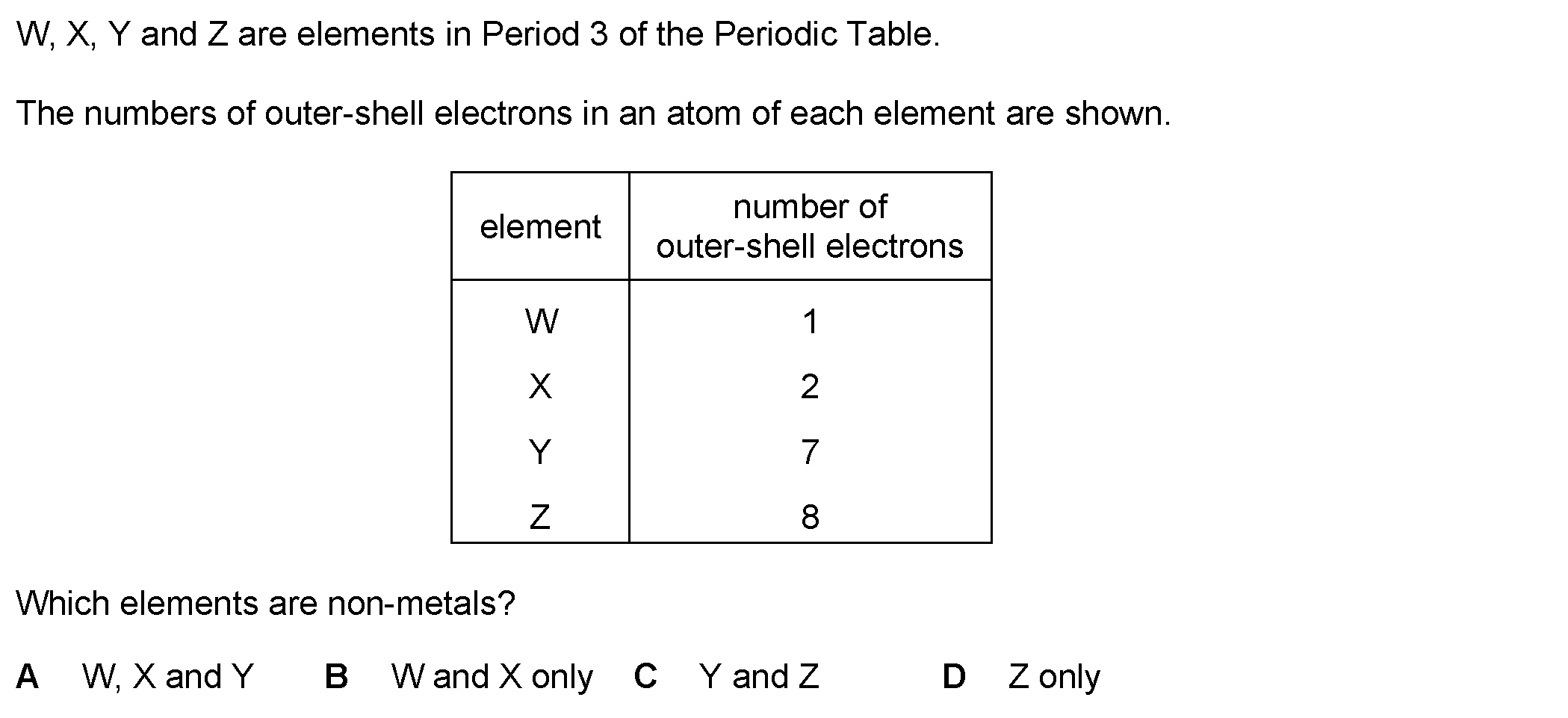
W, X, Y and Z are elements in Period 3 of the Periodic Table.
The numbers of outer-shell electrons in an atom of each element are shown.
number of
element
outer-shell electrons
Ww
xX
Y
Z
Which elements are non-metals?
A W,XandY B WandXonly C YandZ D Zonly
The numbers of outer-shell electrons in an atom of each element are shown.
number of
element
outer-shell electrons
Ww
xX
Y
Z
Which elements are non-metals?
A W,XandY B WandXonly C YandZ D Zonly
Options:
A
B
C
D
Correct Key: C
A
B
C
D
Correct Key: C
Question 8
Paper Ref: 5129/11_Winter_2023_Q16
Paper Ref: 5129/11_Winter_2023_Q16
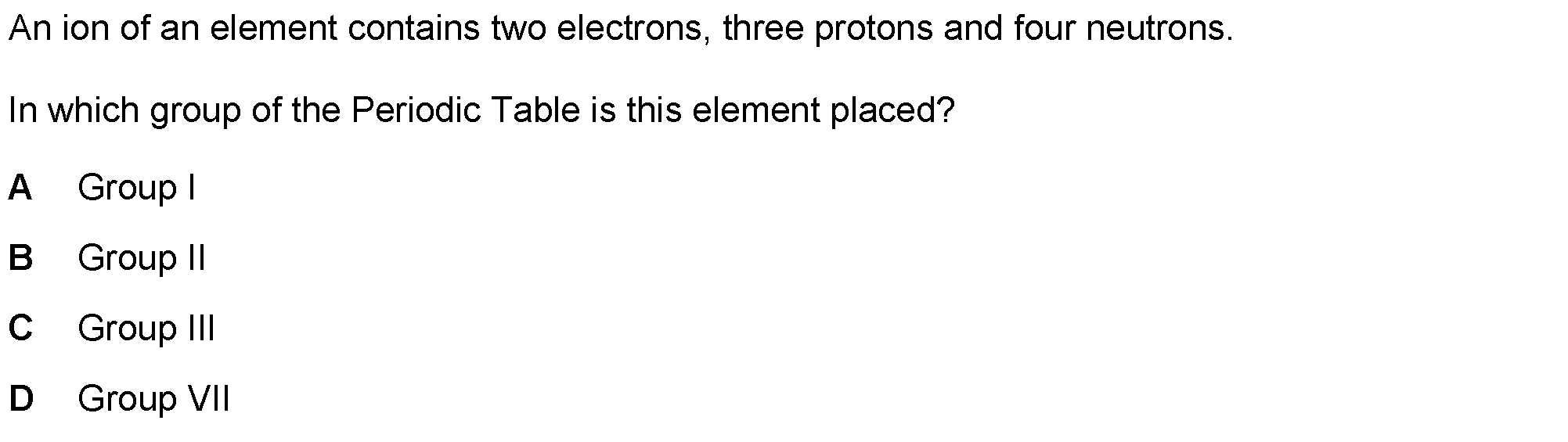
An ion of an element contains two electrons, three protons and four neutrons.
In which group of the Periodic Table is this element placed?
A Group |
B~ Group II
C Group Ill
D_ Group VII
In which group of the Periodic Table is this element placed?
A Group |
B~ Group II
C Group Ill
D_ Group VII
Options:
A
B
C
D
Correct Key: A
A
B
C
D
Correct Key: A
Question 9
Paper Ref: 0620/21_Summer_2022_Q3
Paper Ref: 0620/21_Summer_2022_Q3
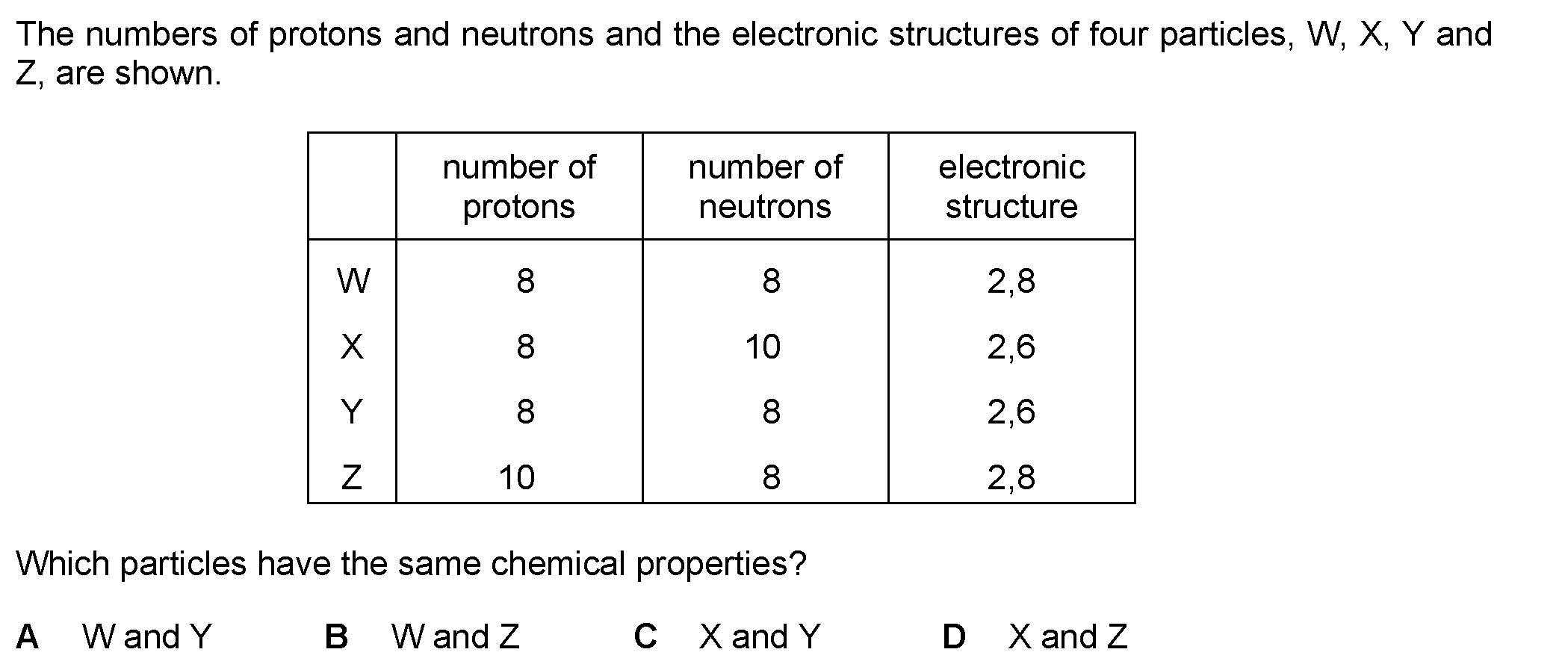
The numbers of protons and neutrons and the electronic structures of four particles, W, X, Y and
number of number of electronic
protons neutrons structure
Z, are shown.
Which particles have the same chemical properties?
A Wandy B WandZ C XandyY D XandZ
number of number of electronic
protons neutrons structure
Z, are shown.
Which particles have the same chemical properties?
A Wandy B WandZ C XandyY D XandZ
Options:
A
B
C
D
Correct Key: C
A
B
C
D
Correct Key: C
Question 10
Paper Ref: 5129/11_Winter_2022_Q21
Paper Ref: 5129/11_Winter_2022_Q21
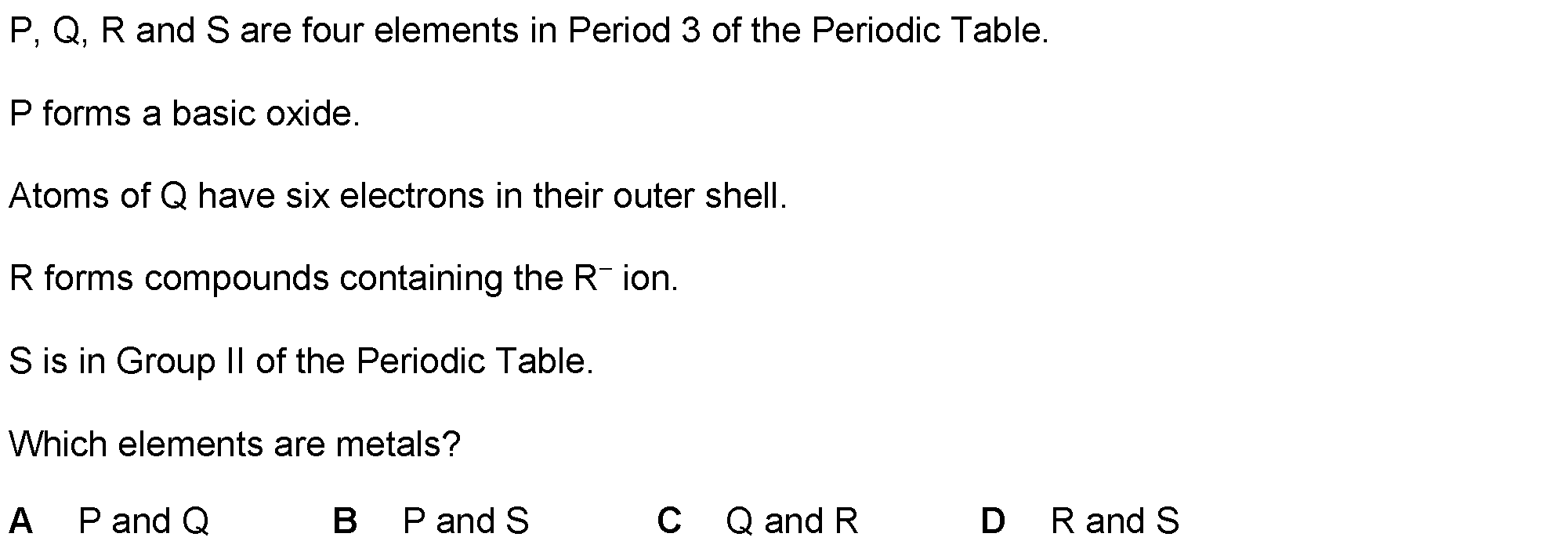
P, Q, R and S are four elements in Period 3 of the Periodic Table.
P forms a basic oxide.
Atoms of Q have six electrons in their outer shell.
R forms compounds containing the R™ ion.
S is in Group II of the Periodic Table.
Which elements are metals?
A PandQ B PandS C QandR D RandS
P forms a basic oxide.
Atoms of Q have six electrons in their outer shell.
R forms compounds containing the R™ ion.
S is in Group II of the Periodic Table.
Which elements are metals?
A PandQ B PandS C QandR D RandS
Options:
A
B
C
D
Correct Key: B
A
B
C
D
Correct Key: B
Question 11
Paper Ref: 0620/22_Summer_2017_Q4
Paper Ref: 0620/22_Summer_2017_Q4
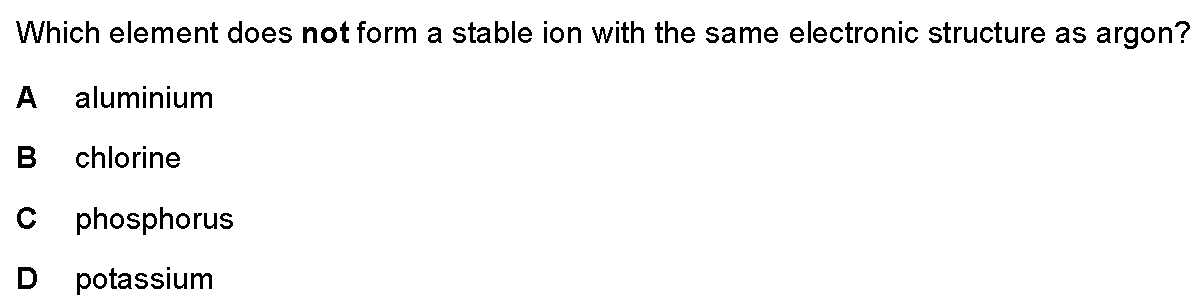
Which element does not form a stable ion with the same electronic structure as argon?
aluminium
B_ chlorine
C phosphorus
D_ potassium
aluminium
B_ chlorine
C phosphorus
D_ potassium
Options:
A
B
C
D
Correct Key: A
A
B
C
D
Correct Key: A
Question 12
Paper Ref: 5129/11_Summer_2025_Q16
Paper Ref: 5129/11_Summer_2025_Q16
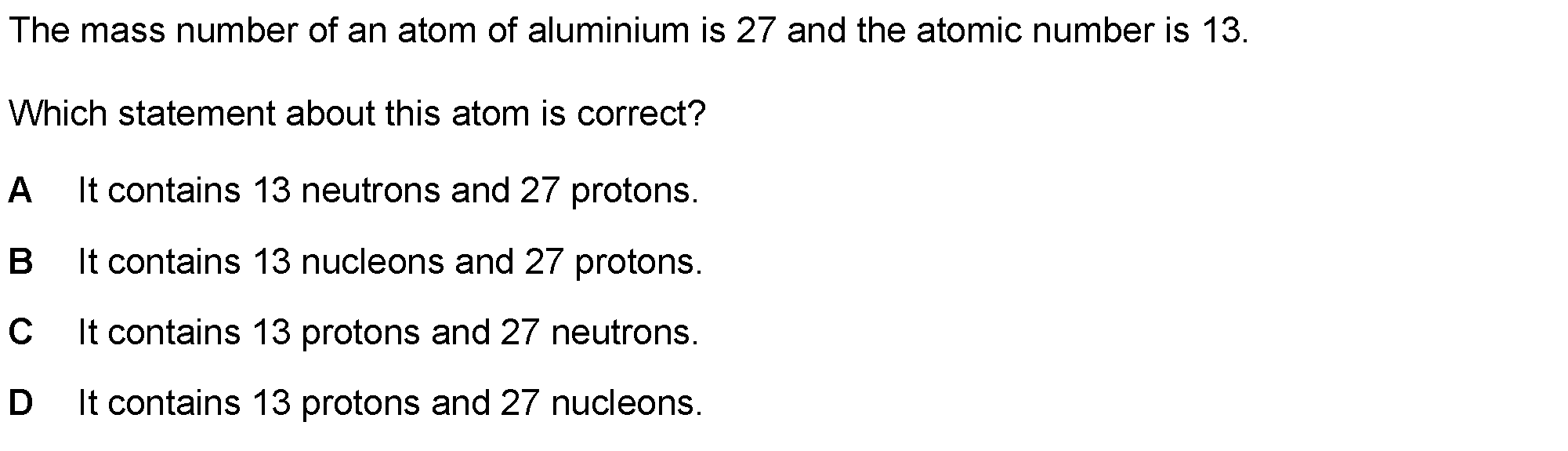
The mass number of an atom of aluminium is 27 and the atomic number is 13.
Which statement about this atom is correct?
A |t contains 13 neutrons and 27 protons.
B It contains 13 nucleons and 27 protons.
C_ It contains 13 protons and 27 neutrons.
D
It contains 13 protons and 27 nucleons.
Which statement about this atom is correct?
A |t contains 13 neutrons and 27 protons.
B It contains 13 nucleons and 27 protons.
C_ It contains 13 protons and 27 neutrons.
D
It contains 13 protons and 27 nucleons.
Options:
A
B
C
D
Correct Key: D
A
B
C
D
Correct Key: D
Question 13
Paper Ref: 0620/22_Summer_2021_Q23
Paper Ref: 0620/22_Summer_2021_Q23
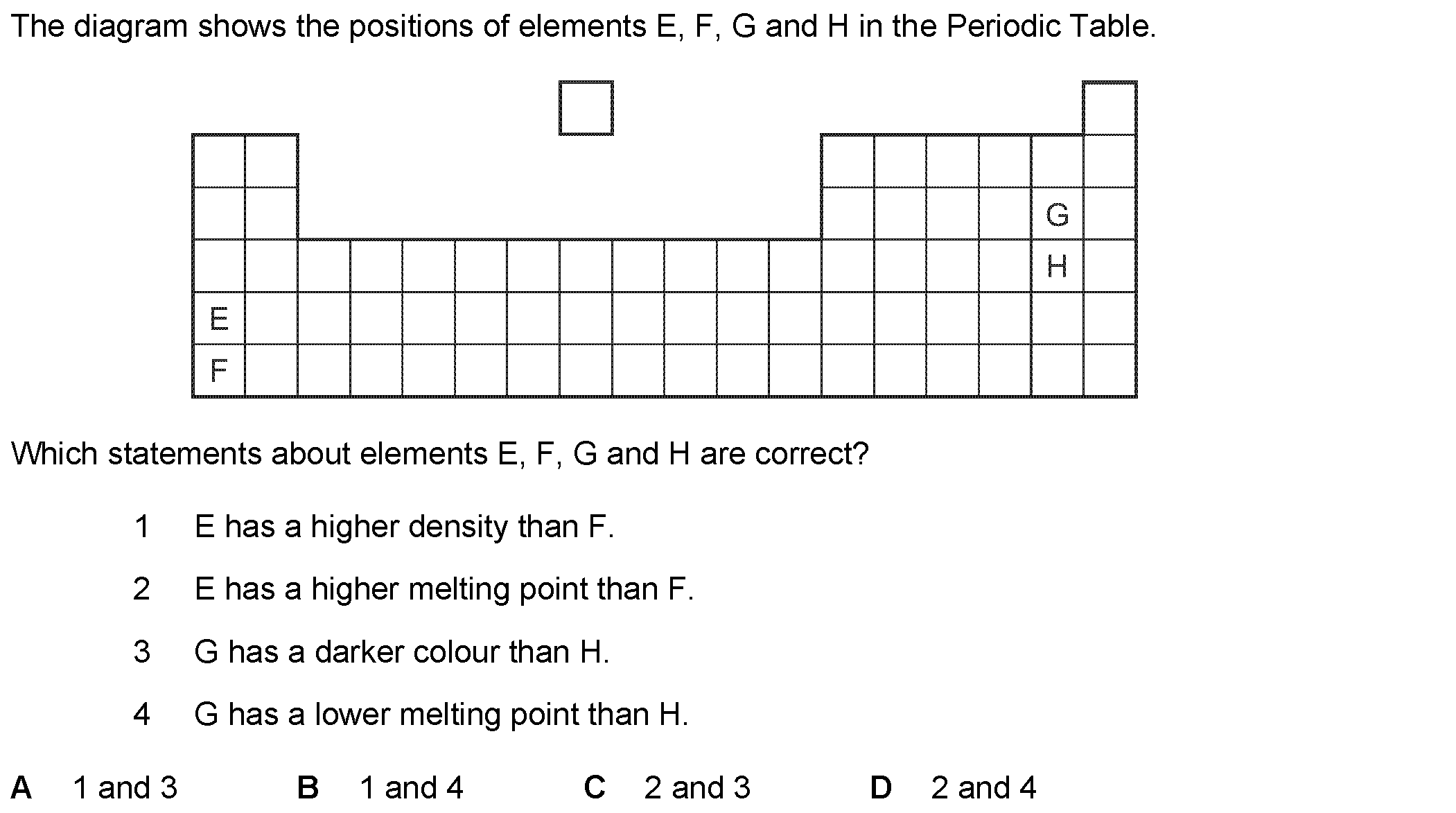
The diagram shows the positions of elements E, F, G and H in the Periodic Table.
Which statements about elements E, F, G and H are correct?
1. E has a higher density than F.
2 E has a higher melting point than F.
3 Ghas a darker colour than H.
4
G has a lower melting point than H.
A 1and3 B 1and4 C 2and3 D 2and4
Which statements about elements E, F, G and H are correct?
1. E has a higher density than F.
2 E has a higher melting point than F.
3 Ghas a darker colour than H.
4
G has a lower melting point than H.
A 1and3 B 1and4 C 2and3 D 2and4
Options:
A
B
C
D
Correct Key: D
A
B
C
D
Correct Key: D
Question 14
Paper Ref: 0620/13_Winter_2017_Q7
Paper Ref: 0620/13_Winter_2017_Q7
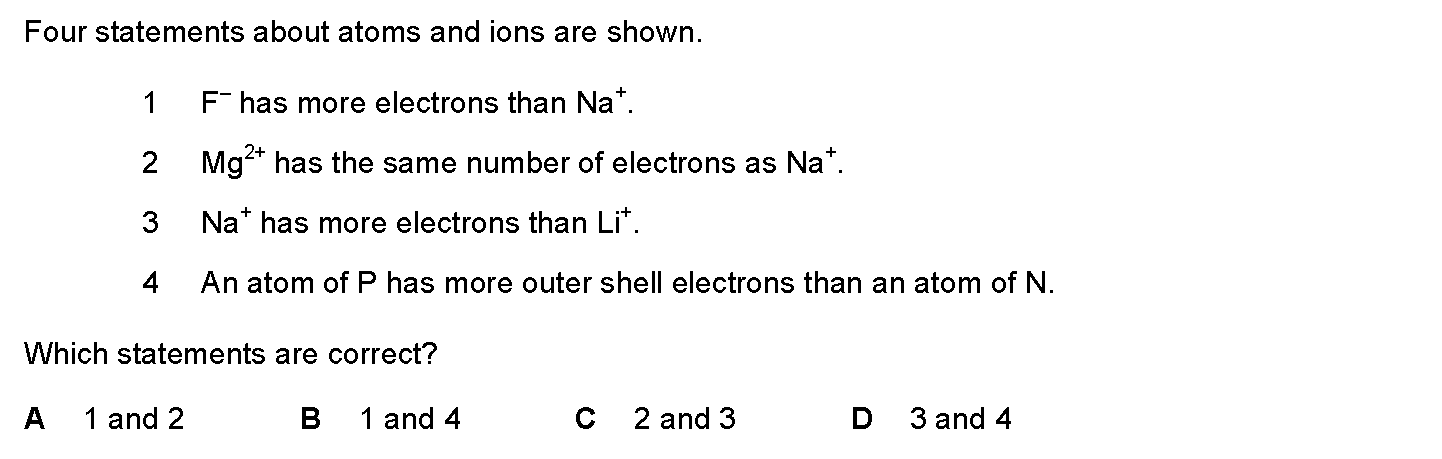
Four statements about atoms and ions are shown.
1 F has more electrons than Na’*.
Mg" has the same number of electrons as Na’.
Na* has more electrons than Li’.
bh WN
An atom of P has more outer shell electrons than an atom of N.
Which statements are correct?
A 1and2 B iand4 C 2and3 D 3and4
1 F has more electrons than Na’*.
Mg" has the same number of electrons as Na’.
Na* has more electrons than Li’.
bh WN
An atom of P has more outer shell electrons than an atom of N.
Which statements are correct?
A 1and2 B iand4 C 2and3 D 3and4
Options:
A
B
C
D
Correct Key: C
A
B
C
D
Correct Key: C
Question 15
Paper Ref: 0620/13_Summer_2024_Q25
Paper Ref: 0620/13_Summer_2024_Q25
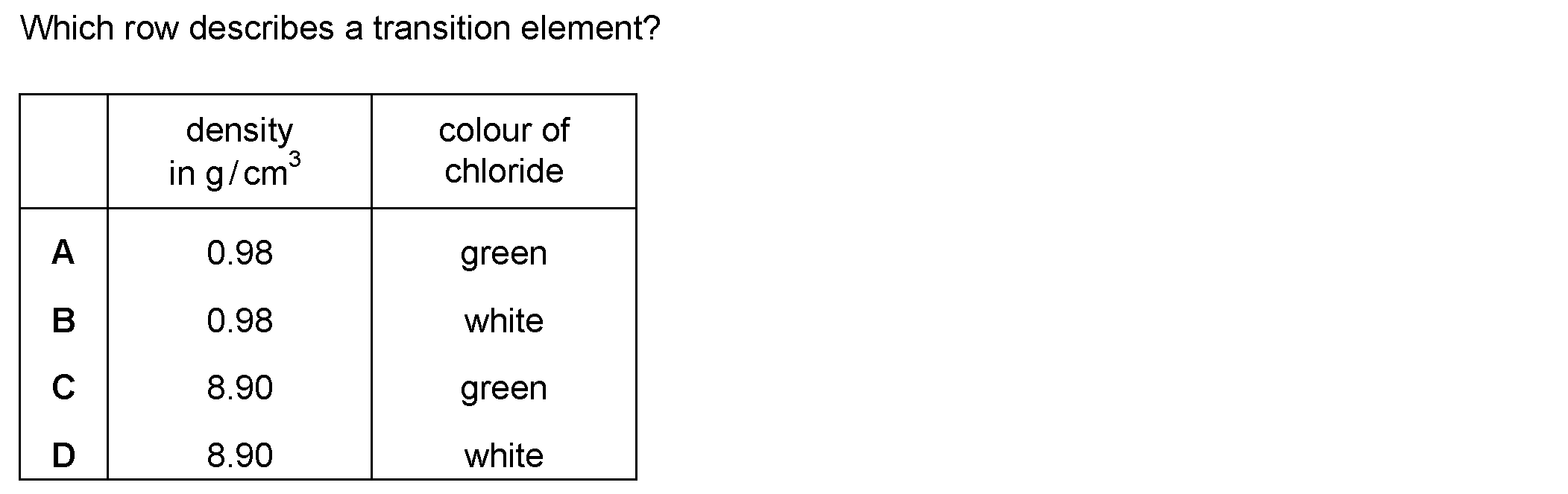
Which row describes a transition element?
density colour of
in g/cm* chloride
density colour of
in g/cm* chloride
Options:
A
B
C
D
Correct Key: C
A
B
C
D
Correct Key: C
Question 16
Paper Ref: 5129/12_Winter_2025_Q16
Paper Ref: 5129/12_Winter_2025_Q16
The nucleon number of an atom of copper is 64 and the atomic number is 29.
How many electrons are there in this atom of copper?
A 29 B 35 C 64 D 93
How many electrons are there in this atom of copper?
A 29 B 35 C 64 D 93
Options:
A
B
C
D
Correct Key: A
A
B
C
D
Correct Key: A
Question 17
Paper Ref: 5129/12_Summer_2021_Q17
Paper Ref: 5129/12_Summer_2021_Q17
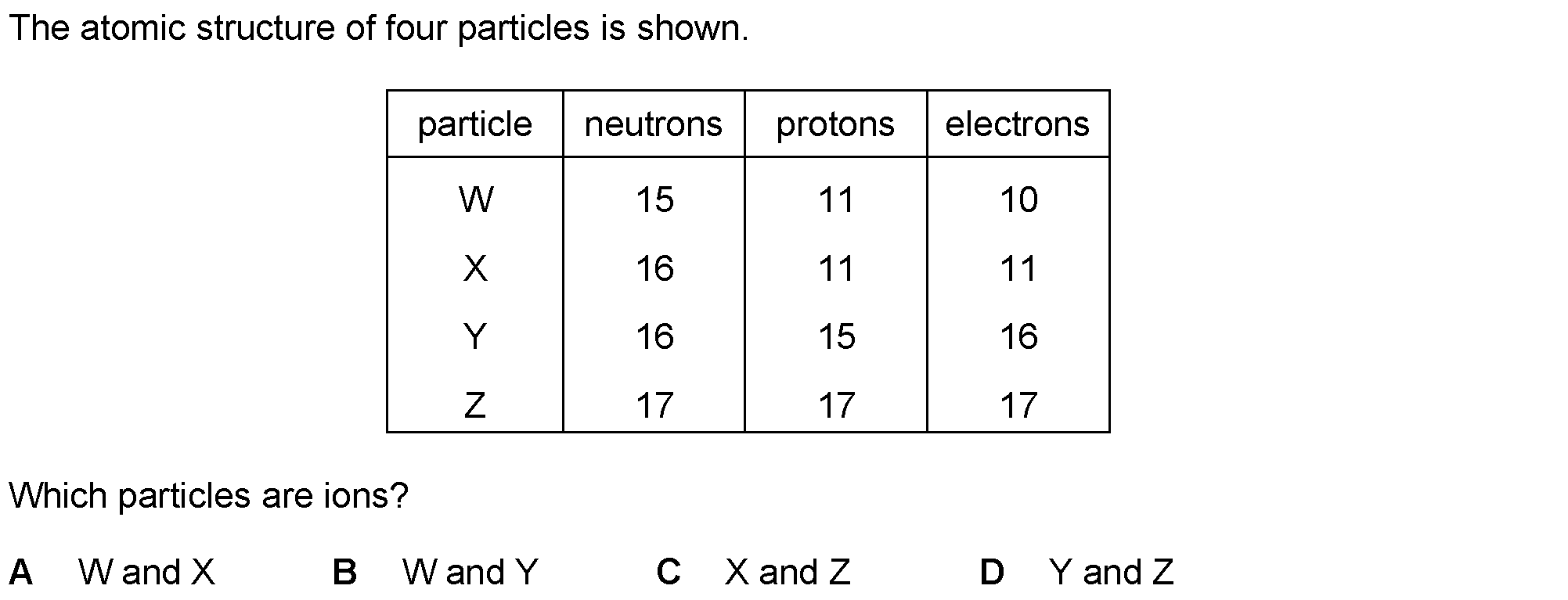
The atomic structure of four particles is shown.
particle | neutrons | protons | electrons
15 11 10
16 11 11
16 15 16
17 17 17
A WandxX B WandY C XandZ D YandZ
Which particles are ions?
particle | neutrons | protons | electrons
15 11 10
16 11 11
16 15 16
17 17 17
A WandxX B WandY C XandZ D YandZ
Which particles are ions?
Options:
A
B
C
D
Correct Key: B
A
B
C
D
Correct Key: B
Structured Questions Mark Scheme & Answers
•1•.• • • •[•▍• •S•P• •S•9• •P•1• • •·• • •Q•2• • •P•a•r•t• •(•a•)• • •·• • •S•p•e•c•i•m•e•n• • •·• • •L•o•w•e•r• •S•e•c• •0•8•9•3•]• • • • • • •2•.•8•.•3• •1• •••c•c•e•p•t• •c•o•r•r•e•c•t• •d•r•a•w•i•n•g• •b•u•t• •2•.•8•.•3• •t•a•k•e•s• •p•r•e•c•e•d•e•n•c•e•
•2•.• • • •[•▍• •S•P• •S•9• •P•2• • •·• • •Q•2• • •P•a•r•t• •(•b•)• • •·• • •S•p•e•c•i•m•e•n• • •·• • •L•o•w•e•r• •S•e•c• •0•8•9•3•]• • • • • • •(•g•r•o•u•p•)• •6• •1• •••c•c•e•p•t• •V•I• •/• •1•6•
•3•.• • • •[•▍• •C•P• •M•a•y• •2•0•2•4• •P•1• • •·• • •Q•2• • •P•a•r•t• •(•b•)• • •·• • •2•0•2•4• • •·• • •L•o•w•e•r• •S•e•c• •0•8•9•3•]• • • • • • •2•.•8•.•8•.•1• •1• •••c•c•e•p•t• •c•o•r•r•e•c•t• •d•o•t•-•a•n•d•-•c•r•o•s•s• •d•i•a•g•r•a•m• •••c•c•e•p•t• •K•2• •L•8• •M•8• •N•1•
•4•.• • • •[•▍• •C•P• •M•a•y• •2•0•2•4• •P•2• • •·• • •Q•1•3• • •P•a•r•t• •(•c•)• • •·• • •2•0•2•4• • •·• • •L•o•w•e•r• •S•e•c• •0•8•9•3•]• • • • • • •s•i•m•p•l•e• •(•s•t•r•u•c•t•u•r•e•)• •1•
•5•.• • • •[•▍• •C•P• •M•a•y• •2•0•2•5• •P•2• • •·• • •Q•2• • •P•a•r•t• •(•a•)• • •·• • •2•0•2•5• • •·• • •L•o•w•e•r• •S•e•c• •0•8•9•3•]• • • • • • •e•l•e•c•t•r•o•n•s• •1• •••c•c•e•p•t• •s•h•a•r•e•d• •p•a•i•r• •o•f• •e•l•e•c•t•r•o•n•s• •I•g•n•o•r•e• •c•o•v•a•l•e•n•t• •b•o•n•d•
•6•.• • • •[•▍• •C•P• •M•a•y• •2•0•2•5• •P•2• • •·• • •Q•2• • •P•a•r•t• •(•b•)• • •·• • •2•0•2•5• • •·• • •L•o•w•e•r• •S•e•c• •0•8•9•3•]• • • • • • •b•r•o•m•i•n•e• •i•s• •i•n• •s•a•m•e• •g•r•o•u•p• •(•o•f• •t•h•e• •P•e•r•i•o•d•i•c• •T•a•b•l•e•)• •a•s• •1• •••c•c•e•p•t• •b•r•o•m•i•n•e• •a•n•d• •c•h•l•o•r•i•n•e• •h•a•v•e• •t•h•e• •s•a•m•e• •c•h•l•o•r•i•n•e• •n•u•m•b•e•r• •o•f• •e•l•e•c•t•r•o•n•s• •i•n• •t•h•e•i•r• •o•u•t•e•r• •s•h•e•l•l•s• •••c•c•e•p•t• •b•r•o•m•i•n•e• •i•s• •a•l•s•o• •i•n• •G•r•o•u•p• •7• •o•r• •b•o•t•h• •a•r•e• •i•n• •G•r•o•u•p• •7• •o•r• •b•o•t•h• •a•r•e• •i•n• •G•r•o•u•p• •1•7• •N•o•t•e• •b•r•o•m•i•n•e• •i•s• •i•n• •G•r•o•u•p• •7• •i•s• •n•o•t• •s•u•f•f•i•c•i•e•n•t• •o•r• •b•r•o•m•i•n•e• •h•a•s• •s•e•v•e•n• •e•l•e•c•t•r•o•n•s• •i•n• •i•t•s• •o•u•t•e•r• •s•h•e•l•l• •i•s• •n•o•t• •s•u•f•f•i•c•i•e•n•t• •t•h•e• •a•n•s•w•e•r• •m•u•s•t• •i•m•p•l•y• •b•o•t•h• •e•l•e•m•e•n•t•s• •a•r•e• •i•n• •t•h•e• •s•a•m•e• •g•r•o•u•p•
•7•.• • • •[•▍• •C•P• •M•a•y• •2•0•2•5• •P•2• • •·• • •Q•2• • •P•a•r•t• •(•c•)• • •·• • •2•0•2•5• • •·• • •L•o•w•e•r• •S•e•c• •0•8•9•3•]• • • • • • •g•a•i•n•s• •(•o•n•e•)• •e•l•e•c•t•r•o•n•(•s•)• •1• •••c•c•e•p•t• •e•−• •o•r• •e• •t•o• •r•e•p•r•e•s•e•n•t• •a•n• •e•l•e•c•t•r•o•n• •D•o• •n•o•t• •a•c•c•e•p•t• •s•h•a•r•e•s• •e•l•e•c•t•r•o•n•s• •D•o• •n•o•t• •a•c•c•e•p•t• •g•a•i•n•s• •e•l•e•c•t•r•o•n•s• •f•r•o•m• •a•n•o•t•h•e•r• •c•h•l•o•r•i•n•e• •a•t•o•m• •b•u•t• •a•c•c•e•p•t• •g•a•i•n•s• •e•l•e•c•t•r•o•n•s• •f•r•o•m• •a•n•o•t•h•e•r• •a•t•o•m• •••0•8•9•3•/•0•2• •C•h•e•c•k•p•o•i•n•t• •S•e•c•o•n•d•a•r•y• •–• •M•a•r•k• •S•c•h•e•m•e• •••p•r•i•l• •2•0•2•5•
•8•.• • • •[•▍• •C•P• •O•c•t•o•b•e•r• •2•0•2•5• •P•1• • •·• • •Q•2• • •P•a•r•t• •(•a•)• • •·• • •2•0•2•5• • •·• • •L•o•w•e•r• •S•e•c• •0•8•9•3•]• • • • • • •E• •1• •••c•c•e•p•t• •b•o•r•o•n• •o•r• •2•.•3•
Last updated:
\n