2.3Thermal Physics
Why elements react — Question Bank (Cambridge) — Cambridge IGCSE Physics 0625 Revision Notes & Topical Questions
10 min read Lesson 21 of 45 Unit quiz
Cambridge Past Paper Bank
2.3 Why elements react
19 Multiple-Choice Questions with Official Mark Schemes
Question 1
0620/22_Spring_2020_Q4
Question 2
0620/23_Winter_2011_Q3
Question 3
0620/23_Summer_2019_Q6
Question 4
0620/22_Spring_2025_Q6
Question 5
0620/13_Summer_2021_Q8
Question 6
0620/22_Spring_2024_Q6
Question 7
0620/22_Spring_2023_Q6
Question 8
0620/21_Winter_2013_Q6
Question 9
0620/23_Summer_2025_Q6
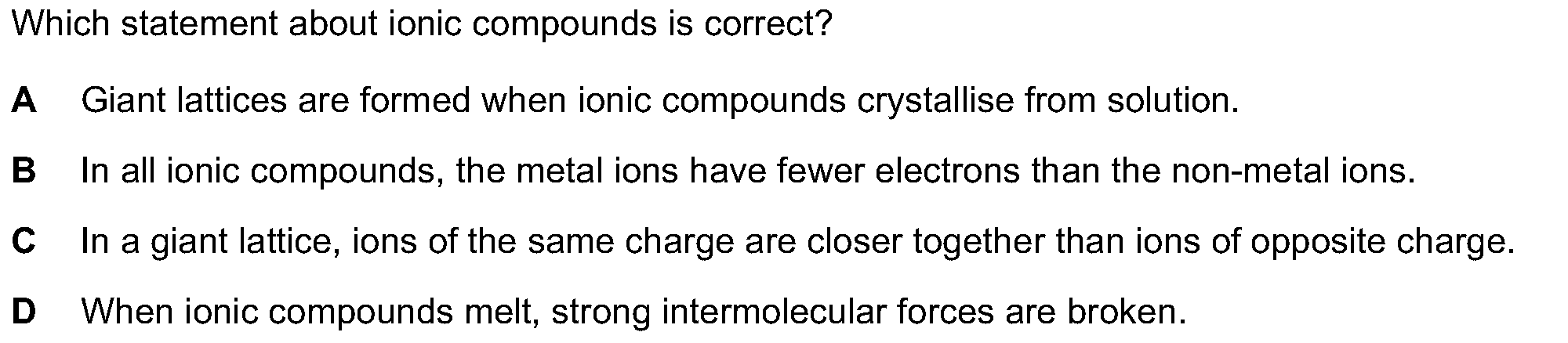
Question 10
0620/23_Summer_2012_Q4
Question 11
0620/22_Winter_2014_Q6
Question 12
0620/22_Spring_2022_Q4
Question 13
0620/23_Winter_2013_Q7
Question 14
0620/23_Summer_2011_Q6
Question 15
0620/23_Winter_2021_Q9
Question 16
0620/23_Summer_2021_Q6
Question 17
0620/12_Summer_2025_Q8

Question 18
0620/22_Winter_2024_Q4
Question 19
0620/23_Winter_2012_Q6

Cambridge Lower Secondary Stage 9
2.3 Why elements react – Complete Question Bank & Mark Scheme
Total Questions19 Questions with Verified Solutions & Past Paper Mark Schemes
Multiple Choice Questions (Exam Practice)
Question 1
Paper Ref: 0620/22_Spring_2020_Q4
Paper Ref: 0620/22_Spring_2020_Q4
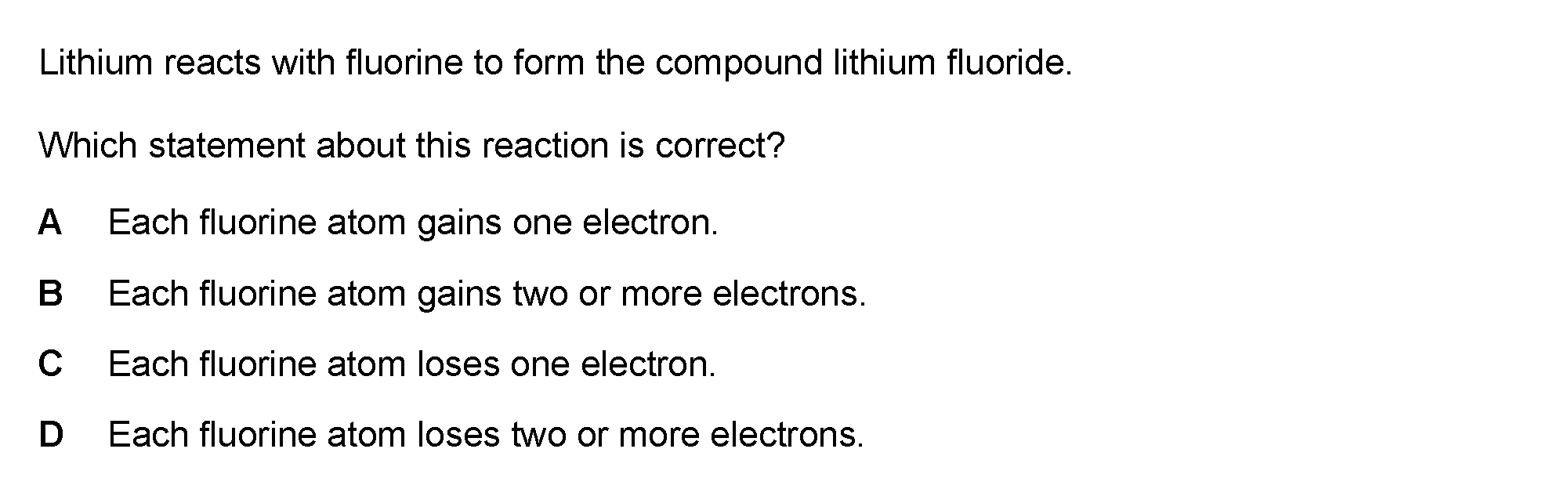
Lithium reacts with fluorine to form the compound lithium fluoride.
Which statement about this reaction is correct?
A
B
Cc
D
Each fluorine atom gains one electron.
Each fluorine atom gains two or more electrons.
Each fluorine atom loses one electron.
Each fluorine atom loses two or more electrons.
Which statement about this reaction is correct?
A
B
Cc
D
Each fluorine atom gains one electron.
Each fluorine atom gains two or more electrons.
Each fluorine atom loses one electron.
Each fluorine atom loses two or more electrons.
Options:
A
B
C
D
Correct Key: A
A
B
C
D
Correct Key: A
Question 2
Paper Ref: 0620/23_Winter_2011_Q3
Paper Ref: 0620/23_Winter_2011_Q3
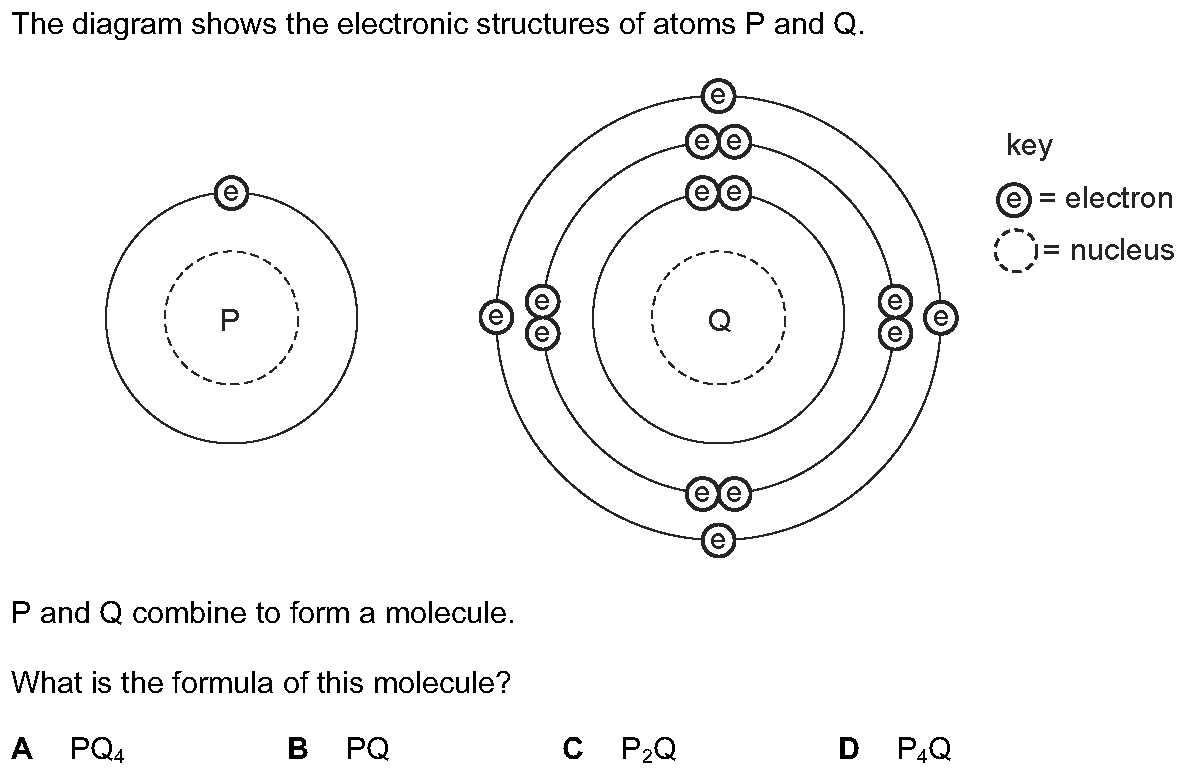
The diagram shows the electronic structures of atoms P and Q.
key
© = electron
on
(_J= nucleus
P and Q combine to form a molecule.
What is the formula of this molecule?
A PQ, B PQ Cc P2Q D P,Q
key
© = electron
on
(_J= nucleus
P and Q combine to form a molecule.
What is the formula of this molecule?
A PQ, B PQ Cc P2Q D P,Q
Options:
A
B
C
D
Correct Key: D
A
B
C
D
Correct Key: D
Question 3
Paper Ref: 0620/23_Summer_2019_Q6
Paper Ref: 0620/23_Summer_2019_Q6
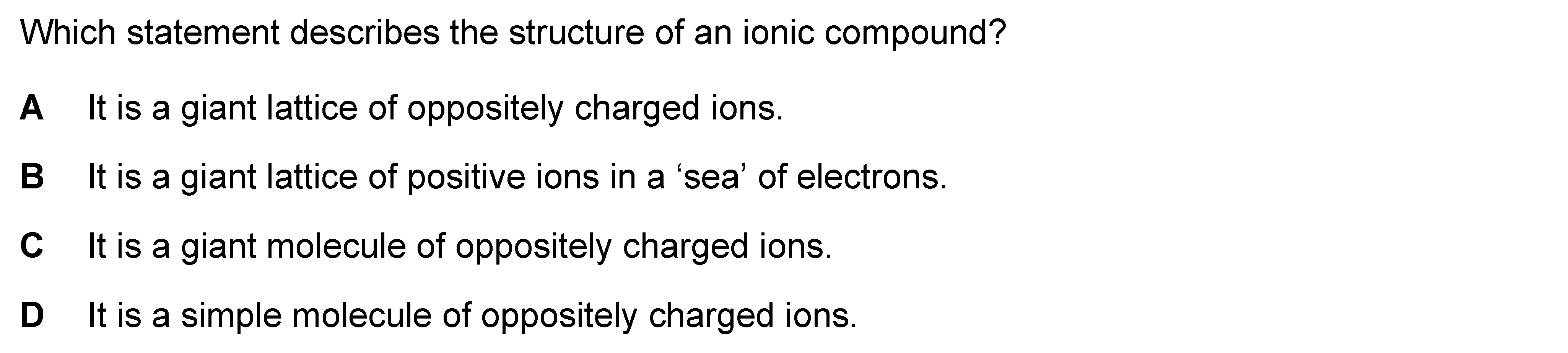
Which statement describes the structure of an ionic compound?
A
B
C
D
It is a giant lattice of oppositely charged ions.
It is a giant lattice of positive ions in a ‘sea’ of electrons.
It is a giant molecule of oppositely charged ions.
It is a simple molecule of oppositely charged ions.
A
B
C
D
It is a giant lattice of oppositely charged ions.
It is a giant lattice of positive ions in a ‘sea’ of electrons.
It is a giant molecule of oppositely charged ions.
It is a simple molecule of oppositely charged ions.
Options:
A
B
C
D
Correct Key: A
A
B
C
D
Correct Key: A
Question 4
Paper Ref: 0620/22_Spring_2025_Q6
Paper Ref: 0620/22_Spring_2025_Q6
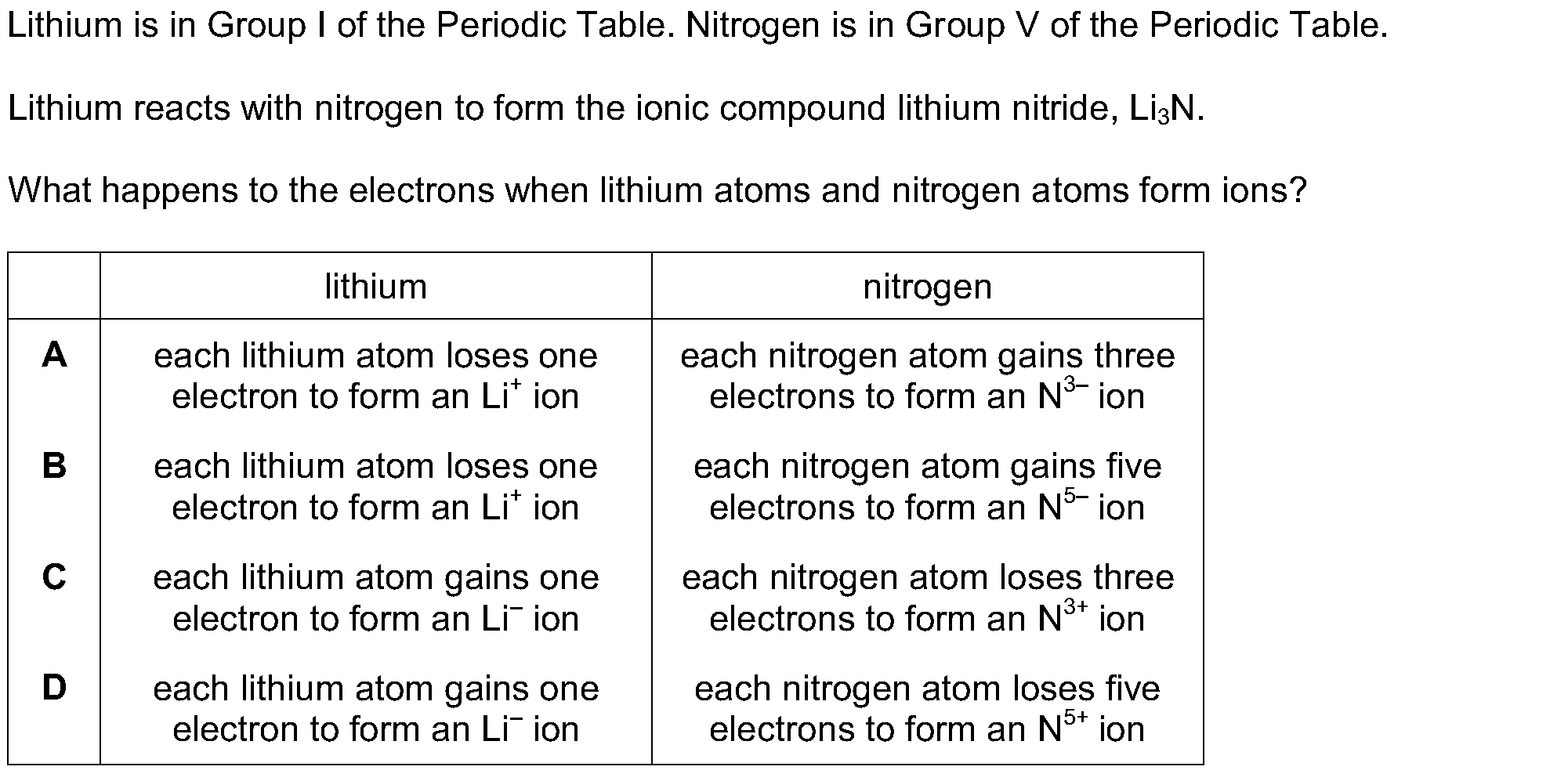
Lithium is in Group | of the Periodic Table. Nitrogen is in Group V of the Periodic Table.
Lithium reacts with nitrogen to form the ionic compound lithium nitride, Li3N.
What happens to the electrons when lithium atoms and nitrogen atoms form ions?
lithium nitrogen
A each lithium atom loses one each nitrogen atom gains three
electron to form an Li’ ion electrons to form an N* ion
B each lithium atom loses one each nitrogen atom gains five
electron to form an Li’ ion electrons to form an N®™ ion
Cc each lithium atom gains one each nitrogen atom loses three
electron to form an Li” ion electrons to form an N* ion
D each lithium atom gains one each nitrogen atom loses five
electron to form an Li” ion electrons to form an N®™ ion
Options:
A
B
C
D
Correct Key: A
A
B
C
D
Correct Key: A
Question 5
Paper Ref: 0620/13_Summer_2021_Q8
Paper Ref: 0620/13_Summer_2021_Q8
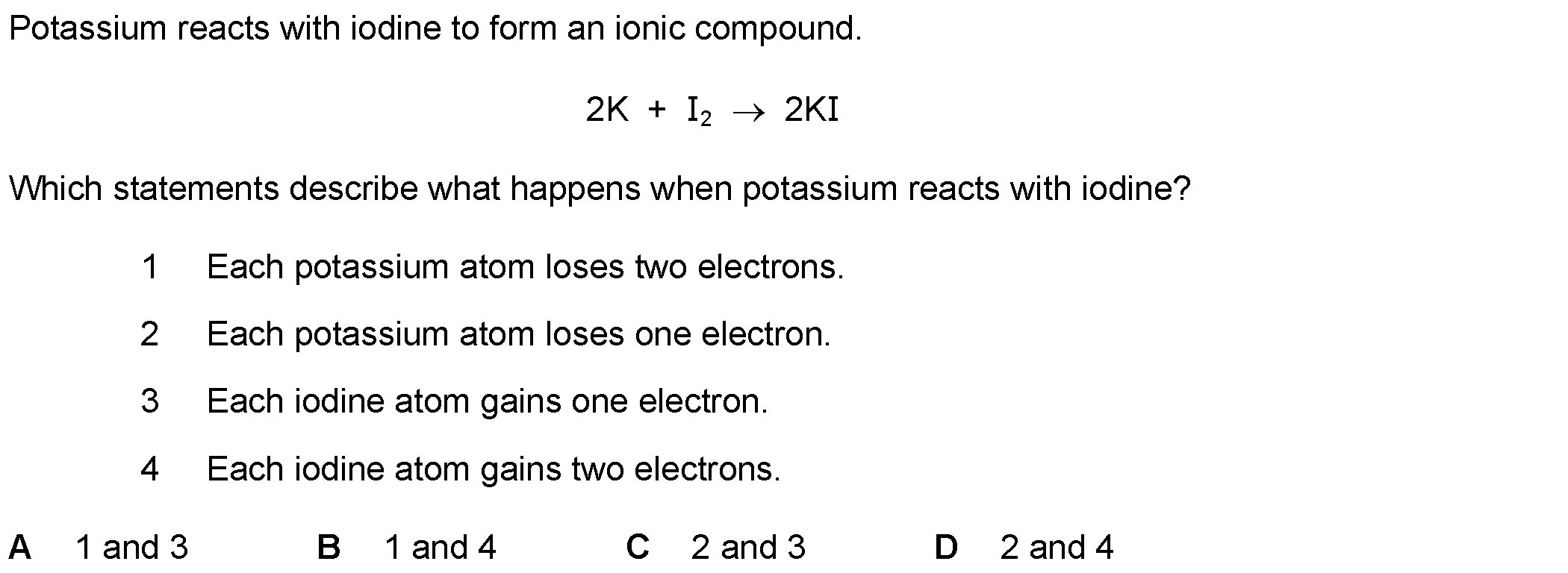
Potassium reacts with iodine to form an ionic compound.
2K + I, > 2KI
Which statements describe what happens when potassium reacts with iodine?
A
1
2
3
4
1 and 3
Each potassium atom loses two electrons.
Each potassium atom loses one electron.
Each iodine atom gains one electron.
Each iodine atom gains two electrons.
B tand4 C 2and3 D 2and4
2K + I, > 2KI
Which statements describe what happens when potassium reacts with iodine?
A
1
2
3
4
1 and 3
Each potassium atom loses two electrons.
Each potassium atom loses one electron.
Each iodine atom gains one electron.
Each iodine atom gains two electrons.
B tand4 C 2and3 D 2and4
Options:
A
B
C
D
Correct Key: C
A
B
C
D
Correct Key: C
Question 6
Paper Ref: 0620/22_Spring_2024_Q6
Paper Ref: 0620/22_Spring_2024_Q6
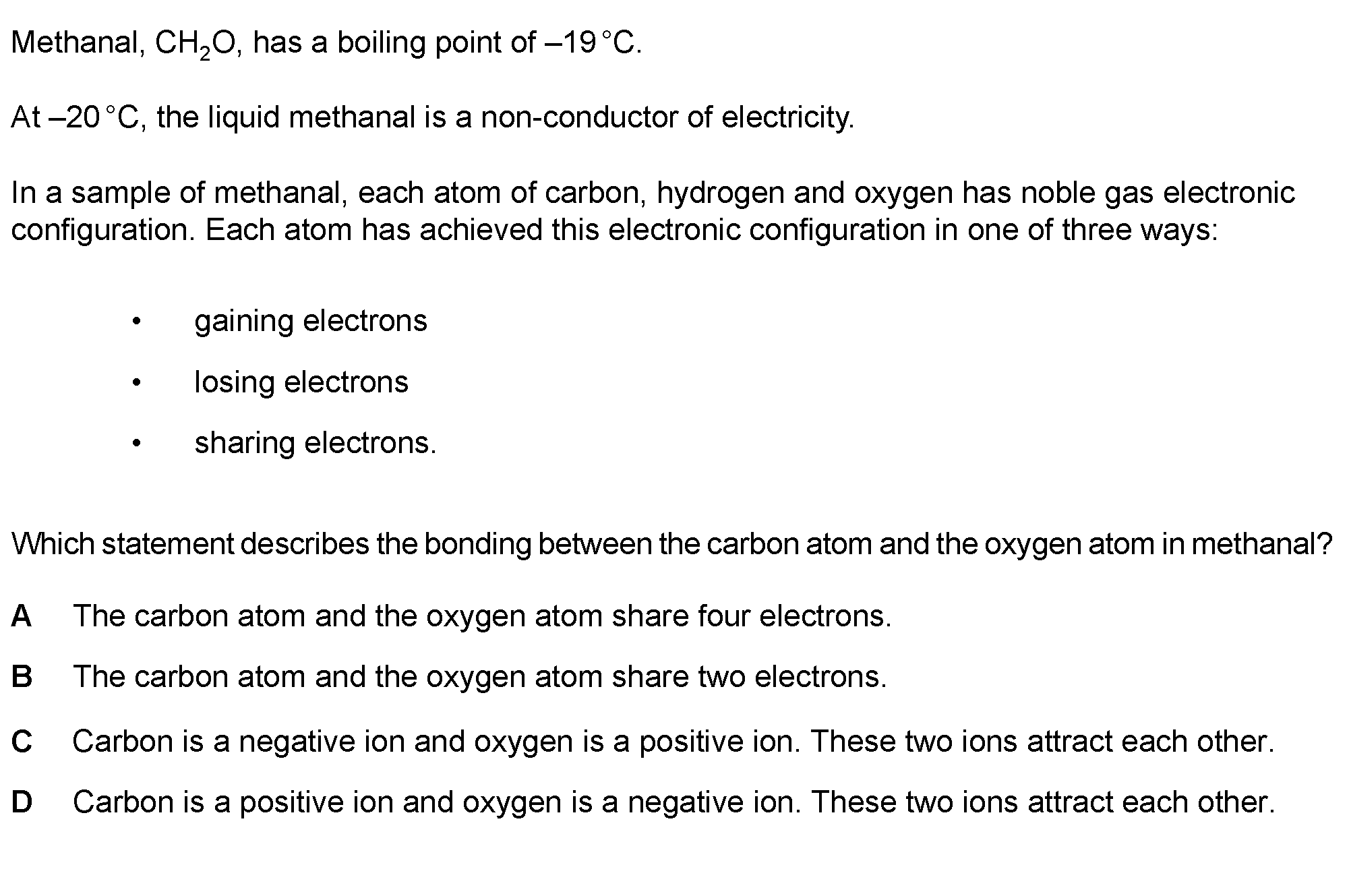
Methanal, CH,O, has a boiling point of -19°C.
At -20°C, the liquid methanal is a non-conductor of electricity.
In a sample of methanal, each atom of carbon, hydrogen and oxygen has noble gas electronic
configuration. Each atom has achieved this electronic configuration in one of three ways:
* gaining electrons
* — losing electrons
* — sharing electrons.
Which statement describes the bonding between the carbon atom and the oxygen atom in methanal?
The carbon atom and the oxygen atom share four electrons.
The carbon atom and the oxygen atom share two electrons.
Carbon is a negative ion and oxygen is a positive ion. These two ions attract each other.
0 0O WD >
Carbon is a positive ion and oxygen is a negative ion. These two ions attract each other.
Options:
A
B
C
D
Correct Key: A
A
B
C
D
Correct Key: A
Question 7
Paper Ref: 0620/22_Spring_2023_Q6
Paper Ref: 0620/22_Spring_2023_Q6
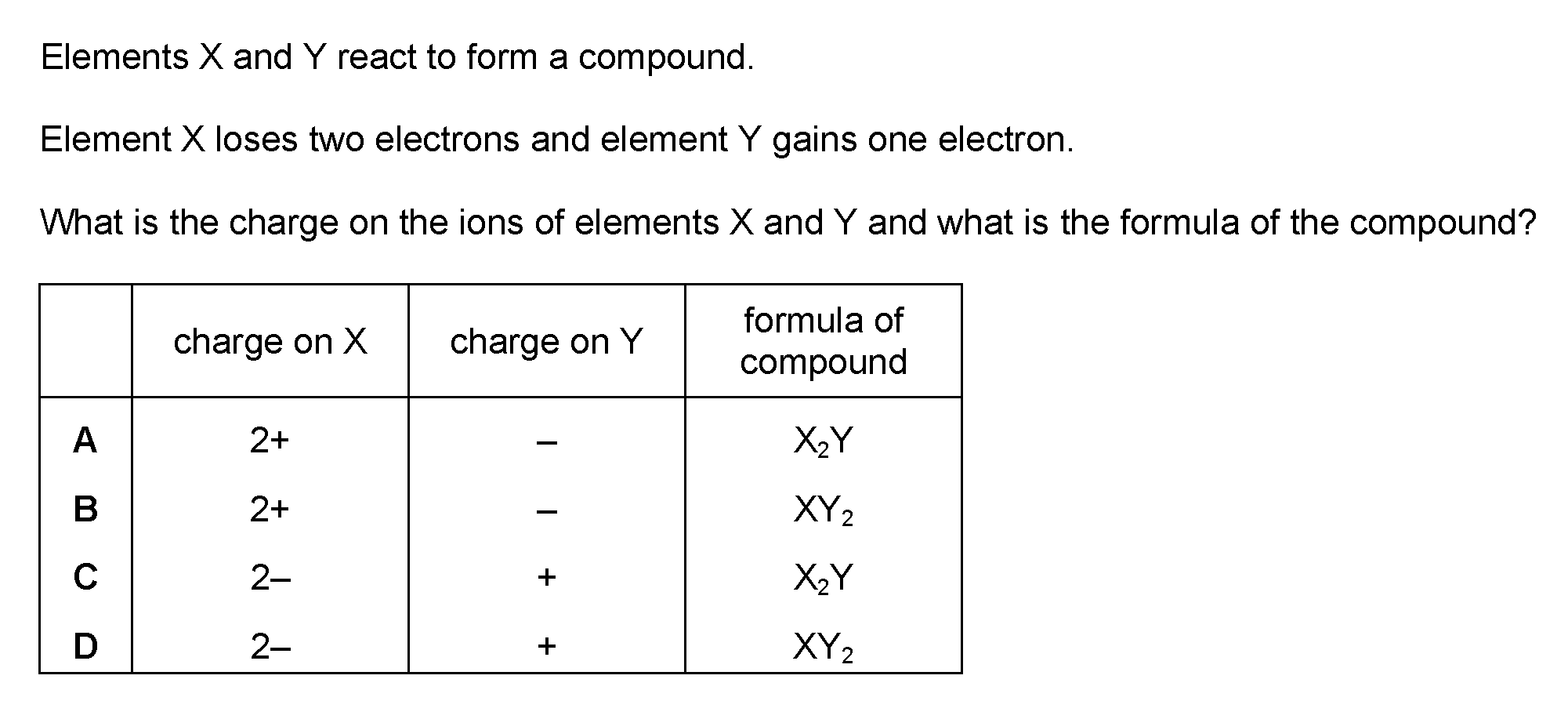
Elements X and Y react to form a compound.
Element X loses two electrons and element Y gains one electron.
What is the charge on the ions of elements X and Y and what is the formula of the compound?
| ormgeonx | ctareony | Smee
compound
A 2+ – XoY
Element X loses two electrons and element Y gains one electron.
What is the charge on the ions of elements X and Y and what is the formula of the compound?
| ormgeonx | ctareony | Smee
compound
A 2+ – XoY
Options:
A
B
C
D
Correct Key: B
A
B
C
D
Correct Key: B
Question 8
Paper Ref: 0620/21_Winter_2013_Q6
Paper Ref: 0620/21_Winter_2013_Q6
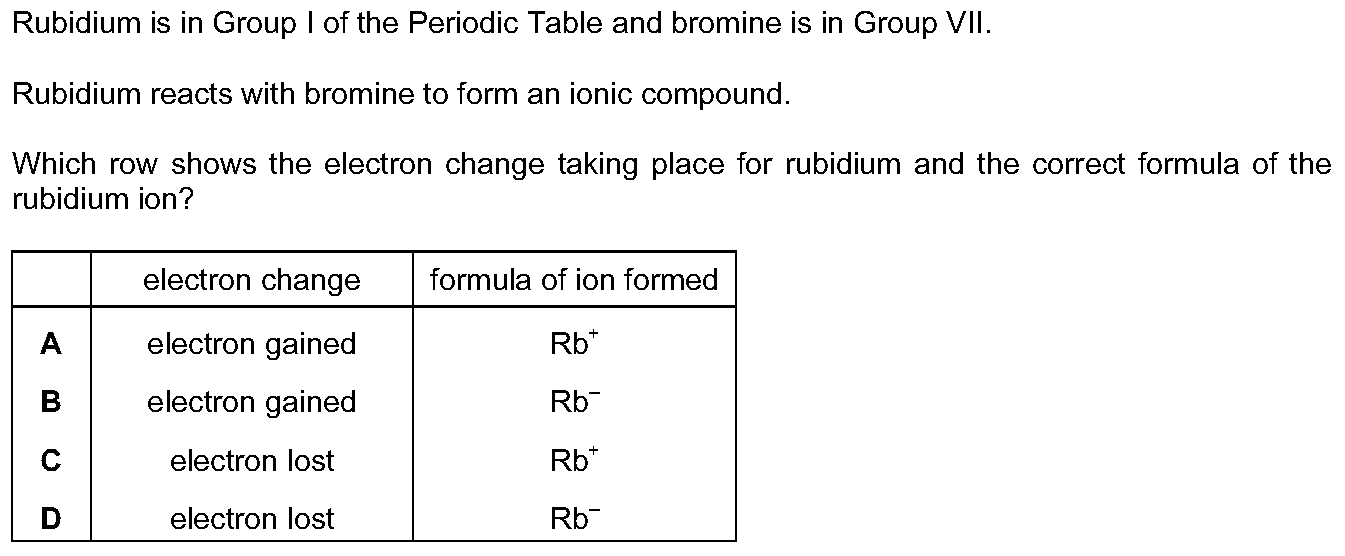
Rubidium is in Group | of the Periodic Table and bromine is in Group VII.
Rubidium reacts with bromine to form an ionic compound.
Which row shows the electron change taking place for rubidium and the correct formula of the
rubidium ion?
| | electron change formula of ion formed
A electron gained Rb’
B electron gained Rb-
Cc electron lost Rb*
D electron lost Rbo-
Rubidium reacts with bromine to form an ionic compound.
Which row shows the electron change taking place for rubidium and the correct formula of the
rubidium ion?
| | electron change formula of ion formed
A electron gained Rb’
B electron gained Rb-
Cc electron lost Rb*
D electron lost Rbo-
Options:
A
B
C
D
Correct Key: C
A
B
C
D
Correct Key: C
Question 9
Paper Ref: 0620/23_Summer_2025_Q6
Paper Ref: 0620/23_Summer_2025_Q6
Which statement about ionic compounds is correct?
A_ Giant lattices are formed when ionic compounds crystallise from solution.
B_Inall ionic compounds, the metal ions have fewer electrons than the non-metal ions.
C_ Ina giant lattice, ions of the same charge are closer together than ions of opposite charge.
D
When ionic compounds melt, strong intermolecular forces are broken.
Options:
A
B
C
D
Correct Key: A
A
B
C
D
Correct Key: A
Question 10
Paper Ref: 0620/23_Summer_2012_Q4
Paper Ref: 0620/23_Summer_2012_Q4
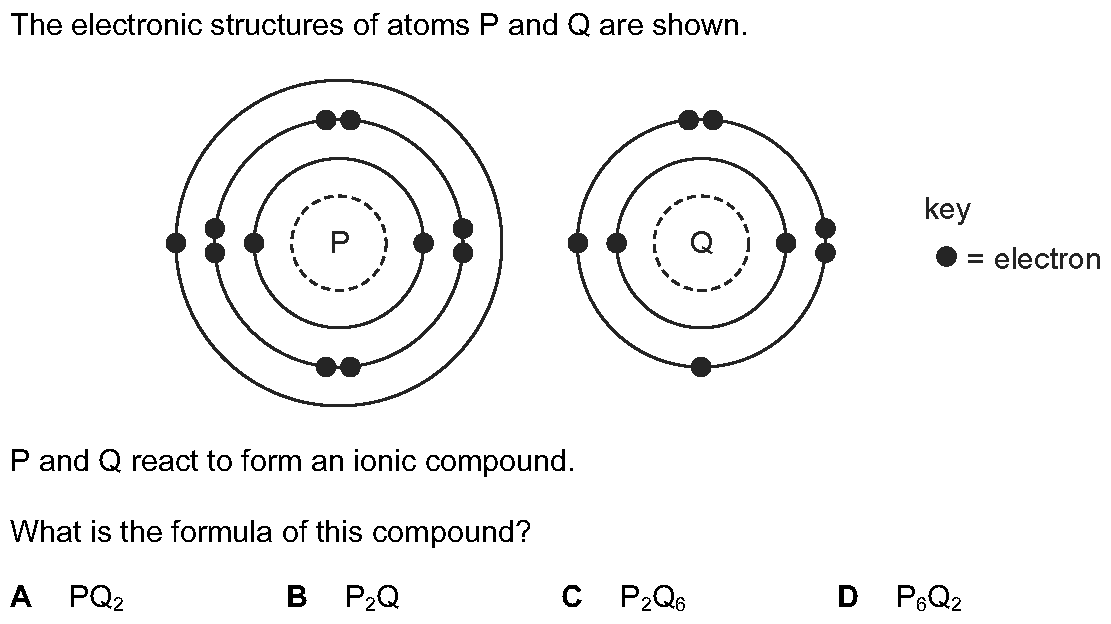
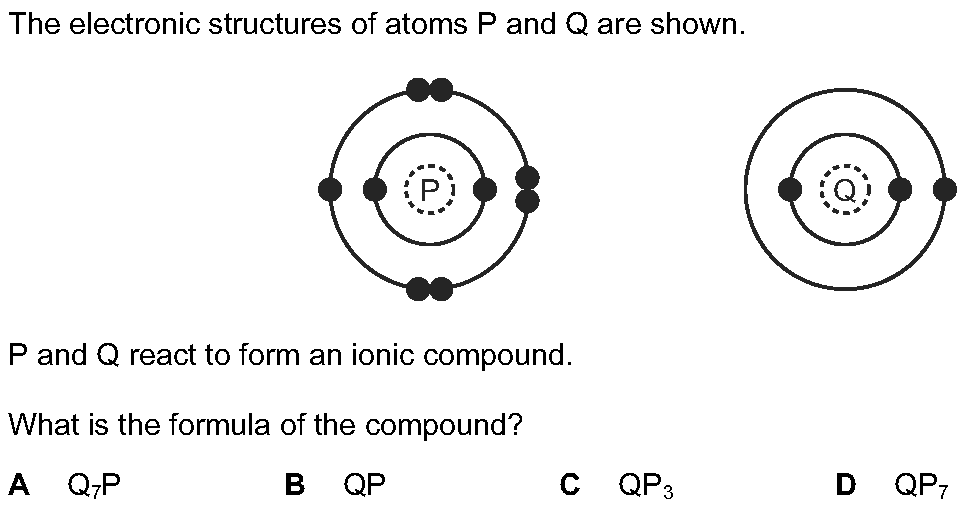
The electronic structures of atoms P and Q are shown.
key
@ = electron
P and Q react to form an ionic compound.
What is the formula of this compound?
A PQ, B P2Q Cc P2Q5 D PeQz
key
@ = electron
P and Q react to form an ionic compound.
What is the formula of this compound?
A PQ, B P2Q Cc P2Q5 D PeQz
Options:
A
B
C
D
Correct Key: B
A
B
C
D
Correct Key: B
Question 11
Paper Ref: 0620/22_Winter_2014_Q6
Paper Ref: 0620/22_Winter_2014_Q6
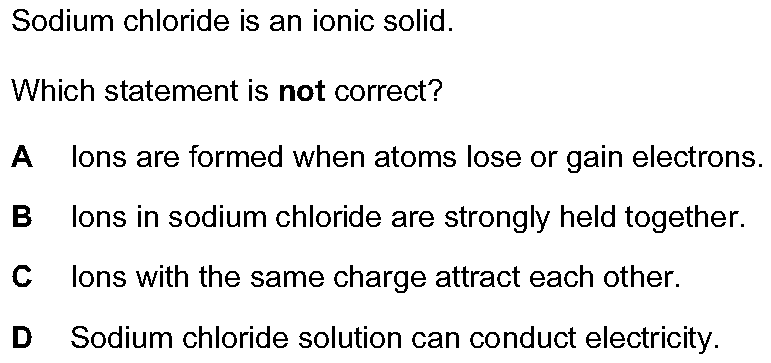
Sodium chloride is an ionic solid.
Which statement is not correct?
A
B
c
D
lons are formed when atoms lose or gain electrons.
lons in sodium chloride are strongly held together.
lons with the same charge attract each other.
Sodium chloride solution can conduct electricity.
Which statement is not correct?
A
B
c
D
lons are formed when atoms lose or gain electrons.
lons in sodium chloride are strongly held together.
lons with the same charge attract each other.
Sodium chloride solution can conduct electricity.
Options:
A
B
C
D
Correct Key: C
A
B
C
D
Correct Key: C
Question 12
Paper Ref: 0620/22_Spring_2022_Q4
Paper Ref: 0620/22_Spring_2022_Q4
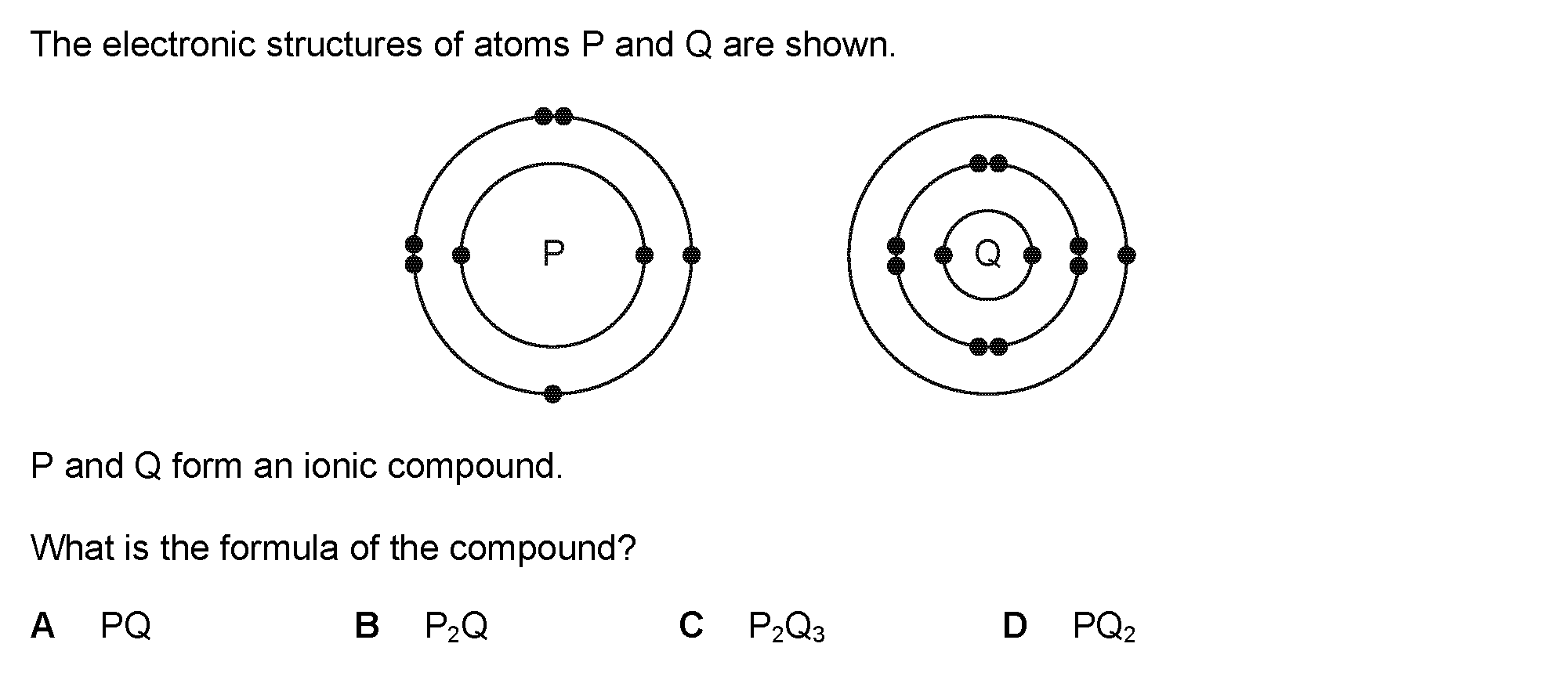
The electronic structures of atoms P and Q are shown.
(3)
P and Q form an ionic compound.
What is the formula of the compound?
A PQ B PQ C P2Q3 D PQ,
(3)
P and Q form an ionic compound.
What is the formula of the compound?
A PQ B PQ C P2Q3 D PQ,
Options:
A
B
C
D
Correct Key: D
A
B
C
D
Correct Key: D
Question 13
Paper Ref: 0620/23_Winter_2013_Q7
Paper Ref: 0620/23_Winter_2013_Q7
The electronic structures of atoms P and Q are shown.
P and Q react to form an ionic compound.
What is the formula of the compound?
A QP B ap C QP, D QP,
P and Q react to form an ionic compound.
What is the formula of the compound?
A QP B ap C QP, D QP,
Options:
A
B
C
D
Correct Key: B
A
B
C
D
Correct Key: B
Question 14
Paper Ref: 0620/23_Summer_2011_Q6
Paper Ref: 0620/23_Summer_2011_Q6
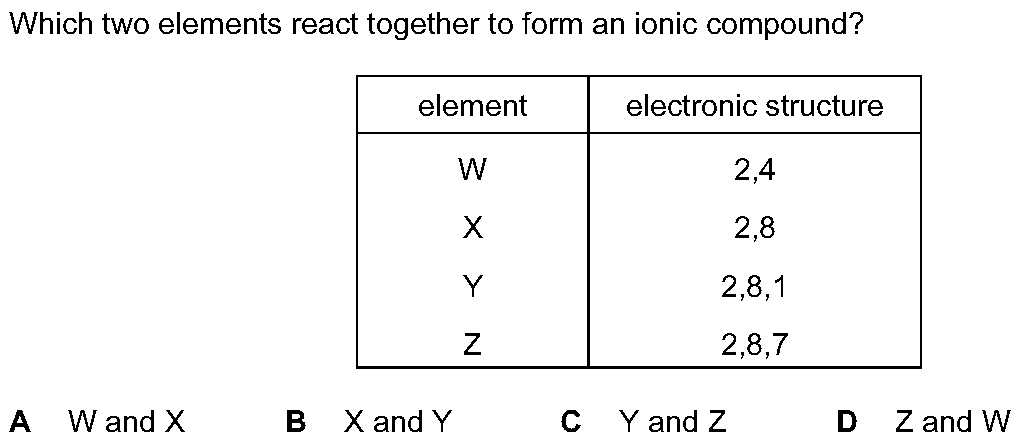
Which two elements react together to form an ionic compound?
element electronic structure
Ww 24
x 2,8
Y 2,8,1
Z 2,8,7
A WandX B XandY C YandZ D ZandW
element electronic structure
Ww 24
x 2,8
Y 2,8,1
Z 2,8,7
A WandX B XandY C YandZ D ZandW
Options:
A
B
C
D
Correct Key: C
A
B
C
D
Correct Key: C
Question 15
Paper Ref: 0620/23_Winter_2021_Q9
Paper Ref: 0620/23_Winter_2021_Q9
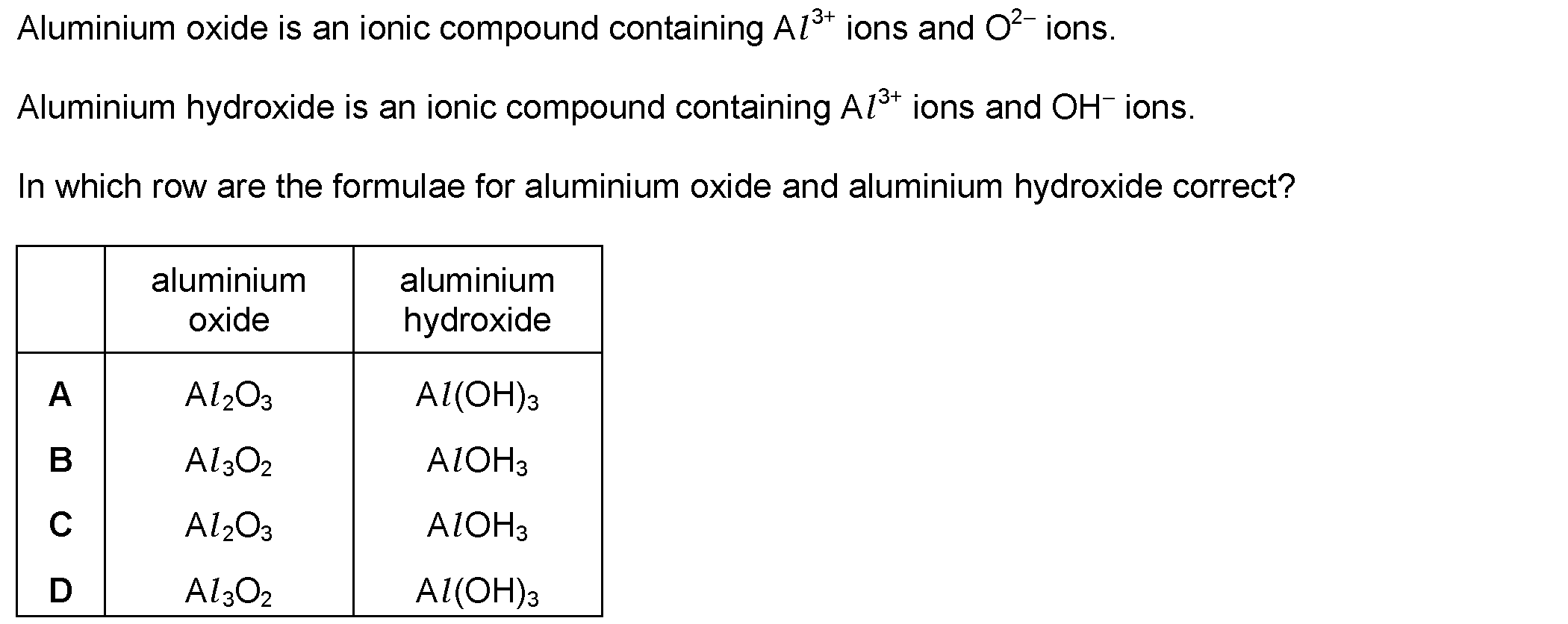
Aluminium oxide is an ionic compound containing Al** ions and ©” ions.
Aluminium hydroxide is an ionic compound containing Al** ions and OH" ions.
In which row are the formulae for aluminium oxide and aluminium hydroxide correct?
aluminium aluminium
oxide hydroxide
AL(OH)s
AIOH3
AIOH3
AL(OH)s
Aluminium hydroxide is an ionic compound containing Al** ions and OH" ions.
In which row are the formulae for aluminium oxide and aluminium hydroxide correct?
aluminium aluminium
oxide hydroxide
AL(OH)s
AIOH3
AIOH3
AL(OH)s
Options:
A
B
C
D
Correct Key: A
A
B
C
D
Correct Key: A
Question 16
Paper Ref: 0620/23_Summer_2021_Q6
Paper Ref: 0620/23_Summer_2021_Q6
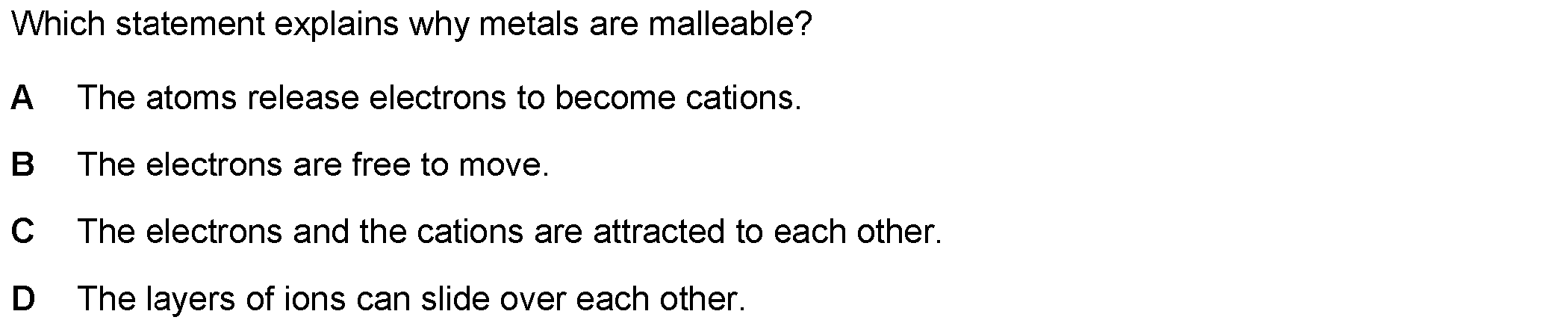
Which statement explains why metals are malleable?
A
B
Cc
D
The atoms release electrons to become cations.
The electrons are free to move.
The electrons and the cations are attracted to each other.
The layers of ions can slide over each other.
A
B
Cc
D
The atoms release electrons to become cations.
The electrons are free to move.
The electrons and the cations are attracted to each other.
The layers of ions can slide over each other.
Options:
A
B
C
D
Correct Key: D
A
B
C
D
Correct Key: D
Question 17
Paper Ref: 0620/12_Summer_2025_Q8
Paper Ref: 0620/12_Summer_2025_Q8
In the molecules CHy, HCZ and H20, which atoms use all of their outer shell electrons in bonding?
A CandCl B CandH C ClandH D HandO
A CandCl B CandH C ClandH D HandO
Options:
A
B
C
D
Correct Key: B
A
B
C
D
Correct Key: B
Question 18
Paper Ref: 0620/22_Winter_2024_Q4
Paper Ref: 0620/22_Winter_2024_Q4
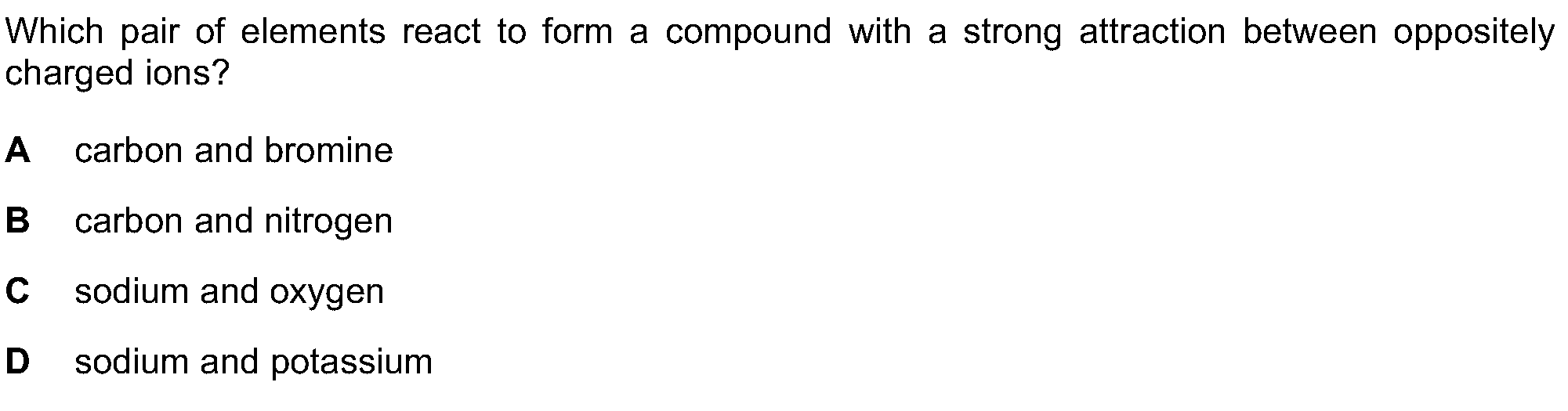
Which pair of elements react to form a compound with a strong attraction between oppositely
charged ions?
A_ carbon and bromine
B- carbon and nitrogen
C sodium and oxygen
D
sodium and potassium
charged ions?
A_ carbon and bromine
B- carbon and nitrogen
C sodium and oxygen
D
sodium and potassium
Options:
A
B
C
D
Correct Key: C
A
B
C
D
Correct Key: C
Question 19
Paper Ref: 0620/23_Winter_2012_Q6
Paper Ref: 0620/23_Winter_2012_Q6
In the molecules CH, HCl and H20, which atoms use all of their outer shell electrons in bonding?
A CandCl B CandH Cc ClandH D HandoO
A CandCl B CandH Cc ClandH D HandoO
Options:
A
B
C
D
Correct Key: B
A
B
C
D
Correct Key: B
Structured Questions Mark Scheme & Answers
•1•.• • • •[•P•R•I• •2•0•0•8••• •P•1• • •·• • •Q•2• • •P•a•r•t• •(•a•)• • •·• • •2•0•0•8• • •·• • •P•r•i•m•a•r•y• •0•8•4•6•]• • • • • • •(•n•o• •p•u•b•l•i•s•h•e•d• •m•a•r•k• •s•c•h•e•m•e• •f•o•r• •t•h•i•s• •p•a•p•e•r•)•
•2•.• • • •[•P•R•I• •2•0•0•8••• •P•1• • •·• • •Q•2• • •P•a•r•t• •(•b•)• • •·• • •2•0•0•8• • •·• • •P•r•i•m•a•r•y• •0•8•4•6•]• • • • • • •(•n•o• •p•u•b•l•i•s•h•e•d• •m•a•r•k• •s•c•h•e•m•e• •f•o•r• •t•h•i•s• •p•a•p•e•r•)•
•3•.• • • •[•P•R•I• •2•0•0•8••• •P•1• • •·• • •Q•2• • •P•a•r•t• •(•c•)• • •·• • •2•0•0•8• • •·• • •P•r•i•m•a•r•y• •0•8•4•6•]• • • • • • •(•n•o• •p•u•b•l•i•s•h•e•d• •m•a•r•k• •s•c•h•e•m•e• •f•o•r• •t•h•i•s• •p•a•p•e•r•)•
•4•.• • • •[•C•P• •O•c•t•o•b•e•r• •2•0•2•4• •P•1• • •·• • •Q•1•0• • •P•a•r•t• •(•b•)• • •·• • •2•0•2•4• • •·• • •L•o•w•e•r• •S•e•c• •0•8•9•3•]• • • • • • •m•o•l•e•c•u•l•e• •1• •I•g•n•o•r•e• •c•o•m•p•o•u•n•d•
•5•.• • • •[•C•P• •O•c•t•o•b•e•r• •2•0•2•4• •P•1• • •·• • •Q•1•0• • •P•a•r•t• •(•c•)• • •·• • •2•0•2•4• • •·• • •L•o•w•e•r• •S•e•c• •0•8•9•3•]• • • • • • •2• •1•
•6•.• • • •[•P•T• •S•9• •2•0•2•6• •P•2• • •·• • •Q•2• • •P•a•r•t• •(•a•)• • •·• • •2•0•2•6• • •·• • •L•o•w•e•r• •S•e•c• •0•8•9•3•]• • • • • • •m•o•l•e•c•u•l•e• •1•
•7•.• • • •[•C•P• •M•a•y• •2•0•2•4• •P•2• • •·• • •Q•2• • •P•a•r•t• •(•a•)• • •·• • •2•0•2•4• • •·• • •L•o•w•e•r• •S•e•c• •0•8•9•3•]• • • • • • ••• •1•
•8•.• • • •[•S•P• •S•9• •P•2• • •·• • •Q•2• • •P•a•r•t• •(•a•)• • •·• • •S•p•e•c•i•m•e•n• • •·• • •L•o•w•e•r• •S•e•c• •0•8•9•3•]• • • • • • •c•o•v•a•l•e•n•t• •2• •s•h•a•r•e•d• •(•p•a•i•r•s• •o•f•)• •e•l•e•c•t•r•o•n•s•
Last updated:
\n