5.6Physical Chemistry and Transition Elements
Transition Elements — OCR A Level Chemistry A H432 Revision Notes & Topical Questions
10 min read 25 parts Lesson 34 of 40
Lesson summary
Complete PDF with figures and original page layoutPage 1 OCR A Level Chemistry A Your notes Transition Elements Contents Transition Elements Ligands & Complex Ions Isomerism in Transition Element Complexes Ligand Substitution Reactions The Biochemic…
Section 1 of 25Definition of transition elements
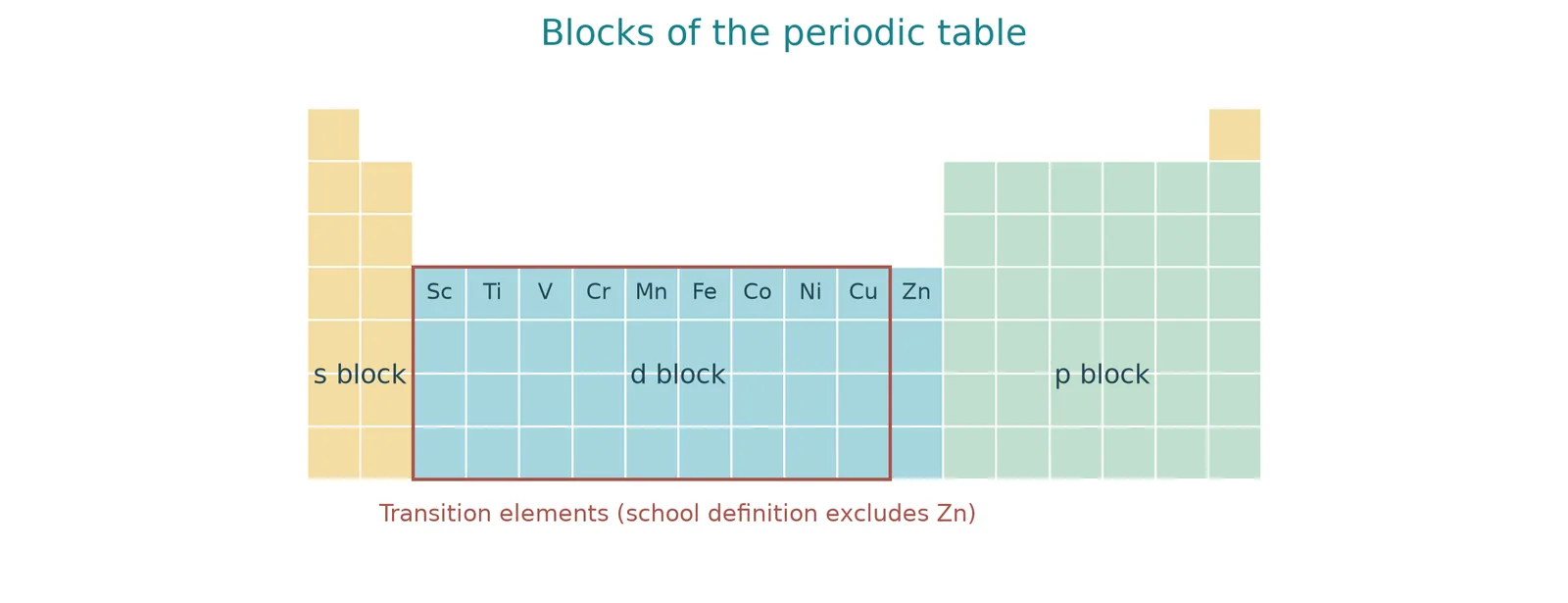
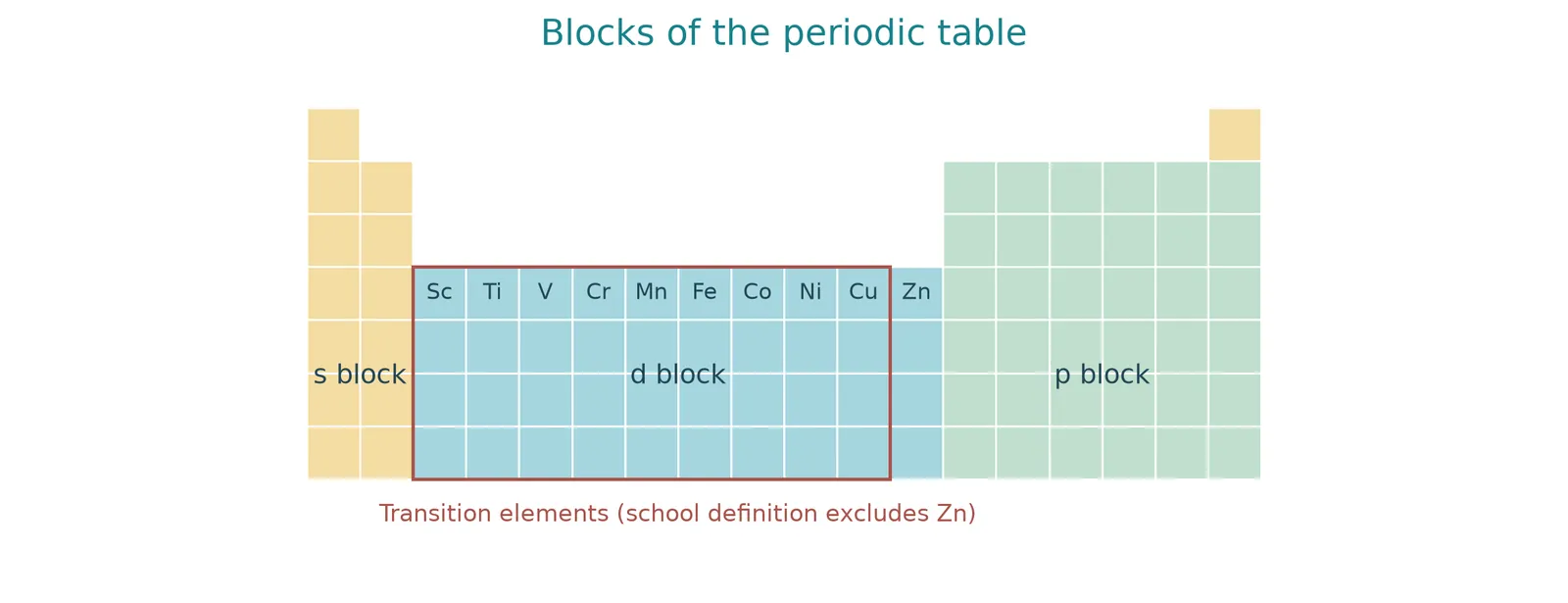
1Transition element
Transition element a d-block element that can form at least one stable ion with an incomplete d subshell
- Scandium and zinc are d-block elements but do not fit this definition.
- Scandium forms only Sc3+ ([Ar] 3d0) and zinc only Zn2+ ([Ar] 3d10).
2First transition series
- First transition series titanium to copper
Section 2 of 25Electron configurations
| Element | Configuration |
|---|---|
| Ti | [Ar] 3d2 4s2 |
| V | [Ar] 3d3 4s2 |
| Cr | [Ar] 3d5 4s1 |
| Mn | [Ar] 3d5 4s2 |
| Fe | [Ar] 3d6 4s2 |
| Co | [Ar] 3d7 4s2 |
| Ni | [Ar] 3d8 4s2 |
| Cu | [Ar] 3d10 4s1 |
Filling order
- Filling order the 4s overlaps with 3d and fills first
- [Ar] represents 1s to 3p, the argon core.
Exceptions
- Cr and Cu promote a 4s electron to 3d to give a half-full or full d subshell, which is more stable
Ions
- 4s electrons are lost first
- Fe
- [Ar] 3d6 4s2;
- Fe2+: [Ar] 3d6;
- Fe3+: [Ar] 3d5.
- [Ar] 3d6 4s2;
Section 3 of 25General properties
- Distinctive properties of transition metals
- Variable oxidation states.
- They form complex ions.
- They form coloured compounds.
- They behave as catalysts.
Section 4 of 25Variable oxidation states
- Variable oxidation state
- unlike other metals, transition elements form more than one positive ion
- Roman numerals show the oxidation state of the metal ion.
- Sodium forms only Na+, so it needs no numeral.
- Iron forms Fe2+, Fe(II), and Fe3+, Fe(III).
Section 5 of 25Complex ions and colour
Complex ion
Complex ion a central metal atom or ion surrounded by molecules or ions called ligands
- Different oxidation states allow different numbers and kinds of ligands.
- Chromium(III) forms [Cr(NH3)6]3+, [Cr(OH)6]3− and [Cr(H2O)6]3+.
Coloured compounds
- Coloured compounds the colour depends on the ligand even at the same oxidation state
- [Cr(OH)6]3− is dark green.
- [Cr(NH3)6]3+ is purple.
Section 6 of 25Transition elements as catalysts
Why good catalysts
- Why good catalysts variable oxidation states let the element gain or donate electrons during catalysis
- Substances can also adsorb onto their surface and be activated.
Heterogeneous catalyst
- Heterogeneous catalyst in a different phase from the reactants, with the reaction at active sites on the surface
- Iron in the Haber processN2(g) + 3H2(g) ⇌ 2NH3(g).
Homogeneous catalyst
- Homogeneous catalyst in the same phase as the reactants
- The decomposition of hydrogen peroxide, 2H2O2 → 2H2O + O2, is a common kinetics example using manganese(IV) oxide as catalyst.
Section 7 of 25Ligands and coordination number
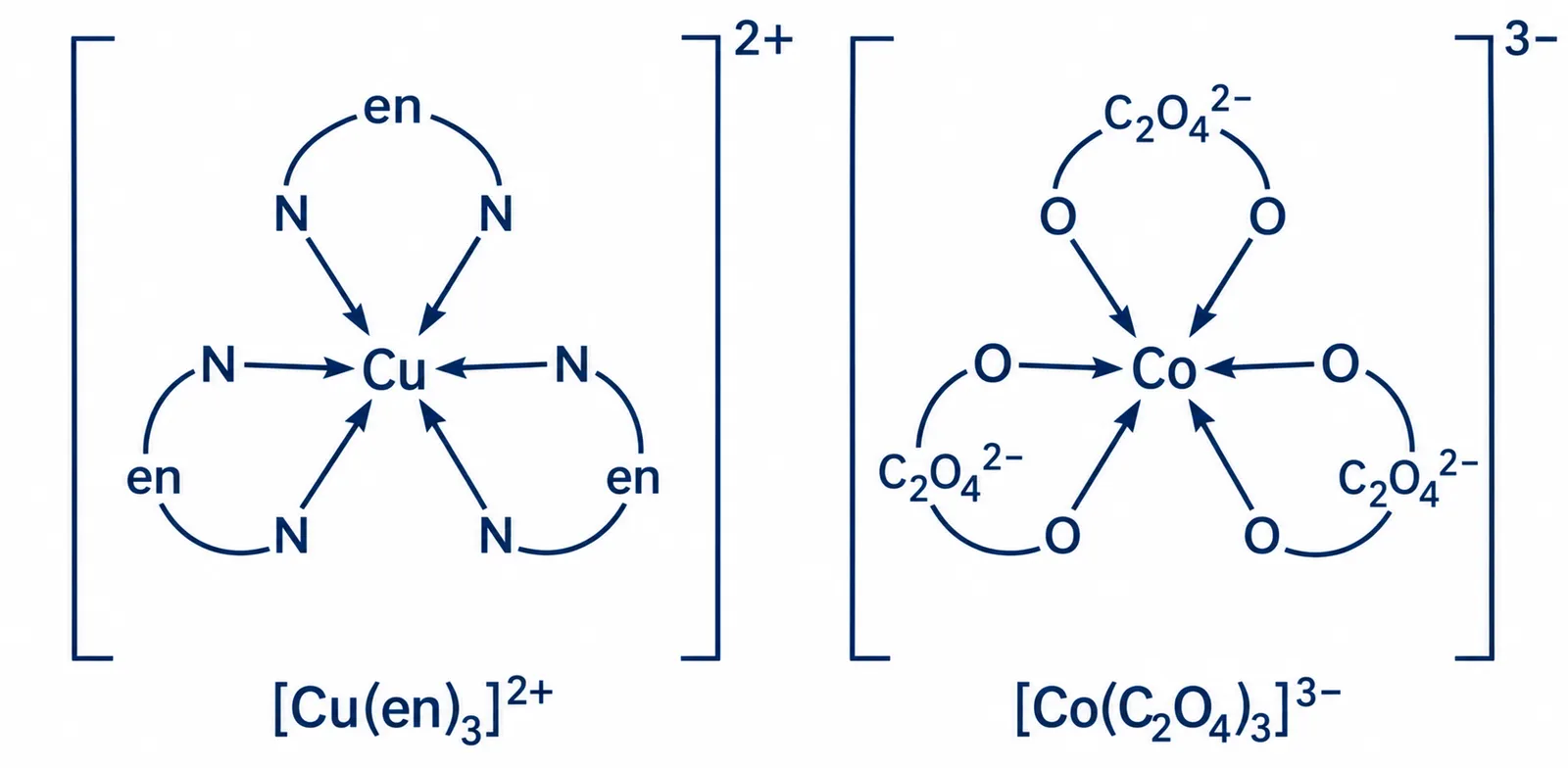
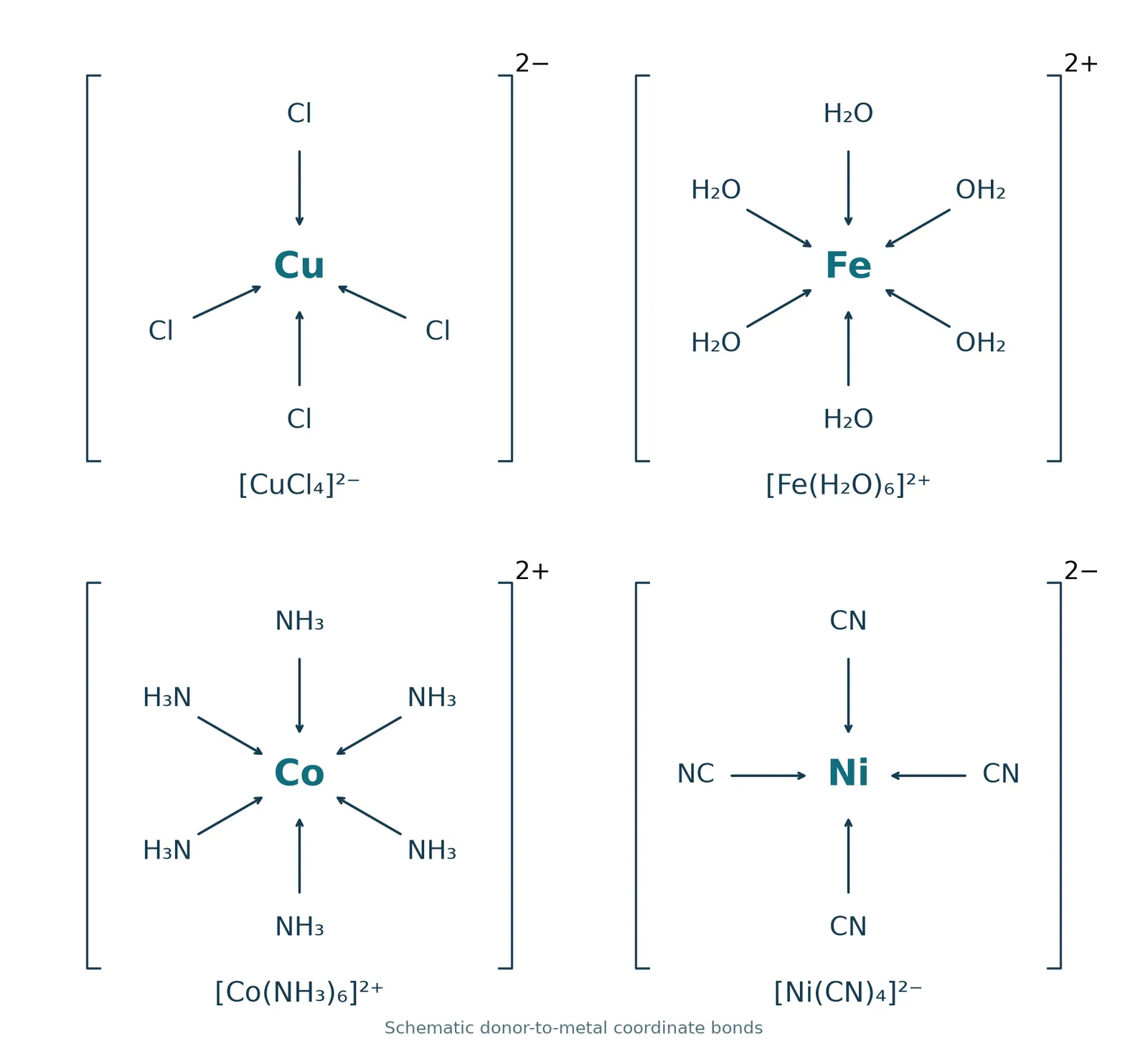
Ligand
Ligand a molecule or ion that forms a coordinate (dative) bond to a transition metal by donating a pair of electrons
- It is a Lewis base (electron pair donor), with a lone pair or negative charge, like a nucleophile.
Coordination number
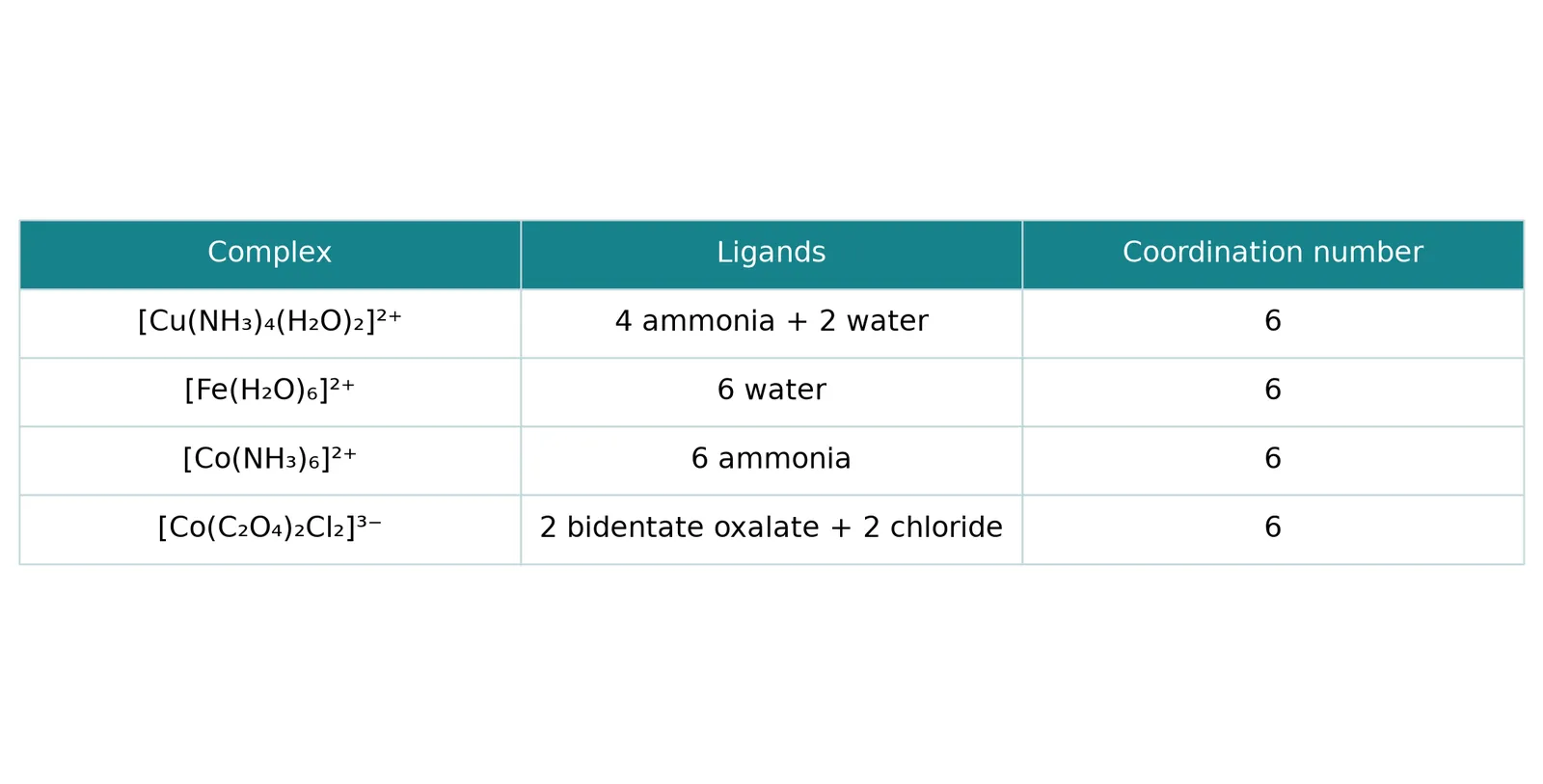
Coordination number the number of coordinate bonds to the central metal atom or ion
Monodentate ligands
- Monodentate ligands form one dative bond, e.g. H2O, NH3, Cl−, CN−, OH−
Bidentate ligands
- Bidentate ligands form two dative bonds because each contains two atoms with lone pairs
- 1,2-diaminoethane, H2NCH2CH2NH2 (en).
- The ethanedioate ion, C2O42− (ox).
Multidentate
- Multidentate some ligands form several dative bonds
Section 8 of 25Shapes of complex ions
| Coordination number | Shape | Bond angle | Details |
|---|---|---|---|
| 6 | Octahedral | 90° | Six small monodentate ligands (water, ammonia, hydroxide, thiocyanate) or three bidentate ligands (en, ethanedioate) |
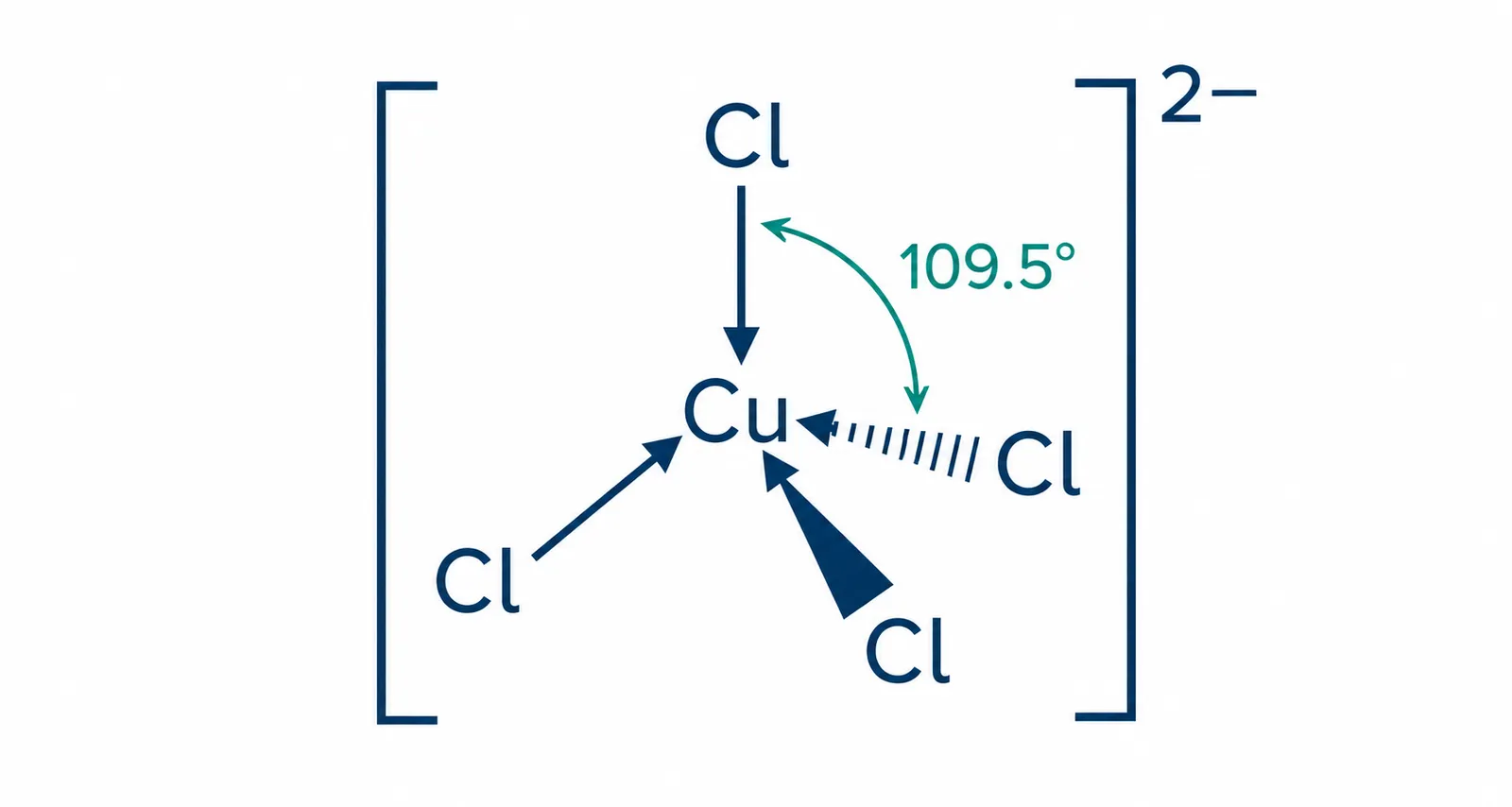
| 4 | Tetrahedral | 109.5° | Often four large chloride ligands, which is all that will fit |
| 4 | Square planar | 90° | Sometimes instead of tetrahedral, e.g. cisplatin |
Section 9 of 25Cis–trans isomerism in complexes
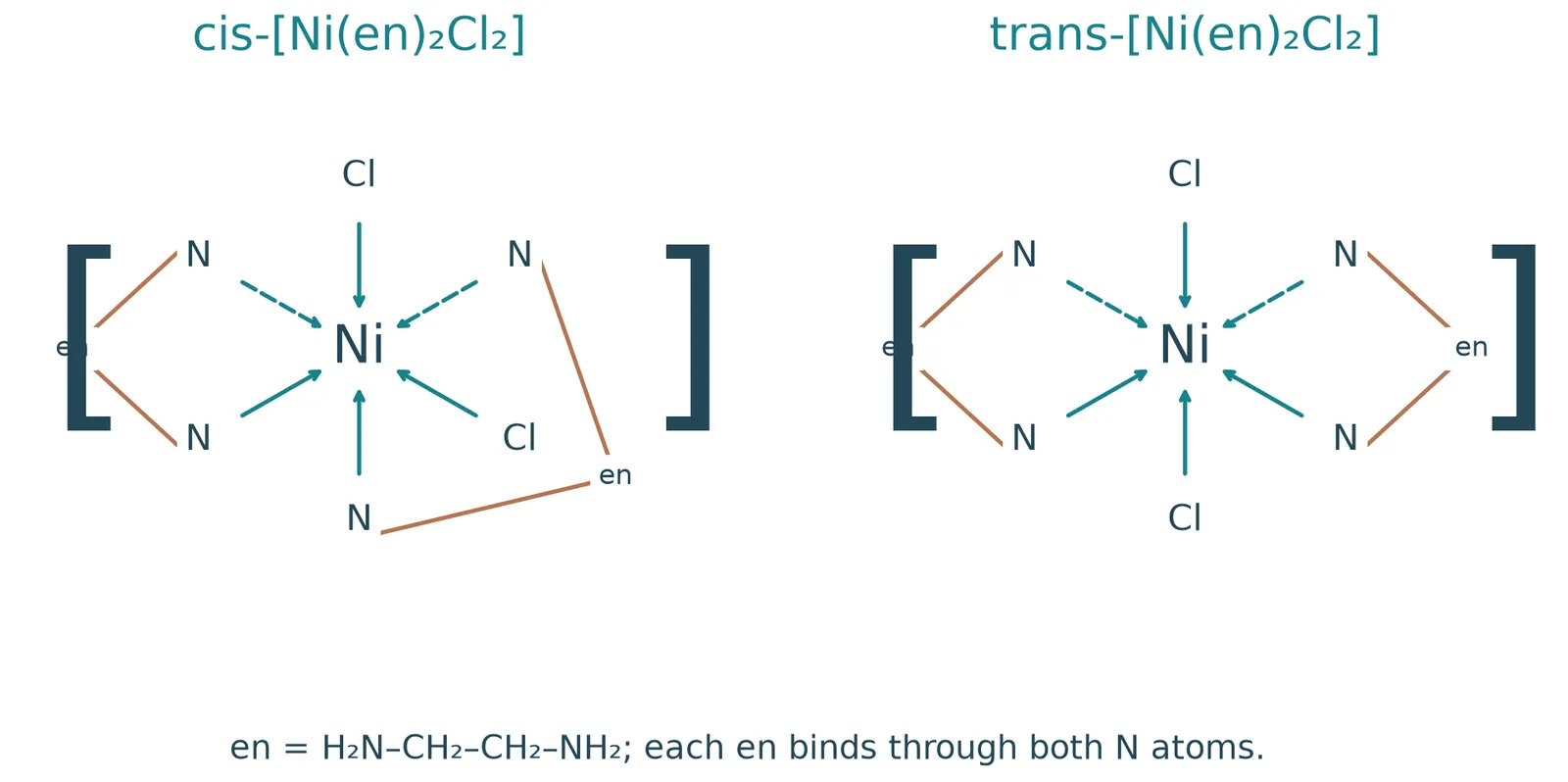
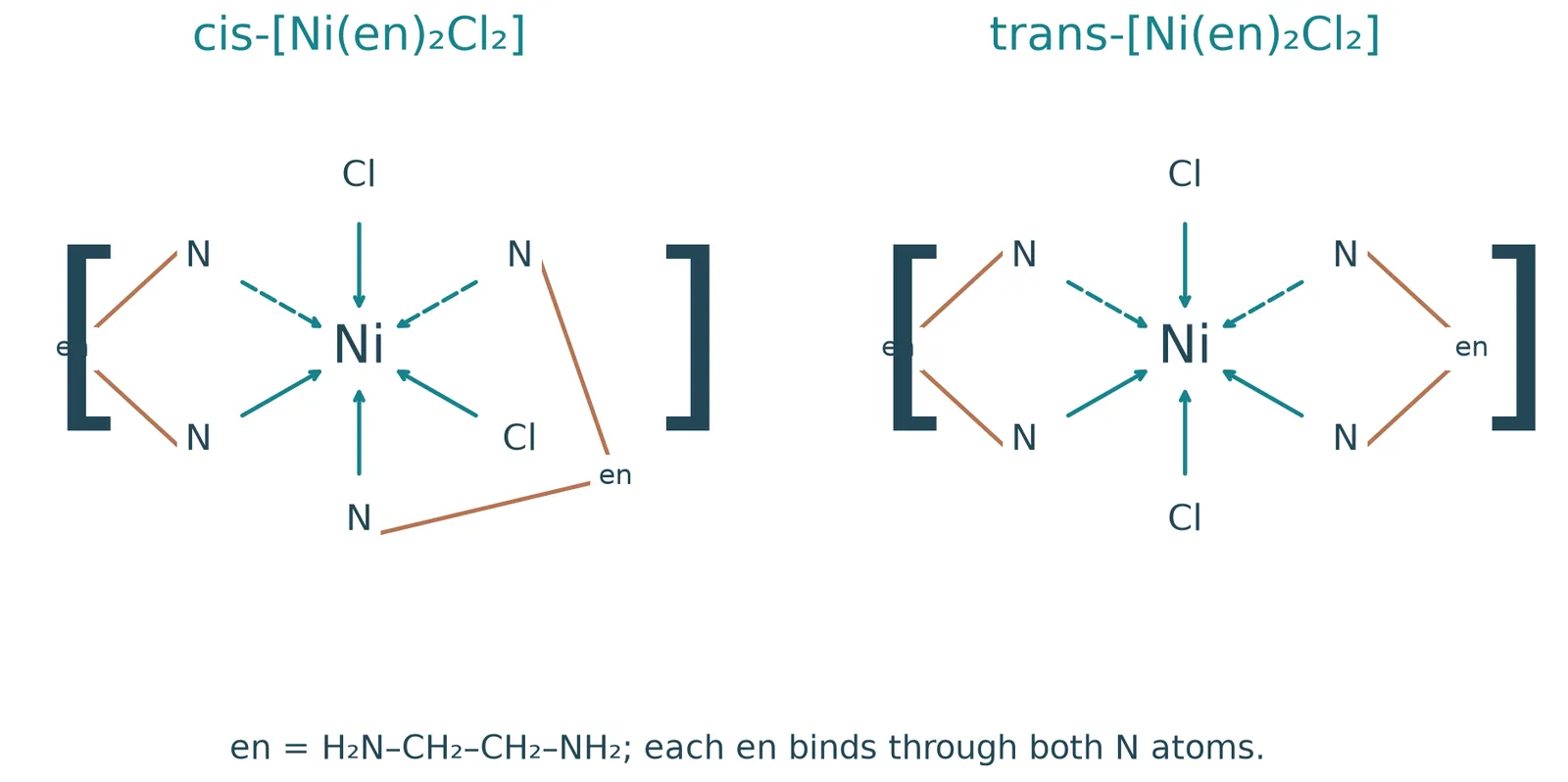
Occurrence
- Occurrence complexes have no double bond but can still show geometrical isomerism
- Square planar and octahedral complexes with two pairs of different ligands (or two ligands different from the rest) show cis–trans isomerism.
Cis and trans
- Cisthe two different ligands are next to each other.
- Transthe two different ligands are opposite each other.
Examples
- Cisplatin, a square planar anti-cancer drug, binds to DNA in cancer cells, whereas trans-platin cannot be used in treatment.
- [Co(NH3)4(H2O)2]2+ has the two water ligands adjacent in cis and opposite in trans.
- [Ni(en)2(H2O)2]2+ also shows cis–trans isomerism.
Section 10 of 25Optical isomerism in complexes
Occurrence
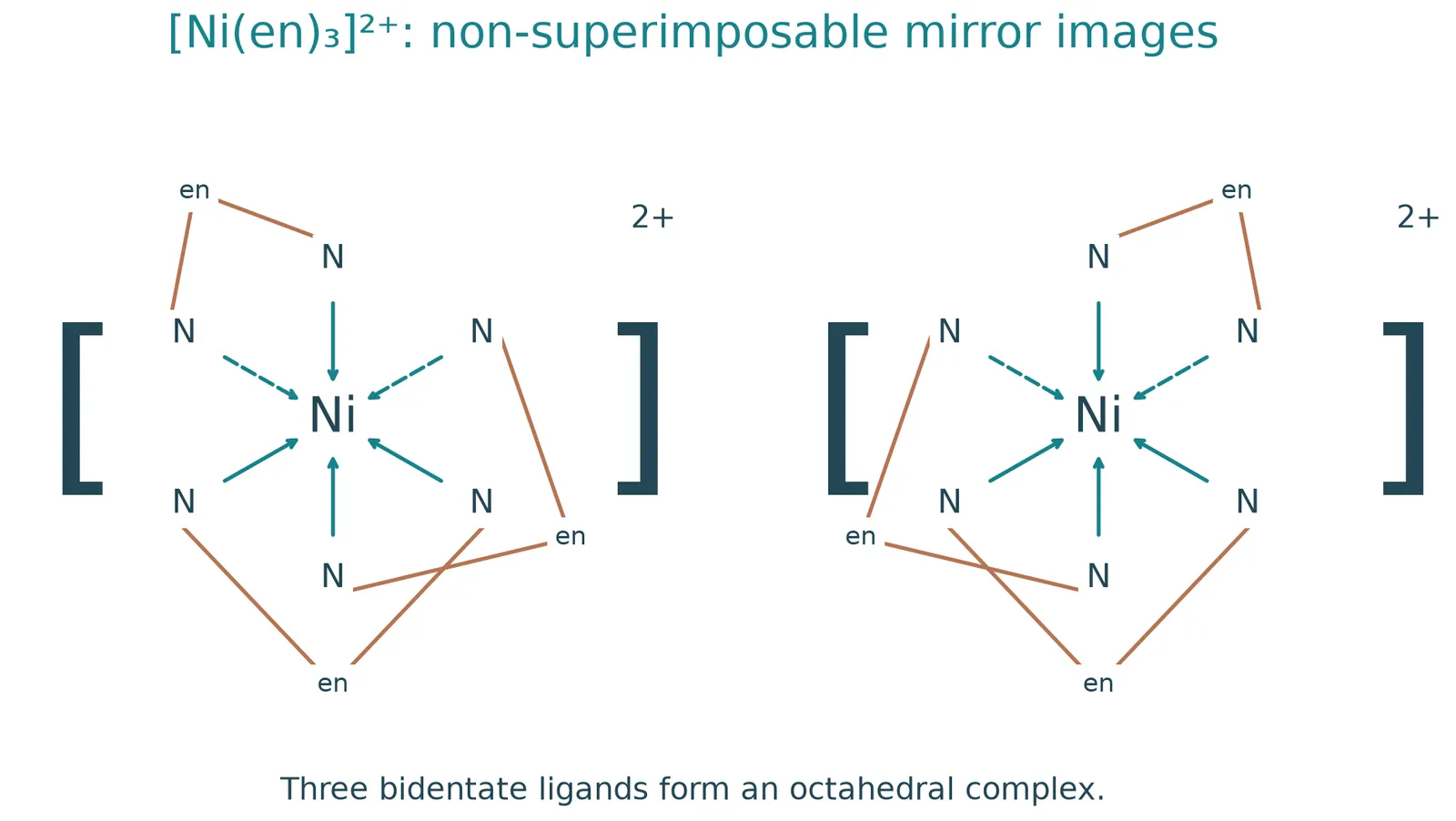
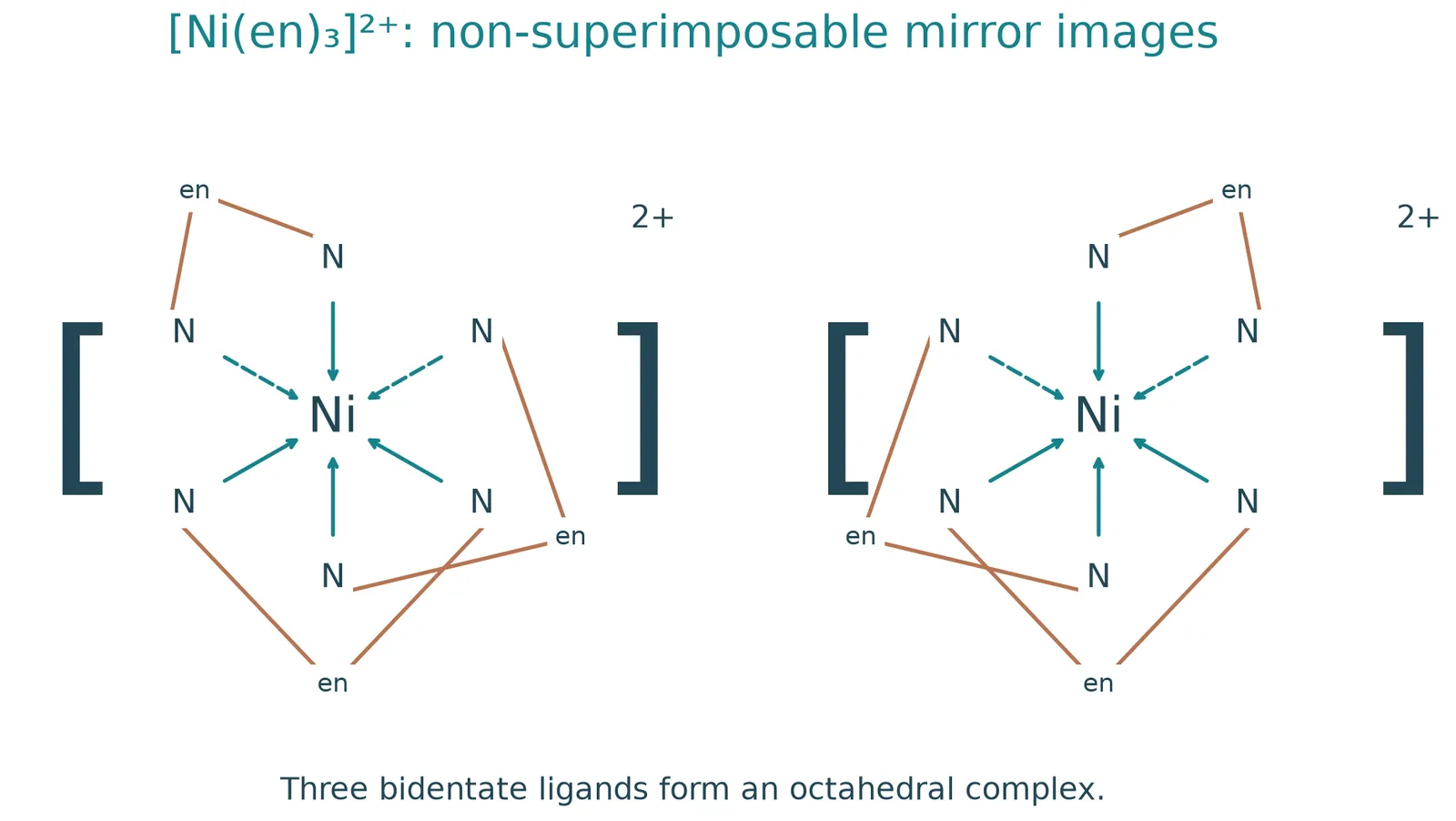
- Occurrence octahedral complexes with bidentate ligands have optical isomers
- The two forms are non-superimposable mirror images, with no plane of symmetry.
- They differ only in rotating the plane of polarised light in opposite directions.
Examples
- [Ni(en)3]2+ and the cis form of [Ni(en)2(H2O)2]2+
Section 11 of 25Cisplatin as an anti-cancer drug
Discovery and use
- Discovery and use cisplatin was discovered in the 1960s and treats cancers such as testicular, ovarian, cervical, breast, lung and brain cancer
Action
- Action it binds to nitrogen atoms on the bases in DNA
- It passes through the cell membrane and undergoes ligand exchange, with chlorines replaced by water molecules.
- Nitrogen is a better ligand than water and forms dative covalent bonds to the platinum.
- This distorts the shape of DNA and prevents it replicating.
Selectivity
- Selectivity cancer cells grow and replicate faster than normal cells, so they are affected more
Adverse effects
- Adverse effects it also binds to healthy cells, especially fast-replicating ones such as hair follicles, causing hair loss
- Society must balance adverse effects against therapeutic value.
- New therapies aim to target cancer cells while leaving healthy cells untouched.
Section 12 of 25Ligand substitution
Ligand substitution
Ligand substitution (exchange)
Ligand substitution (exchange) replacement of one ligand in a complex by another
- It forms a new, more stable complex.
- Ligands can be partly or entirely substituted.
Effect of ligand size
- Water and ammonia ligands are similar in size, so coordination number and geometry do not change.
- Chloride ligands are larger than water, so coordination number and geometry change.
Aqueous ions
- Aqueous ions a transition metal ion in solution exists as a hexaaqua complex
- Cu2+(aq) is the blue [Cu(H2O)6]2+(aq).
Section 13 of 25Copper(II) with sodium hydroxide and ammonia
| Reagent | Observation | Change |
|---|---|---|
| NaOH(aq), dropwise | Pale blue solution to pale blue precipitate | [Cu(H2O)6]2+ + 2OH− → Cu(H2O)4(OH)2(s) + 2H2O (partial substitution) |
| NaOH, excess | No change | Precipitate remains |
| NH3(aq), dropwise | Pale blue precipitate | Same hydroxide precipitate because aqueous ammonia contains OH− |
| NH3, excess concentrated | Precipitate dissolves to a deep blue solution | Cu(H2O)4(OH)2 + 4NH3 → [Cu(NH3)4(H2O)2]2+ + 2H2O + 2OH− |
- Required knowledge
- for copper(II) only the excess ammonia substitution and colour change need to be known
Section 14 of 25Copper(II) with concentrated hydrochloric acid
Reaction
- Reaction full substitution: [Cu(H2O)6]2+ + 4Cl− ⇌ [CuCl4]2− + 6H2O
- The colour changes from blue to yellow.
Changes
- Coordination number changes from 6 to 4, because the larger chloride ligands mean only four fit around the metal ion.
- Geometry changes from octahedral to tetrahedral.
- The colour changes from blue to yellow.
Reversibility
- Reversibility some blue [Cu(H2O)6]2+ remains, so the mixture can appear green
- Adding water displaces the chloride ligands and the pale blue solution returns.
Caution
- Caution solid copper chloride dissolved in water forms [Cu(H2O)6]2+, not [CuCl4]2−
Section 15 of 25Chromium(III) substitution
- Starting complex
- [Cr(H2O)6]3+ is pale purple, though often appears green because of impurities
| Reagent | Observation | Equation |
|---|---|---|
| NaOH, dropwise | Dark green precipitate | [Cr(H2O)6]3+ + 3OH− → Cr(H2O)3(OH)3(s) + 3H2O |
| NaOH, excess | Dissolves to a dark green solution | Cr(H2O)3(OH)3 + 3OH− → [Cr(OH)6]3− + 3H2O |
| NH3, dropwise | Dark green precipitate (same hydroxide) | As for dropwise NaOH |
| NH3, excess concentrated | Dissolves to a purple solution | Cr(H2O)3(OH)3 + 6NH3 → [Cr(NH3)6]3+ + 3H2O + 3OH− |
Section 16 of 25Precipitates with sodium hydroxide
| Ion | Aqua ion | With OH− | Excess OH− |
|---|---|---|---|
| Cu2+ | Pale blue solution | Pale blue precipitate, Cu(H2O)4(OH)2 | No change |
| Fe2+ | Pale green solution | Dark green precipitate, Fe(H2O)4(OH)2 | No change |
| Mn2+ | Pale pink solution | Pale brown precipitate, Mn(H2O)4(OH)2 | No change |
| Cr3+ | Pale purple solution | Dark green precipitate, Cr(H2O)3(OH)3 | Dark green solution, [Cr(OH)6]3− |
| Fe3+ | Yellow solution | Orange-brown precipitate, Fe(H2O)3(OH)3 | No change |
Equations
- [Fe(H2O)6]2+ + 2OH− → [Fe(H2O)4(OH)2](s) + 2H2O.
- [Fe(H2O)6]3+ + 3OH− → [Fe(H2O)3(OH)3](s) + 3H2O.
Remembering formulae
- Remembering formulae the number of OH− in the precipitate equals the charge on the metal ion
Section 17 of 25Precipitates with ammonia
| Ion | With NH3 | Excess NH3 |
|---|---|---|
| Cu2+ | Pale blue precipitate | Dark blue solution, [Cu(NH3)4(H2O)2]2+ |
| Fe2+ | Dark green precipitate | No change |
| Mn2+ | Pale brown precipitate | No change |
| Cr3+ | Dark green precipitate | Purple solution, [Cr(NH3)6]3+ |
| Fe3+ | Orange-brown precipitate | No change |
Role of ammonia
- Role of ammonia aqua ions act as acids with ammonia
- Initially ammonia is a base, removing one H+ per ammonia molecule used: [Cu(H2O)6]2+ + 2NH3 → [Cu(H2O)4(OH)2](s) + 2NH4+.
- With excess ammonia some ions undergo ligand substitution: [Cu(H2O)4(OH)2] + 4NH3 → [Cu(H2O)2(NH3)4]2+ + 2H2O + 2OH−.
Colours
- Colours follow the published OCR colours of inorganic ions and complexes
Section 18 of 25Haemoglobin and oxygen transport
Haemoglobin and oxygen transport
Haem
- Haem a complex with iron(II) at its centre
- Oxygen forms a dative covalent bond to Fe(II), allowing oxygen molecules to be carried in the blood.
- Oxygen is a weak ligand, so it bonds weakly and breaks off easily to be released into cells.
Carbon monoxide poisoning
- CO is a better ligand than oxygen
- It binds strongly and irreversibly to Fe(II), stopping oxygen reaching cells.
- Replacing oxyhaemoglobin by carboxyhaemoglobin gives a darker red colour, a sign of poisoning.
Anaemia
- Anaemia too little haemoglobin because of blood loss or iron deficiency
- Iron deficiency can be treated with iron sulfate tablets in the diet.
Section 19 of 25Iron(II) and iron(III) redox
Iron(II) and iron(III) redox
Self-indicating
- Self-indicating transition metal ions change colour as oxidation state changes, so redox titrations often need no indicator
Oxidation of Fe2+ to Fe3+
- Oxidation of Fe2+ to Fe3+ by acidified manganate(VII)
- MnO4− + 8H+ + 5Fe2+ → Mn2+ + 5Fe3+ + 4H2O.
- Deep purple MnO4− becomes almost colourless Mn2+.
Reduction of Fe3+ to Fe2+
- Reduction of Fe3+ to Fe2+ by reducing agents such as potassium iodide
- 2Fe3+ + 2I− → 2Fe2+ + I2.
- Orange-brown Fe3+ becomes pale green Fe2+, but brown iodine can mask the colour change.
Section 20 of 25Chromium redox
1Reduction of dichromate
- Reduction of dichromate orange Cr2O72− is reduced to green Cr3+ by zinc in acid
- Cr2O72− + 14H+ + 3Zn → 2Cr3+ + 7H2O + 3Zn2+.
- With excess zinc, Cr3+ is reduced further to pale blue Cr2+: Zn + 2Cr3+ → Zn2+ + 2Cr2+.
- Fe2+ is a weaker reducing agent than zinc and reduces dichromate only to Cr3+.
- E⊗ values compare reducing agent strength and explain which reactions occur.
2Oxidation of Cr3+ to chromate(VI)
- Oxidation of Cr3+ to chromate(VI) low oxidation states are more easily oxidised in alkaline solution
- Hot alkaline hydrogen peroxide gives 3H2O2 + 2Cr3+ + 10OH− → 2CrO42− + 8H2O.
- Dark green Cr3+ becomes yellow CrO42−.
- Chromium goes +3 to +6 and oxygen goes −1 to −2.
3Chromate to dichromate
- Chromate to dichromate dilute sulfuric acid: 2CrO42− + 2H+ → Cr2O72− + H2O
- Yellow chromate becomes orange dichromate.
4Skills
- Skills full equations need not be memorised, but you should construct and interpret redox equations from half equations and oxidation numbers
Section 21 of 25Copper redox and disproportionation
1Reduction of Cu2+ to Cu+
- Reduction of Cu2+ to Cu+ with excess iodide ions
- 2Cu2+ + 4I− → 2CuI(s) + I2.
- Pale blue Cu2+ gives a white precipitate of CuI and brown iodine; iodide is oxidised and Cu2+ reduced.
2Disproportionation of Cu+
- Disproportionation of Cu+ copper(I) oxide with hot dilute sulfuric acid gives a brown precipitate of copper and a blue solution of copper(II) sulfate
- Cu2O + H2SO4 → Cu + CuSO4 + H2O.
- Copper is reduced from +1 to 0 and oxidised from +1 to +2 at the same time, which is disproportionation.
Section 22 of 25Qualitative analysis of anions
1Procedure
- Procedure when testing one solution for several anions, carry out the tests in the same fixed order each time
2Silver halides and ammonia
- Silver chloride dissolves in dilute ammonia.
- Silver bromide dissolves in concentrated ammonia.
- Silver iodide is insoluble in concentrated ammonia.
Section 23 of 25Qualitative analysis of cations
Transition metal ions
- Transition metal ions adding aqueous sodium hydroxide gives characteristic precipitates, used to identify an unknown metal ion
- Cu2+ pale blue, Fe2+ dark green, Mn2+ pale brown, Cr3+ dark green (dissolving in excess) and Fe3+ orange-brown.
Ammonium ions
- Ammonium ions warm with hydroxide ions: NH4+(aq) + OH−(aq) → NH3(g) + H2O(l)
- The ammonia turns damp red litmus paper blue.
Section 24 of 25Key terms
| Term | Meaning |
|---|---|
| Transition element | A d-block element that forms at least one stable ion with an incomplete d subshell |
| Ligand | A molecule or ion that donates a lone pair to a metal ion to form a coordinate bond |
| Coordination number | The number of coordinate bonds to the central metal ion |
| Complex ion | A central metal ion surrounded by ligands |
| Bidentate ligand | A ligand forming two coordinate bonds |
| Cisplatin | A square planar platinum complex used as an anti-cancer drug |
| Term | Meaning |
|---|---|
| Ligand substitution | Replacement of one ligand in a complex by another |
| Hexaaqua complex | A complex with six water ligands, such as [Cu(H2O)6]2+ |
| Amphoteric hydroxide | A hydroxide that dissolves in both acid and excess alkali, such as Cr(OH)3 |
| Cisplatin | A square planar platinum complex that binds to DNA and is used against cancer |
| Partial substitution | Replacement of only some of the ligands |
| Term | Meaning |
|---|---|
| Haemoglobin | An iron(II) complex protein that carries oxygen in the blood |
| Disproportionation | A reaction in which the same element is both oxidised and reduced |
| Carboxyhaemoglobin | Haemoglobin with carbon monoxide bound to the iron(II) |
| Self-indicating | A reagent whose own colour change shows the end point |
| Anaemia | A condition caused by too little haemoglobin |
Section 25 of 25Exam technique
1
Calling every d-block element a transition element — Sc and Zn do not form ions with an incomplete d subshell
2
Removing 3d electrons before 4s when forming ions — 4s electrons go first
3
Saying a ligand accepts electron pairs — it donates a lone pair
4
Counting a bidentate ligand as one coordinate bond — it forms two
1
Writing [CuCl4]2− for copper chloride dissolved in water — it forms [Cu(H2O)6]2+
2
Saying the copper hydroxide precipitate dissolves in excess sodium hydroxide — it does not
3
Forgetting that aqueous ammonia first gives the hydroxide precipitate
4
Saying the coordination number stays 6 when chloride replaces water — it becomes 4 and the shape tetrahedral
1
Saying carbon monoxide binds weakly to haemoglobin — it binds strongly and irreversibly
2
Saying iron(II) reduces dichromate to Cr2+ — only zinc is strong enough
3
Describing disproportionation without stating both oxidation and reduction of the same element
4
Testing for halides before removing carbonate and sulfate
Last updated:
\n