3.1Organic Chemistry
Introduction to Organic Chemistry
10 min read 17 parts Lesson 1 of 55 Virtual lab
Lesson summary
Complete PDF with figures and original page layoutPage 1 Oxford AQA International Your notes A Level (IAL) Chemistry Introduction to Organic Chemistry Contents Nomenclature Reaction Mechanisms Structural Isomerism Stereoisomerism Pa…
Section 1 of 17Types of formula


Types of formula
Empirical formula = the simplest whole-number ratio of elements in a compound, such as CH2O for ethanoic acid
Molecular formula = the number and type of each atom in a molecule, such as C2H4O2
General formula = a formula for a homologous series using letters and numbers, such as CnH2n+2 for alkanes
Structural formula = how atoms are bonded to each carbon in the molecule
Displayed formula = a 2D drawing of all atoms and bonds
Skeletal formula = a simplified displayed formula with the carbon-hydrogen bonds removed
Examples
- C2H4Cl2 has empirical formula CH2Cl, and C4H6 has empirical formula C2H3
Section 2 of 17Homologous series and functional groups
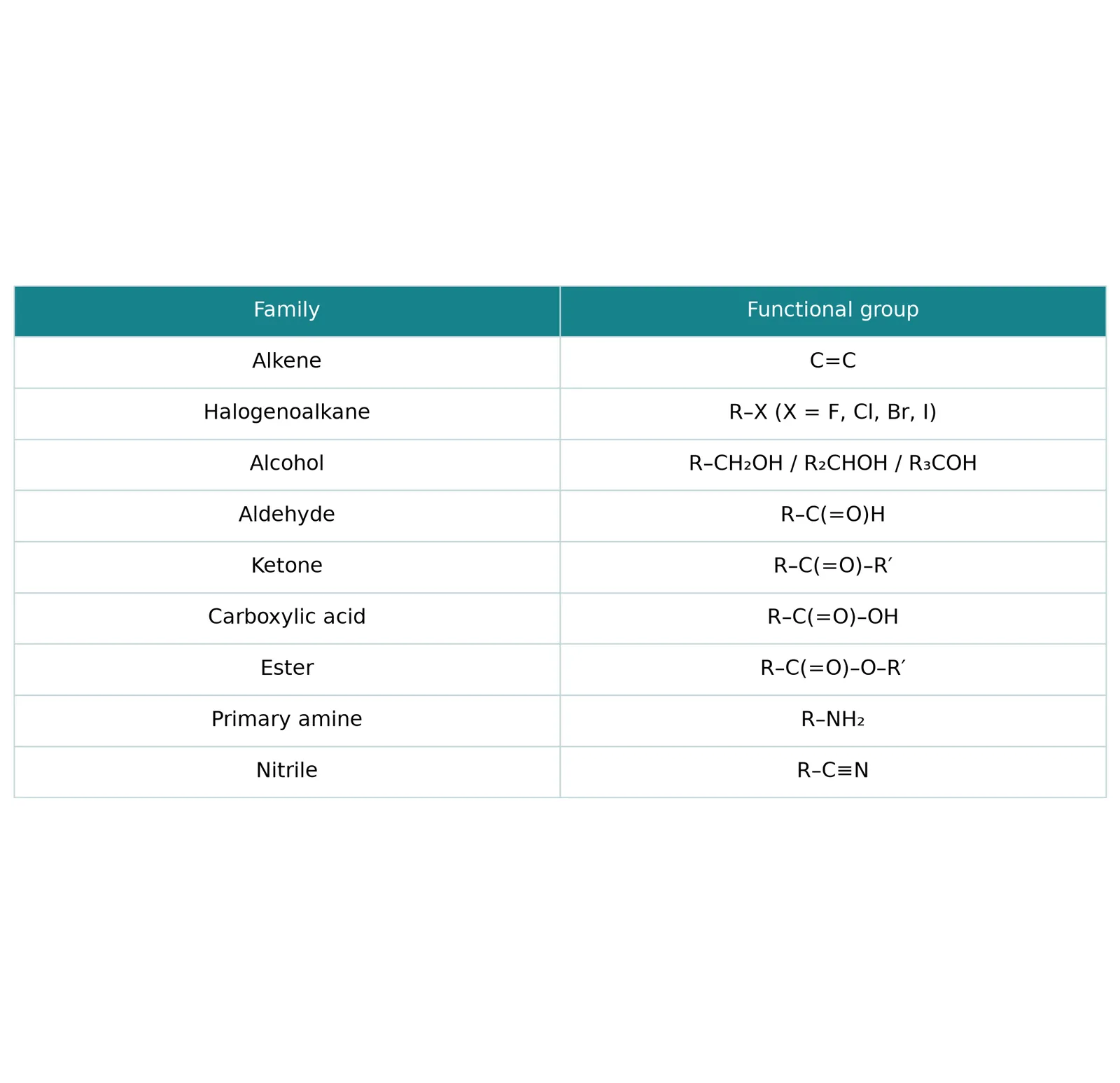

Homologous series and functional groups
Functional group = a specific atom or group of atoms that determines the physical and chemical properties of the molecule
Classification
- Classification molecules are classified by their dominant functional group
Hydrocarbons
- Hydrocarbons compounds of carbon and hydrogen only, with alkanes the simplest and having no functional group
Homologous series = a group of organic compounds with the same functional group, the same general formula and similar chemical properties
Pattern
- Pattern each extra carbon adds two hydrogens, so members differ by –CH2–
Section 3 of 17Trends within a homologous series
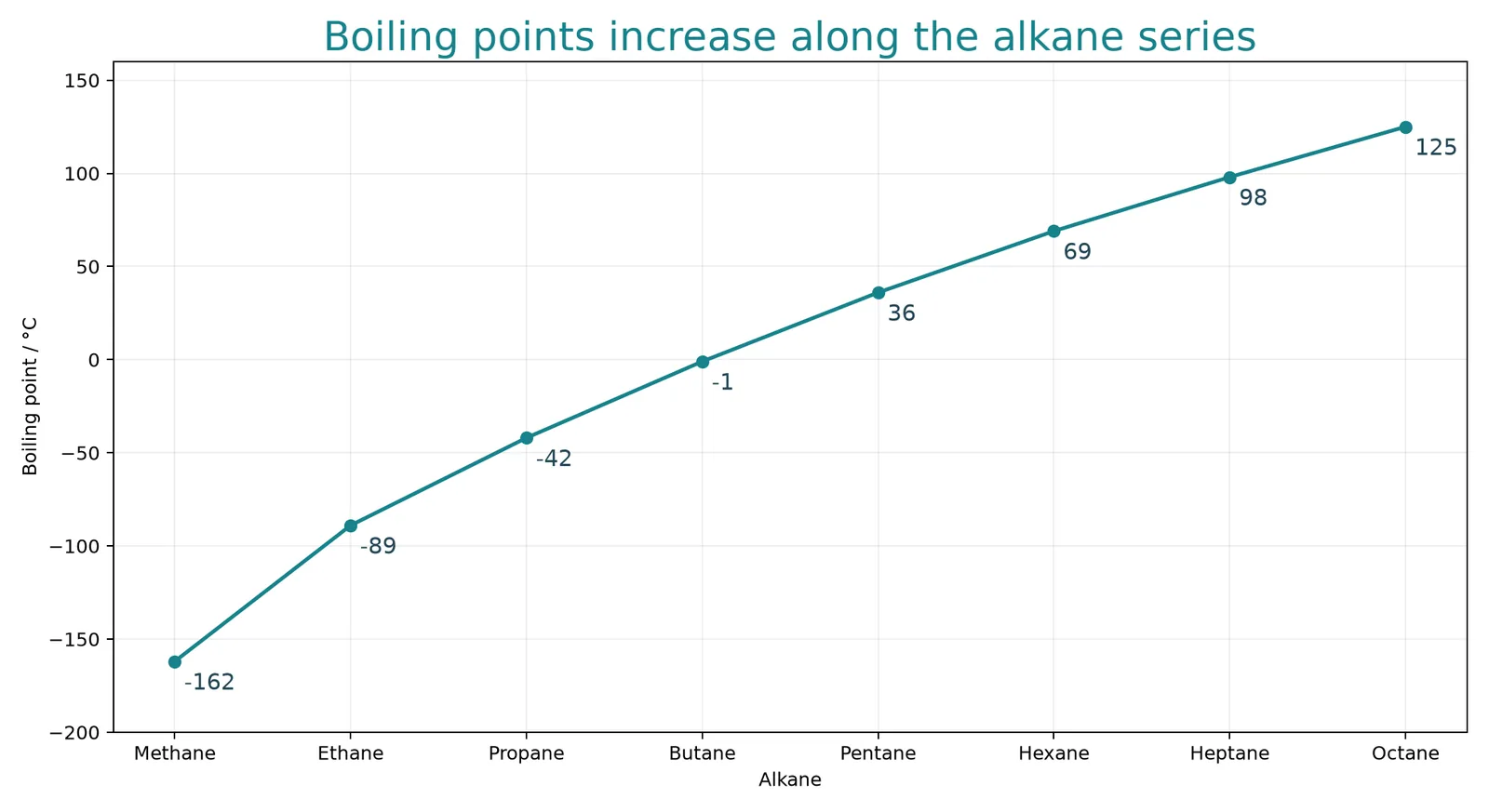
- Physical properties
- they change gradually, such as boiling point, melting point and density
| Alkane | Carbons | Formula | Boiling point / °C | State at room temperature | Melting point / °C |
|---|---|---|---|---|---|
| Methane | 1 | CH4 | -162 | gas | -183 |
| Ethane | 2 | C2H6 | -89 | gas | -172 |
| Propane | 3 | C3H8 | -42 | gas | -188 |
| Butane | 4 | C4H10 | 0 | gas | -138 |
| Pentane | 5 | C5H12 | 36 | liquid | -130 |
Boiling point
- Boiling point it increases with molecular size, because each extra –CH2– strengthens the intermolecular forces
Other series
- Other series similar trends are seen in other series
Section 4 of 17IUPAC nomenclature: stems
- Systematic name
- the stem shows the number of carbons in the longest chain, based on the alkanes
| Carbons | Alkane | Stem |
|---|---|---|
| 1 | methane CH4 | meth- |
| 2 | ethane C2H6 | eth- |
| 3 | propane C3H8 | prop- |
| 4 | butane C4H10 | but- |
| 5 | pentane C5H12 | pent- |
| 6 | hexane C6H14 | hex- |
| 7 | heptane C7H16 | hept- |
| 8 | octane C8H18 | oct- |
| 9 | nonane C9H20 | non- |
| 10 | decane C10H22 | dec- |
Section 5 of 17IUPAC nomenclature: branches and groups
IUPAC nomenclature: branches and groups
Numbering
- Numbering number the longest chain from the end that gives the lowest possible numbers
Side chains
- Side chains they are named by adding -yl to the stem (alkyl groups) and shown in brackets in a structural formula
Multiples
- Multiples di-, tri- and tetra- show two, three and four identical groups
Punctuation
- Punctuation commas separate numbers and hyphens separate numbers and words
Alphabetical order
- Alphabetical order different alkyl groups are listed alphabetically, each with its carbon number
Examples
- 2,5,5-trimethylhex-2-ene: a 6-carbon chain, a double bond on carbon 2, and methyls on carbons 2, 5 and 5.
- Propanalthe aldehyde group is always carbon 1.
- 2-methylbutanal: a 4-carbon chain, methyl on carbon 2, aldehyde on carbon 1.
- Butanoic acidthe carboxylic acid group is carbon 1.
- 2-chlorobutane: chlorine on carbon 2.
Aliphatic
- Aliphatic straight or branched chains, including rings with no benzene ring
Section 6 of 17Homolytic and heterolytic fission

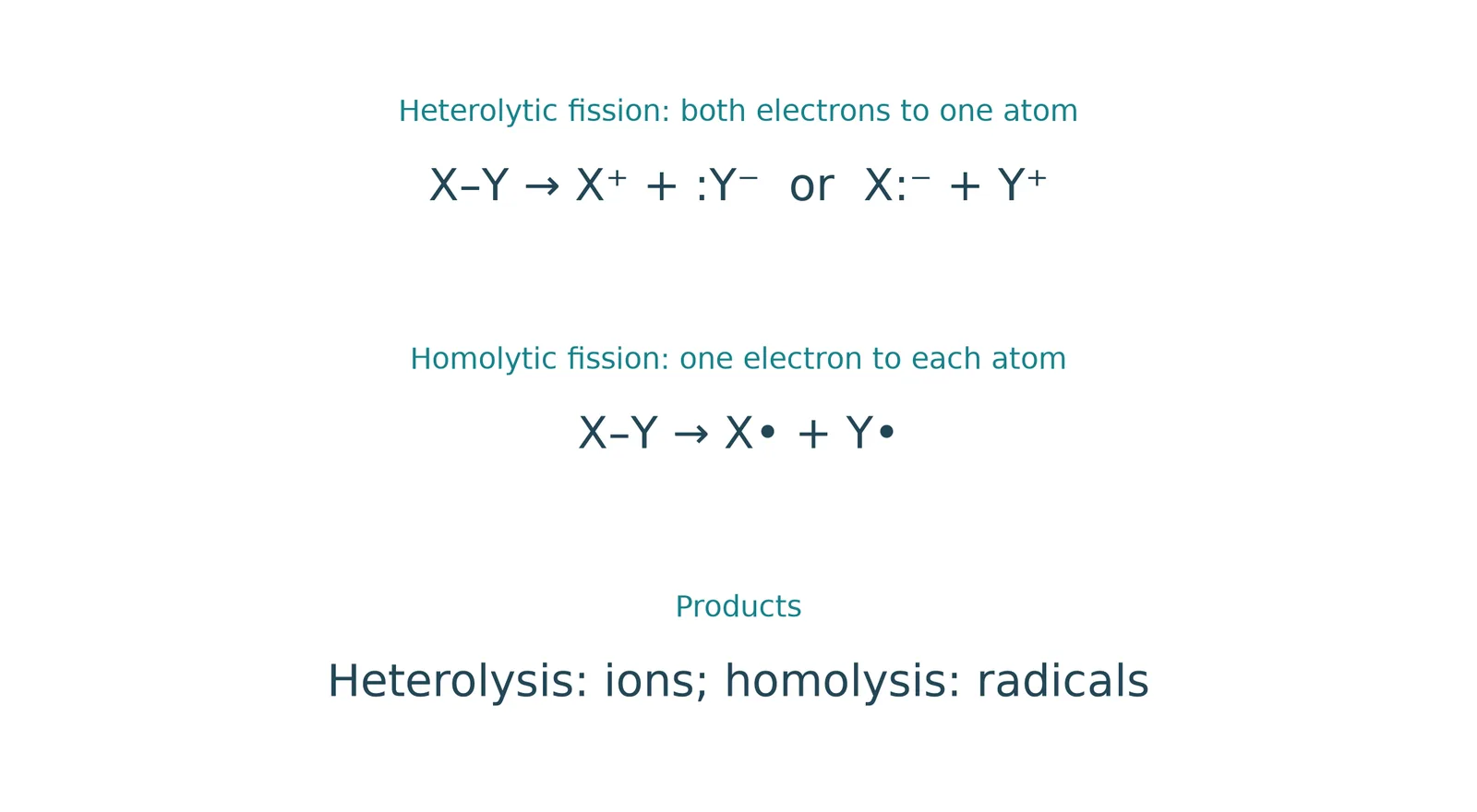
Homolytic fission = breaking a covalent bond so that each atom takes one electron, forming two radicals
Heterolytic fission = breaking a covalent bond so that the more electronegative atom takes both electrons, forming a negative and a positive ion
Syllabus note
- Syllabus note curly arrows are not required for free radical substitution
Section 7 of 17Free radicals and the free radical substitution mechanism

1
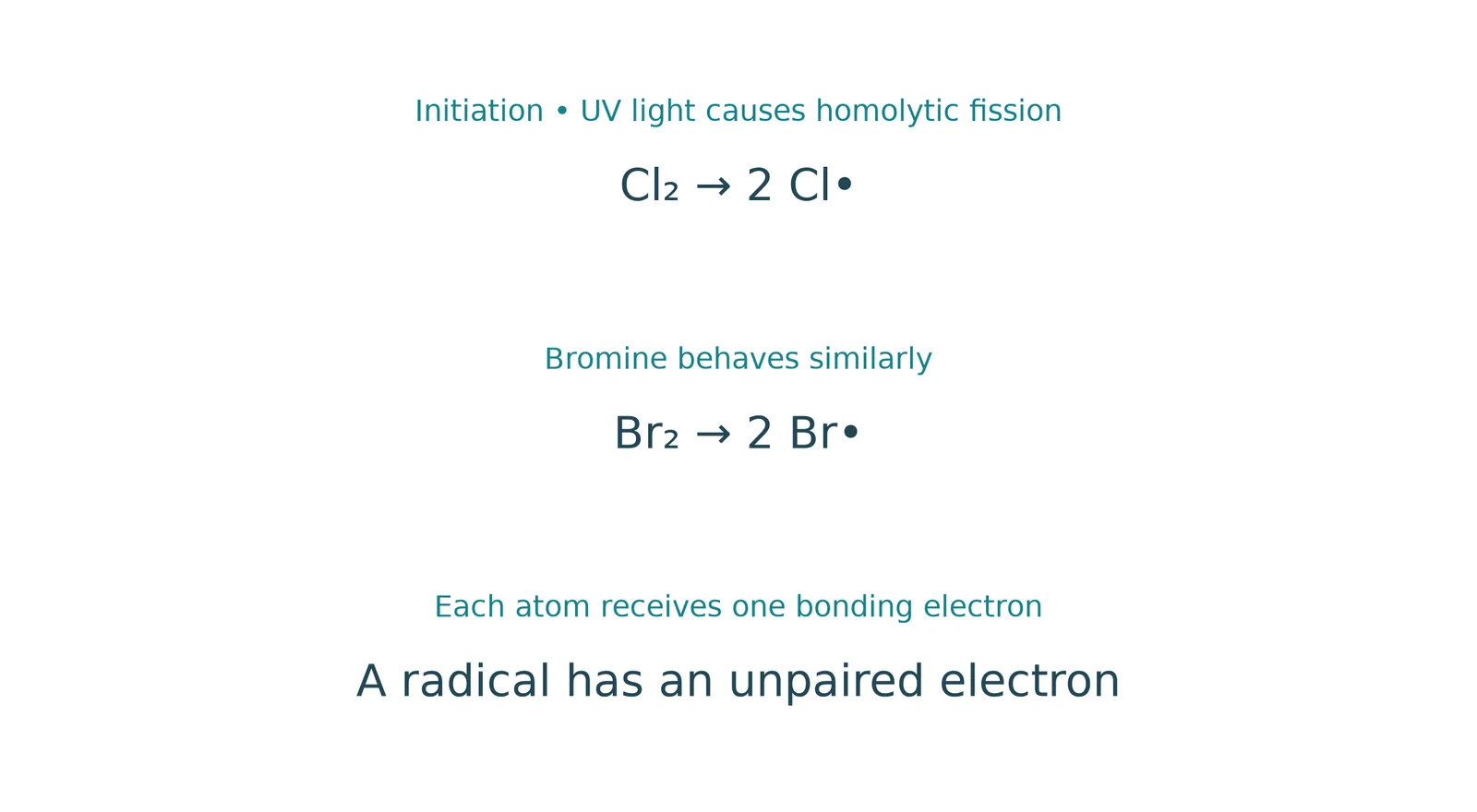
Free radical = a species with one or more unpaired electrons, shown with a dot, such as Cl•
2Free radical substitution
- Free radical substitution a reaction involving radicals in three steps
3
Initiation
- Covalent bonds break using ultraviolet light.
- Two free radicals form.
4
Propagation
- Radicals attack reactant molecules to form more radicals.
- These attack other molecules in turn, continuing the chain.
5
Termination
- Two free radicals react together to form a product molecule.
6Exam skill
- Exam skill write balanced equations for the steps, such as chlorination of methane at AS and substitution of arenes at A Level
Section 8 of 17Fundamentals of reaction mechanisms

1Difference from equations
- Difference from equations equations show amounts of reactants and products, while mechanisms show how the reaction occurs
2Curly arrows
- Curly arrows they show the movement of electrons in forming or breaking a covalent bond
Section 9 of 17Rules for curly arrows
1
The arrow must be double-headed.
2
It must start from a lone pair of electrons or a covalent bond.
3
It must end at an area of positive charge.
4
Include partial charges δ- and δ+, full charges and lone pairs where appropriate.
- Example
- in an addition step, a lone pair on the bromide ion attacks a positive carbocation to form a new covalent bond
Section 10 of 17Types of organic reaction
Types of organic reaction
Addition
- Addition two reactants form one product, such as ethene and bromine forming 1,2-dibromoethane
Substitution
- Substitution an atom or group is replaced by another, such as bromoethane with hydroxide giving ethanol and bromide
Elimination
- Elimination a small molecule is removed from a larger one, such as ethanol with an acid catalyst giving ethene and water
| AS mechanisms | A Level mechanisms |
|---|---|
| Nucleophilic substitution | Nucleophilic addition of carbonyls |
| Elimination of halogenoalkanes | Nucleophilic addition–elimination with water and alcohols |
| Electrophilic addition | Electrophilic substitution |
| Elimination of alcohols | Nucleophilic addition–elimination with ammonia and primary amines |
Section 11 of 17Structural isomerism
Structural isomerism
Structural isomers = compounds with the same molecular formula but different structural formulae, such as propene and cyclopropane (both C3H6)
Chain isomerism
- Chain isomerism the longest chain differs because of branching
- Pentane and 2,2-dimethylpropane are both C5H12.
- Their longest chains are 5 and 3 carbons.
Positional isomerism
- Positional isomerism the functional group is on different carbons
- Butan-1-ol and butan-2-ol are both C4H10O.
Functional group isomerism
- Functional group isomerism different functional groups give very different chemical properties
- Butan-1-ol (alcohol) and ethoxyethane (ether) are both C4H10O.
Section 12 of 17Deducing isomers
Skill
- Skill deduce all possible isomers from a molecular formula
Test
- Test name each structure, since isomers have different names and bending a molecule through 90° does not make an isomer
C3H6Br2
- No functional group isomerism, as Br is the only group.
- No chain isomerism, as the longest chain is 3.
- Positional isomerism occurs because the bromines can be on different carbons.
C4H10
- No functional group or positional isomerism.
- Chain isomerism gives butane and 2-methylbutane (2-methylpropane).
Section 13 of 17E/Z isomerism
Stereoisomers = compounds with the same atoms connected in the same order but arranged differently in space
Cause
- Cause restricted rotation about the planar C=C double bond
Condition
- Condition each C=C carbon must carry two different atoms or groups, so 2-methylpropene has no E/Z isomers
Z isomer
- Z isomer the higher-priority groups are on the same side of the double bond
- (zusammen, together)
E isomer
- E isomer the higher-priority groups are on opposite sides
- (entgegen, opposite)
Terms
- Terms geometric isomer is an outdated term, and cis/trans is superseded by E/Z and not required
Section 14 of 17CIP priority rules
- Rule
- compare the atomic number of the first atom attached to each carbon of the C=C, and the higher atomic number has higher priority
1
Look at the two groups on the left carbon and find the higher priority.
2
Look at the two groups on the right carbon and find the higher priority.
3
If the higher-priority groups are on opposite sides, the isomer is E.
4
If they are on the same side, the isomer is Z.
Example
- 1-bromo-1-propen-2-ol has Br above H and O above C, so the isomer with Br and O on opposite sides is E and the isomer with both on the same side is Z
Naming
- E-2-bromo-1-chloroprop-1-ene has chlorine on carbon 1 and bromine on carbon 2 on opposite sides
Section 15 of 17E/Z when the first atoms are the same
- Next step
- if the first atoms are equal, compare the second atoms attached
1
Ignore atoms identical on both groups, such as hydrogens.
2
Compare the first point of difference by atomic number.
3
CH2Br outranks CH3CH2 because Br outranks C.
4
CH2OH outranks CH3 because O outranks H.
1Result
- Result when the two higher-priority groups are on the same side, the isomer is Z
2Drawing
- E-2-bromobut-2-ene has Br outranking CH3 on one carbon and CH3 outranking H on the other, with the higher-priority groups on opposite sides
Section 16 of 17Key terms
| Term | Meaning |
|---|---|
| Homologous series | A group of compounds with the same functional group and general formula, differing by –CH2–. |
| Functional group | The atom or group of atoms that determines a compound’s characteristic reactions. |
| Free radical | A species with an unpaired electron. |
| Initiation | The step in which radicals are first formed. |
| Propagation | Chain steps in which radicals react and form more radicals. |
| Termination | A step in which two radicals combine. |
| Term | Meaning |
|---|---|
| Structural isomers | Compounds with the same molecular formula but different structural formulae. |
| Stereoisomers | Compounds with the same structural formula but different arrangements in space. |
| E/Z isomerism | Stereoisomerism about a C=C bond using CIP priorities. |
| CIP rules | Priority rules based on atomic number. |
| Positional isomers | Isomers with the functional group in different positions. |
| Chain isomers | Isomers with different carbon chain arrangements. |
Section 17 of 17Exam technique
1
Writing the empirical formula for ionic compounds as different from the molecular formula — for these, they are the same.
2
Numbering the chain from the wrong end — the lowest numbers must be obtained.
3
Writing side chains in numerical order — list them alphabetically.
4
Saying heterolytic fission forms radicals — it forms ions.
1
Naming isomers from drawings that look different — compare names, not drawings.
2
Using cis/trans in exam answers — use E/Z.
3
Using the first atoms only when they are equal — compare the next atoms.
4
Saying E means entgegen is together — E is opposite and Z is together.