3.2Organic Chemistry
Alkanes — Oxford AQA International A Level Chemistry Revision Notes & Topical Questions
5 min read 15 parts Lesson 6 of 55
Lesson summary
Complete PDF with figures and original page layoutPage 1 Oxford AQA International Your notes A Level (IAL) Chemistry Alkanes Contents Fractional Distillation of Crude Oil Modification of Alkanes By Cracking Combustion of Alkanes Chlorination of Alkane…
Part 1 of 9Crude oil and fractional distillation
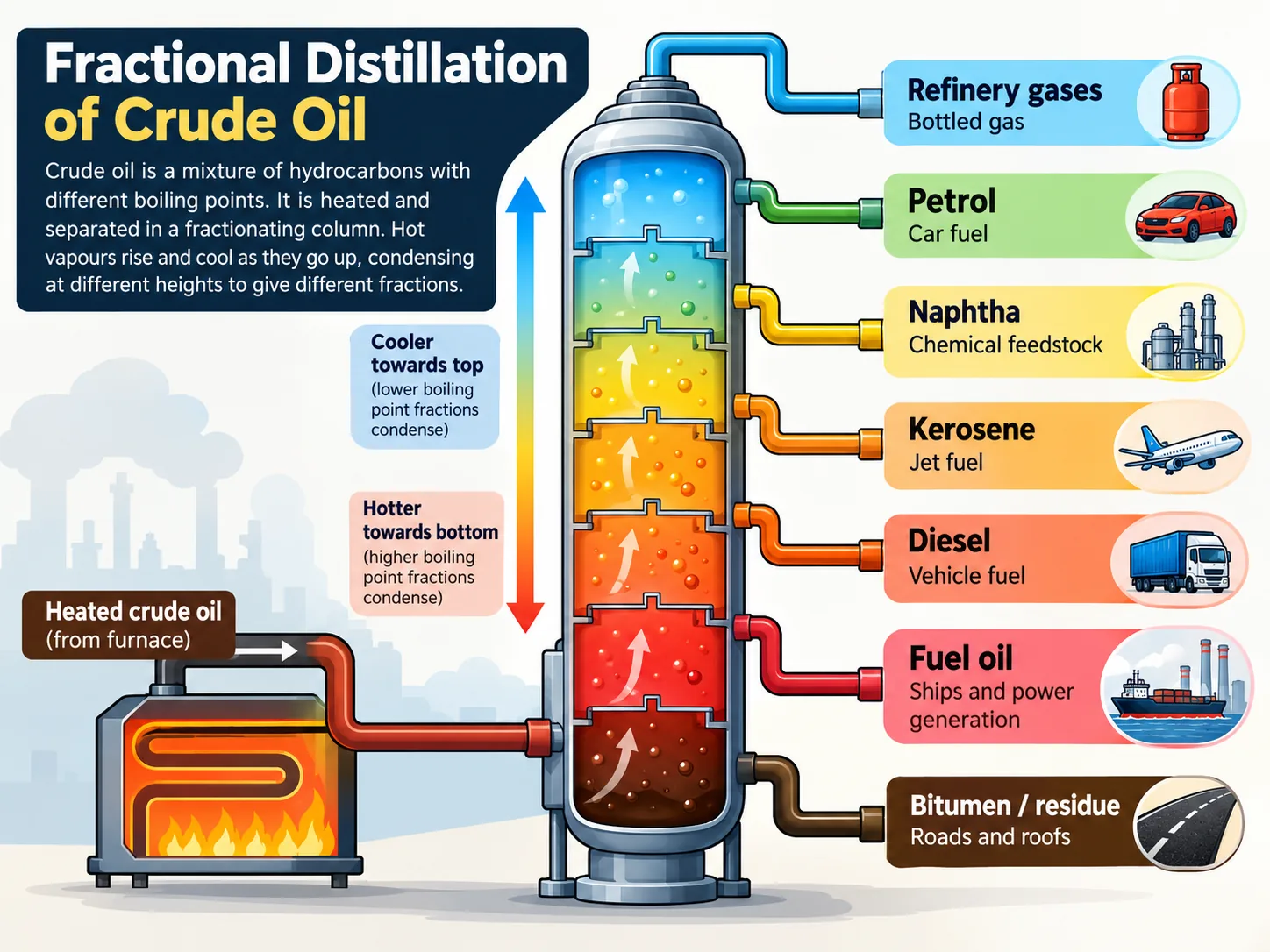

Crude oil
- Crude oil a mixture of mostly alkanes and the world’s main source of organic chemicals
Alkanes
- Alkanes saturated hydrocarbons with only single C–C bonds, made of hydrogen and carbon only, as straight or branched chains
Fractions
- Fractions the mixture is separated into fractions of similar chain length and boiling point, each with its own uses
Link
- Link the size of the molecule decides the fraction it enters, and it relates to the number of carbon and hydrogen atoms
Part 2 of 9The fractionating column
- Temperature gradient
- the column is hot at the bottom and cooler at the top
1
Crude oil is heated and vaporises.
2
The vapours enter the column.
3
Hydrocarbons with high boiling points condense at the bottom.
4
Those with lower boiling points rise and condense at the top.
1Other compounds
- Other compounds crude oil contains small amounts of sulfur compounds, which burn to sulfur dioxide, a cause of acid rain
2Physical process
- Physical process no covalent bonds break, and only intermolecular forces are overcome as the oil is heated
3Syllabus note
- Syllabus note the fractions need not be memorised, but the principle and its purpose must be understood
Part 3 of 9Economics of cracking
Supply
- Supply how much of a fraction fractional distillation produces
Demand
- Demand how much customers want to buy
Imbalance
- Imbalance petrol, kerosene and diesel are in high demand but short supply, whereas fuel oil and bitumen are in low demand but high supply
- (surplus fractions)
Solution
- Solution some surplus fractions are broken down into smaller, more useful compounds
Part 4 of 9Cracking
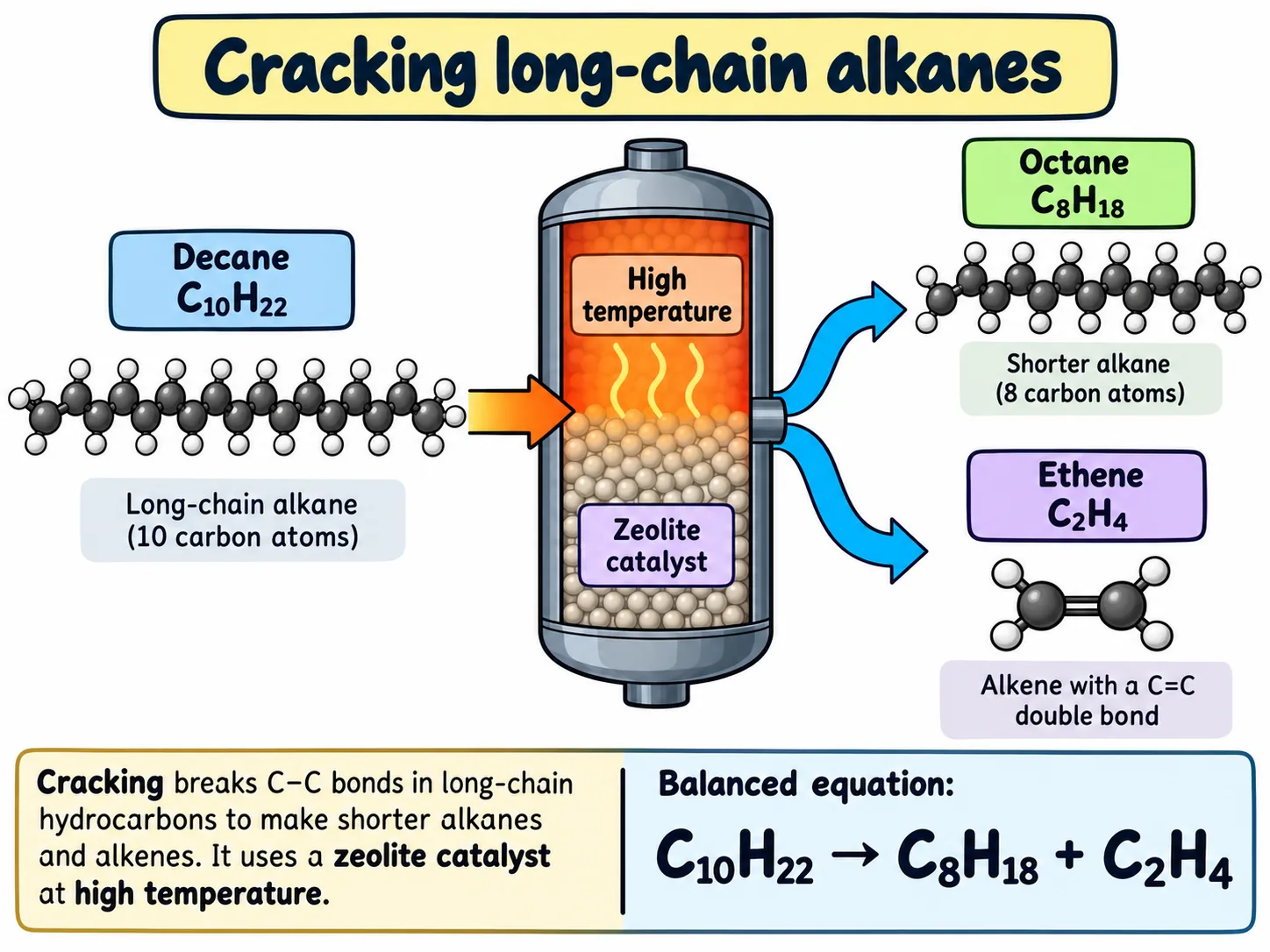
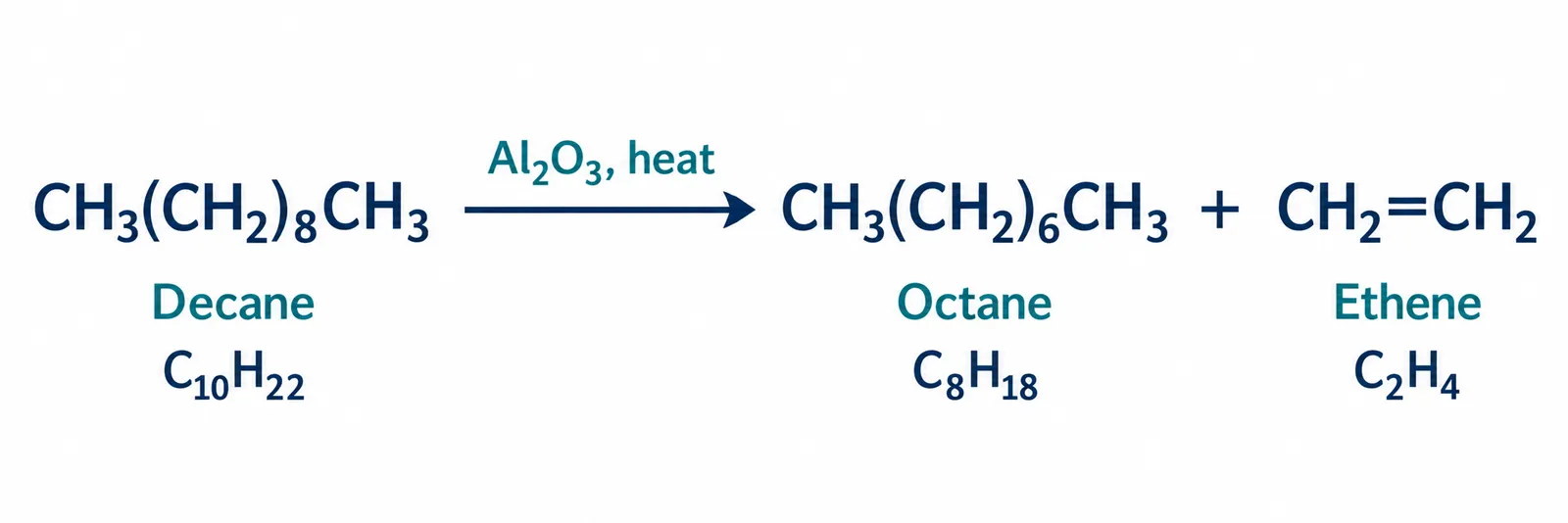
Cracking = an endothermic process that breaks surplus long-chain alkanes into smaller, more useful compounds
Mechanism
- Mechanism single C–C covalent bonds break in long-chain alkanes
Products
- Products a smaller alkane and one or more alkenes with lower Mr
Uses
- Uses low-Mr alkanes make good fuels, and alkenes are useful starting materials
Example
- Example decane cracks into octane and ethene
Part 5 of 9Thermal and catalytic cracking
| Thermal cracking | Catalytic cracking | |
|---|---|---|
| Temperature | High, up to 1000 °C | Lower, about 450 °C |
| Pressure | High, up to 70 atm | Slight pressure |
| Catalyst | None | Zeolite |
| Products | Alkanes and a high percentage of alkenes | Motor fuels and aromatic hydrocarbons |
Part 6 of 9Complete and incomplete combustion
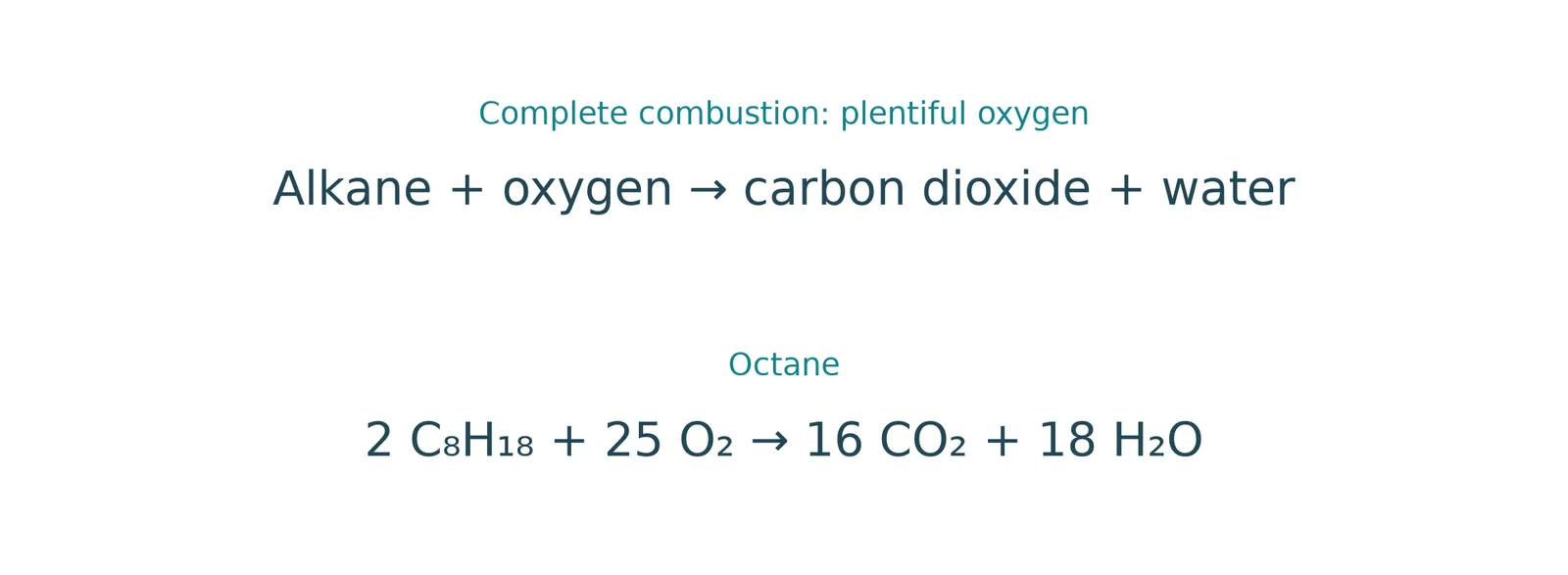
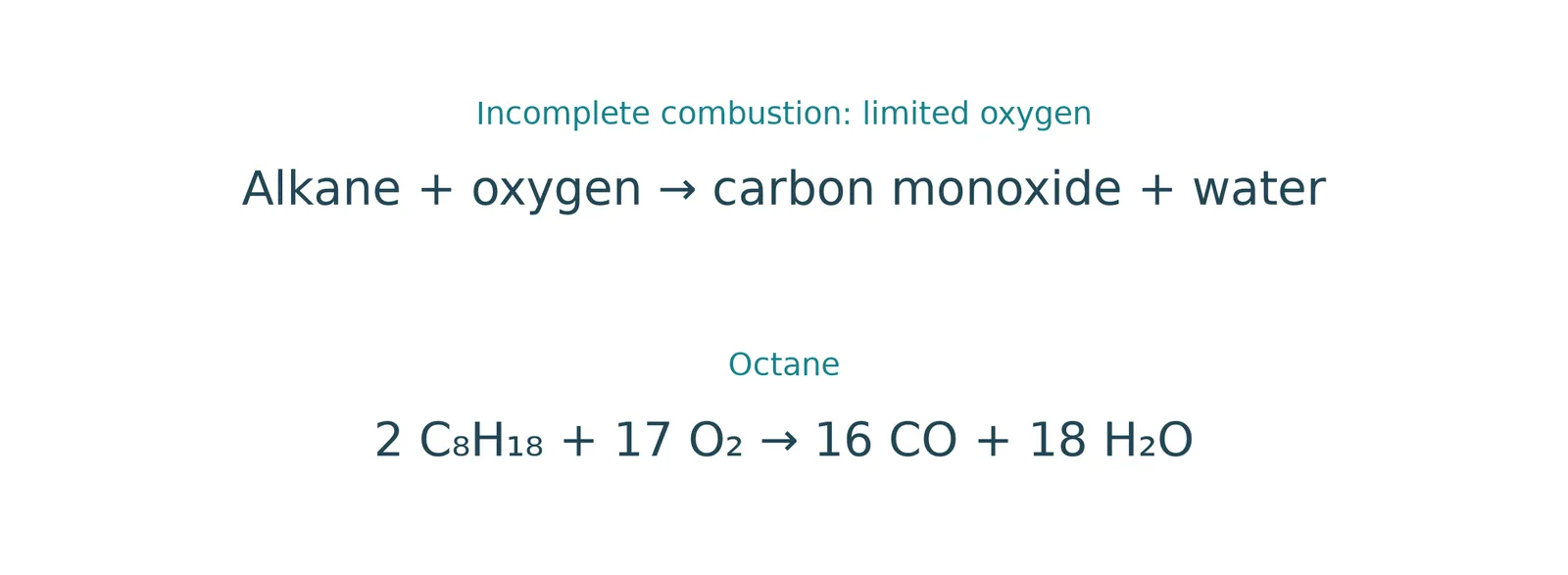

Use
- Use alkanes are burnt on a large scale as fuels
Complete combustion
- Complete combustion excess oxygen oxidises all carbon and hydrogen to carbon dioxide and water, as in octane
Incomplete combustion
- Incomplete combustion limited oxygen oxidises all hydrogen to water but only some carbon, which becomes carbon monoxide
Soot
- Soot with very little oxygen, carbon forms
Car engines
- Car engines incomplete combustion often occurs because oxygen is limited
Part 7 of 9Pollutants: carbon monoxide and oxides of nitrogen
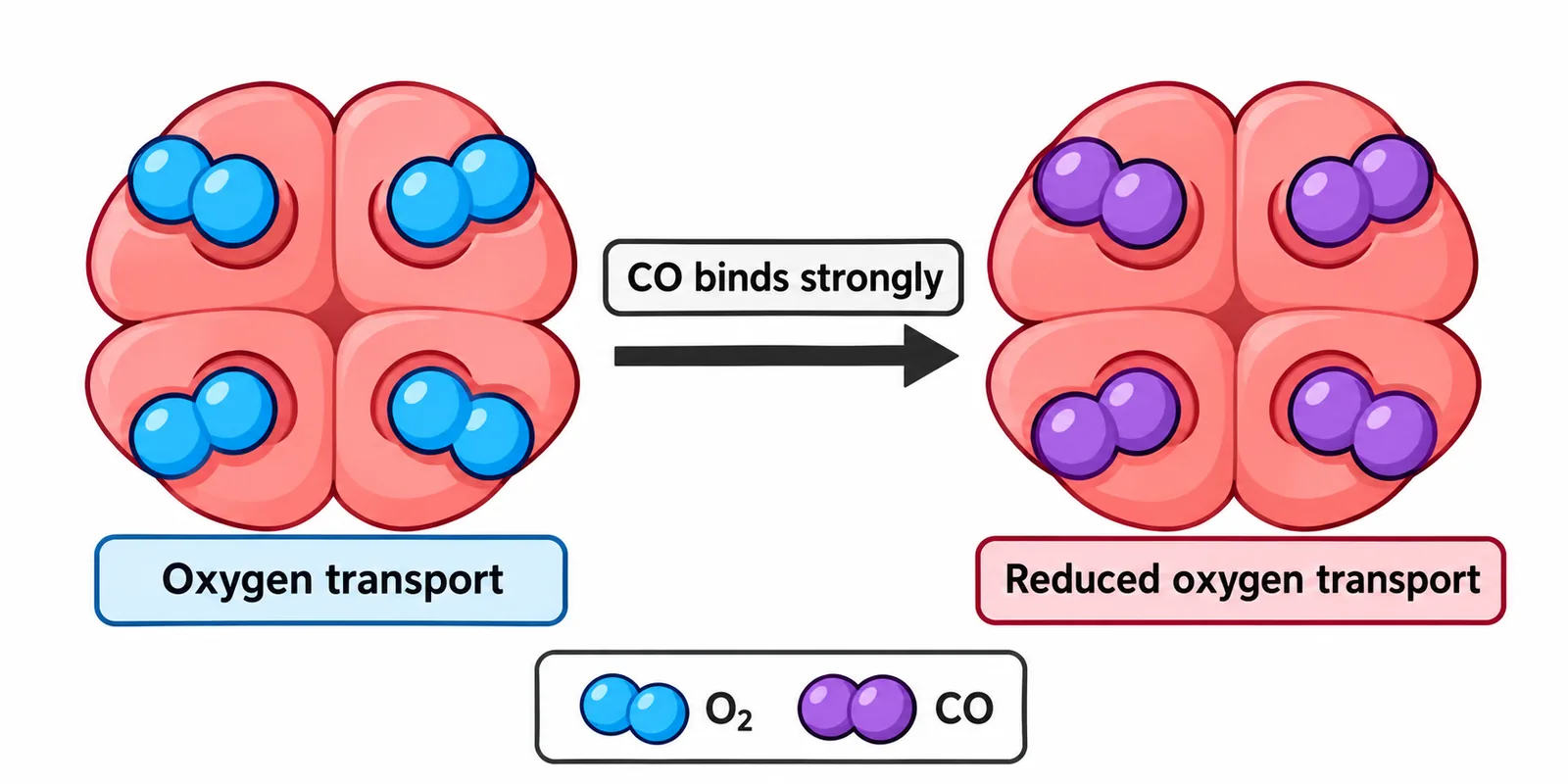
Exhaust pollutants
- Exhaust pollutants carbon monoxide, nitrogen oxides (NOx), unburned hydrocarbons and sulfur dioxide,
- which have serious environmental and health effects
Carbon monoxide
- 2C8H18 + 17O2 → 16CO + 18H2O
- It is toxic and odourless, causing dizziness, loss of consciousness and death.
- It binds to haemoglobin, reducing the transport of oxygen and removal of carbon dioxide.
Oxides of nitrogen
- Nitrogen is normally unreactive, but high temperature and pressure in an engine oxidise it: N2 + O2 → 2NO and N2 + 2O2 → 2NO2.
- They dissolve and react with water and oxygen to form nitric acid, causing acid rain.
- Acid rain corrodes buildings, harms plant and aquatic life, and damages human health.
Part 8 of 9Pollutants: hydrocarbons and sulfur dioxide
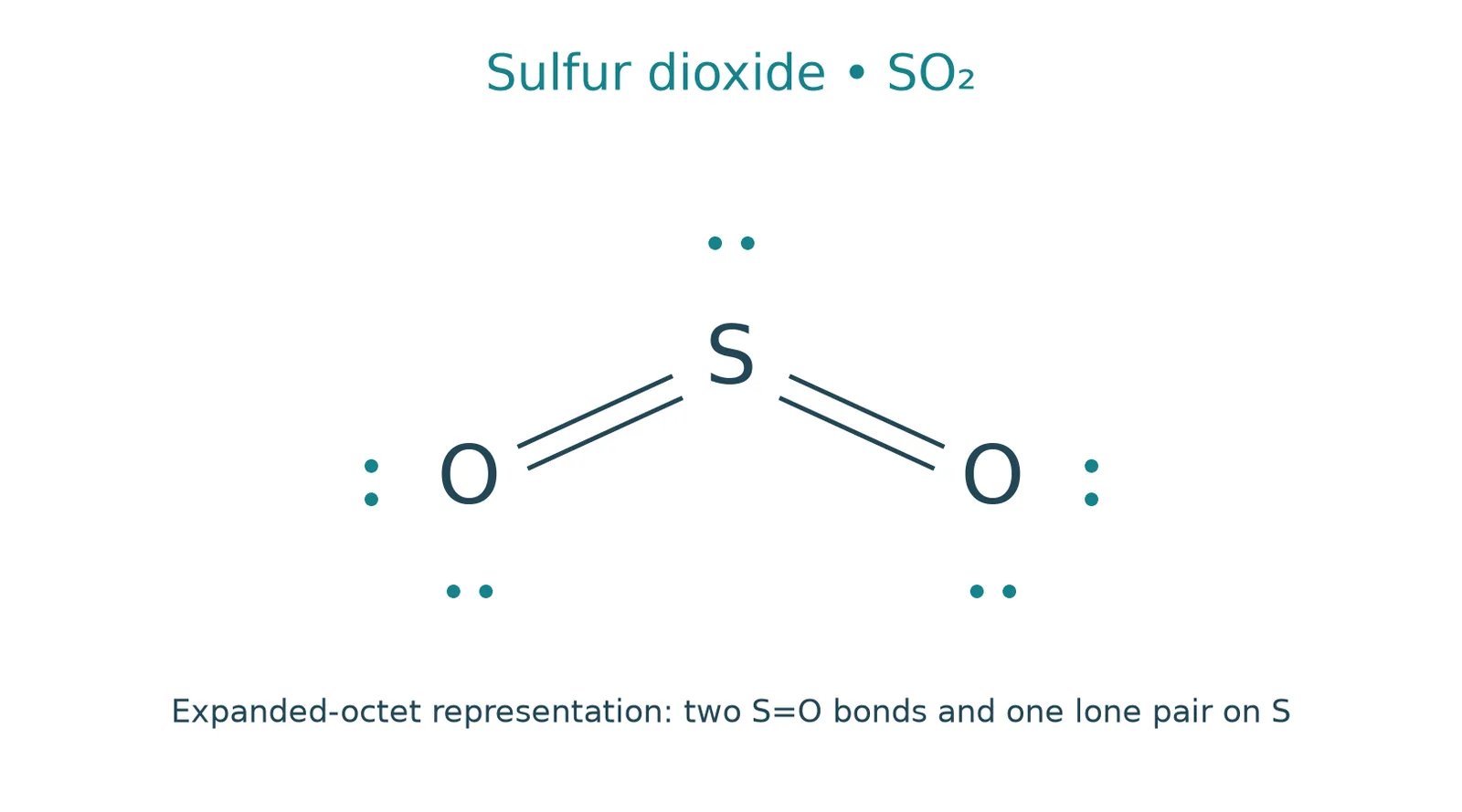

Pollutants: hydrocarbons and sulfur dioxide
Unburned hydrocarbons
- Unburned hydrocarbons nitrogen oxides react with them in air to form photochemical smog, and they harm lungs, eyes and plants
Sulfur dioxide
- Sulfur dioxide sulfur impurities oxidise, S(s) + O2(g) → SO2(g), and SO2 forms sulfuric acid in water, causing acid rain
Sulfur scrubbing (flue gas desulfurisation)
- Sulfur scrubbing (flue gas desulfurisation) a slurry of calcium oxide and calcium carbonate is sprayed into waste gases
- CaO(s) + 2H2O(l) + SO2(g) + ½O2(g) → CaSO4·2H2O(s), forming gypsum via calcium sulfite.
- CaCO3 + ½O2 + SO2 → CaSO4 + CO2.
- It removes 90–95% of the sulfur dioxide.
Part 9 of 9Catalytic converters
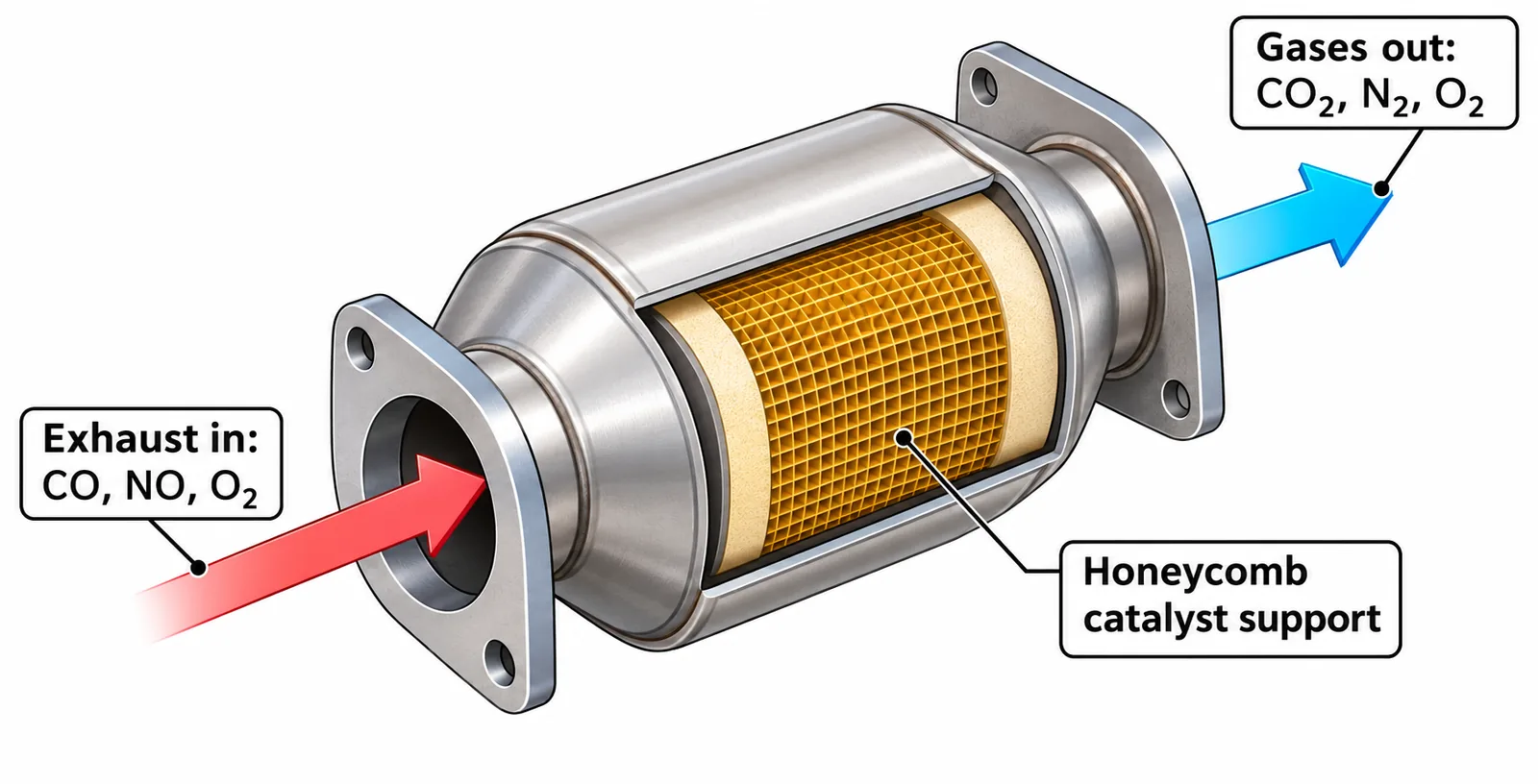
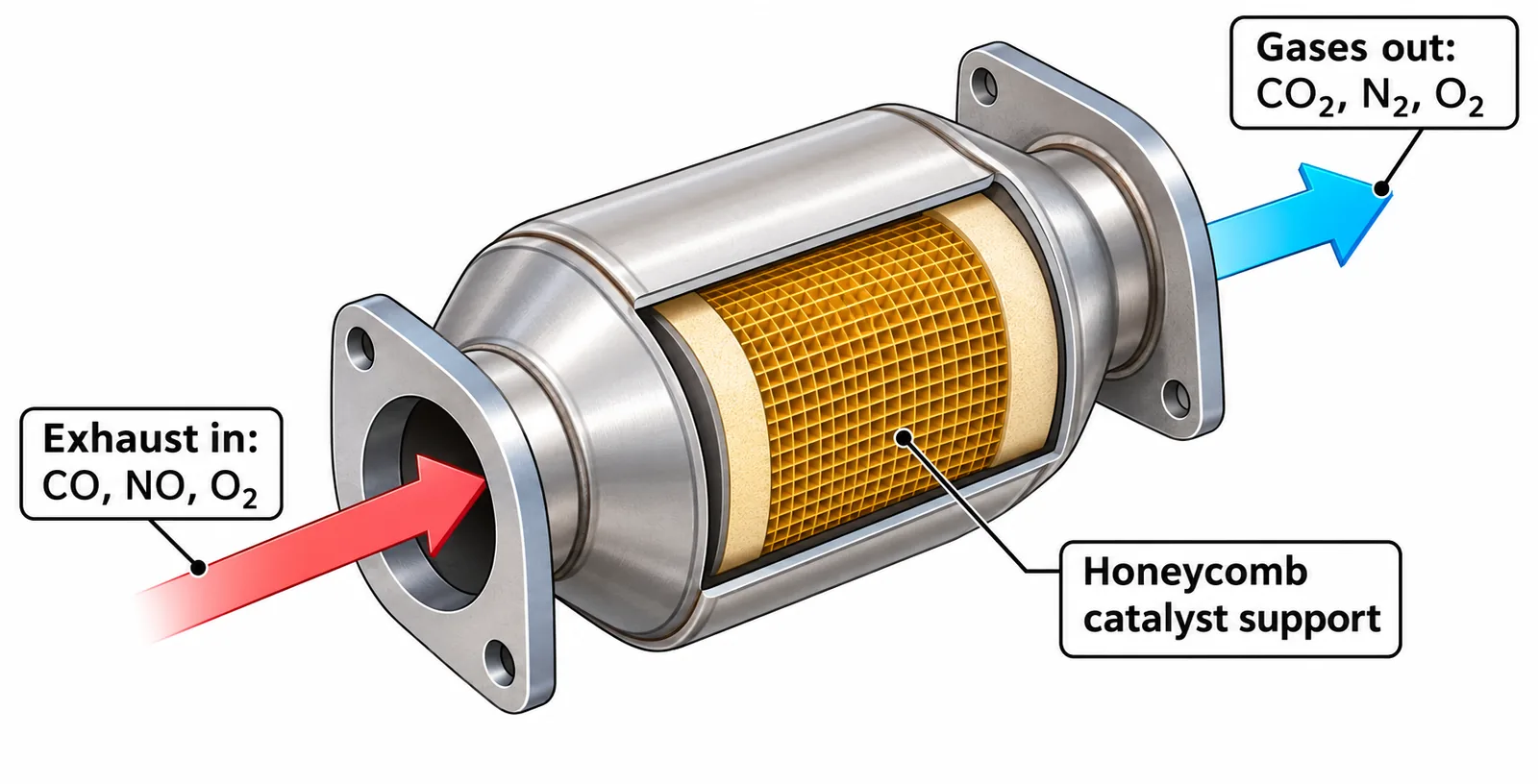
Design
- Design precious metals such as platinum are coated on a honeycomb for a large surface area
Reactions
- Oxidation of CO2CO + O2 → 2CO2.
- Reduction of NO2CO + 2NO → 2CO2 + N2.
- Oxidation of unburnt hydrocarbons, such as octane to CO2 and H2O.
| Pollutant | Formation | Consequence | Catalytic removal |
|---|---|---|---|
| Carbon monoxide | Incomplete combustion in car engines | Toxic gas | Oxidation to CO2 |
| Oxides of nitrogen | Oxidation of nitrogen in car engines | Acid rain | Reduction to N2 |
| Unburned hydrocarbons | Unburned fuel | Smog with nitrogen oxides | Oxidation to CO2 and H2O |
| Sulfur dioxide | Oxidation of sulfur impurities | Acid rain | Oxidation to calcium sulfate (scrubbing) |
- Carbon dioxide
- it is not toxic, but it is a pollutant that causes global warming
Key terms
| Term | Meaning |
|---|---|
| Fractional distillation | Separation of crude oil into fractions by boiling point. |
| Cracking | Breaking long-chain alkanes into shorter alkanes and alkenes. |
| Incomplete combustion | Burning in limited oxygen, producing CO or soot. |
| Catalytic converter | A device with precious metal catalysts that removes pollutants from exhaust. |
| Flue gas desulfurisation | Removing sulfur dioxide from waste gases using calcium compounds. |
Avoid these mistakes
1
Saying fractional distillation breaks covalent bonds — it only overcomes intermolecular forces.
2
Saying cracking is exothermic — it is endothermic.
3
Saying nitrogen oxides form from fuel nitrogen — they form from air nitrogen in hot engines.
4
Forgetting carbon dioxide as a pollutant — it causes climate change.
Last updated:
\n