Organic Chemistry
Oxford AQA International A Level Chemistry — 3.16 Chromatography
5 min read 4 parts Lesson 38 of 55 Virtual lab
Lesson summary
Gas chromatography: interpret peak area and retention time on a gas–liquid chromatogram, then explain what GC-MS adds. In gas–liquid chromatography (GLC), a volatile sample is carried through a long column by an inert gas such as helium or nitrogen.
- area under a peak
- longer retention time
- D has the largest peak area
- B and C have equal peak areas
- D has the longest retention time
Section 1 of 4How GLC separates a sample
1Gas–liquid chromatography (GLC)
In gas–liquid chromatography (GLC), a volatile sample is carried through a long column by an inert gas such as helium or nitrogen. The sample's components interact to different extents with a stationary phase in the column.
2Retention time
A detector records the components as they leave the column. Each component produces a peak at its retention time, the time between injection and detection.
Section 2 of 4Read the peaks
Area under a peak
The area under a peak is related to the amount of that component. Compare peak areas, not just the height of a narrow peak, when deciding which component is most abundant.
Longer retention time
A component that takes longer to leave has a longer retention time. Under the same conditions, stronger interaction with the stationary phase generally delays its movement through the column.
Section 3 of 4Worked chromatogram

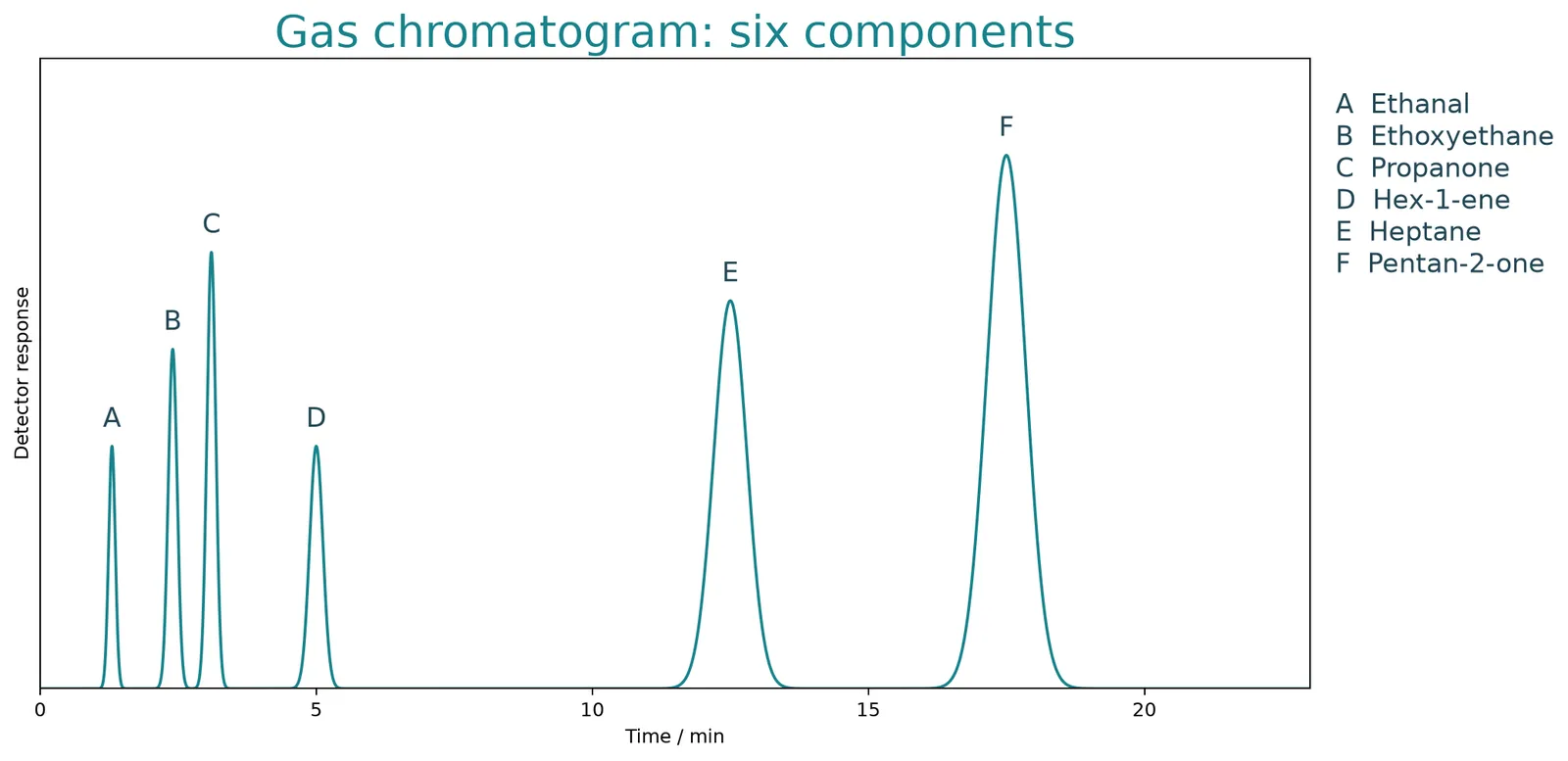
D has the largest peak area
In the four-component worked example, D has the largest peak area, so it is present in the greatest amount. B and C have equal peak areas, so their amounts are equal.
D has the longest retention time
D has the longest retention time, so in this comparison it interacts most strongly with the stationary phase. Peak area and retention time answer different questions.
Section 4 of 4Why combine with mass spectrometry
A retention time can be compared with a reference measured under the same conditions, but different compounds may have similar retention times. GLC alone may not identify an unknown conclusively.
GC-MS
GC-MS joins the chromatograph to a mass spectrometer. The chromatograph separates components and the mass spectra provide extra evidence about their identities.
—
- RNA: 5′ → 3′ 3′ → 5′.
- : AUG UAC .
- : UAA, UAG, UGA tRNA (Release Factor) .