Curriculum
Course: EST II Chemistry
Login

Curriculum

EST II Chemistry

Text lesson

5.1 Acids & Bases

Distinguish Arrhenius, Brønsted-Lowry and Lewis definitions.
1Key ideas2Key ideas3Key ideas4Key ideas5Key ideas6Key ideas
Key ideas
Key ideas
K
w
= [H
3
O
+
1 / 6Next ▶
Key ideas
1

][OH
2

–
3

] = 1.0 × 10
4

-14
5

at 25 °C.
6

pH + pOH = 14 at 25 °C

neutral pH = 7.
◀ Previous2 / 6Next ▶
Key ideas
Key ideas
Each pH unit is a 10-fold change in [H
].
Strong bases
group 1 hydroxides and Ca(OH)
2
, Sr(OH)
◀ Previous3 / 6Next ▶
Key ideas
Key ideas
, Ba(OH)
.
Neutralization
acid + base → salt + water

net ionic: H
+ OH
→ H
◀ Previous4 / 6Next ▶
Key ideas
1

O.
2

M
3

a
4

V
5

= M
6

b
◀ Previous5 / 6Next ▶
Key ideas
1

for 1:1 acid-base ratios.
2

Litmus
3

red in acid, blue in base

phenolphthalein: colorless in acid, pink above pH ~8.2.
4

Stronger acid ↔ weaker conjugate base.
◀ Previous6 / 6
1Essential knowledge2Essential knowledge3Essential knowledge4Essential knowledge5Essential knowledge6Essential knowledge7Essential knowledge8Essential knowledge9Essential knowledge10Essential knowledge11Essential knowledge12Essential knowledge
Essential knowledge
Essential knowledge
Acids taste sour, turn blue litmus red, react with active metals to release H
2
and with carbonates to release CO
. Bases taste bitter, feel slippery and turn red litmus blue.
In the
Brønsted-Lowry
1 / 12Next ▶
Essential knowledge
1

model, every acid-base reaction transfers a proton. In HF + H
2

O ⇌ F
3

–
4

+ H
5

3
6

O
◀ Previous2 / 12Next ▶
Essential knowledge
Essential knowledge
+
, the pairs are HF/F
and H
/H
O. Water is
amphoteric
◀ Previous3 / 12Next ▶
Essential knowledge
Essential knowledge
: it can act as acid or base.
The
Lewis
model is the broadest: any species with a lone pair (NH
, OH
) can be a base

electron-deficient species (BF
◀ Previous4 / 12Next ▶
Essential knowledge
1

, AlCl
2

, Fe
3

3+
4

) can be acids.
5

2H
6

O ⇌ H
◀ Previous5 / 12Next ▶
Essential knowledge
1

+ OH
2

. In pure water at 25 °C both ions are 1.0 × 10
3

-7
4

M. pH &lt

7 is acidic, pH &gt7 is basic.
5

For strong acids, [H
6

] equals the acid concentration (for monoprotic acids). For weak acids, use K
◀ Previous6 / 12Next ▶
Essential knowledge
Essential knowledge
a
= [H
][A
]/[HA]

larger K
means a stronger acid. K
× K
◀ Previous7 / 12Next ▶
Essential knowledge
1

b
2

= K
3

w
4

for a conjugate pair.
5

Polyprotic acids (H
6

SO
◀ Previous8 / 12Next ▶
Essential knowledge
Essential knowledge
4
, H
PO
) lose protons one at a time, each step weaker than the last.
Salts
can be acidic, basic or neutral: strong acid + strong base gives a neutral salt (NaCl)

weak acid + strong base gives a basic salt (NaCH
◀ Previous9 / 12Next ▶
Essential knowledge
Essential knowledge
COO)

strong acid + weak base gives an acidic salt (NH
Cl).
Buffers
resist pH change: the weak acid neutralizes added OH
, and the conjugate base neutralizes added H
. Blood is buffered by H
◀ Previous10 / 12Next ▶
Essential knowledge
1

CO
2

/HCO
3

near pH 7.4.
4

In a
5

titration curve
6

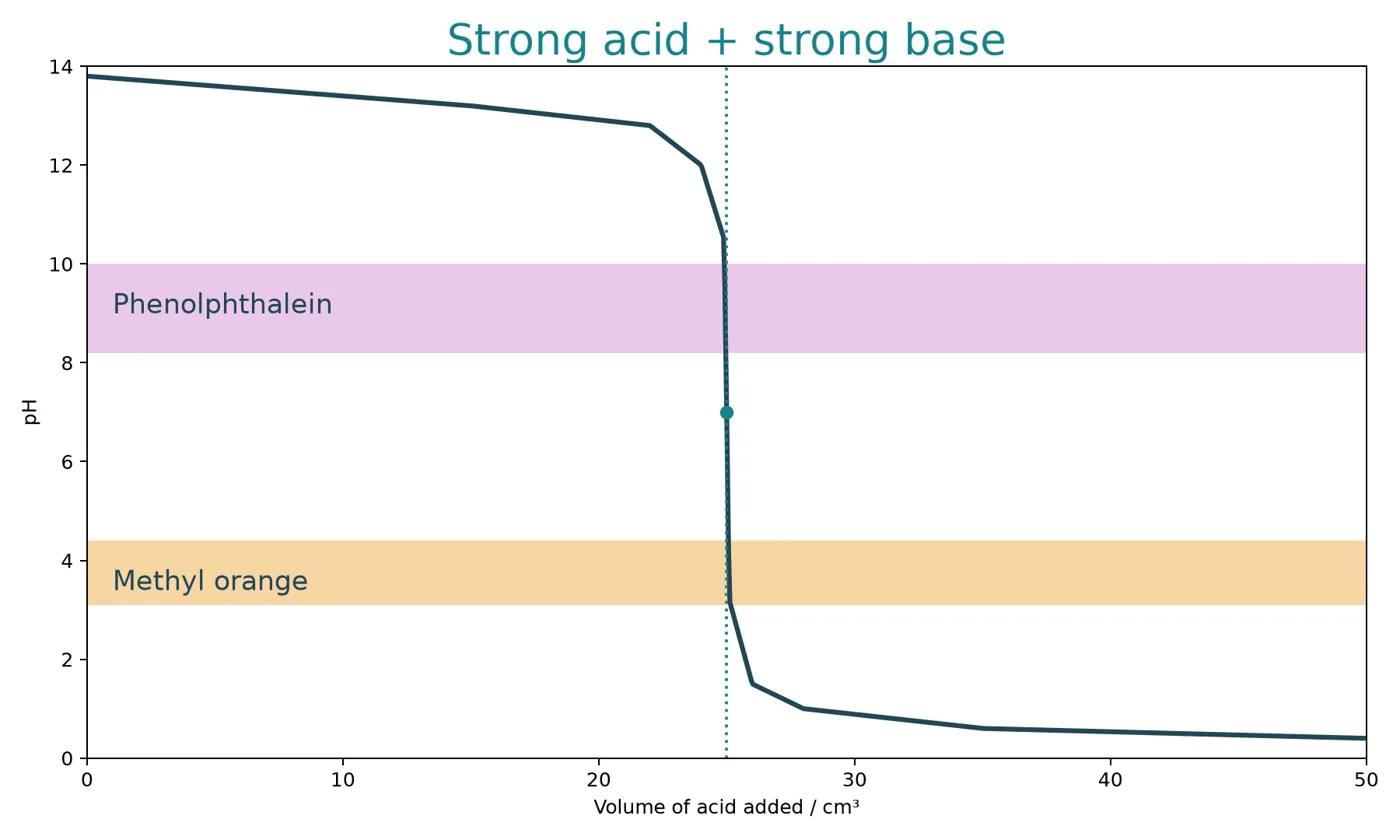
, a strong acid/strong base equivalence point is at pH 7

weak acid/strong base above 7strong acid/weak base below 7. Choose an indicator whose color change range includes the equivalence pH.
◀ Previous11 / 12Next ▶
Essential knowledge
1

A base that dissolves in water is called an alkali, such as sodium hydroxide or potassium hydroxide.
2

Strong and weak describe how far an acid or base dissociates

while dilute and concentrated describe how much solute is present.
3

Weak bases such as ammonia and amines dissociate only partly in water

so their solutions are less basic.
4

Carboxylic acids such as ethanoic acid ionise only partly, and only some of their hydrogen atoms can form ions.
5

A pH meter gives the most accurate pH reading

while universal indicator paper gives a less accurate estimate.
6

Brønsted-Lowry acid-base reactions are not limited to water and can also take place in the gas phase.
◀ Previous12 / 12
1Process & sequence2Process & sequence3Process & sequence4Process & sequence
Process & sequence
Process & sequence
1
Rinse the buret with the titrant and fill it

record the initial volume.
2
Pipet a known volume of the analyte into a flask and add an indicator.
3
Add titrant slowly with swirling, dropwise near the endpoint.
1 / 4Next ▶
Process & sequence
1

4
2

Stop at the first permanent color change and record the final volume.
3

5
4

Calculate moles of titrant used: n = M × V (in liters).
5

6
6

Use the mole ratio to find moles

then molarity, of the analyte.
◀ Previous2 / 4Next ▶
Process & sequence
Process & sequence
Acid-base titration — write these steps in this order

each step is a marking point.
Fill buret with standard solution
Add analyte and indicator to flask
Titrate until color change
Record volume used
Calculate moles and concentration
◀ Previous3 / 4Next ▶
Titration curve strong acid strong base with indicators
Process & sequence
◀ Previous4 / 4
Worked examples
1

HCl is strong: [H3O+] = 1.0 × 10⁻³

so pH = 3. NaOH is strong: [OH–] = 1.0 × 10⁻², pOH = 2, pH = 14 – 2 = 12.
2

Moles NaOH = 0.150 × 0.0200 = 3.00 × 10⁻³ mol. Ratio 1:1

so moles HCl = 3.00 × 10⁻³. [HCl] = 3.00 × 10⁻³/0.0250 = 0.120 M.
1Summary2Summary3Summary4Summary5Summary
Summary
1

1
2

Brønsted acids
3

donate protons
4

bases accept them.
5

2
6

pH = -log[H
1 / 5Next ▶
Summary
Summary
3
O
+
]
pH + pOH = 14.
Strong acids ionize
◀ Previous2 / 5Next ▶
Summary
1

completely
2

weak acids only partly.
3

4
4

Buffers
5

contain a weak acid plus its conjugate base.
6

5
◀ Previous3 / 5Next ▶
Summary
Summary
Titrations use
M
a
V
= M
b
◀ Previous4 / 5Next ▶
Summary
Summary
(adjusted for ratio).
◀ Previous5 / 5
1Check yourself2Check yourself3Check yourself4Check yourself5Check yourself6Check yourself7Check yourself8Check yourself
Check yourself
1

Q1. What is the conjugate base of H2PO4–?
2

A. H3PO4
3

B. HPO42-
4

C. PO43-
5

D. OH–
6

Show answer
1 / 8Next ▶
Check yourself
1

B. Removing one H+ from H2PO4– gives HPO42-.
2

Q2. A solution has [OH–] = 1 × 10⁻⁴ M. Its pH is:
3

A. 4
4

B. 7
5

C. 10
6

D. 14
◀ Previous2 / 8Next ▶
Check yourself
Check yourself
C. pOH = 4

so pH = 14 – 4 = 10.
Q3. Which is a weak acid?
A. HNO3
B. HCl
C. HClO4
D. HF
◀ Previous3 / 8Next ▶
Check yourself
1

D. HF ionizes only partially because of the strong H-F bond

the others are strong acids.
2

Q4. In the Lewis model, NH3 acts as a base because it:
3

1
4

A. Donates an electron pair
5

2
6

B. Donates a proton
◀ Previous4 / 8Next ▶
Check yourself
Check yourself
3
C. Accepts an electron pair
4
D. Produces H
+
A. The lone pair on nitrogen is donated to an electron-pair acceptor.
◀ Previous5 / 8Next ▶
Check yourself
Check yourself
Q5. Which mixture makes a buffer?
A. HCl and NaCl
B. CH
COOH and NaCH
COO
C. NaOH and NaCl
◀ Previous6 / 8Next ▶
Check yourself
1

D. HNO
2

and KNO
3

B. A buffer needs a weak acid and its conjugate base

acetic acid and acetate fit.
4

Q6. A solution at pH 3 has how many times the [H3O+] of one at pH 5?
5

A. 2
6

B. 20
◀ Previous7 / 8Next ▶
Check yourself
1

C. 100
2

D. 1000
3

C. Each pH unit is a factor of 10

two units is 102 = 100.
◀ Previous8 / 8

Arrhenius acid

A substance that increases the H+ (H3O+) concentration when dissolved in water.

Arrhenius base

A substance that increases the OH– concentration when dissolved in water.

Brønsted-Lowry acid

A proton (H+) donor.

Brønsted-Lowry base

A proton (H+) acceptor.

Lewis acid

An electron-pair acceptor, such as BF3 or a metal cation.

Conjugate acid-base pair

Two species that differ by exactly one H+, such as NH4+/NH3.

pH

The negative base-10 logarithm of the hydronium ion concentration: pH = -log[H3O+].

Strong acid

An acid that ionizes completely in water, such as HCl, HBr, HI, HNO3, H2SO4 and HClO4.

Buffer

A solution of a weak acid and its conjugate base (or weak base and its conjugate acid) that resists changes in pH.

Equivalence point

The point in a titration where moles of acid and base have reacted exactly according to the equation.

Three definitions of acids and bases
Model Acid Base Example
Arrhenius Produces H+ in water Produces OH– in water HCl, NaOH
Brønsted-Lowry Proton donor Proton acceptor NH3 + H2O → NH4+ + OH–
Lewis Electron-pair acceptor Electron-pair donor BF3 + NH3
Strong versus weak
Property Strong acid (HCl) Weak acid (CH3COOH)
Ionization ~100% Small fraction (~1%)
Electrical conductivity High Low
pH of 0.1 M solution 1 About 2.9
Ka Very large 1.8 × 10⁻⁵
Conjugate base strength Negligible Weak base
Command terms
Identify / Describe (FRQ)
A short, specific statement; describing requires relevant characteristics, not a single word.
Explain / Justify (FRQ)
Give the cause-and-effect reasoning or evidence; a restated fact does not score.
Calculate
Show setup, substitution and the answer with units.
Predict
State the expected outcome; add a reason only if asked to justify.
MCQ technique
Read every option; eliminate distractors that are true statements but do not answer the question; watch for NOT/EXCEPT.

Keywords the mark scheme looks for in this lesson

Keywords the mark scheme looks for in this lesson
Arrhenius acid · Arrhenius base · Brønsted-Lowry acid · Brønsted-Lowry base · Lewis acid · Conjugate acid-base pair · pH · Strong acid · Buffer · Equivalence point
Learn each definition in the Key words tab exactly; a missing keyword in a definition usually loses the mark.

How to get full marks (examiner guidance)

1

Answer exactly what is asked; extra correct material does not earn credit, and contradictory statements can cancel credit (AP FRQ).
2

Use precise vocabulary (e.g. “active site”, “concentration gradient”, “allele”), never “it/stuff/things”.
3

Show units and working in calculations.
4

In MCQs, predict the answer before reading the options, then eliminate.
Accepted payment methods