Curriculum
Course: EST II Chemistry
Login

Curriculum

EST II Chemistry

Text lesson

4.1 Thermochemistry

Distinguish exothermic and endothermic processes and read energy diagrams.
1Key ideas2Key ideas3Key ideas4Key ideas5Key ideas
Key ideas
Key ideas
q = mcΔT

specific heat of water = 4.18 J/(g·°C) = 1.00 cal/(g·°C).
What the symbols mean:
E, Q or q = energy transferred (J) · m = mass (kg

g in chemistry calorimetry) · c = specific heat capacity (J kg
−1
°C
water 4.18 J g
1 / 5Next ▶
Key ideas
1

) · ΔT or Δθ = temperature change (°C or K)
2

1 cal = 4.184 J

1 kJ = 1000 J.
3

ΔH°
4

rxn
5

= ΣΔH°
6

f
◀ Previous2 / 5Next ▶
Key ideas
Key ideas
(products) − ΣΔH°
(reactants).
of an element in its standard state is zero.
Reversing a reaction changes the sign of ΔH

multiplying it multiplies ΔH.
ΔH = bonds broken − bonds formed (using bond energies).
ΔG = ΔH − TΔS

ΔG &lt0 means spontaneous.
◀ Previous3 / 5Next ▶
Key ideas
Key ideas
ΔG = Gibbs free energy change (kJ mol
feasible when ≤ 0) · ΔH = enthalpy change (kJ mol
) · T = temperature (K) · ΔS = entropy change (J K
mol
, divide by 1000 to use kJ)
Entropy increases
◀ Previous4 / 5Next ▶
Key ideas
Key ideas
solid → liquid → gas, and when moles of gas increase.
◀ Previous5 / 5
1Essential knowledge2Essential knowledge3Essential knowledge
Essential knowledge
1

Chemical energy is stored in bonds. Breaking bonds absorbs energy

forming bonds releases energy. If more energy is released forming product bonds than is absorbed breaking reactant bonds, the reaction is exothermic.
2

On an energy diagram, the activation energy is the hump between reactants and the activated complex, and ΔH is the difference between product and reactant energies.
3

In a coffee-cup calorimeter, the heat released by the reaction is absorbed by the water: q
4

rxn
5

= −q
6

water
1 / 3Next ▶
Essential knowledge
Essential knowledge
. A temperature rise means the reaction was exothermic.
Heat and temperature differ
temperature measures average kinetic energy

while heat is energy transferred because of a temperature difference. Water’s high specific heat means it heats and cools slowly.
Phase changes involve energy without temperature change: q = nΔH
fus
for melting and q = nΔH
◀ Previous2 / 3Next ▶
Essential knowledge
1

vap
2

for boiling. Melting and boiling are endothermic

freezing and condensing are exothermic.
3

Hess’s law lets us combine known equations, reversing or multiplying them, to reach a target equation and add their ΔH values.
4

Entropy measures disorder. Gases have more entropy than liquids

which have more than solidsdissolving and increasing temperature usually increase entropy.
5

Gibbs free energy combines both drives
6

a reaction is spontaneous if ΔG is negative. Spontaneous does not mean fast

rate depends on activation energy.
◀ Previous3 / 3
1Process & sequence2Process & sequence3Process & sequence4Process & sequence
Process & sequence
Process & sequence
1
Measure the mass of water (or solution) in the calorimeter.
2
Record the initial temperature.
3
Add the reactant or hot object and stir.
1 / 4Next ▶
Process & sequence
Process & sequence
4
Record the final (maximum or minimum) temperature.
5
Calculate q = mcΔT for the water.
6
Heat of reaction = −q
◀ Previous2 / 4Next ▶
Process & sequence
1

water
2

divide by moles for ΔH per mole.
3

Coffee-cup calorimetry — write these steps in this order

each step is a marking point.
4

Weigh water in calorimeter
5

Record initial temperature
6

Add reactants and stir
◀ Previous3 / 4Next ▶
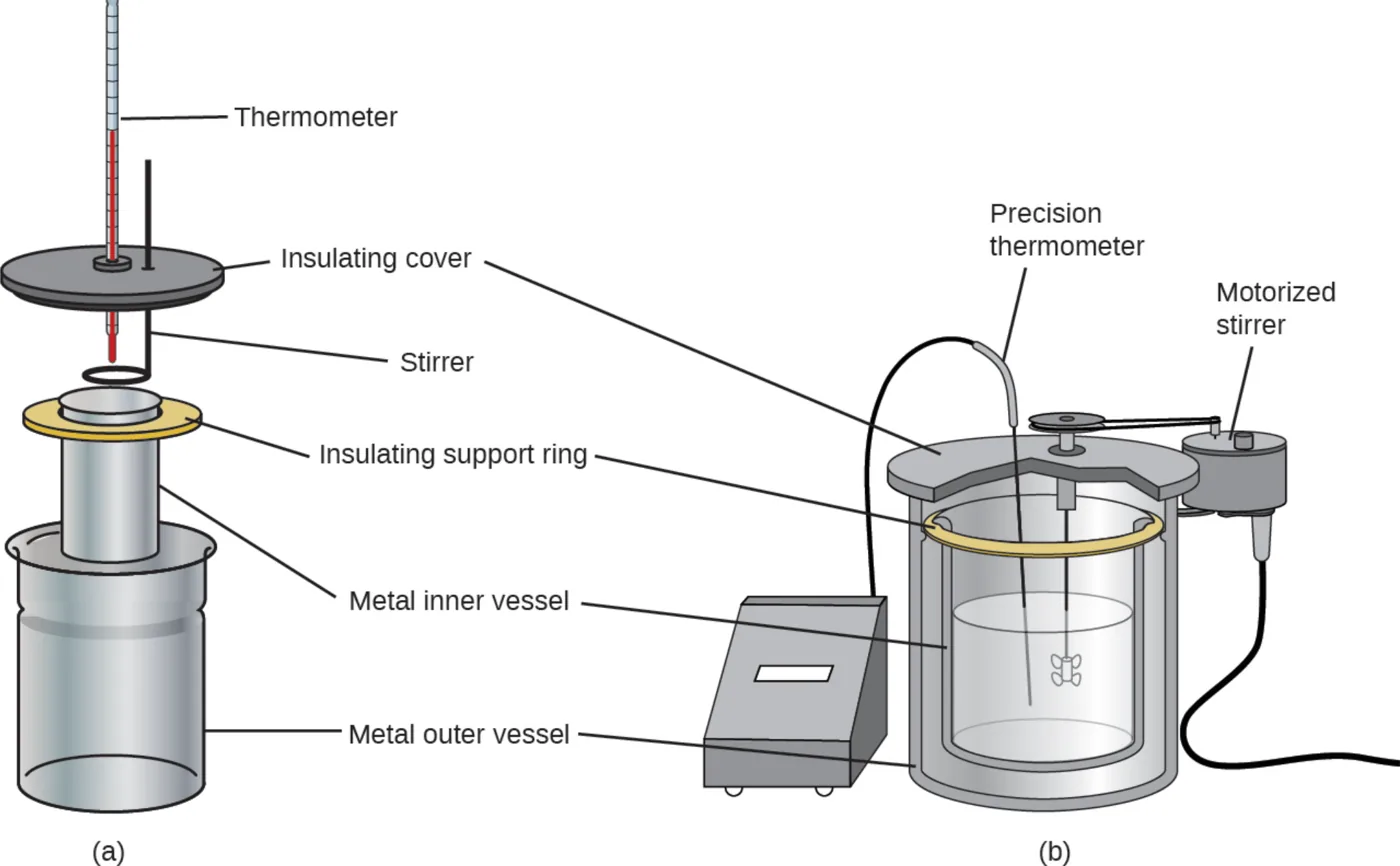
Types of calorimeters: Commercial solution calorimeters, from a simple low-cost model for student use to a costly, more precise instrument for industry and research.
Process & sequence
Types of calorimeters: Commercial solution calorimeters, from a simple low-cost model for student use to a costly, more precise instrument for industry and research." loading= - Dr Khaled Dabour Academy⤢ Enlarge
1

Record final temperature
2

Calculate q = mcΔT
3

Convert to ΔH per mole
◀ Previous4 / 4
1Worked examples2Worked examples3Worked examples
Worked examples
Worked examples
How much heat is needed to warm 200. g of water from 20.0 °C to 45.0 °C?
q = mcΔT = 200. × 4.18 × 25.0 = 20,900 J = 20.9 kJ.
Using ΔH°
f
: CH
4
1 / 3Next ▶
Worked examples
1

= −75 kJ/mol, CO
2

2
3

= −394, H
4

O(l) = −286, find ΔH for CH
5

+ 2O
6

→ CO
◀ Previous2 / 3Next ▶
Worked examples
Worked examples
+ 2H
O(l).
Products: −394 + 2(−286) = −966 kJ. Reactants: −75 + 0 = −75 kJ. ΔH = −966 − (−75) = −891 kJ (exothermic).
◀ Previous3 / 3
1Summary2Summary3Summary
Summary
Summary
1
Exothermic reactions have
negative ΔH
.
2
Calorimetry uses
1 / 3Next ▶
Summary
1

q = mcΔT
2

3
3

Hess’s law
4

: enthalpy is a state function.
5

4
6

Spontaneous processes have
◀ Previous2 / 3Next ▶
Summary
Summary
negative ΔG
◀ Previous3 / 3
1Check yourself2Check yourself3Check yourself4Check yourself5Check yourself6Check yourself7Check yourself
Check yourself
Check yourself
Q1. A reaction in a calorimeter makes the water temperature rise. The reaction is:
A. endothermic with ΔH &gt

0
B. exothermic with ΔH &lt

0
C. exothermic with ΔH &gt

0
D. neither
Show answer
1 / 7Next ▶
Check yourself
1

B. Heat flows out of the reaction into the water

so the reaction is exothermic with negative ΔH.
2

Q2. How much heat raises 50.0 g of water by 10.0 °C?
3

A. 209 J
4

B. 500 J
5

C. 4180 J
6

D. 2090 J
◀ Previous2 / 7Next ▶
Check yourself
Check yourself
D. q = 50.0 × 4.18 × 10.0 = 2090 J.
Q3. Which process is endothermic?
1
A. Melting ice
2
B. Freezing water
◀ Previous3 / 7Next ▶
Check yourself
Check yourself
3
C. Burning propane
4
D. Condensing steam
A. Melting absorbs heat to overcome intermolecular attractions.
Q4. If A → B has ΔH = +50 kJ

then 2B → 2A has ΔH =
◀ Previous4 / 7Next ▶
Check yourself
1

A. +50 kJ
2

B. +100 kJ
3

C. −100 kJ
4

D. −50 kJ
5

C. Reversing flips the sign

doubling doubles the magnitude.
6

Q5. A reaction with ΔH &gt

0 and ΔS &gt0 is spontaneous:
◀ Previous5 / 7Next ▶
Check yourself
1

A. at all temperatures
2

B. only at low temperatures
3

C. never
4

D. only at high temperatures
5

D. ΔG = ΔH − TΔS becomes negative only when TΔS exceeds ΔH.
6

Q6. The standard enthalpy of formation of O2(g) is:
◀ Previous6 / 7Next ▶
Check yourself
Check yourself
A. 0 kJ/mol
B. −286 kJ/mol
C. +498 kJ/mol
D. It depends on temperature only
A. Elements in their standard states have ΔH°f = 0 by definition.
◀ Previous7 / 7

Enthalpy change (ΔH)

The heat absorbed or released by a reaction at constant pressure.

Exothermic

A process that releases heat to the surroundings; ΔH is negative.

Endothermic

A process that absorbs heat from the surroundings; ΔH is positive.

Specific heat capacity (c)

The heat needed to raise 1 g of a substance by 1 °C.

Calorimetry

Measuring heat changes by recording temperature changes of a known mass of water or other material.

Standard enthalpy of formation

The enthalpy change when 1 mol of a compound forms from its elements in their standard states.

Hess’s law

The total enthalpy change of a reaction is the same whatever route is taken.

Entropy (S)

A measure of the disorder or dispersal of energy in a system.

Gibbs free energy (G)

A quantity combining enthalpy and entropy that predicts whether a process is spontaneous.

Activation energy

The minimum energy needed for reactants to form the activated complex.

Predicting spontaneity with ΔG = ΔH − TΔS
ΔH ΔS ΔG Spontaneous?
− + Always − At all temperatures
+ − Always + Never
− − − at low T Only at low temperature
+ + − at high T Only at high temperature
Exothermic vs endothermic
Feature Exothermic Endothermic
Sign of ΔH Negative Positive
Surroundings Get warmer Get cooler
Energy diagram Products lower than reactants Products higher than reactants
Examples Combustion, freezing, condensation Melting, evaporation, photosynthesis
Command terms
Identify / Describe (FRQ)
A short, specific statement; describing requires relevant characteristics, not a single word.
Explain / Justify (FRQ)
Give the cause-and-effect reasoning or evidence; a restated fact does not score.
Calculate
Show setup, substitution and the answer with units.
Predict
State the expected outcome; add a reason only if asked to justify.
MCQ technique
Read every option; eliminate distractors that are true statements but do not answer the question; watch for NOT/EXCEPT.

Keywords the mark scheme looks for in this lesson

Keywords the mark scheme looks for in this lesson
Enthalpy change (ΔH) · Exothermic · Endothermic · Specific heat capacity (c) · Calorimetry · Standard enthalpy of formation · Hess’s law · Entropy (S) · Gibbs free energy (G) · Activation energy
Learn each definition in the Key words tab exactly; a missing keyword in a definition usually loses the mark.

How to get full marks (examiner guidance)

1

Answer exactly what is asked; extra correct material does not earn credit, and contradictory statements can cancel credit (AP FRQ).
2

Use precise vocabulary (e.g. “active site”, “concentration gradient”, “allele”), never “it/stuff/things”.
3

Show units and working in calculations.
4

In MCQs, predict the answer before reading the options, then eliminate.
Accepted payment methods