Curriculum
Course: EST II Chemistry
Login

Curriculum

EST II Chemistry

Text lesson

2.2 Solutions

Describe the dissolving process and factors affecting solubility.
1Key ideas2Key ideas3Key ideas4Key ideas5Key ideas
Key ideas
Key ideas
M = mol solute / L solution.
M
1
V
= M
2
1 / 5Next ▶
Key ideas
1

.
2

ΔT
3

b
4

= i K
5

m (K
6

water = 0.512 °C/m).
◀ Previous2 / 5Next ▶
Key ideas
Key ideas
f
water = 1.86 °C/m).
i = 1 for sugar, 2 for NaCl, 3 for CaCl
(ideal).
Adding a nonvolatile solute lowers vapor pressure (Raoult’s law).
Solubility rules
◀ Previous3 / 5Next ▶
Key ideas
Key ideas
all Na
+
, K
, NH
4
and NO
◀ Previous4 / 5Next ▶
Key ideas
1

3
2

−
3

salts are soluble

AgCl, BaSO
4

, CaCO
5

are insoluble.
6

Mass percent = (mass solute / mass solution) × 100.
◀ Previous5 / 5
1Essential knowledge2Essential knowledge3Essential knowledge4Essential knowledge
Essential knowledge
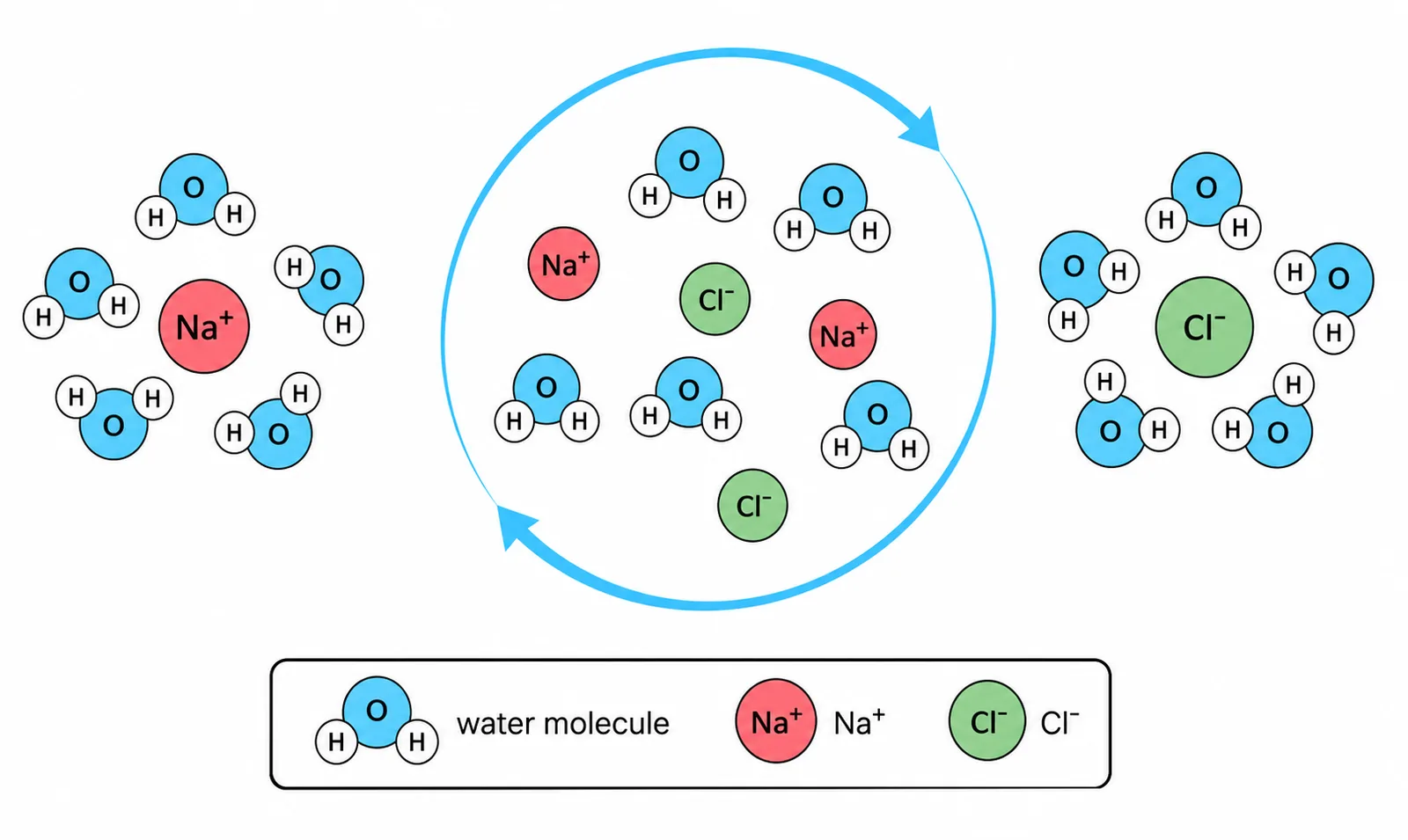
Ion hydration — progressive drawing" loading= - Dr Khaled Dabour Academy⤢ Enlarge
1

1
2

A solution is a homogeneous mixture. When an ionic solid dissolves in water, polar water molecules surround the ions (hydration): the δ− oxygen faces cations, and the δ+ hydrogens face anions.
3

2
4

Polar and ionic solutes dissolve in polar solvents like water

nonpolar solutes such as oils dissolve in nonpolar solvents like hexane. This is ‘like dissolves like’.
5

3
6

Solubility curves show grams of solute per 100 g water against temperature. A point below the curve is unsaturated, on it is saturated, and above it is supersaturated.
1 / 4Next ▶
Essential knowledge
Essential knowledge
4
Gases become less soluble as temperature rises (warm soda goes flat) and more soluble as pressure rises (Henry’s law: C = kP).
5
Molarity changes slightly with temperature because volume changes

molality does notwhich is why molality is used for colligative properties.
6
When diluting, the number of moles of solute stays the same, only the volume increases

so M
◀ Previous2 / 4Next ▶
Essential knowledge
1

V
2

= M
3

.
4

7
5

Colligative properties include vapor pressure lowering, boiling point elevation, freezing point depression and osmotic pressure. Salt on roads lowers water’s freezing point

antifreeze does the same in car radiators.
6

8
◀ Previous3 / 4Next ▶
Essential knowledge
Essential knowledge
Ionic compounds dissociate into several ions

so they have a larger effect than the same molality of a molecular solute. 1 m CaCl
gives about 3 m of particles.
◀ Previous4 / 4
1Process & sequence2Process & sequence3Process & sequence4Process & sequence
Process & sequence
Process & sequence
1
Calculate the moles of solute needed: n = M × V(L).
2
Convert moles to grams: mass = n × molar mass.
3
Weigh the solute and dissolve it in less than the final volume of solvent.
1 / 4Next ▶
Process & sequence
1

4
2

Transfer to a volumetric flask.
3

5
4

Add solvent up to the calibration mark.
5

6
6

Stopper and invert to mix thoroughly.
◀ Previous2 / 4Next ▶
Process & sequence
1

Preparing a standard solution — write these steps in this order

each step is a marking point.
2

Calculate moles needed
3

Convert to grams
4

Dissolve in some solvent
5

Transfer to volumetric flask
6

Fill to the mark
◀ Previous3 / 4Next ▶
Process & sequence
Process & sequence
Mix thoroughly
◀ Previous4 / 4
1How many grams of NaOH (40.0 g/mol) are needed to make 250. 2How many grams of NaOH (40.0 g/mol) are needed to make 250.
How many grams of NaOH (40.0 g/mol) are needed to make 250. mL of 0.400 M solution?
1

n = 0.400 mol/L × 0.250 L = 0.100 mol. Mass = 0.100 × 40.0 = 4.00 g.
2

V1 = M2V2/M1 = (1.50 × 500.)/12.0 = 62.5 mL, diluted to 500. mL with water.
3

Find the freezing point of a solution of 0.50 mol NaCl in 1.00 kg water.
4

m = 0.50 m, i = 2. ΔTf = 2 × 1.86 × 0.50 = 1.86 °C. Freezing point = −1.86 °C.
5

Titration is used to analyse solution concentration by finding exactly how much of one solution neutralises a given amount of another.
6

Litmus is unsuitable for titration because its wide colour range gives no sharp endpoint.
1 / 2Next ▶
How many grams of NaOH (40.0 g/mol) are needed to make 250. mL of 0.400 M solution?
Methyl orange and phenolphthalein give sharp colour changes at the endpoint

so they suit titrations well.
◀ Previous2 / 2
1Summary2Summary
Summary
Summary
1
Like dissolves like
.
2
Molarity is
moles per liter of solution
1 / 2Next ▶
Summary
1

3
2

Dilution keeps
3

moles of solute constant
4

4
5

Colligative properties depend on
6

number of particles
◀ Previous2 / 2
1Check yourself2Check yourself3Check yourself4Check yourself5Check yourself6Check yourself7Check yourself
Check yourself
1

Q1. What is the molarity of 0.20 mol KCl in 400. mL of solution?
2

A. 0.080 M
3

B. 0.50 M
4

C. 2.0 M
5

D. 0.20 M
6

Show answer
1 / 7Next ▶
Check yourself
Check yourself
B. 0.20 mol / 0.400 L = 0.50 M.
Q2. Which 0.1 m aqueous solution has the lowest freezing point?
A. Glucose
B. NaCl
C. Ethanol
D. AlCl3
◀ Previous2 / 7Next ▶
Check yourself
1

D. AlCl3 produces 4 ions (i = 4), the most particles.
2

Q3. Solubility of CO2 in water increases when:
3

1
4

A. temperature decreases and pressure increases
5

2
6

B. temperature increases
◀ Previous3 / 7Next ▶
Check yourself
Check yourself
3
C. pressure decreases
4
D. the solution is stirred
A. Gases are more soluble at low temperature and high pressure.
Q4. Which is a weak electrolyte?
◀ Previous4 / 7Next ▶
Check yourself
Check yourself
A. HCl
B. KNO3
C. CH3COOH
D. Sucrose
C. Acetic acid ionizes only partially

sucrose is a nonelectrolyte.
Q5. 50.0 mL of 2.00 M NaCl is diluted to 200. mL. The new concentration is:
◀ Previous5 / 7Next ▶
Check yourself
1

A. 0.500 M
2

B. 1.00 M
3

C. 8.00 M
4

D. 0.250 M
5

A. M2 = (2.00 × 50.0)/200. = 0.500 M.
6

Q6. Which substance dissolves best in hexane (C6H14)?
◀ Previous6 / 7Next ▶
Check yourself
1

A. NaCl
2

B. I2
3

C. H2O
4

D. KBr
5

B. I2 is nonpolar, and like dissolves like.
◀ Previous7 / 7

Solute

The substance dissolved in a solution, usually present in the smaller amount.

Solvent

The substance that does the dissolving, usually present in the larger amount.

Molarity (M)

Moles of solute per liter of solution.

Molality (m)

Moles of solute per kilogram of solvent.

Saturated solution

A solution holding the maximum amount of solute that can dissolve at that temperature.

Supersaturated solution

An unstable solution containing more dissolved solute than a saturated solution at the same temperature.

Electrolyte

A substance that produces ions in solution and so conducts electricity.

Colligative property

A property that depends on the number of solute particles, not their identity.

Van ‘t Hoff factor (i)

The number of particles a solute produces per formula unit when it dissolves.

Mole fraction

Moles of one component divided by total moles of all components.

Factors affecting solubility
Factor Solid in liquid Gas in liquid
Raising temperature Usually increases solubility Decreases solubility
Raising pressure Little effect Increases solubility (Henry’s law)
Stirring / crushing Faster dissolving, same solubility Faster rate only
Polarity match Like dissolves like Like dissolves like
Electrolyte strength
Type Ionization Examples Conductivity
Strong Complete NaCl, HCl, NaOH, KNO3 High
Weak Partial CH3COOH, NH3, HF Low
Nonelectrolyte None Sugar (C12H22O11), ethanol None
Command terms
Identify / Describe (FRQ)
A short, specific statement; describing requires relevant characteristics, not a single word.
Explain / Justify (FRQ)
Give the cause-and-effect reasoning or evidence; a restated fact does not score.
Calculate
Show setup, substitution and the answer with units.
Predict
State the expected outcome; add a reason only if asked to justify.
MCQ technique
Read every option; eliminate distractors that are true statements but do not answer the question; watch for NOT/EXCEPT.

Keywords the mark scheme looks for in this lesson

Keywords the mark scheme looks for in this lesson
Solute · Solvent · Molarity (M) · Molality (m) · Saturated solution · Supersaturated solution · Electrolyte · Colligative property · Van ‘t Hoff factor (i) · Mole fraction
Learn each definition in the Key words tab exactly; a missing keyword in a definition usually loses the mark.

How to get full marks (examiner guidance)

1

Answer exactly what is asked; extra correct material does not earn credit, and contradictory statements can cancel credit (AP FRQ).
2

Use precise vocabulary (e.g. “active site”, “concentration gradient”, “allele”), never “it/stuff/things”.
3

Show units and working in calculations.
4

In MCQs, predict the answer before reading the options, then eliminate.
Accepted payment methods