Curriculum
Physics
Chapter 1 - Electric Current, Ohms Law and Kirchhoffs Laws
0/20
Chapter 2 - Magnetic Effects of Electric Current and Measuring Instruments
0/223.1Use3.2Construction3.3Action3.4Why the parts are used (typical reasons)3.5Sensitivity3.6The ammeter (shunt)3.7The voltmeter (multiplier)3.8Comparison of ammeter and voltmeter3.9The ohmmeter3.10Using the galvanometer to measure current, emf and resistance3.11Analogue and digital instruments3.12Typical "give reasons" for this chapter3.13Summary of formulas
Chapter 3 - Electromagnetic Induction and AC Dynamo and Transformer
0/24Chapter 4 - Alternating Current AC Circuits
0/301.1Alternating current1.2Advantages of AC1.3The hot-wire ammeter1.4Non-inductive ohmic resistor1.5Pure inductor (coil of zero ohmic resistance)1.6Inductive reactance1.7Capacitor and DC1.8Capacitor and AC1.9Capacitive reactance1.10Combinations of capacitors1.11Key Scientific Tables & Anatomical Diagrams Extracted from Official Curricula1.12📌 Comprehensive Scientific Terminology Dictionary:1.13🔍 In-Depth Explanations, Deductions & Multi-Book Insights:1.14Lesson summary
2.1Impedance2.2Phase relationships in a series circuit2.3R–L series circuit2.4R–C series circuit2.5R–L–C series circuit2.6Power2.7Variation with frequency2.8Worked examples (new values)2.9The oscillating (LC) circuit2.10Resonance2.11Tuning a radio receiver2.12Summary of formulas2.13Key Scientific Tables & Anatomical Diagrams Extracted from Official Curricula2.14📌 Comprehensive Scientific Terminology Dictionary:2.15🔍 In-Depth Explanations, Deductions & Multi-Book Insights:2.16Lesson summary
Chapter 5 - Dual Nature of Wave and Particle
0/331.1Before we start: why "modern" physics?1.2What we already know about light1.3Hot bodies radiate1.4Features of the Planck curve1.5Applications of thermal radiation1.6The black body1.7The failure of classical physics (the "ultraviolet catastrophe")1.8Planck's explanation (1900)1.9Worked examples (Lesson 1)1.10Key Scientific Tables & Anatomical Diagrams Extracted from Official Curricula1.11Lesson 1 - Blackbody Radiation, Planck Hypothesis and Photoelectric Effect1.12Lesson summary
2.1Why electrons stay inside a metal2.2Thermionic emission and the cathode-ray tube (CRT)2.3The photoelectric effect2.4Einstein's explanation (1905)2.5Stopping potential and the graphs2.6Using the energy unit eV2.7Worked examples (Lesson 2)2.8The Compton effect2.9Properties of the photon2.10Radiation force (light pressure)2.11Macroscopic and microscopic models of light2.12Reflection or transmission of photons2.13Worked examples (Lesson 3)2.14De Broglie's idea (1923)2.15Why do we not notice the wave nature of a ball?2.16Wavelength of an accelerated electron2.17The electron microscope2.18Comparison: optical and electron microscope2.19Worked examples (Lesson 4)2.20Chapter summary (key points)2.21Common mistakes to avoid
Chapter 6 - Atomic Spectra and X-Rays
0/281.1Why a new model was needed1.2Bohr's postulates (hydrogen atom)1.3Radii and energies of the hydrogen atom1.4Excitation and emission in hydrogen1.5The series of the hydrogen spectrum1.6Limitations1.7Worked examples (Lesson 1)1.8The spectrometer1.9Types of spectra1.10Worked examples (Lesson 2)1.11What are X-rays?1.12Properties of X-rays1.13Production: the Coolidge tube1.14The X-ray spectrum1.15Origin of the characteristic radiation1.16Origin of the continuous radiation (bremsstrahlung)1.17Comparison of characteristic and continuous X-rays1.18Applications of X-rays1.19Worked examples (Lesson 3)1.20Going deeper — how Bohr's numbers are obtained, and a problem-solving workshop1.21Derivation of the radius and energy (hydrogen)1.22Understanding the energy-level diagram1.23Ionisation, excitation and de-excitation1.24More worked examples1.25X-ray quantities for practice1.26Exam-style reasoning guide1.27Chapter summary1.28Common mistakes
Chapter 7 - Lasers and Principles
0/311.1Energy levels and transitions1.2Comparison between spontaneous and stimulated emission1.3Worked examples (Lesson 1)1.4Properties of the laser beam1.5Monochromaticity (spectral purity)1.6Collimation (a parallel narrow beam)1.7Coherence1.8Intensity (concentration)1.9Worked examples (Lesson 2)1.10Population inversion1.11The three essential elements of any laser1.12Laser action step by step1.13Worked examples (Lesson 3)1.14Construction1.15Operation1.16Applications of lasers1.17Holography (3-D photography)1.18Medicine1.19Other applications1.20Why a threshold? (gain versus loss)1.21Continuous and pulsed operation1.22A guide to common lasers1.23Eye safety and classes1.24Photon arithmetic for laser problems1.25Typical exam questions and model answers (outline)1.26Chapter summary1.27Common mistakes1.28Key Scientific Tables & Anatomical Diagrams Extracted from Official Curricula1.29📌 Comprehensive Scientific Terminology Dictionary:1.30🔍 In-Depth Explanations, Deductions & Multi-Book Insights:1.31Lesson summary
Chapter 8 - Modern Electronics and Semiconductors
0/311.1Conductors, insulators and semiconductors1.2The silicon crystal1.3Free electrons and holes1.4Motion of holes1.5Conduction in a semiconductor compared with a metal1.6Sensitivity of semiconductors1.7Worked examples (Lesson 1)1.8Why dope?1.9n-type semiconductor (donor impurities)1.10p-type semiconductor (acceptor impurities)1.11The law of mass action1.12Summary comparison1.13Worked examples (Lesson 2)1.14Formation of the junction1.15Biasing the junction1.16The diode as a switch and as a rectifier1.17Electronic tuning (the varactor)1.18Worked examples (Lesson 3)1.19Structure1.20Operation (n-p-n, common base)1.21Current ratios1.22The transistor as an amplifier1.23The transistor as a switch (and inverter)1.24Worked examples (Lesson 4)
More lessons
0/831.1Key terms1.2Laws and key relationships1.3Boyle's Law and Isothermal Compression Mechanics1.4Charles's Law, Absolute Zero, and the Kelvin Temperature Scale1.5The General Gas Law and Ideal Gas Mixtures1.6Comparison1.7Worked examples1.8Exam tips1.9Key Scientific Tables & Anatomical Diagrams Extracted from Official Curricula1.10🔍 In-Depth Explanations, Deductions & Multi-Book Insights:
2.1Key terms2.2Laws and key relationships2.3Intensive Physics of Density and Non-Contracting Fluid Mixtures2.4Liquid Pressure at Depth and Manometric Measuring Instruments2.5Pascal's Principle and Hydraulic Systems2.6Worked examples2.7Exam tips2.8Real-world applications2.9Key Scientific Tables & Anatomical Diagrams Extracted from Official Curricula2.10📌 Comprehensive Scientific Terminology Dictionary:2.11🔍 In-Depth Explanations, Deductions & Multi-Book Insights:
4.1Key terms4.2Laws and key relationships4.3Torricellian Barometer and Standard Atmospheric Pressure4.4The U-Tube Manometer and Immiscible Fluids Hydrostatic Equilibrium4.5Pascal's Principle and Hydraulic Engineering Systems4.6Comparison4.7Worked examples4.8Exam tips4.9Key Scientific Tables & Anatomical Diagrams Extracted from Official Curricula4.10🔍 In-Depth Explanations, Deductions & Multi-Book Insights:4.11Lesson summary
Text lesson
Lesson 1 Summary: Boyle, Charles, Pressure Laws and General Gas Law
Lesson 1 Summary: Boyle, Charles, Pressure Laws and General Gas Law
مقدمة الدرس
مقدمة الدرس
- ★ Comprehensive Study & Detailed Pedagogical Guide ★
- • Understand Brownian motion and intermolecular spaces in ideal gases.
- • Formulate and apply Boyle’s Law (P1V1 = P2V2), Charles’s Law (V1/T1 = V2/T2), and Pressure Law (P1/T1 = P2/T2).
- • Solve multi-variable gas problems using the General Gas Law (P1V1/T1 = P2V2/T2) and Kelvin temperature scale.
Lesson 1 Summary: Boyle, Charles, Pressure Laws and General Gas Law · 1 / 6
المفاهيم والمصطلحات الأساسية
المفاهيم والمصطلحات الأساسية
📖 📖 Core Terminology, Scientific Definitions & Glossaries:
| Comparison aspect | Main idea | Keywords |
|---|---|---|
| Crucial Kelvin Rule |
| AlwaysconverttemperaturesCelsius |
| Boyle’s law |
| constanttemperaturevolumefixed |
| Charles’s law |
| constantpressurevolumefixed |
| Pressure law (Gay-Lussac’s law) |
| constantvolumefixedmass |
- Absolute zero is the temperature
- −273.15 °C or 0 K
- at which the volume and pressure of an ideal gas would theoretically reach zero.
Lesson 1 Summary: Boyle, Charles, Pressure Laws and General Gas Law · 2 / 6
الشرح والتفصيل العلمي الشامل
الشرح والتفصيل العلمي الشامل
- ◄ 1. Boyle’s Law, Charles’s Law, Gay-Lussac’s Law, and General Gas Law
- The macroscopic state of a fixed mass of an ideal gas is governed by three variables: Pressure (P), Volume (V), and Absolute Temperature on the Kelvin scale (T(K) = t(°C) + 273).
- At Absolute Zero (0 K = -273.15 °C), the theoretical volume and pressure of an ideal gas vanish.
- Combining the three experimental gas laws yields the General Gas Law: (P1 V1)/T1 = (P2 V2)/T2 = nR, where Standard Temperature and Pressure (STP) corresponds to T = 273 K (0 °C) and P = 1 atm = 76 cmHg = 1.013 x 10⁵ Pa.
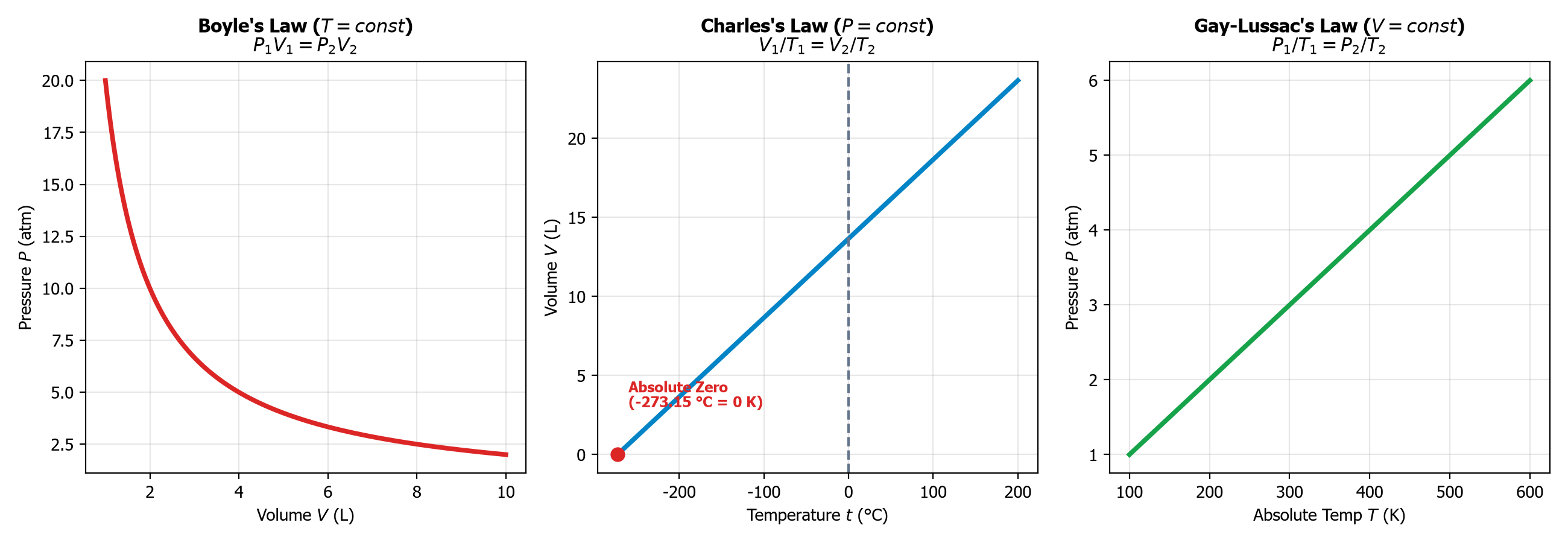
- Boyle’s Law (Isothermal, T = const) P is inversely proportional to V => P1 V1 = P2 V2.
| Comparison aspect | Main idea | Keywords |
|---|---|---|
| Charles’s Law (Isobaric, P = const) | V is directly proportional to T(K) => V1 / T1 = V2 / T2 | directlyproportional |
| Pressure / Gay-Lussac’s Law (Isochoric, V = const) | P is directly proportional to T(K) => P1 / T1 = P2 / T2 | directlyproportional |
| قانون وعلاقة حاكمة |
| FigureLawsBoyleCharles |
| • | 🧮 Exemplary Step-by-Step Worked Problems & Applied Exercises | ExemplaryStepWorkedProblems |
| Worked Example 1 | Worked Example 1 | |
| Problem Statement |
| bubblevolumebottomlake |
Detailed Solution & Derivation→At the bottom: P1 = Pa + rho*g*h = 1.013×10⁵ + 1000*9.8*20.66 = 3.038×10⁵ Pa = 3 atm, V1 = 2 cm3, T1 = 7 + 273 = 280 K.
| Comparison aspect | Main idea | Keywords |
|---|---|---|
| At the surface |
| |
| By General Gas Law | (3 * 2)/280 = (1 * V2)/300 => V2 = 1800 / 280 = 6.43 cm3 | 1800 |
| Worked Example 2 | Worked Example 2 | |
| Problem Statement | A sealed cylinder contains gas at 27 °C and 2 atm pressure. To what Celsius temperature must it be heated at constant volume so its pressure becomes 5 atm? | sealedcylindercontainspressure |
| Detailed Solution & Derivation | T1 = 27 + 273 = 300 K. Using P1/T1 = P2/T2 => 2/300 = 5/T2 => T2 = 750 K => t2 = 750 – 273 = 477 °C | Using |
| Comparison aspect | Main idea | Keywords |
|---|---|---|
| قانون وعلاقة حاكمة |
| ComprehensiveExplanationLessonBoyle |
| قانون وعلاقة حاكمة | Physics – Secondary Stage (English Section – Egyptian Curriculum 2026-2027) | 2026 / 2027 | 2026 / 2027 | Chapter 2: Gas Laws and Kinetic Theory of Gases | PhysicsSecondaryStageEnglish |
| قانون وعلاقة حاكمة |
| GoverningScientificLawsTheorems |
| ★ Boyle’s Law | [ Formula: P1 V1 = P2 V2 (at constant T) ] Boyle’s Law | Formulaconstant |
| ★ Charles’s Law | [ Formula: V1 / T1 = V2 / T2 (at constant P) ] Charles’s Law | Formulaconstant |
| ★ General Gas Law | [ Formula: (P1 V1) / T1 = (P2 V2) / T2 = P1 / (rho_1 T1) ] General Gas Law | Formula |
| • | 📌 Exhaustive In-Depth Pedagogical Breakdown | ExhaustiveDepthPedagogicalBreakdown |
Lesson 1 Summary: Boyle, Charles, Pressure Laws and General Gas Law · 3 / 6
المقارنات وخريطة المفاهيم الجوهرية
المقارنات وخريطة المفاهيم الجوهرية
🗺️ ★ High-Yield Summary, Mind Maps & Comparison Tables ★
- Summary Lesson 1 – Boyle, Charles, Pressure Laws and General Gas Law
- Physics – Secondary Stage (English Section – Egyptian Curriculum 2026-2027) | 2026 / 2027 | 2026 / 2027 | Chapter 2: Gas Laws and Kinetic Theory of Gases
- 🗺️ Core Concept Map & Knowledge Architecture:
- ✔ Temperature must always be in Kelvin T(K) = t(°C) + 273.
- ✔ At constant mass, gas density rho is directly proportional to pressure P and inversely proportional to absolute temperature T.
- 📊 Classification & Comparative Summary Tables:
- 💡 Exam Flashcard Capsules & High-Yield Secrets:
- ★ Always convert temperatures from Celsius to Kelvin (T = t + 273) BEFORE substituting into Charles’s Law, Pressure Law, or the General Gas Law.
- ★ Temperature must always be in Kelvin T(K) = t(°C) + 273.
- ★ At constant mass, gas density rho is directly proportional to pressure P and inversely proportional to absolute temperature T.
| Gas Law | Constant Parameter | Mathematical Formula | Expansion Coefficient |
|---|---|---|---|
| Boyle’s Law | Temperature (T) & Mass | P1 V1 = P2 V2 | Isothermal compressibility |
| Charles’s Law | Pressure (P) & Mass | V1 / T1 = V2 / T2 | alpha_v = 1 / 273 K-1 |
| Pressure Law (Jolly) | Volume (V) & Mass | P1 / T1 = P2 / T2 | beta_p = 1 / 273 K-1 |
| General Gas Law | Mass / Number of moles (n) | (P1 V1) / T1 = (P2 V2) / T2 | PV = nRT |
Lesson 1 Summary: Boyle, Charles, Pressure Laws and General Gas Law · 4 / 6
أمثلة ومسائل محلولة بالخطوات
أمثلة ومسائل محلولة بالخطوات
- مثال تطبيقي نموذجي:
- مسألة شاملة على قوانين Lesson 1 – Boyle, Charles, Pressure Laws and General Gas Law مع بيان خطوات الحل والتعويض المباشر والوحدات الدولية.
Lesson 1 Summary: Boyle, Charles, Pressure Laws and General Gas Law · 5 / 6
تريكات الامتحان وكبسولة التفوق الوزاري
تريكات الامتحان وكبسولة التفوق الوزاري
كبسولة التفوق لطلاب الثانوية والإعدادية→احرص على حفظ الوحدات بدقة، والانتباه للرسومات البيانية والمحاور والتحويلات، ومراجعة بنك الأسئلة أدناه.
Lesson 1 Summary: Boyle, Charles, Pressure Laws and General Gas Law · 6 / 6
Well done! You finished this lesson
What would you like to do next?