Curriculum
Mathematics — Third Preparatory
Unit 1
0/20
1.11-1 The base, the exponent, and the product and quotient of powers1.21-2 The zero exponent and the negative exponent1.31-3 Power of a power, of a product and of a quotient1.41-4 Sign of a power: even and odd exponents1.51-5 Powers, square roots and fractional exponents1.61-6 Simplifying expressions that combine several laws1.71-7 Exponential equations by equalising the base1.81-8 Equations with negative exponents and fractions1.91-9 Equations solved by taking out a common factor1.101-10 Equations in which the unknown is the base1.111-11 Real-life applications1.121-12 Summary of the laws of this unit1.13Exam traps and key takeaways
Unit 2
0/121.12-1 The quadratic function: definition, values and points1.22-2 The vertex form y = a(x − h)2 + k1.32-3 The vertex from the general form1.42-4 Sketching the parabola1.52-5 Maximum and minimum applications1.62-6 Polynomial functions and their degree1.72-7 Zeros of a polynomial function1.82-8 The rational algebraic function, its domain and simplifying1.92-9 Common domain of two functions and equality of functions1.102-10 Addition, subtraction, multiplication and division1.112-11 Additive and multiplicative inverses, and properties1.12Exam traps and key takeaways
Unit 3
0/121.13-1 The two conditions of similarity and the ratio of perimeters and areas1.23-2 Cases of similarity of triangles and the parallel line1.33-3 Real-life applications of similarity1.43-4 The dilation and its properties1.53-5 Dilation on the coordinate plane1.63-6 Sides relative to an angle, and the definitions of sin, cos and tan1.73-7 Finding side lengths and complementary angles1.83-8 Exact ratios of 30°, 45° and 60°1.93-9 Using the calculator and applications of trigonometry1.103-10 The slope of a line, parallel and perpendicular lines1.113-11 Equations of a line and the intercepts1.12Exam traps and key takeaways
Unit 4
0/131.14-1 Measures of central tendency: recap1.24-2 Why do we need measures of dispersion?1.34-3 The range1.44-4 The median recap, quartiles and the interquartile range1.54-5 The box plot (box-and-whisker)1.64-6 Deviation, variance and standard deviation of a set of values1.74-7 Standard deviation of a simple frequency distribution1.84-8 Standard deviation of a grouped (class) distribution1.94-9 Using the scientific calculator1.104-10 Comparing two data sets1.114-11 Effect of adding or multiplying every value1.124-12 Outliers and choosing the right measure1.13Exam traps and key takeaways
Text lesson
Unit 2: The Quadratic, Polynomial and Rational Functions and Their Operations
Unit 2: The Quadratic, Polynomial and Rational Functions and Their Operations
Overview
Overview
- Define the quadratic function, find its vertex in both forms and sketch its graph.
- Use the maximum or minimum value in real-life optimisation.
- Find the zeros of polynomial functions by factoring, completing the square or reading the graph.
- Determine the domain of a rational function, simplify it, and perform the four operations with their restrictions.
Quadratic, Polynomial and Rational Functions
├── 2-1 The quadratic function
│   ├── definition, values, points on the curve
│   ├── vertex form y = a(x - h)² + k
│   ├── equation from the vertex and one point
│   ├── sketch and vertex from the general form
│   └── maximum and minimum applications
├── 2-2 Polynomial functions
│   ├── degree and leading term
│   └── zeros: factoring, completing the square, from the graph
├── 2-3 Rational algebraic functions
│   ├── domain, simplifying
│   └── zeros of a rational function
├── 2-4 Common domain of two functions and equality of functions
└── 2-5 Operations on functions
    ├── addition and subtraction
    ├── multiplication and division
    ├── additive and multiplicative inverses
    └── properties of the operations
Unit 2: The Quadratic, Polynomial and Rational Functions and Their Operations · 1 / 13
2-1 The quadratic function: definition, values and points
2-1 The quadratic function: definition, values and points
- A quadratic function is f(x) = ax2 + bx + c with a, b, c real and a ≠ 0; its graph is a parabola.
- The function value at x = k is f(k) substitute and compute — a point (k, m) lies on the curve exactly when f(k) = m.
- To find an unknown coefficient from a point on the curve, substitute the point and solve the resulting linear equation.
- The y-intercept is (0, c); the x-intercepts are the zeros of f.
Unit 2: The Quadratic, Polynomial and Rational Functions and Their Operations · 2 / 13
2-2 The vertex form y = a(x − h)2 + k
2-2 The vertex form y = a(x − h)2 + k
- In vertex form the vertex is (h, k) and the axis of symmetry is the line x = h.
- a > 0 the parabola opens upward and k is the minimum value; a < 0 it opens downward and k is the maximum value.
- Watch the sign inside the bracket y = (x − 3)2 + 2 has vertex (3, 2), while y = (x + 3)2 − 2 has vertex (−3, −2).
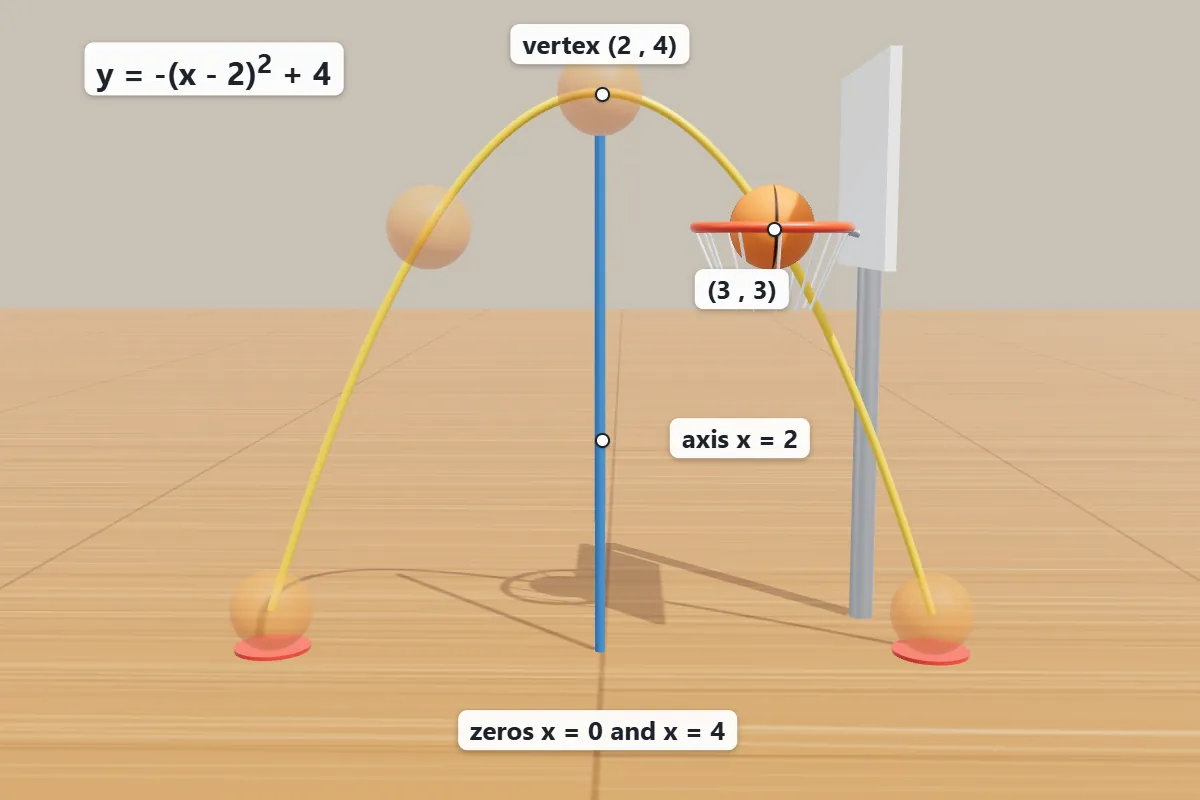
Equation from the vertex and one point
- Write y = a(x − h)2 + k with the given vertex, then substitute the other point to obtain a.
- Vertex (1, −4) through (3, 0) 0 = a(3 − 1)2 − 4 → 4a = 4 → a = 1, so y = (x − 1)2 − 4 = x2 − 2x − 3.
Unit 2: The Quadratic, Polynomial and Rational Functions and Their Operations · 3 / 13
2-3 The vertex from the general form
2-3 The vertex from the general form
For f(x) = ax2 + bx + ch = −b/(2a) and k = f(h) = (4ac − b2)/(4a).
Completing the square converts between the two formsx2 + 6x + 5 = (x + 3)2 − 4, vertex (−3, −4).
Zeros from the general formsolve ax2 + bx + c = 0; the axis x = h is exactly halfway between the two zeros.
Unit 2: The Quadratic, Polynomial and Rational Functions and Their Operations · 4 / 13
2-4 Sketching the parabola
2-4 Sketching the parabola
| Comparison aspect | Main idea | Keywords |
|---|---|---|
| Plot, in order |
| vertexinterceptreflectionacross |
| Δ = b2 − 4ac tells how many x-intercepts |
| vertextouchesaxisnone |
| • |
| Drawsmoothsymmetriccurve |
| Translations | y = a(x − h)2 + k is the image of y = ax2 shifted h right and k up | imageshiftedright |
Unit 2: The Quadratic, Polynomial and Rational Functions and Their Operations · 5 / 13
2-5 Maximum and minimum applications
2-5 Maximum and minimum applications
| Comparison aspect | Main idea | Keywords |
|---|---|---|
| • |
| quantitymodelledquadraticreaches |
| Fenced area | with a fixed perimeter the area A(x) is quadratic in x and maximal at the vertex — the answer is always a square | fixedperimeterquadraticmaximal |
| Profit |
| revenueminuscostquadratic |
| Projectile height |
| 16t2opensdownwardvertex |
| • |
| Rejectvaluevariablesituation |
Unit 2: The Quadratic, Polynomial and Rational Functions and Their Operations · 6 / 13
2-6 Polynomial functions and their degree
2-6 Polynomial functions and their degree
| Comparison aspect | Main idea | Keywords |
|---|---|---|
| • |
| polynomialfunctionaₙxndegree |
| Names by degree |
| linearquadraticcubicconstants |
| The end behaviour follows the leading term |
| evendegreepositivecoefficient |
Unit 2: The Quadratic, Polynomial and Rational Functions and Their Operations · 7 / 13
2-7 Zeros of a polynomial function
2-7 Zeros of a polynomial function
By factoring
- Set f(x) = 0 and factor completely
- each factor gives a zero. x3 − 4x = x(x − 2)(x + 2) → zeros 0
- 2
- −2.
- x2 − 6x + 4 = 0 → (x − 3)2 = 5 → x = 3 ± √5.
- A zero is an x-intercept. If the curve crosses the axis the multiplicity is odd; if it only touches and turns the multiplicity is even.
- A polynomial of degree n has at most n real zeros, and the sum of the multiplicities equals n.
Unit 2: The Quadratic, Polynomial and Rational Functions and Their Operations · 8 / 13
2-8 The rational algebraic function, its domain and simplifying
2-8 The rational algebraic function, its domain and simplifying
| Comparison aspect | Main idea | Keywords |
|---|---|---|
| • |
| rationalfunctionpolynomials |
| Domain |
| realsexceptvaluesmake |
| Simplifying |
| factornumeratordenominatorcancel |
| Zeros of a rational function | the zeros of the numerator that belong to the domain — a value that also vanishes the denominator is not a zero | numeratorbelongdomainvalue |
Unit 2: The Quadratic, Polynomial and Rational Functions and Their Operations · 9 / 13
2-9 Common domain of two functions and equality of functions
2-9 Common domain of two functions and equality of functions
- The common domain of two or more functions is the intersection of their domains; any operation between them is defined only there.
- Two functions are equal when they have the same domain and the same value for every element of it — identical simplified formulas on different domains are not the same function.
- When asked for the domain of a sum, product or quotient, start from the intersection and then remove the zeros of any denominator that appears.
Unit 2: The Quadratic, Polynomial and Rational Functions and Their Operations · 10 / 13
2-10 Addition, subtraction, multiplication and division
2-10 Addition, subtraction, multiplication and division
| Comparison aspect | Main idea | Keywords |
|---|---|---|
| Addition and subtraction |
| lowestcommondenominatorrewrite |
| Multiplication |
| factoreverythingcancelcommon |
| Division |
| multiplyreciprocaldivisorrestrictions |
| • | State the final answer in simplest form together with its domain restrictions | Statefinalanswersimplest |
Unit 2: The Quadratic, Polynomial and Rational Functions and Their Operations · 11 / 13
2-11 Additive and multiplicative inverses, and properties
2-11 Additive and multiplicative inverses, and properties
- The additive inverse of f is −f; their sum is the zero function, the additive identity.
- The multiplicative inverse (reciprocal) of f = P/Q is Q/P, defined only where P ≠ 0 and Q ≠ 0; their product is 1.
- Properties on the common domain closure, commutativity and associativity of addition and multiplication, the distributive law of multiplication over addition, and the identities 0 (additive) and 1 (multiplicative).
- Subtraction and division are not commutative and not associative — do not extend those properties to them.
Unit 2: The Quadratic, Polynomial and Rational Functions and Their Operations · 12 / 13
Exam traps and key takeaways
Exam traps and key takeaways
💡 High-yield traps
- The vertex of y = a(x − h)2 + k is (h, k) — the sign of h is opposite to what appears in the bracket.
- k is a maximum only when a < 0; read the sign of a before answering.
- For the general form use h = −b/(2a); forgetting the minus sign puts the vertex on the wrong side.
- The definition of a quadratic requires a ≠ 0.
- Zeros from the graph touching means even multiplicity, crossing means odd.
- Cancel factors, never terms — (x + 2)/x is already simplest.
- Simplifying does not enlarge the domain; the old restrictions must be restated.
- A zero of a rational function comes from the numerator only, and must not vanish the denominator.
- Division of fractions doubles the restrictions those of the divisor and those created by flipping it.
- Two functions are equal only with the same domain and the same rule.
Unit 2: The Quadratic, Polynomial and Rational Functions and Their Operations · 13 / 13
Well done! You finished this lesson
What would you like to do next?