2.5Chapter 2: Elements, Compounds and Mixtures
Organising the elements — Alhussan Chemistry - Stage 7 Revision Notes & Topical Questions
5 min read 8 parts Lesson 5 of 13 3 quizzes
2.5 Organising the elements — Groups, Periods and Mendeleev — Alhussan International Academy — Chemistry (Stages 7–9) notes: Describe how the periodic table is arranged and how Mendeleev and other scientists developed it.Order — the modern table arranges the elements in order of …
- Metals and non-metals
- Special groups
- Outer electrons
- John Dalton
- Stanislao Cannizzaro
- Arrangement
Part 1 of 6Layout of the periodic table
- Order the modern table arranges the elements in order of increasing atomic number.
- Groups vertical columns, and elements in the same group have similar chemical properties.
- Group 1 metals (lithium, sodium, potassium) all react with water to give an alkaline solution and hydrogen.
- Periods horizontal rows, and elements in the same period have the same number of electron shells.
- Metals and non-metals metals are on the left and in the centre, non-metals are on the right, and a stepped line separates them.
- Group 0 (or 18), the noble gases, are very unreactive, and Group 7, the halogens, are reactive non-metals.
- Outer electrons the number of outer-shell electrons equals the group number for Groups 1 to 7,
- which explains why elements in a group behave similarly.
Part 2 of 6Building up knowledge
- By 1860 scientists had discovered around 60 elements and knew some of their properties, but the knowledge was a jumble of facts.
- They asked what patterns exist in properties, how many more elements there are, and whether patterns could help find new elements.
- John Dalton in the early 1800s he studied experimental evidence and suggested that atoms of each element have a different mass.
- Stanislao Cannizzaro this Italian scientist worked out the masses and in 1860 gave data on the atomic masses of known elements at a conference in Germany.
- Mendeleev the Russian scientist Dmitri Mendeleev picked up a copy of the data.
- Other scientists several tried to use the mass data to show patterns in properties, but nobody found the perfect arrangement.
Part 3 of 6Mendeleev's periodic table
- Mendeleev wrote each element on a card with its atomic mass and properties and tried sorting the cards in different ways.
- Arrangement he found one with the elements in atomic mass order and elements with similar properties grouped together.
- Elements with similar properties repeat at intervals, which is why it is called periodic.
- The first periodic table was written on the back of an envelope.
- Gaps he was confident enough to leave gaps for elements he predicted should exist but had not been discovered, and predicted their properties.
- Swaps he swapped the order of a few elements, such as tellurium and iodine, so they fitted the pattern of properties.
Part 4 of 6Finding the missing elements
- 1874 a French scientist found the missing element beneath aluminium, named gallium, with properties as Mendeleev predicted.
- Swedish scientists soon discovered more of the missing elements, and their properties were also as predicted.
- 1925 most gaps were filled, but there were spaces beneath manganese for two more elements.
- Ida Tacke and Walter Noddack extracted 1 g of a new substance from 660 kg of rock, and called it rhenium.
- Acceptance scientists accepted the table because it explained patterns in properties and its predictions turned out to be correct.
| Date | Contribution |
|---|---|
| Early 1800s | Dalton: atoms of each element have a different mass |
| 1860 | Cannizzaro gives atomic mass data; about 60 elements known |
| 1869 | Mendeleev arranges elements by mass and leaves gaps |
| 1874 onwards | Gallium, scandium and germanium discovered |
| 1925 | Tacke and Noddack discover rhenium |
Part 5 of 6From Mendeleev to today
- Atomic number later work on atomic structure showed the order should follow the number of protons, not atomic mass,
- which explained why Mendeleev had to swap some elements.
- Noble gases they were discovered after his time and fitted into a new group.
| Feature | Mendeleev | Modern table |
|---|---|---|
| Order | Atomic mass | Atomic number |
| Gaps | Left for unknown elements | No gaps for elements up to 118 |
| Noble gases | Not included | Group 0 |
Part 6 of 6Patterns in groups
- Group 1 soft metals that react with water, with reactivity increasing down the group,
- so potassium reacts more vigorously than sodium and sodium more than lithium.
- Group 7 coloured non-metals, with reactivity decreasing down the group, so chlorine is more reactive than bromine.
- Group 0 all unreactive, so they are used in lamps and balloons.
- Position sodium is in Period 3, Group 1, so the period gives the row and the group gives the column.
Key terms
| Term | Meaning |
|---|---|
| Group | A vertical column of the periodic table. |
| Period | A horizontal row of the periodic table. |
| Atomic number | The number of protons in an atom. |
| Atomic mass | The mass of an atom compared with others. |
| Prediction | A statement of what will be found, based on a pattern. |
| Noble gas | An unreactive element in Group 0. |
Avoid these mistakes
Marked practiceQuizzes for this lesson
?What do you want to solve now?
✓Checkpoint Quiz
1 written questions from real exam papers on this lesson.
Written question 1 of 1 · part (a)(i) (1 / 8) 3:00

Show the answer

Written question 1 of 1 · part (a)(ii) (2 / 8) 3:00

Show the answer

Written question 1 of 1 · part (a)(iii) (3 / 8) 3:00

Show the answer

Written question 1 of 1 · part (a)(iv) (4 / 8) 3:00

Show the answer

Written question 1 of 1 · part (a)(v) (5 / 8) 3:00

Show the answer

Written question 1 of 1 · part (a)(vi) (6 / 8) 3:00
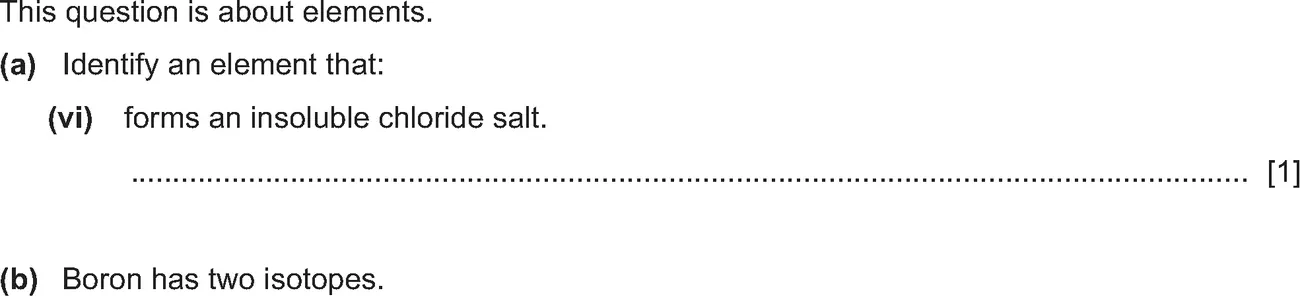
Show the answer

Written question 1 of 1 · part (b)(i) (7 / 8) 3:00
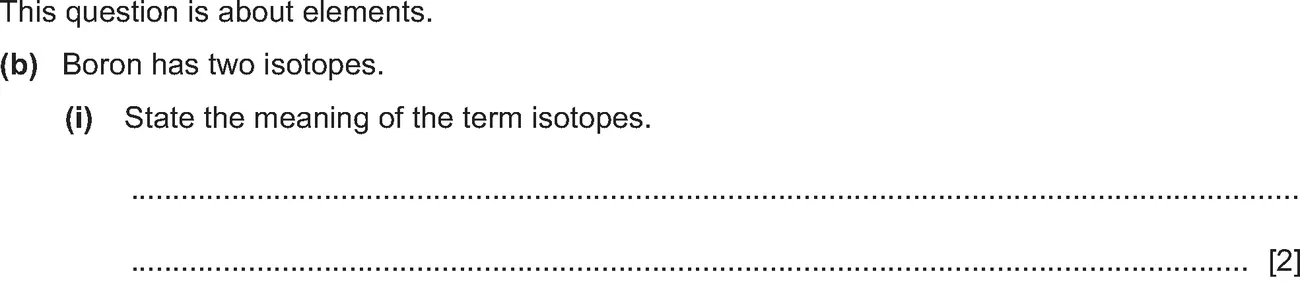
Show the answer

Written question 1 of 1 · part (b)(ii) (8 / 8) 3:00
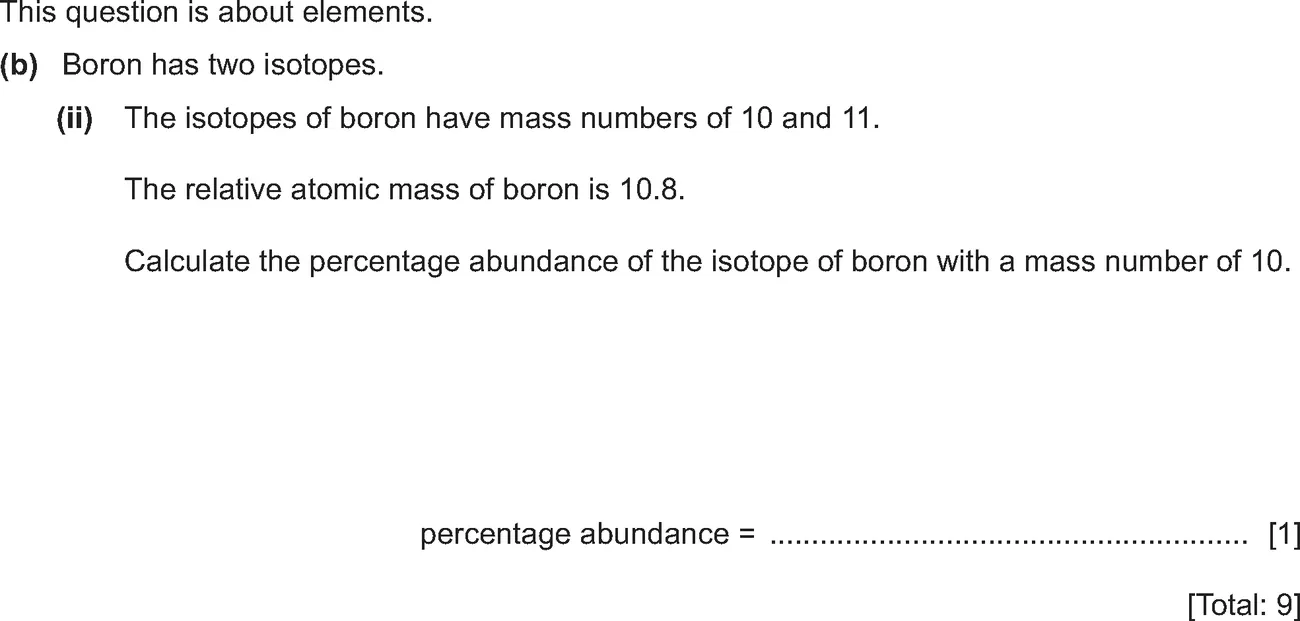
Show the answer
Each part of a written question is on its own screen. Write your answer first, then open "Show the answer" to check it against the mark scheme.
Last updated: