2.11Chapter 2: Elements, Compounds and Mixtures
Comparing elements, mixtures, and compounds — Alhussan Chemistry - Stage 7 Revision Notes & Topical Questions
5 min read 8 parts Lesson 11 of 13 3 quizzes
Lesson summary
2.11 Comparing elements, mixtures, and compounds — Alhussan International Academy — Chemistry (Stages 7–9) notes: Classify a substance as an element, a compound or a mixture and justify the choice using properties and particle diagrams.Element — it contains one type of atom and c…
- Pure substances
- Combinations
- Question 1
- Question 2
- Question 3
- Iron sulfide
Section 1 of 8Three types of matter
Three types of matter
Element
- Element it contains one type of atom and cannot be split into other substances.
- Iron and sulfur are both elements, and sulfur atoms differ from iron atoms.
Compound
- Compound it contains two or more elements chemically bonded in a fixed ratio.
Mixture
- Mixture it contains two or more substances that are not chemically bonded.
- (elements, compounds or both)
Pure substances
- Pure substances elements and compounds are both pure, and mixtures are not.
Section 2 of 8Iron and sulfur
Elements
- 7 g of iron powder is attracted to a magnet and 4 g of sulfur powder is separate and yellow.
Mixture
- Mixture when the two are mixed, both can still be seen and a magnet separates them.
- The properties are similar to the properties of the elements.
- The elements have not joined, so there can be any amounts of iron and sulfur and they are easy to separate.
- Carbon disulfide can also dissolve the sulfur.
Compound
- Compound when the mixture is heated the elements join to form iron sulfide, FeS.
- The iron cannot be taken out with a magnet.
- The properties of the compound differ from the properties of the elements.
- Iron sulfide always has 7 g of iron for every 4 g of sulfur.
Section 3 of 8Sodium and chlorine
Elements
- Elements sodium is a shiny metal that fizzes in water and may explode, and chlorine is a green, smelly, poisonous gas at 20 °C.
Mixture
- Mixture a mixture of the two could kill.
Compound
- Compound when they join they make sodium chloride, the table salt added to food.
Section 4 of 8Comparison table
| Feature | Element | Mixture | Compound |
|---|---|---|---|
| Single substance | Yes | No | Yes |
| Types of atom | One | Two or more | Two or more |
| Composition | Fixed | Variable | Fixed ratio |
| Properties | Its own | Those of the parts | New, different from the elements |
| Separation | Cannot be split chemically | By physical methods | By chemical reactions |
| Substances joined | No | No | Yes, atoms are bonded |
| Melting point | Sharp | Range | Sharp |
| Example | Oxygen, iron | Air, sea water | Water, salt |
Section 5 of 8Using particle diagrams
Using particle diagrams
Element
- Element it shows one kind of circle only, whether single or in pairs.
Compound
- Compound it shows different circles joined, with the same arrangement in every unit.
Mixture
- Mixture it shows different particles not joined, or different molecules, in no fixed pattern.
Check
- Check if every unit is identical the substance is pure, and if the units differ it is a mixture.
Combinations
- Combinations separate atoms of two kinds form a mixture of two elements, and joined pairs of unlike atoms alone form a compound.
- Joined unlike pairs plus separate atoms of a third kind form a mixture of a compound and an element.
Section 6 of 8Classifying substances
Classifying substances
Question 1
- Question 1 is it made of one type of atom?
- Then it is an element.
Question 2
- Question 2 is it made of different atoms in a fixed ratio with a single formula?
- Then it is a compound.
Question 3
- Question 3 is it made of more than one substance with no fixed formula that can be separated physically?
- Then it is a mixture.
Examples
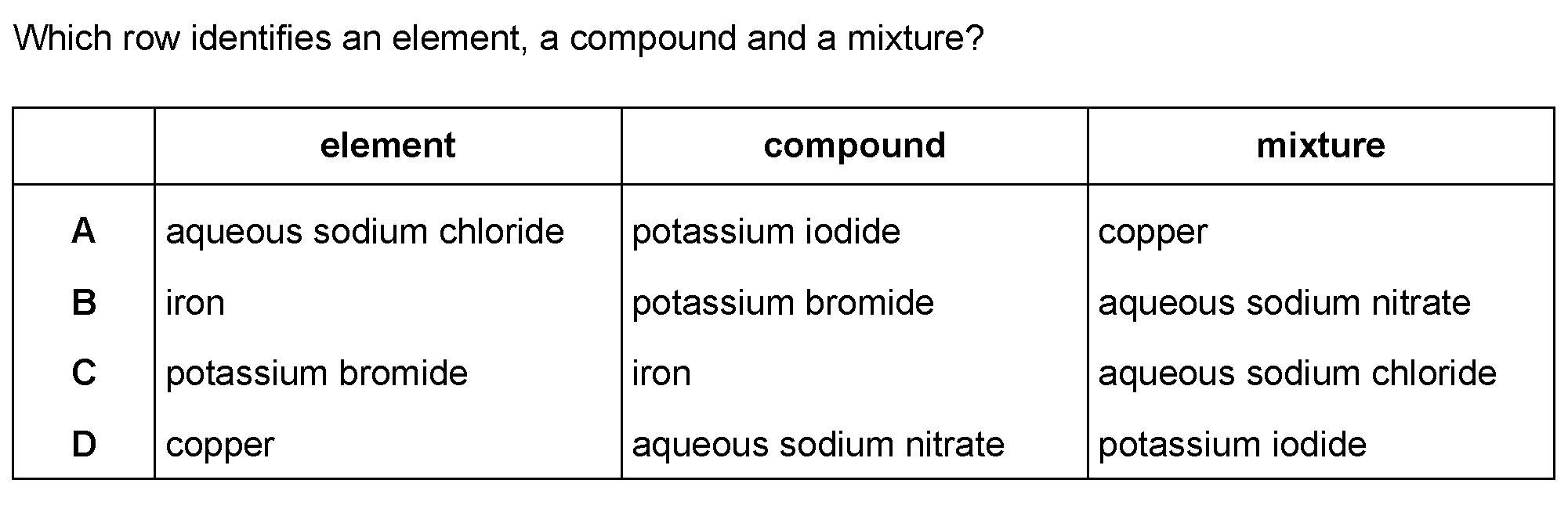
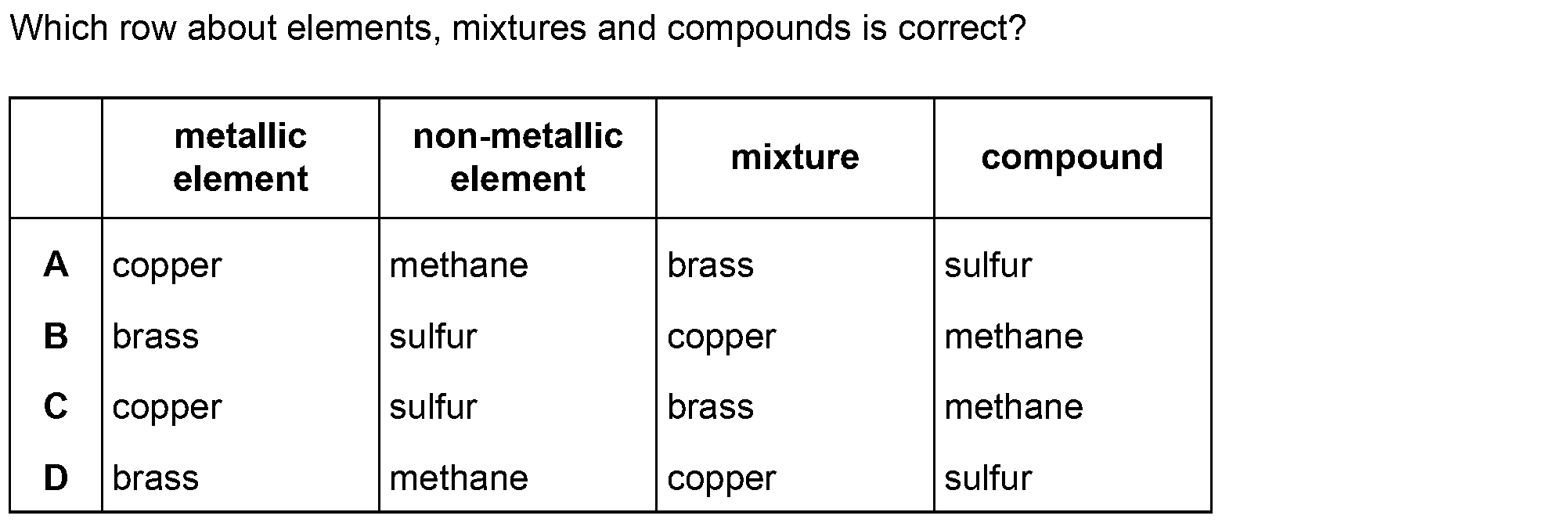
- Examples brass, air, ink and milk are mixtures;
- helium, sulfur and iron are elements;
- ammonia, methane and calcium carbonate are compounds.
Evidence
- Evidence support each classification with the formula, particle picture, melting point or whether it can be separated physically.
Section 7 of 8Key terms
| Term | Meaning |
|---|---|
| Element | A substance made of one type of atom. |
| Compound | A substance with two or more elements chemically bonded in a fixed ratio. |
| Mixture | Two or more substances not chemically joined. |
| Pure substance | A substance with only one element or one compound. |
| Iron sulfide | A compound of iron and sulfur, FeS. |
| Chemically bonded | Joined by strong forces between atoms. |
Section 8 of 8Exam technique
1
Saying all pure substances are elements.
2
Saying water is a mixture of hydrogen and oxygen.
3
Thinking an alloy is a compound.
4
Believing a mixture always looks uneven.
Marked practiceQuizzes for this lesson
?What do you want to solve now?
✓Checkpoint Quiz
4 multiple-choice questions from real exam papers on this lesson.
Question 1 of 4 1:30
Question 2 of 4 1:30

Question 3 of 4 1:30
Question 4 of 4 1:30

Score: 0 / 4
Answer key
1 B2 C3 C4 C
Last updated: