1.5Chapter 1: Energy
Gravitational potential energy and kinetic energy — Alhussan Physics - Stage 7 Revision Notes & Topical Questions
5 min read 7 parts Lesson 5 of 8 2 quizzes
1.5 Gravitational potential energy and kinetic energy — Alhussan International Academy — Physics (Stages 7–9) notes: Describe the factors that affect gravitational potential energy and kinetic energy and the energy changes between them, including dissipation.GPE = the energy some…
- Rearranging
- Stationary
- Ball thrown upwards
- Entering water
- Bouncing ball
- Pulling back
Section 1 of 7Gravitational potential energy (GPE)
- GPE depends on distance from the centre of the Earth, so moving up two floors gains twice as much GPE as moving up one floor.
- Mass it also depends on mass, so a mother with twice the mass of her son gains twice as much GPE going up one floor.
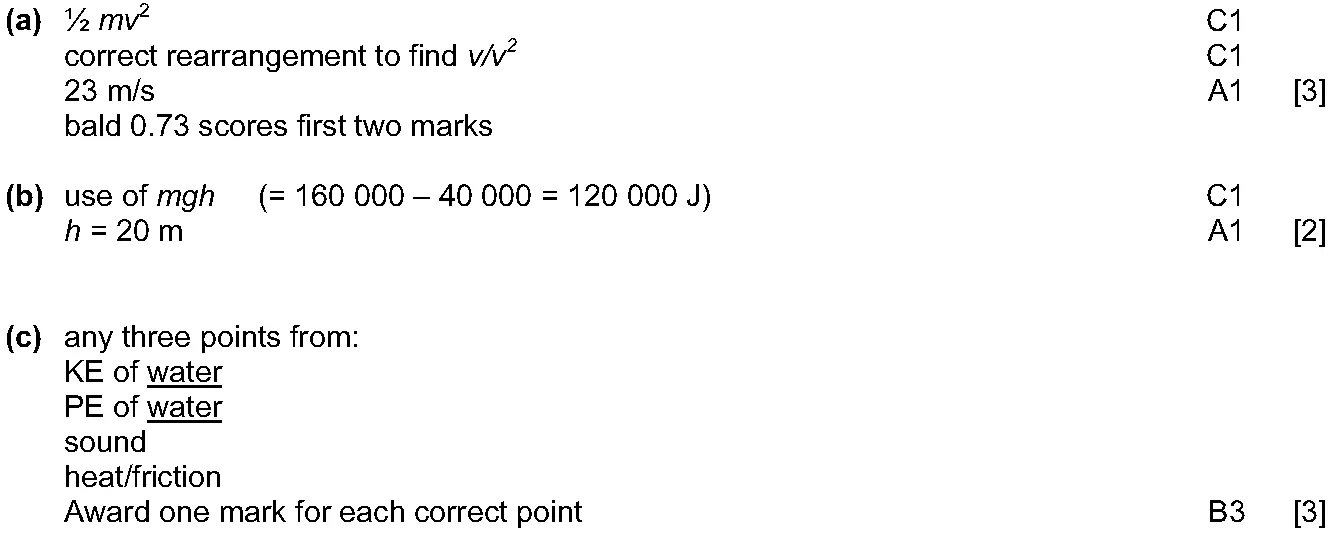
- GPE = mass × gravitational field strength × height, E = m × g × h.
- On Earth g = 10 N/kg, and height must be in metres and mass in kilograms.
- A 2 kg book on a shelf 1.5 m high has 30 J of GPE.
- Rearranging h = GPE ÷ (m × g) and m = GPE ÷ (g × h).
- Graph a graph of GPE against height is a straight line through the origin, with gradient m × g.
Section 2 of 7Kinetic energy (KE)
- Mass if a lion and an antelope move at the same speed, the lion has more kinetic energy because it has more mass.
- Speed two lions of the same mass running at different speeds have different kinetic energy, and the faster lion has more.
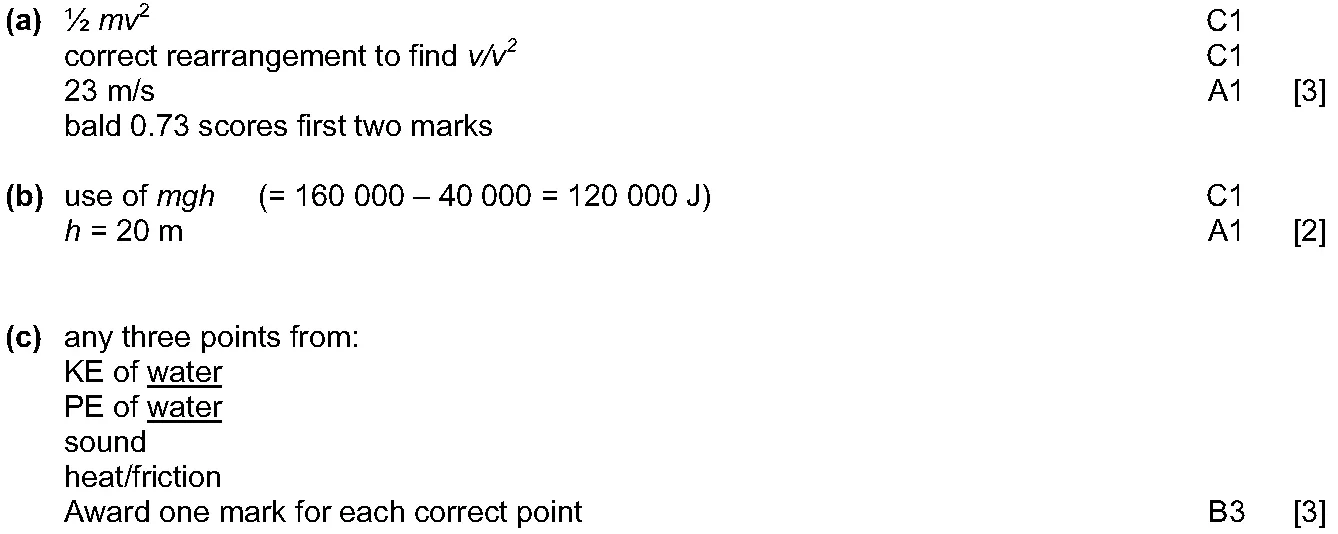
- Doubling the speed makes the kinetic energy four times as large.
- KE = ½ × m × v2.What the symbols mean: Ek = kinetic energy (J) · m = mass (kg) · v = speed (m s−1)
- Stationary a stationary object has zero KE.
Section 3 of 7Up and down
- Ball thrown upwards it slows down, stops for an instant, then speeds up as it falls.
- On the way up, energy moves from the kinetic store to the gravitational store.
- The increase in GPE equals the decrease in kinetic energy.
- On the way down, energy is transferred from the gravitational store to the kinetic store.
- Dissipation a very small amount of energy is transferred to the surroundings because of air resistance.
- Diver at the top of the board GPE is greatest and KE is zero, halfway they have equal amounts,
- and just above the water GPE is smallest and KE is greatest.
| Position | GPE | KE |
|---|---|---|
| Top | Maximum | Zero |
| Halfway | Half | Half |
| Just above the ground or water | Minimum | Maximum |
- KE is transferred to the kinetic energy of the water, thermal energy and sound.
- Bouncing ball it converts between KE and GPE but loses a little energy to thermal and sound on each bounce, so each bounce is lower.
Section 4 of 7Back and forth: the pendulum
- Pulling back when you pull the pendulum back you also pull it up, so its GPE increases.
- Letting go it falls and energy is transferred to a kinetic store.
- Swinging up energy is transferred back to a gravity store.
- At the highest point of the swing there is no kinetic energy and GPE is a maximum.
- At the lowest point KE is a maximum and GPE is a minimum.
- Swing a child on a swing behaves like a pendulum.
- If the father stops pushing, she does not swing so high, because friction warms parts of the swing and air resistance heats the air.
- Kinetic energy is transferred to the thermal store of the surroundings, which is dissipation.
Section 5 of 7Rollercoasters
- Design engineers think carefully about kinetic energy and GPE to know how much energy is needed for passengers to reach the top of the hills.
- Lifting the ride lifts people up high so they can move fast on the way down.
- Calculation a 500 kg car lifted 20 m gains 100 000 J of GPE.
- Ignoring friction, all of this becomes KE at the bottom of the first drop, where the car reaches its top speed.
- Dissipation friction and air resistance mean the car has less KE than expected, so later hills must be lower than the first.
- Ordering GPE compare mass × height, using consistent units.
Section 6 of 7Key terms
| Term | Meaning |
|---|---|
| Gravitational potential energy | the energy stored because of position in a gravitational field. |
| Kinetic energy | the energy of a moving object. |
| Gravitational field strength | the force per kilogram of mass, 10 N/kg on Earth. |
| Joule | the unit of energy. |
| Pendulum | a mass hanging from a pivot that swings freely. |
| Air resistance | a force from air that opposes motion and heats the air. |
Section 7 of 7Exam technique
Marked practiceQuizzes for this lesson
?What do you want to solve now?
✓Checkpoint Quiz
3 multiple-choice + 1 written questions from real exam papers on this lesson.
Question 1 of 3 1:30

Question 2 of 3 1:30

Question 3 of 3 1:30

Answer key
1 B2 B3 A
Written question 1 of 1 · part (a) (1 / 2) 3:00

Show the answer
Written question 1 of 1 · part (b) (2 / 2) 3:00

Show the answer
Each part of a written question is on its own screen. Write your answer first, then open "Show the answer" to check it against the mark scheme.
Last updated: