8.3Chapter 8: Magnetism and Electromagnets
Electromagnets — Alhussan Physics - Stage 8 Revision Notes & Topical Questions
5 min read 8 parts Lesson 3 of 6 1 quiz
Physics 8.3 Electromagnets — Solenoids, Iron Cores and Magnetic Field Strength — Alhussan International Academy — Physics (Stages 7–9) notes: Describe how to make an electromagnet and how to change its strength.Fixed strength — A bar magnet has a fixed strength, but a magnet whos…
- Current and field
- Straight wire
- Circular loop
- Iron not steel
- Medical use
- Fixed strength — A bar magnet has a fixed strength, but a magnet whose strength can vary is more useful
Part 1 of 6What an electromagnet is
- A bar magnet has a fixed strength, but a magnet whose strength can vary is more useful.
- A magnetic field is produced only while a current flows, so a switch turns the electromagnet on and off.
Part 2 of 6From a wire to a solenoid
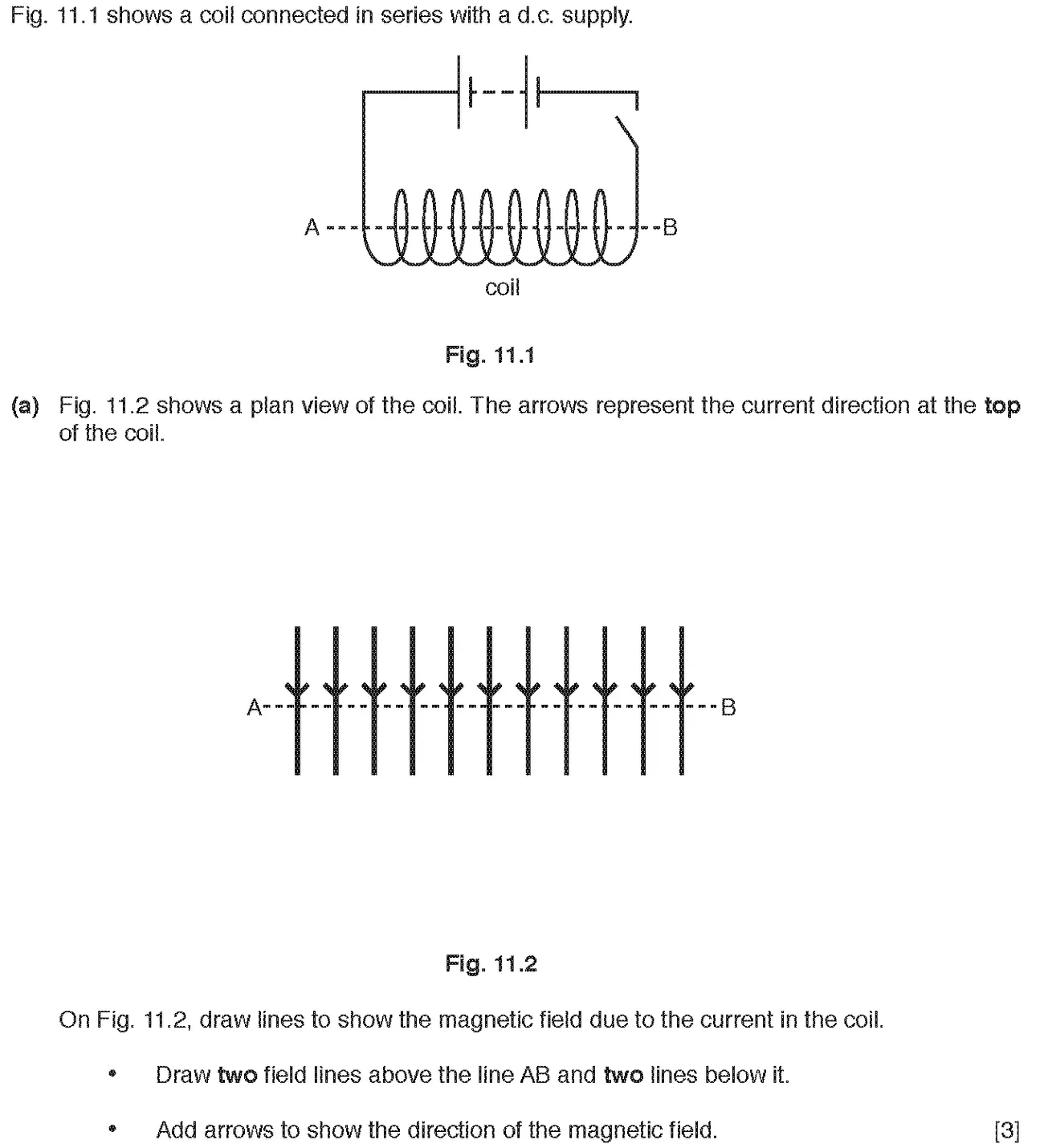
- The magnetic field lines around a single wire are circles, and the field gets weaker further from the wire.
- Plotting compasses show the shape of the field.
- The field lines at the centre of a loop are straight, and the field is stronger.
- Coiling concentrates the magnetic field inside the loops, making it much stronger than for a single loop.
- The field has a similar shape to that of a bar magnet, with a north pole at one end and a south pole at the other.
Part 3 of 6The iron core
- A coil wound on a core of magnetic material is an electromagnet, and most cores are iron.
- The core becomes magnetised by the field of the coil, which makes the electromagnet much stronger.
- Iron is easily magnetised and demagnetised, so it stops being a magnet when the current is switched off, whereas steel would stay magnetised.
- The current flows only in the wire; the iron is magnetised by the field.
Part 4 of 6Strength of an electromagnet
| Factor | Effect on strength |
|---|---|
| Number of turns of the coil | More turns make a stronger electromagnet |
| Current | More current makes a stronger electromagnet |
| Type of core | A magnetic material in the core makes it stronger |
- Current
- It depends on the power supply and the type of wire used.
Part 5 of 6Electromagnets and permanent magnets
| Permanent magnet | Electromagnet |
|---|---|
| Fixed strength | Strength can be varied |
| Always on | Can be switched on and off |
| Poles fixed | Poles reverse when the current is reversed |
- Large electromagnets move iron and steel in factories and scrapyards and drop the load when the current is turned off.
- A small electromagnet can remove iron or steel splinters from an eye.
- Electromagnets can lift a train off its track to reduce friction.
Part 6 of 6Investigating electromagnet strength
Key terms
| Term | Meaning |
|---|---|
| Electromagnet | A coil of wire carrying a current, usually around an iron core, that acts as a magnet. |
| Solenoid | A coil made from many loops of wire. |
| Core | The magnetic material, usually iron, inside a coil. |
| Turns | The loops of wire in a coil. |
| Magnetic field | The region where magnetic materials experience a force. |
Avoid these mistakes
Topic quiz · 10 questionsQuiz for this lesson
?What do you want to solve now?
✓Checkpoint Quiz
1 written questions from real exam papers on this lesson.
Written question 1 of 1 · part (a) (1 / 3) 3:00
Show the answer

Written question 1 of 1 · part (b)(i) (2 / 3) 3:00

Show the answer

Written question 1 of 1 · part (b)(ii) (3 / 3) 3:00

Show the answer
Each part of a written question is on its own screen. Write your answer first, then open "Show the answer" to check it against the mark scheme.
Last updated: