14.0Sound
Overview: Sound: Properties, Detection and the Physics of Music — American System Physics Revision Notes & Topical Questions
5 min read 7 parts Lesson 2 of 5 Unit quiz
Lesson summary
Describe properties of sound.Sound cannot travel through a vacuum.Sound travels faster in solids than gases.A 10 dB increase is ten times the intensity.Timbre depends on the mix of harmonics.The human ear hears about 20 Hz to 20 000 Hz.Describe properties of sound.Explain the Dop…
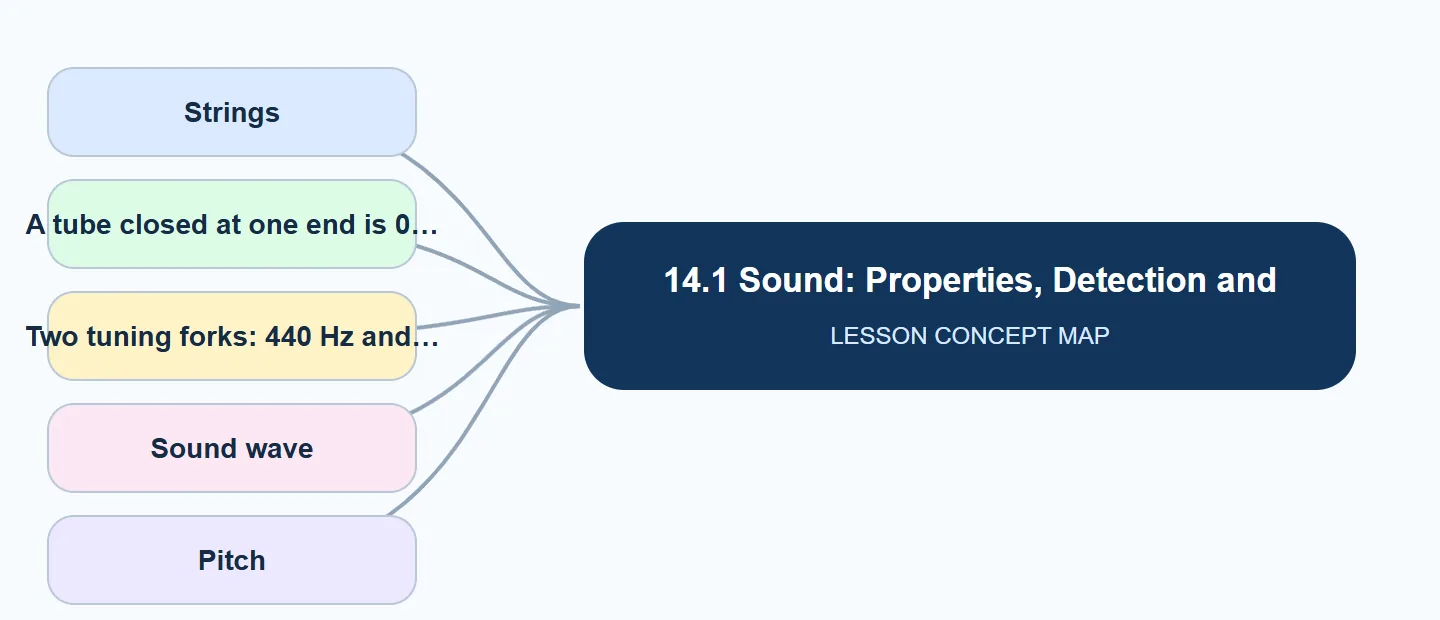
- A tube closed at one end is 0.25 m long. Fundamental frequency (v = 340 m/s)?
- Two tuning forks: 440 Hz and 444 Hz. Beat frequency?
- Sound wave
- Doppler effect
- Identify / Describe (FRQ)
- Explain / Justify (FRQ)
Section 1 of 7Overview: Sound: Properties, Detection and the Physics of Music
Ultrasound (> 20 kHz) is used in medical imaging.
Echolocation uses reflected sound.
Sonic booms occur when a source exceeds the speed of sound.
Strings
Strings fn = nv/2L.
Tuning uses beats to match frequencies.
Section 2 of 7Process & sequence
1
Identify the source frequency.
2
For Doppler: approaching raises observed frequency, receding lowers it.
3
For pipes, match length to allowed wavelengths.
4
Find frequency from f = v/λ.
5
For beats, subtract the two frequencies.
Doppler effectwrite these steps in this order; each step is a marking point.
1
Source emits waves
2
Source moves
3
Waves bunch ahead
4
Higher pitch ahead
5
Lower pitch behind
Section 3 of 7Compare
| Medium | Approx. speed (m/s) |
|---|---|
| Air (20 °C) | 343 |
| Water | 1500 |
| Steel | 5900 |
| Pipe | Resonant lengths | Harmonics present |
|---|---|---|
| Closed at one end | λ/4, 3λ/4, 5λ/4 | Odd only |
| Open both ends | λ/2, λ, 3λ/2 | All |
| Sound | dB |
|---|---|
| Whisper | 20 |
| Conversation | 60 |
| Rock concert | 110 |
| Pain threshold | 120 |
Section 4 of 7Worked examples
1A tube closed at one end is 0.25 m long. Fundamental frequency (v = 340 m/s)?
- λ = 4L = 1.0 m; f = 340 Hz.
2Two tuning forks
440 Hz and 444 Hz. Beat frequency?
- 4 Hz.
Section 5 of 7Key terms
Section 6 of 7Command terms
Command terms
Identify / Describe (FRQ)
A short, specific statement; describing requires relevant characteristics, not a single word.
Explain / Justify (FRQ)
Give the cause-and-effect reasoning or evidence; a restated fact does not score.
Calculate
Show setup, substitution and the answer with units.
Predict
State the expected outcome; add a reason only if asked to justify.
MCQ technique
Read every option; eliminate distractors that are true statements but do not answer the question; watch for NOT/EXCEPT.
Section 7 of 7Exam technique
Keywords the mark scheme looks for in this lesson
Keywords the mark scheme looks for in this lesson
Sound wave · Pitch · Loudness · Doppler effect · Resonance · Fundamental · Harmonics · Beats
Learn each definition in the Key words tab exactly; a missing keyword in a definition usually loses the mark.
How to get full marks (examiner guidance)
1
Answer exactly what is asked; extra correct material does not earn credit, and contradictory statements can cancel credit (AP FRQ).
2
Use precise vocabulary (e.g. “active site”, “concentration gradient”, “allele”), never “it/stuff/things”.
3
Show units and working in calculations.
4
In MCQs, predict the answer before reading the options, then eliminate.
Instant feedbackCheck yourself
Q1. Sound travels fastest in
- A. air
- B. water
- C. steel
- D. vacuum
Show answer
C. Solids.
Q2. An ambulance approaching sounds
- A. lower
- B. higher
- C. same
- D. silent
Show answer
B. Doppler.
Q3. A closed pipe produces
- A. all harmonics
- B. odd harmonics only
- C. even only
- D. none
Show answer
B. Node at closed end.
Q4. Frequencies 256 Hz and 260 Hz give beats of
- A. 4 Hz
- B. 516 Hz
- C. 258 Hz
- D. 1 Hz
Show answer
A. Difference.
Last updated: