Skip to content
Dabour HubLEARN · PRACTICE · EXPLORESign inStudent

14.3Sound

Sound Applications and Hearing — American System Physics Revision Notes & Topical Questions

10 min read 7 parts Lesson 5 of 5 1 quiz

🩺
100% Curriculum Specification Match Lesson Doctor Verified
The only platform with 100% curriculum specification match and verified interactive question banks.
0%read
Lesson summary

Interpret oscilloscope traces to compare pitch and loudness.Frequency from a tracef = 1/T, where T = number of divisions × time-base.Sonar depthd = vt/2.Wave equationv = fλ.Sound levelβ = 10 log10(I/I0) dB, where I0 = 10−12 W/m².Every +10 dB = ×10 intensity; +3 dB ≈ ×2 intensity.…

  • Bats and dolphins echolocate
  • Hearing works as follows
  • A sound increases from 60 dB to 90 dB. By what factor does its intensity increase?
  • Echolocation
  • Reverberation
  • Noise-cancelling

Section 1 of 7Sound Applications and Hearing
1
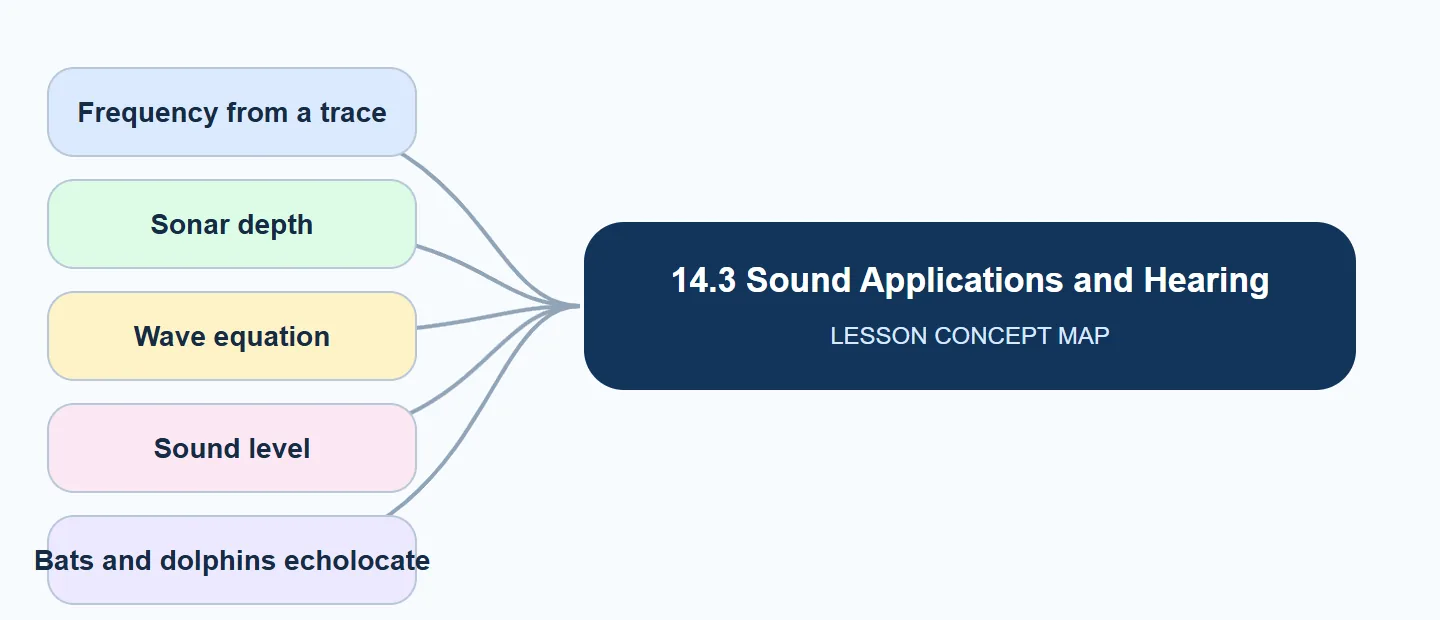
14.3 Sound Applications and Hearing concept map: Frequency from a trace, Sonar depth, Wave equation, Sound level, Bats and dolphins echolocate
Visual guide to the key ideas explained in this lesson.
2
An oscilloscope shows how the pressure variation of a sound changes with time. A louder sound gives a taller trace; a higher-pitched sound gives more waves on the same screen width.
3
To find frequency from a trace, measure the period in divisions, convert using the time-base, then use f = 1/T. Measuring across several waves and dividing improves accuracy.
4
Sonar sends ultrasonic pulses from ships; the echo time from the seabed or a fish shoal gives the distance. Because the pulse goes out and back, the one-way distance is half of v × t.
5
Medical ultrasound scanning works because some ultrasound is reflected at each boundary between tissues of different density. It is preferred to X-rays for pregnancy because it is non-ionising.
6Bats and dolphins echolocate
Bats and dolphins echolocate they emit high-frequency clicks and interpret the delay, direction and Doppler shift of the echoes to find prey and obstacles.
7
The decibel scale is logarithmic to match the huge range of intensities the ear can detect (a factor of about 1012). Sustained exposure above about 85 dB can damage hair cells in the cochlea permanently, so ear defenders are worn.
8Hearing works as follows
Hearing works as follows pressure waves enter the ear canal, vibrate the eardrum, the ossicles amplify the vibration onto the oval window, and hair cells in the cochlea respond to different frequencies and send nerve impulses to the brain.
9
Hearing sensitivity varies with frequency – the ear is most sensitive around 1–4 kHz – and the upper limit falls with age.
10
Reverberation in a hall is controlled using soft, porous materials (curtains, carpets, foam panels) that absorb sound instead of reflecting it.
11
Noise-cancelling headphones sample incoming noise with a microphone and play a sound of equal amplitude but in antiphase, so destructive interference reduces what the listener hears.
12
When a jet travels faster than sound, wavefronts pile up into a cone-shaped shock wave; people on the ground hear a sonic boom as it passes.

Section 2 of 7Process & sequence

1
Connect a microphone to an oscilloscope (or data logger) and place it in front of a loudspeaker driven by a signal generator.
2
Adjust the time-base and volts/div so that two or three complete waves are displayed clearly.
3
Count the number of horizontal divisions for one complete wave and multiply by the time-base to get the period T.
4
Calculate frequency f = 1/T and compare with the signal generator setting.
5
Increase the volume: note the trace becomes taller (larger amplitude) but the spacing is unchanged.
6
Increase the frequency: note the waves become closer together (shorter period) while height stays the same.

How sonar finds the depth of the seabedwrite these steps in this order; each step is a marking point.

1
Transmitter on the ship's hull emits a short ultrasound pulse downward.
2
Pulse travels through seawater at about 1500 m/s.
3
Pulse reflects from the seabed.
4
Receiver detects the echo and a timer records the total time t.
5
Depth calculated as d = vt/2 and displayed.

Section 3 of 7Compare

Typical sound levels
SourceSound level (dB)Relative intensity
Threshold of hearing01
Whisper20–30102–103
Conversation60106
Heavy traffic80–90108–109
Rock concert1101011
Threshold of pain≈120–1301012–1013
Uses of ultrasound
UseHow it works
Prenatal / medical scanningPartial reflection at tissue boundaries; echo times give depths; non-ionising so safe
Sonar / depth soundingEcho time from seabed or shoal gives distance d = vt/2
Crack detection in metalUnexpected early echo shows a flaw inside
CleaningVibrations dislodge dirt from delicate items
Kidney stone treatmentFocused ultrasound breaks up stones

Section 4 of 7Worked examples

500 Hz
An oscilloscope trace shows one complete wave spanning 4.0 divisions with a time-base of 0.50 ms/div. Find the frequency.
  • T = 4.0 × 0.50 ms = 2.0 ms = 2.0 × 10⁻³ s. f = 1/T = 1 ÷ 0.0020 s = 500 Hz.
    What the symbols mean: T = period, the time for one complete wave (s) · f = frequency (Hz)
2.0 m
A bat emits ultrasound and hears the echo from a moth 0.012 s later. Speed of sound is 340 m/s. How far away is the moth?
  • d = vt/2 = 340 × 0.012 ÷ 2 = 2.0 m (2 s.f.).
1000 times

A sound increases from 60 dB to 90 dB. By what factor does its intensity increase?

  • Increase = 30 dB = 3 × 10 dB, so intensity × 10 × 10 × 10 = 1000 times.

Section 5 of 7Key terms

Section 6 of 7Command terms

Command terms
Identify / Describe (FRQ)
A short, specific statement; describing requires relevant characteristics, not a single word.
Explain / Justify (FRQ)
Give the cause-and-effect reasoning or evidence; a restated fact does not score.
Calculate
Show setup, substitution and the answer with units.
Predict
State the expected outcome; add a reason only if asked to justify.
MCQ technique
Read every option; eliminate distractors that are true statements but do not answer the question; watch for NOT/EXCEPT.

Section 7 of 7Exam technique

Keywords the mark scheme looks for in this lesson

Keywords the mark scheme looks for in this lesson
Sonar · Echolocation · Pitch · Frequency · Amplitude · Oscilloscope trace · Time-base · Reverberation · Noise-cancelling · Threshold of hearing · Cochlea · Sonic boom
Learn each definition in the Key words tab exactly; a missing keyword in a definition usually loses the mark.

How to get full marks (examiner guidance)

1
Answer exactly what is asked; extra correct material does not earn credit, and contradictory statements can cancel credit (AP FRQ).
2
Use precise vocabulary, never “it/stuff/things”.
3
Show units and working in calculations.
4
In MCQs, predict the answer before reading the options, then eliminate.

Words to avoid

1
ultrasound is used because it is louderultrasound has a short wavelength giving detailed images and is non-ionising.
2
taller waves on the screen mean higher pitchtaller waves mean larger amplitude and louder sound.
3
20 dB is twice as intense as 10 dBeach 10 dB increase is 10 times the intensity.
4
noise-cancelling blocks the soundit adds an antiphase wave causing destructive interference.
5
Don't forget to halve the time (or distance) in echo calculations.

Last updated: