14.2Sound
The Physics of Music — American System Physics Revision Notes & Topical Questions
10 min read 7 parts Lesson 4 of 5 1 quiz
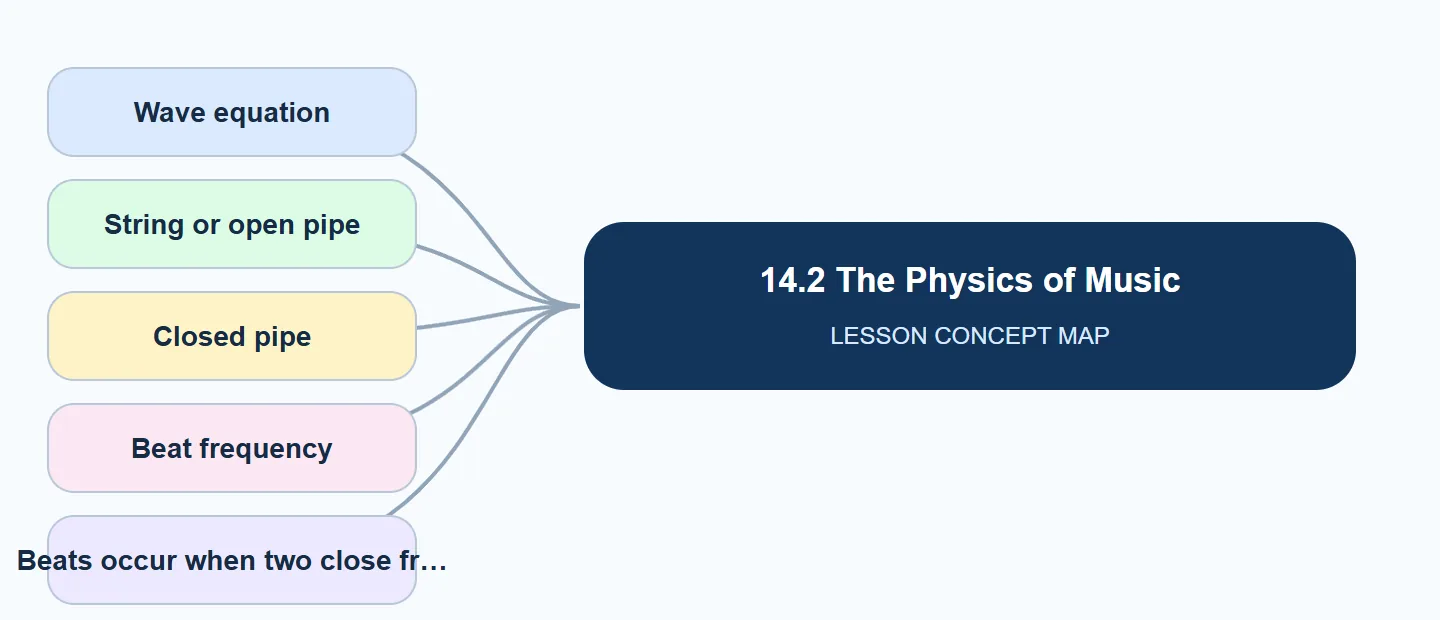
Explain how resonance in air columns and strings produces musical notes.Wave equationv = fλ.String or open pipefn = nv/(2L), n = 1, 2, 3...Closed pipefn = nv/(4L), n = 1, 3, 5...
- Beat frequency
- Beats occur when two close frequencies interfere
- Natural frequency
- Fundamental frequency
- Timbre (sound quality)
- Closed-pipe resonator
Section 1 of 7The Physics of Music
Section 2 of 7Process & sequence
How a flute produces a notewrite these steps in this order; each step is a marking point.
Section 3 of 7Compare
| Resonator | Ends | Resonant lengths | Harmonics present | Fundamental f1 |
|---|---|---|---|---|
| String fixed at both ends | Node–node | L = nλ/2 | All (n = 1,2,3...) | v/2L |
| Open pipe | Antinode–antinode | L = nλ/2 | All | v/2L |
| Closed pipe | Node–antinode | L = nλ/4, n odd | Odd only (1,3,5...) | v/4L |
v is the wave speed: on the string for strings, the speed of sound for pipes.
Section 4 of 7Worked examples
- Fundamental
- L = λ/4 → λ = 4 × 0.25 = 1.0 m;
- f1 = v/λ = 340/1.0 = 340 Hz.
- Next harmonic present is the 3rd: f3 = 3 × 340 = 1020 Hz (≈1.0 kHz).
- L = λ/4 → λ = 4 × 0.25 = 1.0 m;
- Fundamentalλ = 2L = 2 × 0.65 = 1.30 m. v = fλ = 196 × 1.30 = 255 m/s (3 s.f.).What the symbols mean: v = wave speed (m s−1) · f = frequency (Hz) · λ = wavelength (m)
- fbeat = |444 − 440| = 4 Hz, i.e. 4 beats per second.
Section 5 of 7Key terms
Section 6 of 7Command terms
Section 7 of 7Exam technique
Keywords the mark scheme looks for in this lesson
How to get full marks (examiner guidance)
Words to avoid
Instant feedbackCheck yourself
Q1. The shortest resonant length of a closed pipe is
- A. λ/4
- B. λ/2
- C. λ
- D. 2λ
Show answer
A. Node at closed end, antinode at open end: quarter wavelength.
Q2. Which harmonics are present in a closed pipe?
- A. All
- B. Even only
- C. Odd only
- D. Only the fundamental
Show answer
C. Only L = nλ/4 with n odd fits.
Q3. Two notes of 256 Hz and 260 Hz give beats of
- A. 4 Hz
- B. 258 Hz
- C. 516 Hz
- D. 2 Hz
Show answer
A. |260 − 256| = 4 Hz.
Q4. Two instruments play the same note but sound different because of different
Show answer
C. Timbre depends on harmonics.
Q5. Tightening a guitar string makes the note
- A. Lower
- B. Higher
- C. Unchanged
- D. Quieter only
Show answer
B. Higher tension → faster waves → higher frequency.
Q6. The note one octave above 220 Hz is
- A. 110 Hz
- B. 330 Hz
- C. 440 Hz
- D. 660 Hz
Show answer
C. An octave doubles the frequency.
Marked practiceQuizzes for this lesson
Last updated: