Skip to content
Dabour HubLEARN · PRACTICE · EXPLORESign inStudent

14.2Sound

The Physics of Music — American System Physics Revision Notes & Topical Questions

10 min read 7 parts Lesson 4 of 5 1 quiz

🩺
100% Curriculum Specification Match Lesson Doctor Verified
The only platform with 100% curriculum specification match and verified interactive question banks.
0%read
Lesson summary

Explain how resonance in air columns and strings produces musical notes.Wave equationv = fλ.String or open pipefn = nv/(2L), n = 1, 2, 3...Closed pipefn = nv/(4L), n = 1, 3, 5...

  • Beat frequency
  • Beats occur when two close frequencies interfere
  • Natural frequency
  • Fundamental frequency
  • Timbre (sound quality)
  • Closed-pipe resonator

Section 1 of 7The Physics of Music
Essential knowledge
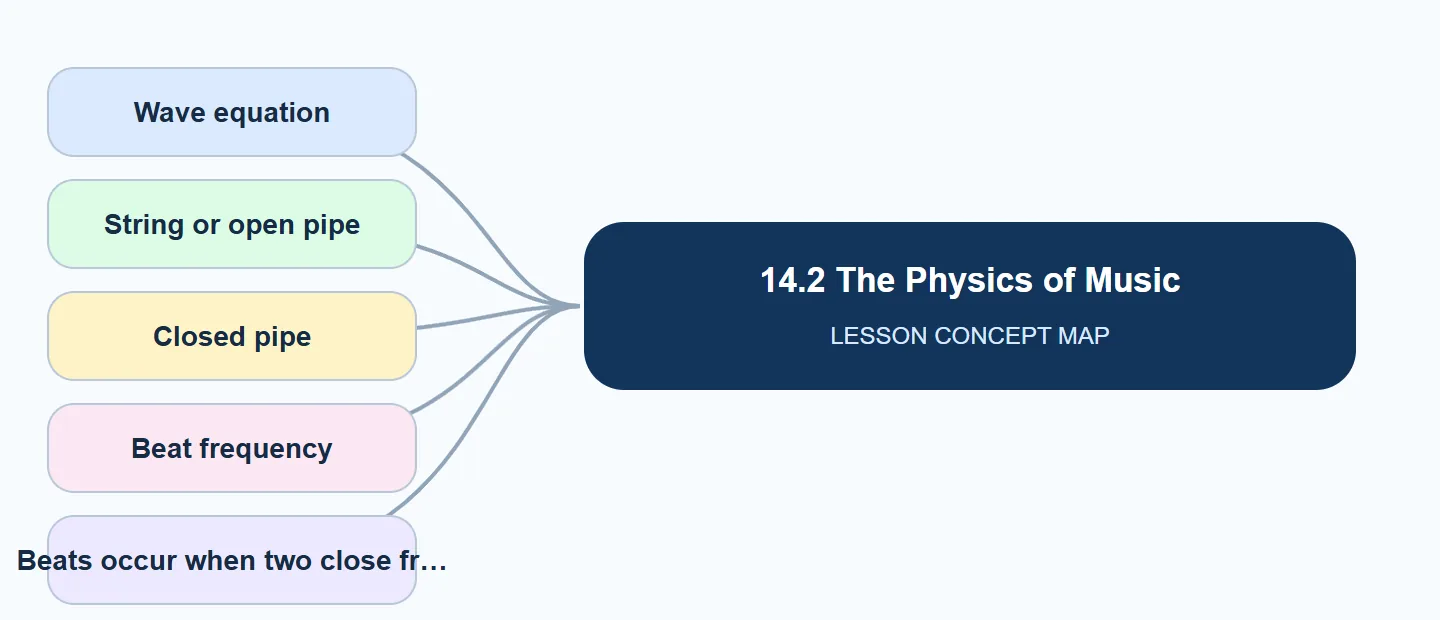
14.2 The Physics of Music concept map: Wave equation, String or open pipe, Closed pipe, Beat frequency, Beats occur when two close fr
Visual guide to the key ideas explained in this lesson.
Musical instruments produce sound by making something vibrate – a string, a reed, the lips, a membrane or an air column – and use resonance to amplify particular frequencies.
In a wind instrument, a standing sound wave forms in the air column. At a closed end, air cannot move, so there is a displacement node; at an open end, air moves freely, so there is a displacement antinode.
For a closed pipe, the shortest resonant length is a quarter wavelength (L = λ/4). The next resonances occur at 3λ/4, 5λ/4..., so only odd harmonics exist, giving a distinctive "hollow" sound (like a clarinet).
For an open pipe (like a flute), antinodes are at both ends. The shortest resonant length is λ/2 and all whole-number harmonics are possible.
On a string fixed at both ends there are nodes at each end. The fundamental has one loop, L = λ/2. The pitch rises if the string is shortened (fingering), tightened (tuning) or made lighter.
A real note contains the fundamental plus several harmonics. The relative amplitudes of the harmonics make the waveform shape; different shapes give different timbres, so a violin and a flute playing the same pitch sound different.
The body of a guitar or violin acts as a sounding board: it is set into forced vibration by the strings and moves more air, making the sound louder.
Beats occur when two close frequencies interfere
Beats occur when two close frequencies interfere the waves alternately reinforce and cancel, giving a loudness that rises and falls at |f1 − f2|. Musicians tune by adjusting until beats disappear.
Consonant intervals have simple frequency ratios (octave 2:1, perfect fifth 3:2, fourth 4:3). Dissonance results when frequencies are close but not equal or in complex ratios.
Air temperature affects pitch of wind instruments because it changes the speed of sound
1warmer air2faster sound3higher resonant frequencies

Section 2 of 7Process & sequence

1
Hold a vibrating tuning fork of known frequency f over the top of a tube partly submerged in water (a closed pipe).
2
Slowly raise the tube, lengthening the air column, while listening.
3
Stop where the sound is loudest (first resonance) and measure the length L1 of the air column.
4
Continue raising to find the second resonance and measure L2.
5
The difference L2 − L1 = λ/2, so λ = 2(L2 − L1); this removes the end-correction error.
6
Calculate the speed of sound v = fλ; repeat with other tuning forks and average.

How a flute produces a notewrite these steps in this order; each step is a marking point.

1
Player blows across the mouth hole, creating a turbulent vibrating air stream.
2
The vibration contains many frequencies and sends sound waves into the tube.
3
Waves reflect at the open end and superpose with incoming waves.
4
Only frequencies that fit standing waves with antinodes at both ends resonate and grow.
5
Covering holes changes the effective length, changing the fundamental and so the pitch.

Section 3 of 7Compare

Resonant conditions for instruments
ResonatorEndsResonant lengthsHarmonics presentFundamental f1
String fixed at both endsNode–nodeL = nλ/2All (n = 1,2,3...)v/2L
Open pipeAntinode–antinodeL = nλ/2Allv/2L
Closed pipeNode–antinodeL = nλ/4, n oddOdd only (1,3,5...)v/4L

v is the wave speed: on the string for strings, the speed of sound for pipes.

Section 4 of 7Worked examples

340 Hz
A closed pipe is 0.25 m long. Speed of sound = 340 m/s. Find the fundamental frequency and the next harmonic present.
  • Fundamental
    • L = λ/4 → λ = 4 × 0.25 = 1.0 m;
      • f1 = v/λ = 340/1.0 = 340 Hz.
    • Next harmonic present is the 3rd: f3 = 3 × 340 = 1020 Hz (≈1.0 kHz).
255 m/s
A guitar string 0.65 m long has a fundamental of 196 Hz. Find the speed of waves on the string.
  • Fundamentalλ = 2L = 2 × 0.65 = 1.30 m. v = fλ = 196 × 1.30 = 255 m/s (3 s.f.).
    What the symbols mean: v = wave speed (m s−1) · f = frequency (Hz) · λ = wavelength (m)
4 Hz
Two tuning forks of 440 Hz and 444 Hz are sounded together. How many beats per second are heard?
  • fbeat = |444 − 440| = 4 Hz, i.e. 4 beats per second.

Section 5 of 7Key terms

Section 6 of 7Command terms

Command terms
Identify / Describe (FRQ)
A short, specific statement; describing requires relevant characteristics, not a single word.
Explain / Justify (FRQ)
Give the cause-and-effect reasoning or evidence; a restated fact does not score.
Calculate
Show setup, substitution and the answer with units.
Predict
State the expected outcome; add a reason only if asked to justify.
MCQ technique
Read every option; eliminate distractors that are true statements but do not answer the question; watch for NOT/EXCEPT.

Section 7 of 7Exam technique

Keywords the mark scheme looks for in this lesson

Keywords the mark scheme looks for in this lesson
Natural frequency · Resonance · Fundamental frequency · Harmonic · Overtone · Timbre (sound quality) · Closed-pipe resonator · Open-pipe resonator · Beats · Consonance · Dissonance · Octave · Standing wave in an instrument
Learn each definition in the Key words tab exactly; a missing keyword in a definition usually loses the mark.

How to get full marks (examiner guidance)

1
Answer exactly what is asked; extra correct material does not earn credit, and contradictory statements can cancel credit (AP FRQ).
2
Use precise vocabulary, never “it/stuff/things”.
3
Show units and working in calculations.
4
In MCQs, predict the answer before reading the options, then eliminate.

Words to avoid

1
a closed pipe has a node at the open enda closed pipe has a node at the closed end and an antinode at the open end.
2
timbre depends on frequencytimbre depends on the mixture of harmonics present.
3
beats are echoesbeats are periodic changes in loudness caused by interference of two close frequencies.
4
a longer string makes a higher notea longer string has a longer wavelength and lower fundamental frequency.
5
resonance makes the frequency increaseresonance increases the amplitude at the natural frequency.

Last updated: