Curriculum
Course: AP Physics C: Electricity AND Magnetism
Login

Curriculum

AP Physics C: Electricity AND Magnetism

Text lesson

10.4 Dielectrics

10.4 Dielectrics — AP PHYSICS C: ELECTRICITY AND MAGNETISM notes: You will be able to explain how a dielectric polarizes in an electric field, relate the dielectric constant to the permittivity of the material, and calculate how a dielectric inserted between the plates of a capacitor changes its field, potential difference, charge, capacitance and stored energy.

1Polarization of a dielectric2Polarization of a dielectric
Polarization of a dielectric
A dielectric is an insulating material.
In a dielectric, electric charges are not free to move through the material as they are in a conductor.
Each atom or molecule is bound

but the charges within it can shift slightly.
In an external electric field the positive and negative charges of each molecule are pulled slightly apart,

and in molecules that already have a dipole moment the dipoles turn to line up with the field.
The material is then polarized: one face acquires a net bound charge of one sign and the opposite face acquires a net charge of the other sign.
No charge flows through a dielectric during polarization

so the bound charges stay at the molecular scale and cannot be removed from the material.
1 / 2Next ▶
Polarization of a dielectric
1

The bound charges produce their own electric field

which points opposite to the external field.
2

The net field inside the dielectric is therefore weaker than the external field that caused the polarization.
3

In a capacitor, the charges on the plates are free charges, and the charges induced on the faces of the dielectric are bound charges.
◀ Previous2 / 2
Dielectric constant and permittivity
The dielectric constant κ of a material relates the electric permittivity ε of that material to the permittivity of free space:
κ = ε/ε0.
The dielectric constant is a dimensionless number, and it is always at least 1. Vacuum has κ = 1 by definition, and air is very close to 1. The permittivity ε of a material has units of farads per metre (F/m), and ε0 = 8.85 × 10⁻¹² F/m.
Materials with a larger dielectric constant can be polarized more strongly.
Approximate values at room temperature are shown below.
Material Approximate dielectric constant κ
Vacuum 1 (exact)
Air 1.0006
Paper about 3.5
Glass about 4 to 10, depending on the type
Water about 80
1Effect on the field of an isolated capacitor2Effect on the field of an isolated capacitor
Effect on the field of an isolated capacitor
Consider a parallel-plate capacitor whose plates carry free charges +Q0 and −Q0, with surface charge density σ0 = Q0/A.
Without a dielectric, the field between the plates is E0 = σ0/ε0.
Now insert a dielectric that completely fills the space between the plates.
If the capacitor is isolated, the free charge on the plates stays at Q0

because there is no path for it to leave.
The polarized dielectric has bound surface charge of density σb on each face, with sign opposite to the nearby plate charge. Its field is opposite to E0

so the net field is
E = E0 − σb/ε0.
1 / 2Next ▶
Parallel-plate capacitors: field, potential and capacitance: Field lines run straight between the plates of a charged parallel-plate capacitor.
Effect on the field of an isolated capacitor
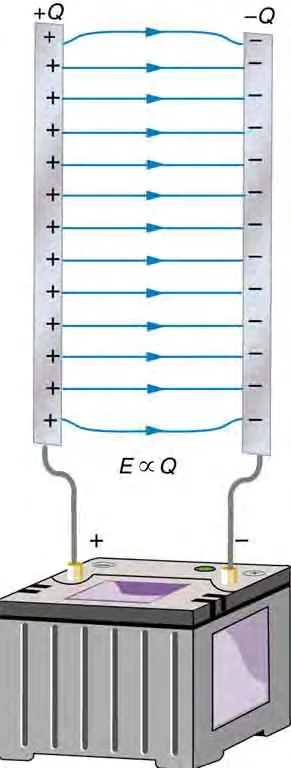
Parallel-plate capacitors: field, potential and capacitance: Field lines run straight between the plates of a charged parallel-plate capacitor." loading= - Dr Khaled Dabour Academy⤢ Enlarge
1

The bound charge must be exactly the amount that leaves the net field equal to the vacuum field divided by κ. This gives σb = σ0(1 − 1/κ), and substituting it back gives
2

E = E0/κ.
3

The field between the plates of an isolated capacitor decreases by the factor κ when the dielectric is inserted. Because the separation d is unchanged, the potential difference also decreases: ΔV = Ed = ΔV0/κ.
◀ Previous2 / 2
1Capacitance with a dielectric2Capacitance with a dielectric
Capacitance with a dielectric
1

The capacitance of the filled capacitor is found from its charge and potential difference. For the isolated capacitor, C = Q0/ΔV = κQ0/ΔV0, so
2

C = κC0 = κε0A/d,
3

where C0 is the capacitance without the dielectric. The dielectric multiplies the capacitance by the dielectric constant. Which other quantities change depends on how the capacitor is connected, and the two cases must be kept apart.
4

Capacitor isolated (charge fixed). The charge stays at Q0.
5

The capacitance rises by κ, the potential difference falls by κ, the field falls by κ, and the stored energy U = Q2/(2C) falls by κ.
6

The fall in stored energy is not lost: the electric field pulls the dielectric into the gap, and the energy difference is the work done by that field.
1 / 2Next ▶
Capacitance with a dielectric
Capacitor still connected to a battery (potential difference fixed). The potential difference stays at ΔV0

so the field E = ΔV/d is unchanged. The charge rises to κQ0because the battery supplies the extra charge, and the stored energy U = ½CΔV2 rises by κ.
◀ Previous2 / 2
1Example 1: An isolated capacitor with a dielectric2Example 1: An isolated capacitor with a dielectric3Example 2: The same dielectric with the battery still connec4Example 3: Finding the dielectric constant from a measuremen
Example 1: An isolated capacitor with a dielectric
1

The parallel-plate capacitor from topic 10.3, with C0 = 8.9 × 10⁻¹¹ F, plate separation 2.0 mm and plate area 2.0 × 10⁻² m2, is charged by a 12 V battery

which is then disconnected.
2

A dielectric of constant κ = 4.0 is inserted to fill the space between the plates.
3

Find the new capacitance, charge, potential difference, field and stored energy.
4

Working: The charge on the plates is fixed at Q0 = C0ΔV0 = (8.85 × 10⁻¹¹ F)(12 V) = 1.1 × 10⁻⁹ C.
5

The new capacitance is C = κC0 = (4.0)(8.85 × 10⁻¹¹ F) = 3.5 × 10⁻¹⁰ F.
6

The new potential difference is ΔV = Q0/C = (1.06 × 10⁻⁹ C)/(3.54 × 10−10 F) = 3.0 V.
1 / 4Next ▶
Example 1: An isolated capacitor with a dielectric
The new field is E = ΔV/d = 3.0 V/(2.0 × 10−3 m) = 1.5 × 10³ V/m.
The stored energy is U = ½Q0ΔV = ½(1.06 × 10⁻⁹ C)(3.0 V) = 1.6 × 10⁻⁹ J.
Check: before insertion the energy was 6.4 × 10⁻⁹ J, and 6.4 × 10⁻⁹ J/4.0 = 1.6 × 10⁻⁹ J.
Answer: C = 3.5 × 10⁻¹⁰ F

Q = 1.1 × 10⁻⁹ C (unchanged)ΔV = 3.0 VE = 1.5 × 10³ V/mU = 1.6 × 10⁻⁹ J.
◀ Previous2 / 4Next ▶
Example 2: The same dielectric with the battery still connected
The same capacitor, with κ = 4.0, is now connected to the 12 V battery while the dielectric is inserted. Find the new charge, field and stored energy.
Working: The potential difference stays at 12 V.
The capacitance is C = 3.5 × 10⁻¹⁰ F

so the new charge is Q = CΔV = (3.54 × 10⁻¹⁰ F)(12 V) = 4.2 × 10⁻⁹ Cwhich is four times the original charge.
The field is still E = ΔV/d = 6.0 × 10³ V/m.
The energy is U = ½CΔV2 = ½(3.54 × 10⁻¹⁰ F)(12 V)2 = 2.5 × 10⁻⁸ J, four times the original value.
Answer: Q = 4.2 × 10⁻⁹ C

E = 6.0 × 10³ V/m, unchangedU = 2.5 × 10⁻⁸ J.
◀ Previous3 / 4Next ▶
Example 3: Finding the dielectric constant from a measurement
1

An empty parallel-plate capacitor has capacitance 2.0 μF. When a sheet of material fills the space between its plates, the capacitance is 6.0 μF. Find the dielectric constant of the material and its permittivity.
2

Working: κ = C/C0 = (6.0 μF)/(2.0 μF) = 3.0. The permittivity is ε = κε0 = (3.0)(8.85 × 10⁻¹² F/m) = 2.7 × 10⁻¹¹ F/m.
3

Answer: The dielectric constant is 3.0 and the permittivity is 2.7 × 10⁻¹¹ F/m.
◀ Previous4 / 4
Key terms
Term Meaning
Dielectric An insulating material that becomes polarized, but not conducting, when placed in an electric field.
Polarization of a dielectric The shifting of bound charges, or the alignment of molecular dipoles, that produces a net bound charge on the faces of the material.
Bound charge Charge that is displaced within a dielectric and cannot move freely through the material.
Dielectric constant The dimensionless ratio κ = ε/ε0, which is equal to 1 for vacuum and greater than 1 for other materials.
Permittivity The property ε of a material that relates its electric field to the field of free charges, measured in farads per metre.
Induced field The field produced by bound charges in a dielectric, which points opposite to the external field.
Isolated capacitor A capacitor whose plates have no connection to a source, so the charge on the plates stays constant.
Dielectric-filled capacitance The capacitance C = κC0 = κε0A/d of a parallel-plate capacitor completely filled with a dielectric.
1Avoid these mistakes2Avoid these mistakes3Avoid these mistakes4Avoid these mistakes
Avoid these mistakes
1Avoid this
Thinking that a dielectric increases the field between the plates.Avoid this
The induced field opposes the external field, so the net field decreases by the factor κ for an isolated capacitor.Avoid this
2Avoid this
Confusing the dielectric constant with the permittivity of free space. The dielectric constantAvoid this
κAvoid this
1 / 4Next ▶
Avoid these mistakes
is dimensionless, whileAvoid this
εAvoid this
0Avoid this
has units of F/m.Avoid this
3Avoid this
Assuming that the charge on the plates changes when an isolated capacitor is filled with a dielectric.Avoid this
◀ Previous2 / 4Next ▶
Avoid these mistakes
The charge stays fixed; the potential difference falls.Avoid this
4Avoid this
Assuming that the potential difference rises when a dielectric is inserted into a capacitor connected to a battery.Avoid this
The battery holds the potential difference fixed, and the extra charge flows from the battery.Avoid this
5Avoid this
Multiplying the stored energy byAvoid this
◀ Previous3 / 4Next ▶
Avoid these mistakes
for an isolated capacitor.Avoid this
Its energy falls by κ, while for a capacitor held at fixed potential difference the energy rises by κ.Avoid this
6Avoid this
Describing a dielectric as a conductor that lets charge pass between the plates.Avoid this
A dielectric is an insulator, so the free charge on the plates cannot pass through it.Avoid this
◀ Previous4 / 4
Accepted payment methods