Curriculum
AP Physics C: Electricity AND Magnetism
8. Electric Charges, Fields, and Gauss’s Law
0/13
-
8. Electric Charges, Fields, and Gauss’s Law
 Preview
-
8.1 Electric Charge and Electric Force
Preview
-
8.1 Electric Charge and Electric Force - Check yourself
 Preview
-
8.2 Conservation of Electric Charge and the Process of Charging
Preview
-
8.2 Conservation of Electric Charge and the Process of Charging - Check yourself
Preview
-
8.3 Electric Fields
Preview
-
8.3 Electric Fields - Check yourself
Preview
-
8.4 Electric Fields of Charge Distributions
Preview
-
8.4 Electric Fields of Charge Distributions - Check yourself
Preview
-
8.5 Electric Flux
Preview
-
8.5 Electric Flux - Check yourself
Preview
-
8.6 Gauss’s Law
Preview
-
8.6 Gauss’s Law - Check yourself
Preview
9. Electric Potential
0/7
10. Conductors and Capacitors
0/9
11. Electric Circuits
0/17
12. Magnetic Fields and Electromagnetism
0/9
13. Electromagnetic Induction
0/13
Text lesson
8.3 Electric Fields
8.3 Electric Fields — AP PHYSICS C: ELECTRICITY AND MAGNETISM notes: You will be able to describe the electric field produced by point charges and by charged conductors and insulators, calculate the field from the force on a test charge, add fields as vectors, and represent fields with field lines and maps.
1
The electric field at a given point is the ratio of the electric force exerted on a test charge at that point to the charge of the test charge: E = FE/q.
2
The field is a vector, with SI units of newtons per coulomb (N/C), which are equal to volts per metre (V/m).
3
A test charge is a point charge small enough that its presence does not significantly change the electric field in its vicinity.
4
The field is a property of the source charges, and the test charge only probes it.
5
The force on a positive test charge is in the same direction as the field, and the force on a negative charge is in the opposite direction.
6
The field itself does not depend on the value of the test charge q.
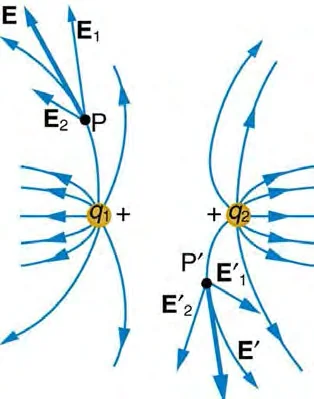
The field points away from an isolated positive charge and toward an isolated negative charge.
Both statements follow from the direction of the force on a positive test charge.
The field produced by several sources is the vector sum of the fields from each source.
This is the principle of superposition for fields.
The net field at a point is found by calculating the field from each charge separately, resolving each field into components, adding the components, and then finding the magnitude and direction of the resultant.
Field magnitudes must never be added as scalars unless the fields point in the same direction.

1
The electric field is a vector field, so its value can be represented at every point in space by a vector.
2
An electric field map draws short arrows at many locations, with each arrow pointing in the direction of the field and its length indicating the magnitude.
3
An electric field line diagram is a simplified model of such a map: a field line is drawn so that its tangent at any point gives the direction of the field there.
4
Field lines start on positive charges and end on negative charges, and they never cross.
5
Where the lines are closer together, the field is stronger.
6
A line diagram can therefore show the relative magnitude and direction of the field at any position in the diagram.
7
A field line is not a path that a charge follows, unless the charge’s motion happens to match it.

1
If there were a field inside, free charge carriers would move until the field was cancelled, so equilibrium is reached only when the interior field is zero.
2
At the surface of a charged conductor, the electric field is perpendicular to the surface.
3
A component of the field parallel to the surface would move the surface charges along the surface until the parallel component vanished.
4
Outside an isolated sphere with spherically symmetric charge distribution, the electric field is the same as that of a point charge with the same net charge located at the centre of the sphere.
5
This is why a charged metal sphere can be modelled as a point charge when analysing the field outside it.
The electric field within an insulator may therefore have a nonzero value.
This is the main contrast with a conductor, whose interior field is always zero in equilibrium.
1
E = F/q = (3.0 × 10⁻³ N)/(2.0 × 10−6 C) = 1.5 × 10³ N/C.
2
The field points in the same direction as the force on the positive test charge.
3
The force on an electron, with charge −1.60 × 10⁻¹⁹ C, is F = qE = (−1.60 × 10⁻¹⁹ C)(1.5 × 10³ N/C) = −2.4 × 10⁻¹⁶ N.
What the symbols mean
E = electric field strength (N C−1) · F = force on the charge (N) · Q or q = charge (C)
Answer
The field is 1.5 × 10³ N/C in the direction of the force on the positive test charge. The electron experiences a force of magnitude 2.4 × 10⁻¹⁶ N in the opposite direction to the field.
1
The distance from each charge to the midpoint is 0.30 m, so each has magnitude E = (9.0 × 10⁹)(4.0 × 10⁻⁶)/(0.30)2 = 4.0 × 10⁵ N/C.
2
The field from the positive charge points away from it, in the +x direction.
3
The field from the negative charge points toward it, which is also in the +x direction.
4
The two fields add.
Answer
The net field at the midpoint is 4.0 × 10⁵ + 4.0 × 105 = 8.0 × 10⁵ N/C in the +x direction.
1
The first charge is 0.30 m from the origin, so its field there is E1 = (9.0 × 10⁹)(3.0 × 10⁻⁶)/(0.30)2 = 3.0 × 10⁵ N/C, pointing away from it, in the −x direction.
2
The second charge is 0.40 m from the origin, so E2 = (9.0 × 10⁹)(3.0 × 10⁻⁶)/(0.40)2 = 1.69 × 10⁵ N/C, pointing in the −y direction.
3
The components are Ex = −3.0 × 10⁵ N/C and Ey = −1.69 × 10⁵ N/C.
4
The magnitude is √((3.0 × 10⁵)2 + (1.69 × 10⁵)2) = 3.4 × 10⁵ N/C.
Answer
The net field has magnitude 3.4 × 10⁵ N/C and points into the third quadrant, at an angle of about 29° below the −x axis.
Using the sign of a source charge to decide the field direction at a point without thinking about the test charge
The field points away from positive sources and toward negative sources.
Adding two field magnitudes as scalars when the fields point in different directions
Add the field vectors component by component.
Thinking that the field inside a charged conductor is nonzero
In electrostatic equilibrium the interior field of a conductor is zero, although an insulator may have an interior field.
Treating a field line as the path a charge follows
Field lines show the direction of the field at each point, and a charge follows them only in special cases.
Avoid
Forgetting that the test charge’s sign changes the direction of the force, not the direction of the field
Avoid
Using a value of the test charge that is large enough to disturb the source field, which makes the measured field incorrect