Theme B — Form and function
Theme B — Form and function — IB Biology SL Revision Notes & Topical Questions
5 min read 13 parts Lesson 1 of 13 Unit quiz
Curriculum Equation Key قوانين الرقم الهيدروجيني والاتزان الأيوني - pH & Acid-Base Equilibrium FormulasFast Exam Solution
pH = -log[H⁺] | pOH = -log[OH⁻] | pH + pOH = 14 | [H⁺][OH⁻] = 10⁻¹⁴
Word Equation & Conditions: الرقم الهيدروجيني = -لوغاريتم تركيز أيون الهيدروجين | pH + pOH = 14
Location & Specifications: الاتزان الأيوني، كيمياء 3 ثانوي، التحصيلي، و AP Chemistry.
Lesson summary
Theme B — Form and function — IB BIOLOGY SL notes: Connect macromolecules, organelles, differentiation, gas exchange and plant and animal transport in Theme B.Monomer = a small molecule that links with others of its kindPolymer = a chain of many monomers, formed by polymerisation…
- Condensation reaction
- Functional groups
- SI prefixes
- Phospholipid
- Amino acid
- Immunoglobulin
Part 1 of 11Macromolecules and their monomers
Monomer
Monomer a small molecule that links with others of its kind
Polymer
Polymer a chain of many monomers, formed by polymerisation
Macromolecule
Macromolecule a molecule of 1000 or more atoms
- Not all macromolecules are polymers, as lipids are not made of repeating monomers.
| Macromolecule | Monomer |
|---|---|
| Polysaccharides (carbohydrates) | Monosaccharides |
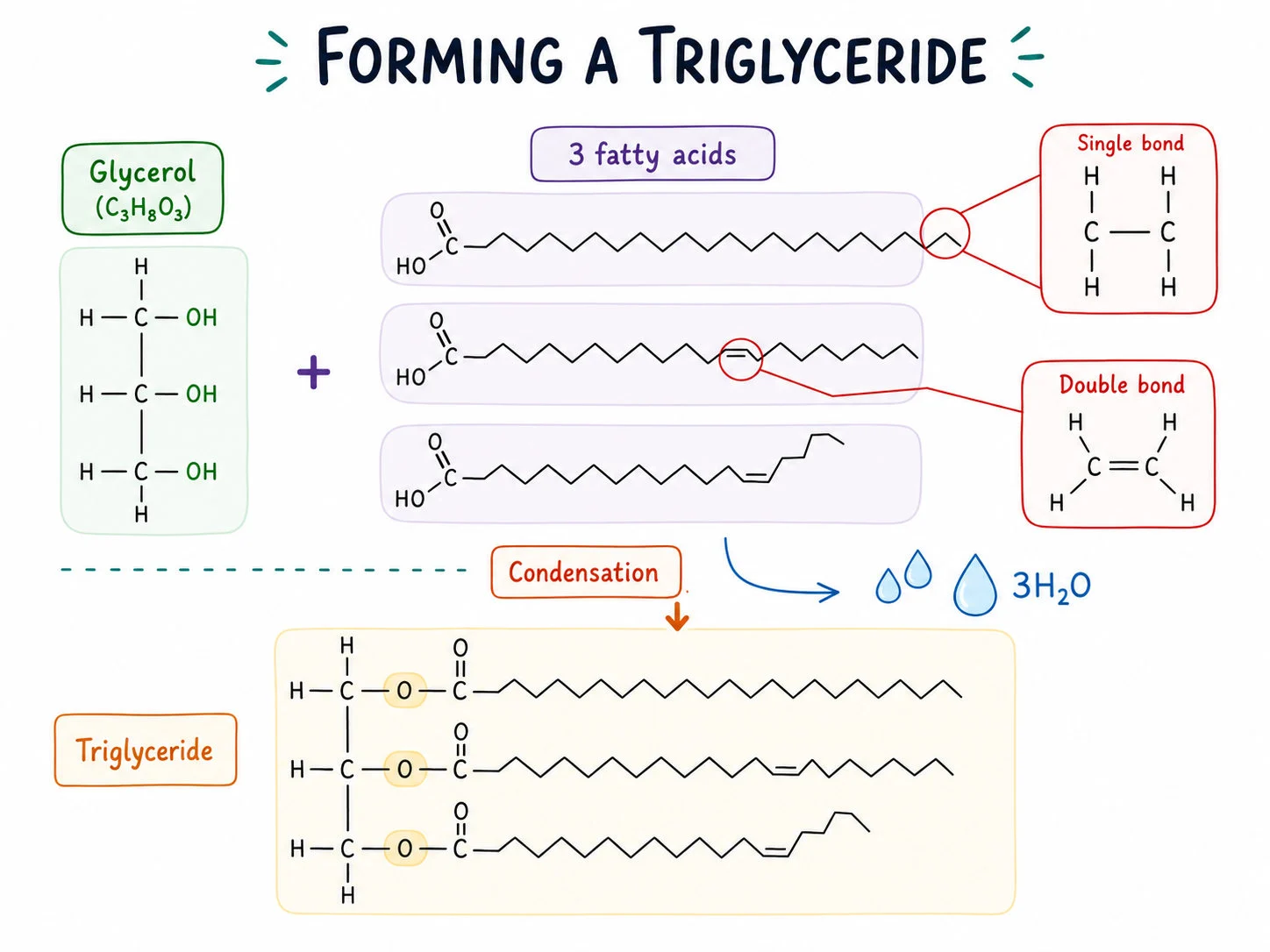
| Lipids | Fatty acids, glycerol and phosphate groups |
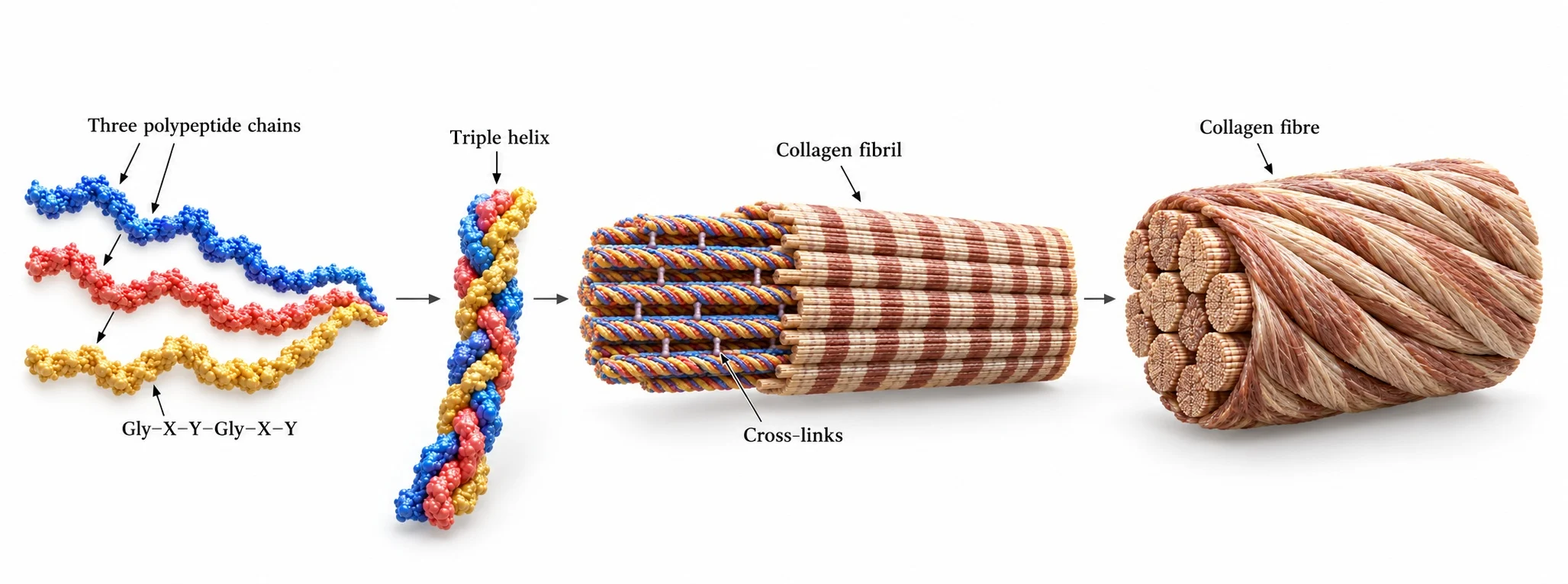
| Polypeptides (proteins) | Amino acids |
| Nucleic acids | Nucleotides |
Part 2 of 11Condensation and functional groups
Condensation and functional groups
Condensation reaction
- Condensation reaction covalent bonds form and water is removed
- Polysaccharides form when hydroxyl groups on different monosaccharides form a glycosidic bond.
Functional groups
- Functional groups hydroxyl (OH), amino (NH2), carboxyl (COOH) and phosphate (H2PO4)
SI prefixes
- SI prefixes agreed internationally: kilo 103, centi 10-2, milli 10-3, micro 10-6
Part 3 of 11Key molecular terms
Phospholipid
Phospholipid glycerol, two fatty acids and a phosphate group, which is amphipathic
Amino acid
Amino acid an amine group, a carboxyl group and a variable R group on a central carbon
Immunoglobulin
Immunoglobulin a Y-shaped antibody protein with variable tips that bind specific antigens
Selective permeability
Selective permeability the ability of a membrane to let some substances through while blocking others
Part 4 of 11Organelles and compartments
Organelles and compartments
Separation
- Separation organelles are separated from the cytosol mainly by membranes
- Ribosomes are organelles without a membrane.
- The nuclear envelope is a double membrane with two phospholipid bilayers, perforated by pores.
- Cell walls and the cytoskeleton are not organelles.
Compartments
- Compartments they let reactants and enzymes reach high local concentrations
- In eukaryotes transcription and translation occur in different compartments.
Lysosomes
- Lysosomes their enzymes work best near pH 5, lower than the cytosol at about pH 7.2
- Enclosing digestive enzymes protects the rest of the cell.
Ultracentrifuge
- Ultracentrifuge spins samples so that cell parts separate by mass and density
Part 5 of 11Differentiation
- Differentiation the process by which a cell becomes specialised by expressing a particular set of genes
1
The zygote divides by mitosis.
2
Early cells are unspecialised stem cells.
3
Morphogen gradients signal position to each cell.
4
Specific genes are switched on and others off.
5
Specific proteins are made.
6
Cell structure and function become specialised.
Part 6 of 11Making a red blood cell
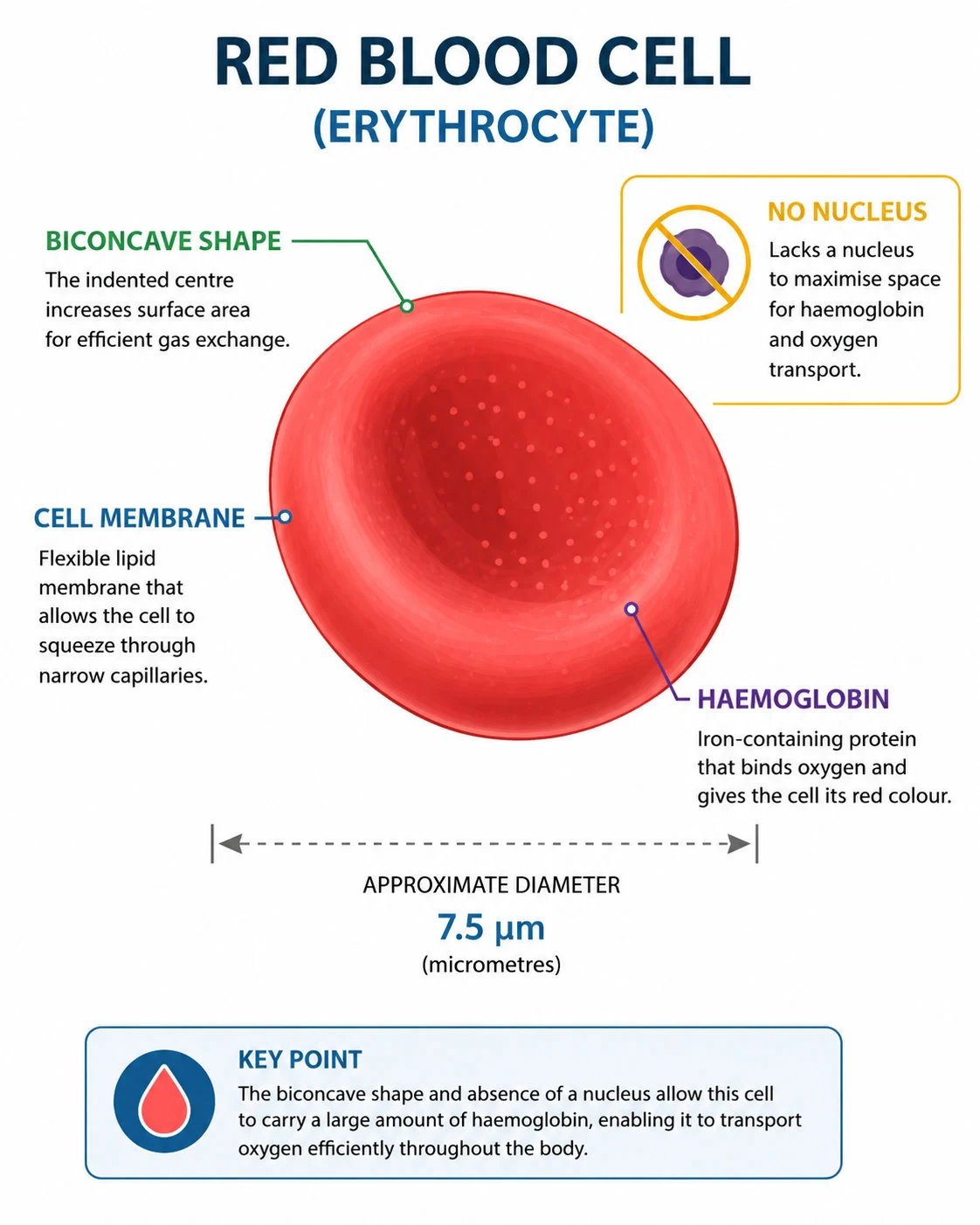
1
A stem cell divides in the bone marrow niche.
2
One daughter cell stays a stem cell.
3
The other commits to the red cell lineage.
4
Haemoglobin genes switch on.
5
The nucleus is lost.
6
A biconcave cell enters the blood.
Part 7 of 11Gas exchange
Inhalation
- Inhalation the diaphragm and external intercostals contract, thorax volume increases and pressure falls below atmospheric, so air is drawn in
Spirometer
- Spirometer traces give lung volumes
Part 8 of 11Transport in animals
Capillaries
- Capillaries walls one cell thick give a short diffusion distance
Veins
- Veins a wide lumen, thin wall and valves, and the valves prevent backflow
Pulse
- Pulse a pressure wave from contraction of the ventricles
Embolus
- Embolus a clot that breaks free and travels in the blood
Atheroma (plaque)
- Atheroma (plaque) a build-up in artery walls
Correlation
- Correlation smokers having more coronary heart disease may indicate a causal link but does not prove that smoking causes every case
- A correlation coefficient of r = -0.9 on a scatter graph shows a strong negative correlation.
Part 9 of 11Transport and structure in plants
Transport and structure in plants
Xylem
- Xylem continuous tubes of dead cells reinforced with lignin
- Cohesion allows a continuous column of water.
- Without lignin the vessels would collapse under tension.
Dicot root
- Dicot root the xylem is in the centre as a cross, with phloem between the arms
- The cortex is parenchyma that stores starch.
- The epidermis forms the outer layer, with root hairs that absorb water and minerals.
- The endodermis is the boundary between the vascular tissue and the cortex.
Dicot stem
- Dicot stem the vascular bundles form a ring with the phloem on the outer part
Plan diagram
- Plan diagram shows tissues and not individual cells, and has no shading
Part 10 of 11Adaptation links
Habitat
Habitat where a species lives
Niche
- Niche no two species can permanently share exactly the same niche
Convergent evolution
Convergent evolution the development of similar adaptations in unrelated species
Obligate aerobe
- Obligate aerobe needs oxygen
Epiphyte
- Epiphyte grows on another plant to reach light
Carnivorous plants
- Carnivorous plants trap insects mainly for nitrogen
Arms race
- Arms race herbivores and plants show defences and counter-adaptations
Part 11 of 11More from the specification
More from the specification
Carbon Bonding and Hydrocarbon Skeletons
- Carbon's tetravalent property allows it to form four stable covalent bonds,
- producing diverse linear, branched,
- and ring-shaped hydrocarbon skeletons essential for all organic biomolecules.
Saturated vs Unsaturated Lipids and Hydrophobic Properties
- Fatty acids consist of hydrocarbon chains; saturated fatty acids contain only single C-C bonds,
- whereas unsaturated fatty acids contain one or more double C=C bonds;
- their non-polar hydrophobic nature makes them ideal for cellular energy storage and membrane formation.
Carbohydrate Polymers
- Glucose, Energy Storage,
- and Cellulose — Glucose isomers polymerise into distinct polysaccharides: α-glucose monomers condense into helical starch and glycogen for cellular energy storage,
- while β-glucose monomers link into rigid, unbranched cellulose fibres providing tensile strength to plant cell walls.
Glucose
- A simple sugar; the unit that starch, glycogen and cellulose are built from.
Cellulose
- A structural polysaccharide of β-glucose.
Saturated
- Having no C=C double bonds.
Unsaturated
- A fatty acid with one or more C=C double bonds.
Hydrophobic
- Water-hating; non-polar and unable to dissolve in water.
Hydrophilic
- Water-loving; polar or charged and able to dissolve in water.
Key terms
| Term | Meaning |
|---|---|
| Monomer | A small molecule that links with others to form a polymer. |
| Condensation | A reaction that joins molecules and removes water. |
| Differentiation | Specialisation of a cell by expression of a specific set of genes. |
| Xylem vessel | A tube of dead lignified cells carrying water upwards. |
| Embolus | A clot that breaks free and travels in the blood. |
| Selective permeability | The property of a membrane that allows some substances through but not others. |
Avoid these mistakes
1
Saying that lipids are polymers — they are macromolecules but not made of repeating monomers
2
Saying that veins always carry deoxygenated blood — veins are defined by structure and the pulmonary veins carry oxygenated blood
3
Drawing shaded cells in a plan diagram — draw tissue outlines only without shading
4
Saying all organelles are surrounded by a membrane — ribosomes have none
Last updated:
\n