B1.2Theme B — Form and function
Proteins — IB Biology SL Revision Notes & Topical Questions
5 min read 11 parts Lesson 3 of 13 2 quizzes
Lesson summary
B1.2 Proteins — IB BIOLOGY SL notes: Describe amino acid and peptide bond structure, protein diversity and roles, and the effect of heat and pH on protein structure.Protein = a polymer made of amino acid monomers, whose sequence, type and number decide its shape and functionAll g…
- Polypeptide
- Hydrolysis
- Recognising the bond
- Non-essential amino acids
- Vegetarian and vegan diets
- Choice at each position
Part 1 of 9Proteins and amino acids
Protein
Protein a polymer made of amino acid monomers, whose sequence, type and number decide its shape and function
- All genes code for proteins, so all the reactions of life depend on protein function.
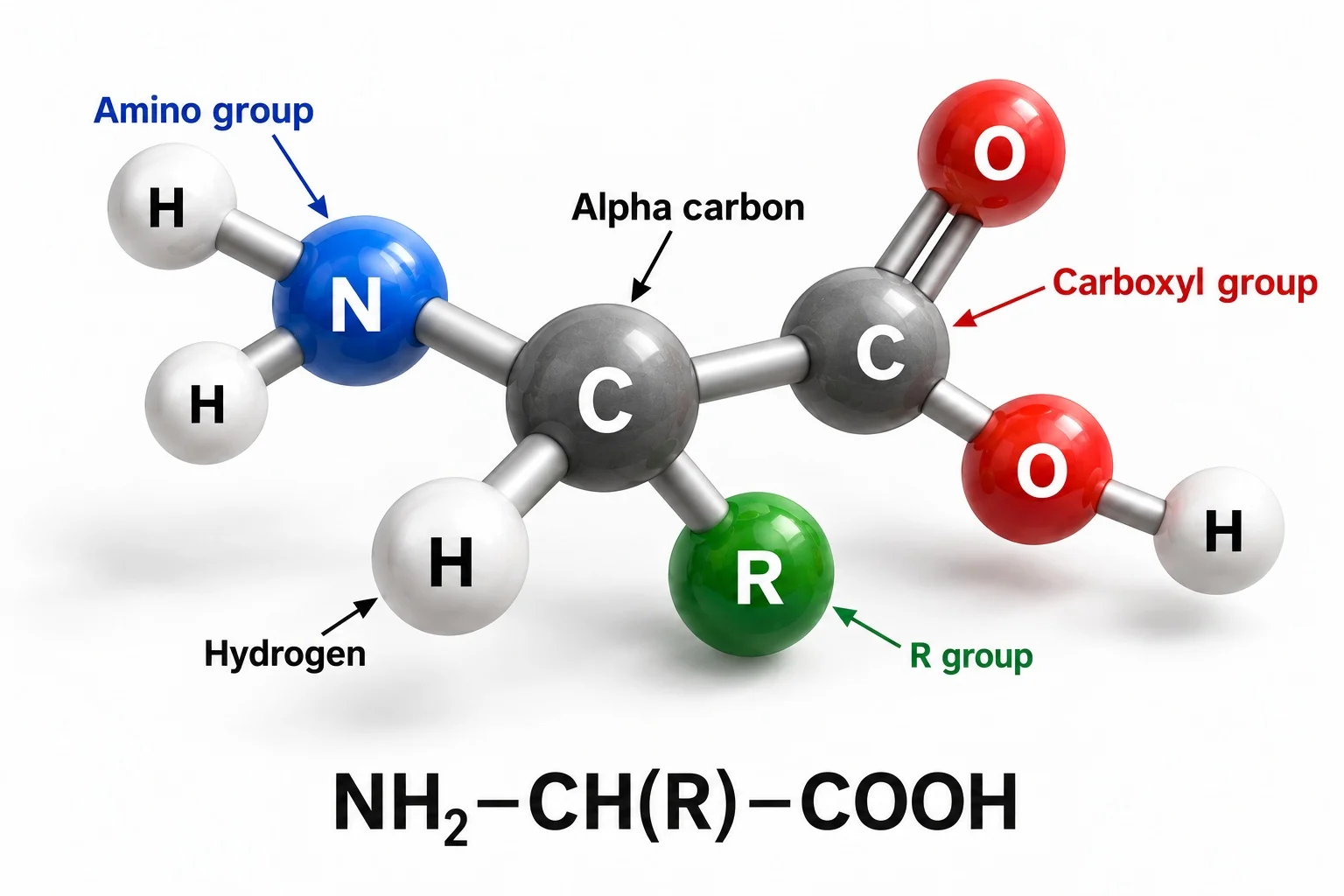
Amino acid
- 20 types are common to all living organisms
- A central alpha carbon is bonded to an amine group (NH2), a carboxyl group (COOH), a hydrogen atom and an R group.
- The R group is the only part that differs.
- R groups range from a single hydrogen in glycine to an aromatic ring in phenylalanine.
- R groups can be polar or non-polar and acidic or basic, which decides how the chain folds.
Part 2 of 9Peptide bond formation
Peptide bond
- Peptide bond formed by a condensation reaction between two amino acids
- An OH is lost from the carboxyl group of one amino acid and an H from the amine group of the other.
- The remaining carbon with its double-bonded oxygen bonds to the nitrogen of the second amino acid.
- Water is released.
Dipeptide
- Dipeptide two amino acids joined by one peptide bond, as in amino acid + amino acid → dipeptide + water
Polypeptide
- Polypeptide three or more amino acids, and a protein may have one or several chains
Hydrolysis
- Hydrolysis adding water breaks peptide bonds and releases amino acids, as in digestion
Recognising the bond
- Recognising the bond look for nitrogen bonded to a carbon that has a double bond to oxygen, and the R group is not involved
Modelling
- Modelling molecular modelling kits show how the peptide bond forms
Part 3 of 9Dietary amino acids
Dietary amino acids
Non-essential amino acids
- 11 of the 20 can be made by body cells from other amino acids
Essential amino acids
- Essential amino acids the other nine must come from the diet
Vegetarian and vegan diets
- Vegetarian and vegan diets meat contains all nine, so a plant diet must be varied and balanced, for example legumes with grains
Part 4 of 9Diversity of polypeptides
1Choice at each position
- 20 amino acids can be added at every step on a ribosome
- The mRNA codon decides which amino acid is added.
2Variation
- Variation chains range from a few to thousands of amino acids
- The DNA base sequence codes for the number and order of the amino acids.
3Number of sequences
20n for a chain of n amino acids
- A short 50-amino-acid chain has 2050 = about 1.13 × 1065 possible sequences.
- The average protein has 300 amino acids, so the variety is effectively infinite.
Part 5 of 9Roles of proteins
| Role | Example |
|---|---|
| Catalysis | Enzymes such as rubisco, pepsin and lipase |
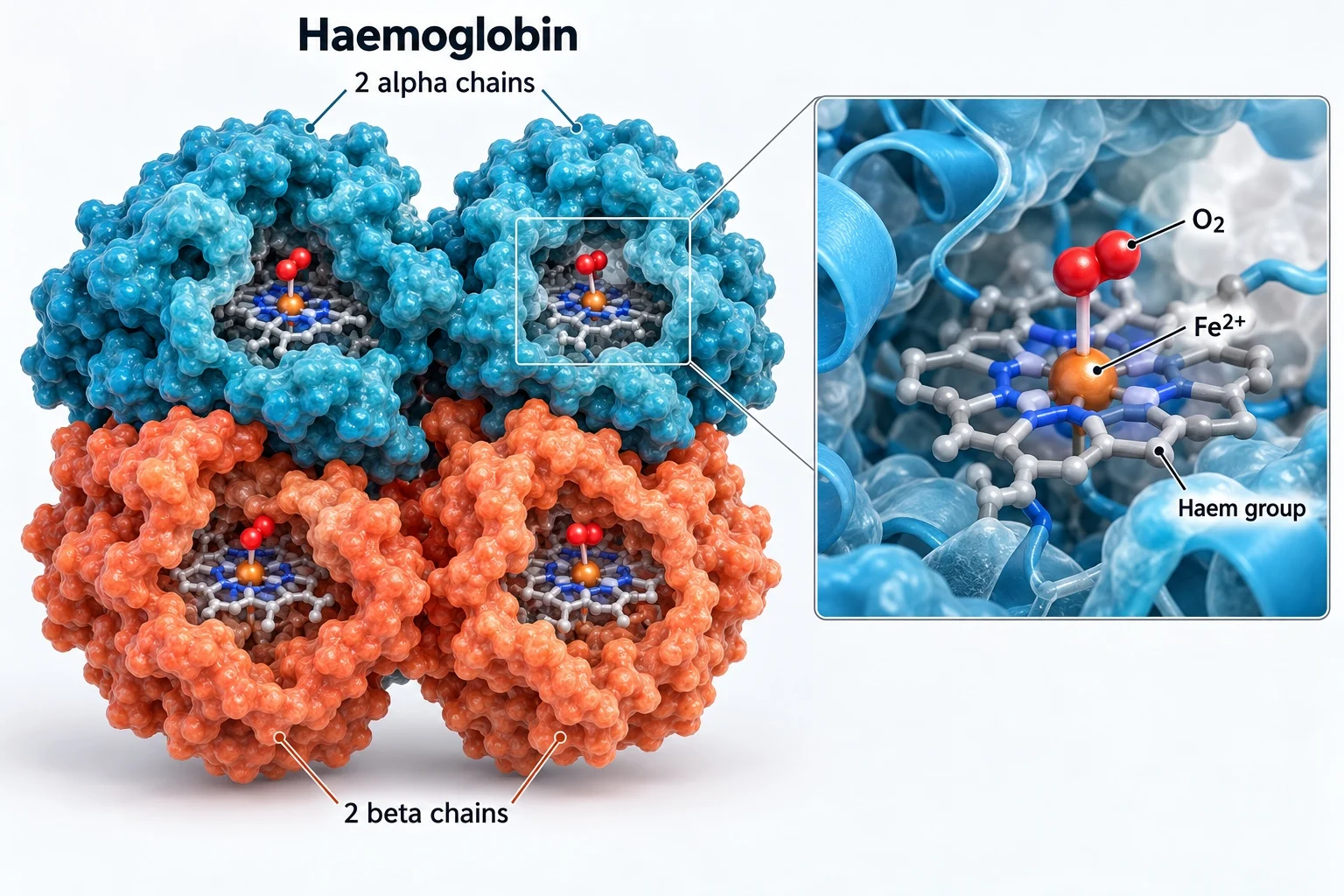
| Transport | Haemoglobin carries oxygen in blood |
| Contraction | Myosin and actin shorten muscle fibres |
| Structure | Keratin in hair and nails, collagen in skin and tendons |
| Defence | Immunoglobulins recognise pathogens |
| Signalling | Hormones such as insulin and receptors such as rhodopsin |
- Other roles
- Blood clotting, where blood proteins form a gel-like scab over a wound.
- The cytoskeleton, which moves chromosomes in the cell cycle.
- Cell adhesion between cells of the same tissue.
- Histone proteins that compact DNA in chromosomes.
- Membrane channel and carrier proteins that decide which substances cross.
- Cell receptors for hormones, tastes, light and sound.
Part 6 of 9Named proteins
Rubisco
- Rubisco an enzyme made of 16 polypeptide chains that fixes CO2 in photosynthesis
- It is the source of all organic carbon and the most abundant enzyme on Earth.
- It is a slow catalyst but the most effective to have evolved.
Insulin
- Insulin a short globular hormone of 2 polypeptide chains made by beta cells of the pancreas
- It binds reversibly to receptors on liver, fat and muscle cells, causing glucose uptake from the blood.
Immunoglobulin
- Immunoglobulin a Y-shaped antibody with variable binding tips that bind specific antigens
- It is the most diverse protein group and can be made against millions of antigens.
Rhodopsin
- Rhodopsin a retinal pigment containing retinal, derived from vitamin A
- A photon changes its shape, which sends a nerve impulse along the optic nerve to the brain.
Collagen
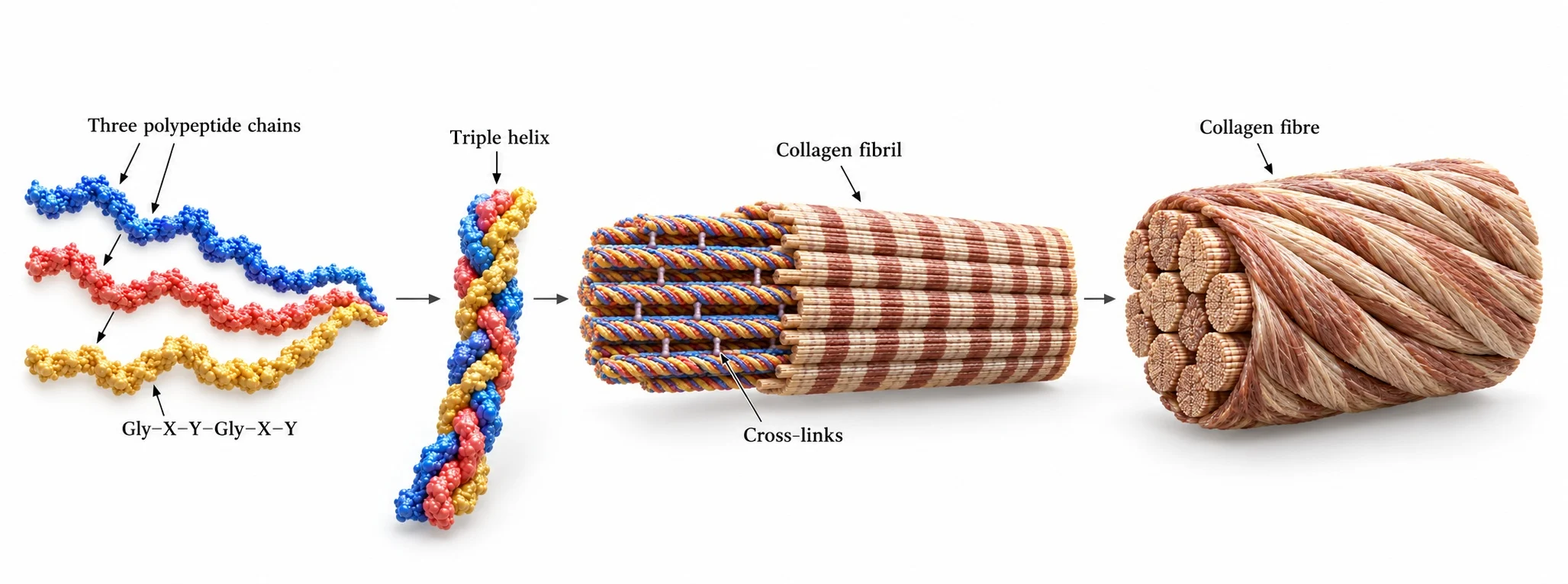
- Collagen a fibrous protein of three chains wound together, about 25% of human protein
- It forms networks in skin and blood vessel walls that resist tearing and reduces the brittleness of bones and teeth.
Spider silk
- Spider silk as strong as steel but lighter, with rope-like fibrous regions and coiled regions that stretch
- It does not denature easily at extreme temperatures.
- It can be made in goats' milk by genetic engineering.
Part 7 of 9Globular and fibrous proteins
| Feature | Globular | Fibrous |
|---|---|---|
| Shape | Compact and rounded | Long strands |
| Solubility | Usually soluble | Insoluble |
| Role | Metabolic, for example enzymes and hormones | Structural support |
| Sequence | Irregular | Often repetitive |
| Example | Insulin | Collagen |
- Conformation
- the specific 3D shape of a protein, held by weak bonds between R groups
Part 8 of 9Denaturation by heat and pH
Denaturation
Denaturation a change in the 3D shape of a protein that is almost always irreversible
- The weak bonds between R groups break easily, whereas peptide bonds stay intact.
- Active sites and binding sites then no longer fit their substrates or ligands.
Heat
- Heat vibrations break hydrogen and ionic bonds, so the shape is lost
Extreme pH
- Extreme pH changes the charges on R groups, so ionic bonds fail
Small reversible changes
- Small reversible changes some proteins, such as haemoglobin, tolerate slight pH fluctuations
Optimum
- Optimum at the optimum pH or temperature the 3D structure is not denatured
- Pepsin has an optimum of pH 2 in the stomach.
Part 9 of 9Denaturation in practice
1
Albumin in egg white is soluble with its hydrophobic groups inside.
2
Heat increases molecular vibration.
3
Hydrogen and ionic bonds between R groups break.
4
The chain unfolds and exposes the hydrophobic groups.
5
Unfolded molecules clump and become insoluble.
6
A solid white layer forms that cannot revert.
Extremophiles
- Thermus aquaticus lives in hot springs at 80 °C because its proteins stay stable
Stomach
- Stomach acid at pH 2 denatures dietary proteins before they are hydrolysed
Protein drugs
- Protein drugs they are injected because stomach acid would denature them
Enzyme experiments
- Enzyme experiments find the optimum pH or temperature of an enzyme such as pepsin or lipase
Key terms
| Term | Meaning |
|---|---|
| Amino acid | The monomer of proteins with an amine group, a carboxyl group and a variable R group on a central carbon. |
| Peptide bond | The covalent link formed by condensation between the carboxyl group of one amino acid and the amine group of the next. |
| Polypeptide | A chain of three or more amino acids. |
| Essential amino acid | An amino acid the body cannot make, so it must come from the diet. |
| Denaturation | The loss of 3D shape, and so function, of a protein caused by heat or pH change. |
| Conformation | The specific 3D shape of a protein held by weak bonds between R groups. |
| Globular protein | A rounded, usually soluble protein, such as an enzyme or insulin. |
| Fibrous protein | A long, insoluble structural protein, such as collagen. |
Avoid these mistakes
1
Confusing peptide bonds with the bonds holding the 3D shape — peptide bonds make the chain and weaker bonds fold it
2
Saying denaturation breaks peptide bonds — it breaks the weaker bonds between R groups
3
Saying amino acids differ in their amine or carboxyl group — only the R group differs
4
Thinking denaturation is easily reversed — it is almost always irreversible
Marked practiceQuizzes for this lesson
Last updated:
\n