2.4Theme B — Form and function
Organelles & Compartmentalisation — IB Biology SL Revision Notes & Topical Questions
5 min read 10 parts Lesson 11 of 13 Unit quiz
Curriculum Equation Key قوانين الرقم الهيدروجيني والاتزان الأيوني - pH & Acid-Base Equilibrium FormulasFast Exam Solution
pH = -log[H⁺] | pOH = -log[OH⁻] | pH + pOH = 14 | [H⁺][OH⁻] = 10⁻¹⁴
Word Equation & Conditions: الرقم الهيدروجيني = -لوغاريتم تركيز أيون الهيدروجين | pH + pOH = 14
Location & Specifications: الاتزان الأيوني، كيمياء 3 ثانوي، التحصيلي، و AP Chemistry.
Lesson summary
2.4 Organelles & Compartmentalisation — IB BIOLOGY SL notes: Distinguish organelles from other cell structures and explain the advantages of compartmentalisation and how cell fractionation separates organelles.Organelle = a discrete subunit of a cell adapted to perform a specific…
- Not organelles
- Concentration
- Protection
- Optimal conditions
- Flexibility
- Separation of incompatible reactions
Part 1 of 8What counts as an organelle
Organelle
Organelle a discrete subunit of a cell adapted to perform a specific function
- Eukaryotic organelles are bound by a single or double membrane.
- Ribosomes are organelles without a membrane.
Not organelles
- Not organelles the cell wall, the cytoskeleton and the cytoplasm
- The cytoskeleton moves vesicles but is not a discrete subunit.
Sizes
- Sizes mitochondria are typically 0.5-1 µm wide and chloroplasts are about 2-10 µm long
Ribosomes
- Ribosomes eukaryotic cytoplasmic ribosomes are 80S
- Prokaryotic, mitochondrial and chloroplast ribosomes are 70S, which is evidence for endosymbiosis.
Part 2 of 8Advantages of compartmentalisation
Advantages of compartmentalisation
Concentration
- Concentration enzymes and substrates are localised and so at higher concentrations
Protection
- Protection damaging substances are kept apart, for example digestive enzymes in lysosomes
Optimal conditions
- Optimal conditions each process keeps its own pH
Flexibility
- Flexibility the number and location of organelles can change with the needs of the cell
- Very active cells have more mitochondria.
Separation of incompatible reactions
- Separation of incompatible reactions nitrogenase is inactivated by oxygen, so it is kept in an oxygen-free region away from aerobic reactions
Part 3 of 8Prokaryote and eukaryote gene expression
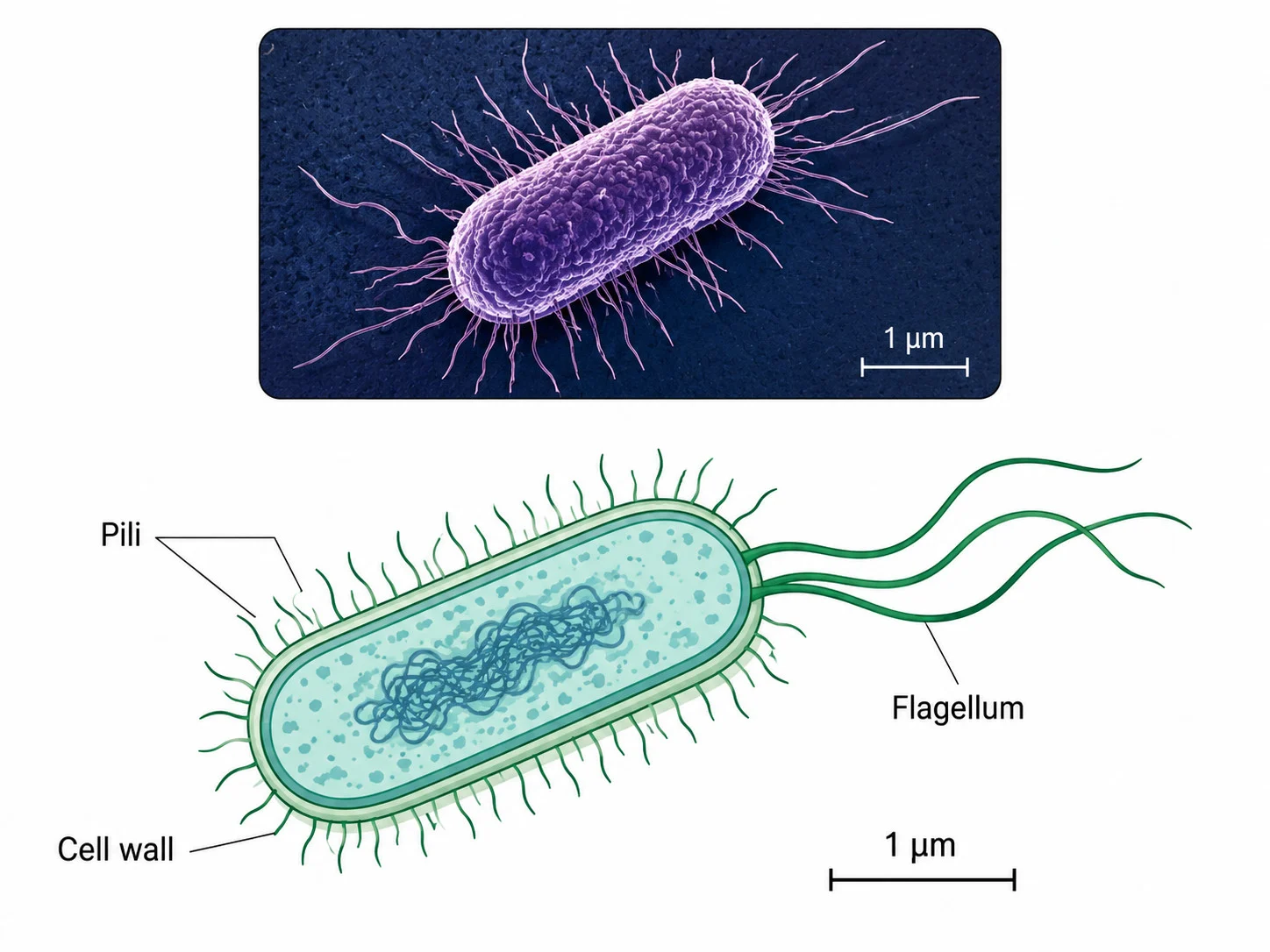
Prokaryotes
- Prokaryotes no membrane-bound organelles, so transcription and translation happen together in the cytoplasm
- Ribosomes translate the mRNA while it is still being transcribed.
- This allows very rapid responses to environmental change.
Eukaryotes
- Eukaryotes the nuclear envelope keeps mRNA away from ribosomes until it has been processed
- Pre-mRNA can be spliced and modified in the nucleus.
- This reduces errors in the protein produced.
Nuclear pore
- Nuclear pore a gap in the double nuclear membrane lined by proteins
- mRNA leaves through it and proteins and nucleotides enter.
Part 4 of 8Lysosomes and phagocytic vacuoles
Lysosome
- Lysosome a vesicle containing hydrolytic enzymes that work best at the acid pH maintained inside
- If the enzymes were released they would digest cell components.
Phagocytic vacuole
- Phagocytic vacuole formed by endocytosis around a large particle
- White blood cells and protists use it to digest engulfed particles without harming the cell.
- It fuses with lysosomes so the contents are digested safely.
Vacuoles
- Vacuoles plant cells have a large permanent vacuole that stores sap and maintains turgor
- Animal cells have small temporary vacuoles.
Part 5 of 8Adaptations of organelles
| Organelle | Structure | Function |
|---|---|---|
| Nucleus | Double membrane with pores | Protects DNA and separates transcription from translation |
| Rough ER | Ribosomes on membrane sacs | Synthesis of proteins for export |
| Golgi apparatus | Flattened cisternae with vesicles budding off | Modifies and packages proteins |
| Lysosome | Single membrane and acidic interior | Digestion by autophagy and phagocytosis |
| Mitochondrion | Cristae, matrix and a small intermembrane space | Aerobic respiration and ATP production |
| Chloroplast | Grana, thylakoids and stroma | Photosynthesis |
Part 6 of 8Protein secretion pathway
1
The gene is transcribed in the nucleus and the mRNA is processed and exits through a nuclear pore.
2
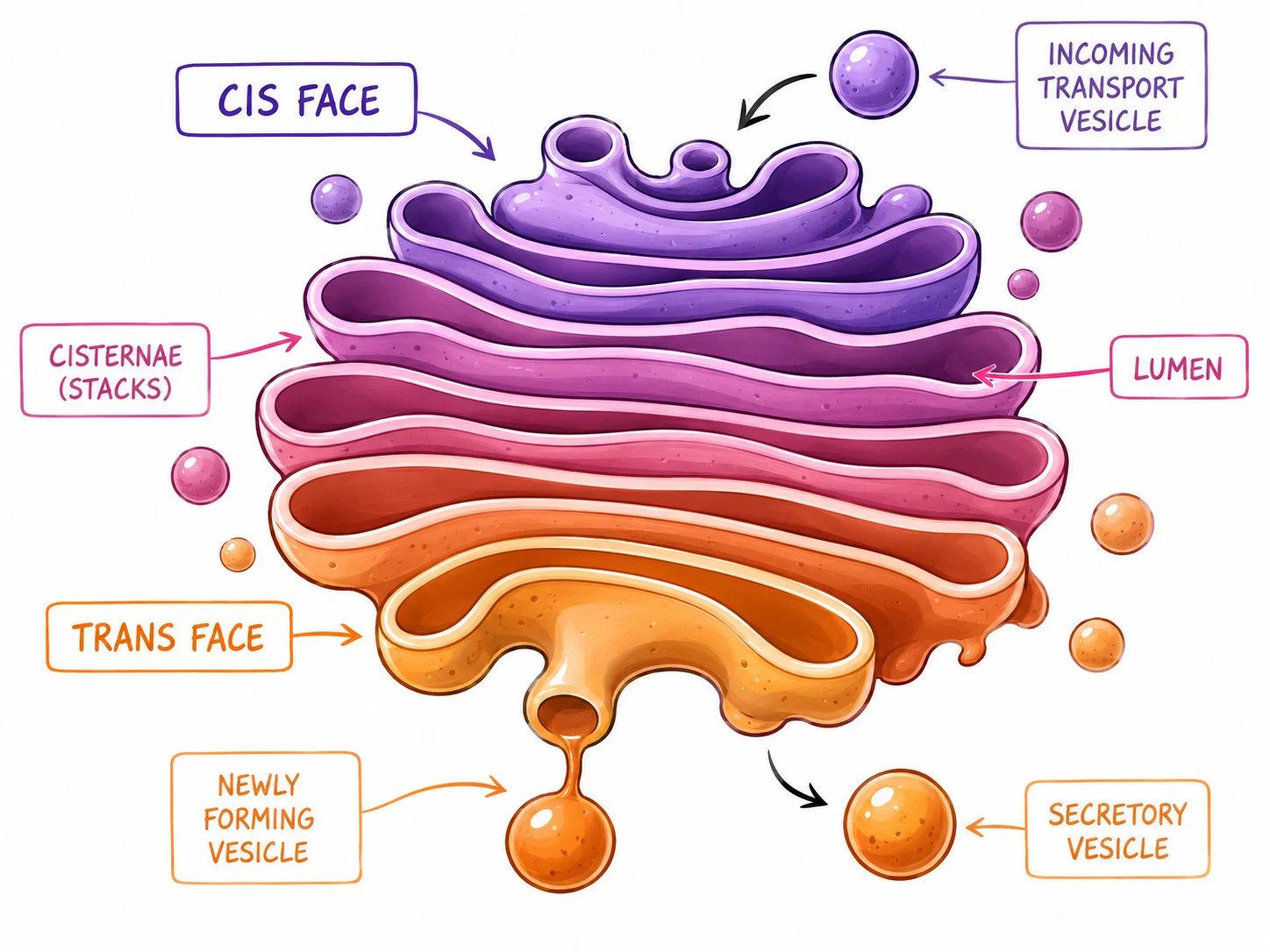
The polypeptide enters the rough ER lumen and folds, and is carried in a vesicle to the cis face of the Golgi.
3
The Golgi modifies the protein, for example by adding carbohydrate, and sorts it.
4
Secretory vesicles bud from the trans face and move along the cytoskeleton to the plasma membrane.
5
The vesicle fuses with the plasma membrane and releases the protein by exocytosis.
Part 7 of 8Cell fractionation
Purpose
- Purpose it allows biochemical study of isolated organelles
- Isolated mitochondria, for example, respire pyruvate.
Solution conditions
- Cold, to reduce enzyme activity and autolysis.
- Isotonic, to prevent osmotic bursting.
- Buffered, to prevent denaturation by pH change.
1
Place the tissue in a cold, isotonic, buffered solution.
2
Homogenise (blend) to break open the cells.
3
Filter to remove debris.
4
Centrifuge at low speed so that nuclei form the pellet.
5
Spin the supernatant faster so that mitochondria and chloroplasts form a pellet.
6
Spin fastest so that ribosomes and membranes form a pellet.
Part 8 of 8More from the specification
More from the specification
Subcellular fractionation of an organelle sample
- Subcellular fractionation of an organelle sample differential centrifugation of a homogenized cellular sample separates mitochondria and nuclei into pure fractions.
Complex
- Two or more molecules joined, such as an antibody and antigen.
Ultrastructure
- The internal structure of a cell seen with an electron microscope.
Key terms
| Term | Meaning |
|---|---|
| Organelle | A discrete subunit of a cell adapted to perform a specific function. |
| Compartmentalisation | Separation of the cell into membrane-bound regions so that incompatible processes are kept apart. |
| Nuclear pore | A gap in the nuclear envelope, lined by proteins, that lets mRNA out and proteins in. |
| Rough endoplasmic reticulum | Membrane sacs with bound ribosomes that make proteins for export. |
| Golgi apparatus | A stack of flattened membrane sacs that modifies, sorts and packages proteins into vesicles. |
| Lysosome | A membrane-bound vesicle with hydrolytic enzymes kept separate from the cytoplasm. |
| Vesicle | A small membrane-bound sac that moves materials within a cell or to the plasma membrane. |
| Phagocytic vacuole | A vacuole formed by endocytosis of a large particle that fuses with lysosomes. |
Avoid these mistakes
1
Counting the cytoplasm as an organelle — it is the medium in which the organelles lie
2
Saying all ribosomes are 80S — prokaryotic, mitochondrial and chloroplast ribosomes are 70S
3
Using warm, pure water for homogenisation — use cold, isotonic buffer to protect the organelles
4
Saying compartmentalisation only protects the cell — it also concentrates enzymes and keeps conditions optimal
Last updated:
\n