B2.1Theme B — Form and function
Membranes and membrane transport — IB Biology SL Revision Notes & Topical Questions
5 min read 12 parts Lesson 4 of 13 2 quizzes
Curriculum Equation Key قوانين الرقم الهيدروجيني والاتزان الأيوني - pH & Acid-Base Equilibrium FormulasFast Exam Solution
pH = -log[H⁺] | pOH = -log[OH⁻] | pH + pOH = 14 | [H⁺][OH⁻] = 10⁻¹⁴
Word Equation & Conditions: الرقم الهيدروجيني = -لوغاريتم تركيز أيون الهيدروجين | pH + pOH = 14
Location & Specifications: الاتزان الأيوني، كيمياء 3 ثانوي، التحصيلي، و AP Chemistry.
Lesson summary
B2.1 Membranes and membrane transport — IB BIOLOGY SL notes: Describe membrane structure and the processes by which substances cross membranes.Phospholipid — a glycerol, two fatty acid tails and a phosphate headThe head is polar and hydrophilic and the tails are non-polar and hyd…
- Membranes everywhere
- Integral proteins
- Peripheral proteins
- Protein content
- Transport proteins
- Selectivity
Part 1 of 10Phospholipid bilayer as a barrier
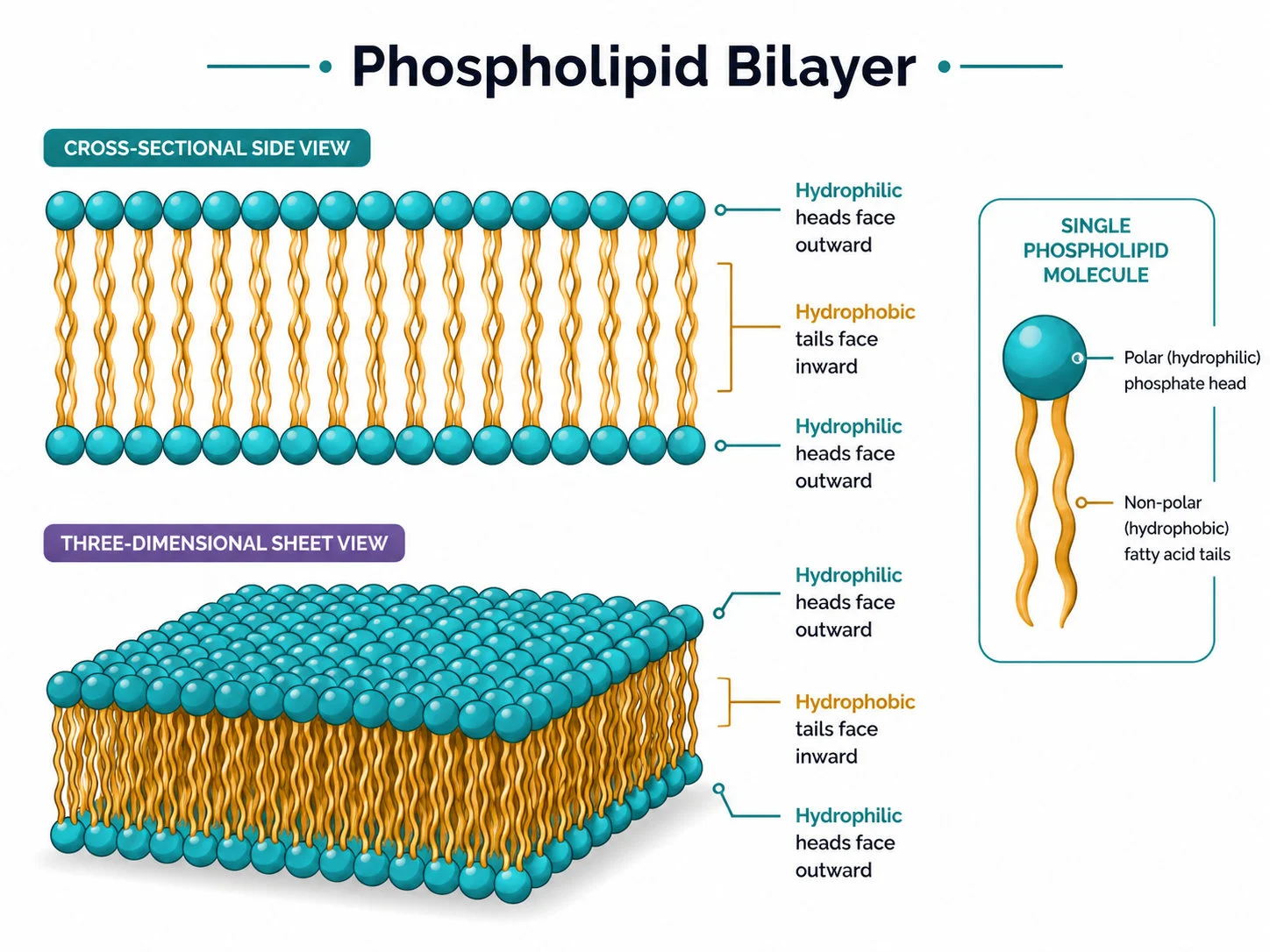
Phospholipid
- Phospholipid a glycerol, two fatty acid tails and a phosphate head
- The head is polar and hydrophilic and the tails are non-polar and hydrophobic.
- This makes the molecule amphipathic.
Monolayer
- Monolayer on a water surface the heads sit in the water and the tails point into the air
Bilayer
- Bilayer with enough phospholipid, two layers form spontaneously with the tails meeting in the middle
- The membrane is about 7-10 nm thick.
Barrier
- Barrier the tightly packed hydrophobic core has a low permeability
- Large molecules, polar molecules and ions are attracted to water and do not mix with the tails.
- Small non-polar molecules such as O2 and CO2 cross freely.
- Small polar molecules such as urea diffuse slowly.
Membranes everywhere
- Membranes everywhere the plasma membrane and organelle membranes compartmentalise the cell and communicate between cells
Part 2 of 10Membrane proteins
Integral proteins
- Integral proteins amphipathic and embedded in one or both layers
- Their hydrophobic parts meet the lipid tails.
- Examples are channel proteins.
Peripheral proteins
- Peripheral proteins hydrophilic and attached to the surface
- They bind to integral proteins or to a lipid anchor and can lie inside or outside the cell.
Protein content
- Protein content it varies with function
- Mitochondrial and chloroplast membranes are the most protein-rich because of their electron carriers.
Part 3 of 10Functions of membrane proteins
| Function | What it does | Example |
|---|---|---|
| Transport | Channels and carriers move ions and polar molecules | Aquaporins and glucose carriers |
| Receptor | Binds a signal and triggers events inside | Hormone and neurotransmitter receptors |
| Immobilised enzyme | Catalyses reactions at the membrane | Digestive enzymes on gut cells |
| Cell adhesion | Holds neighbouring cells together | Cells joined within a tissue |
| Recognition | Marks a cell as self | ABO antigens |
Functions of membrane proteins
Transport proteins
- Transport proteins each is specific to one ion or molecule, so the cell controls what enters or leaves
Receptors
- Receptors bind peptide hormones such as insulin, neurotransmitters or antibodies
Part 4 of 10Simple diffusion
Diffusion
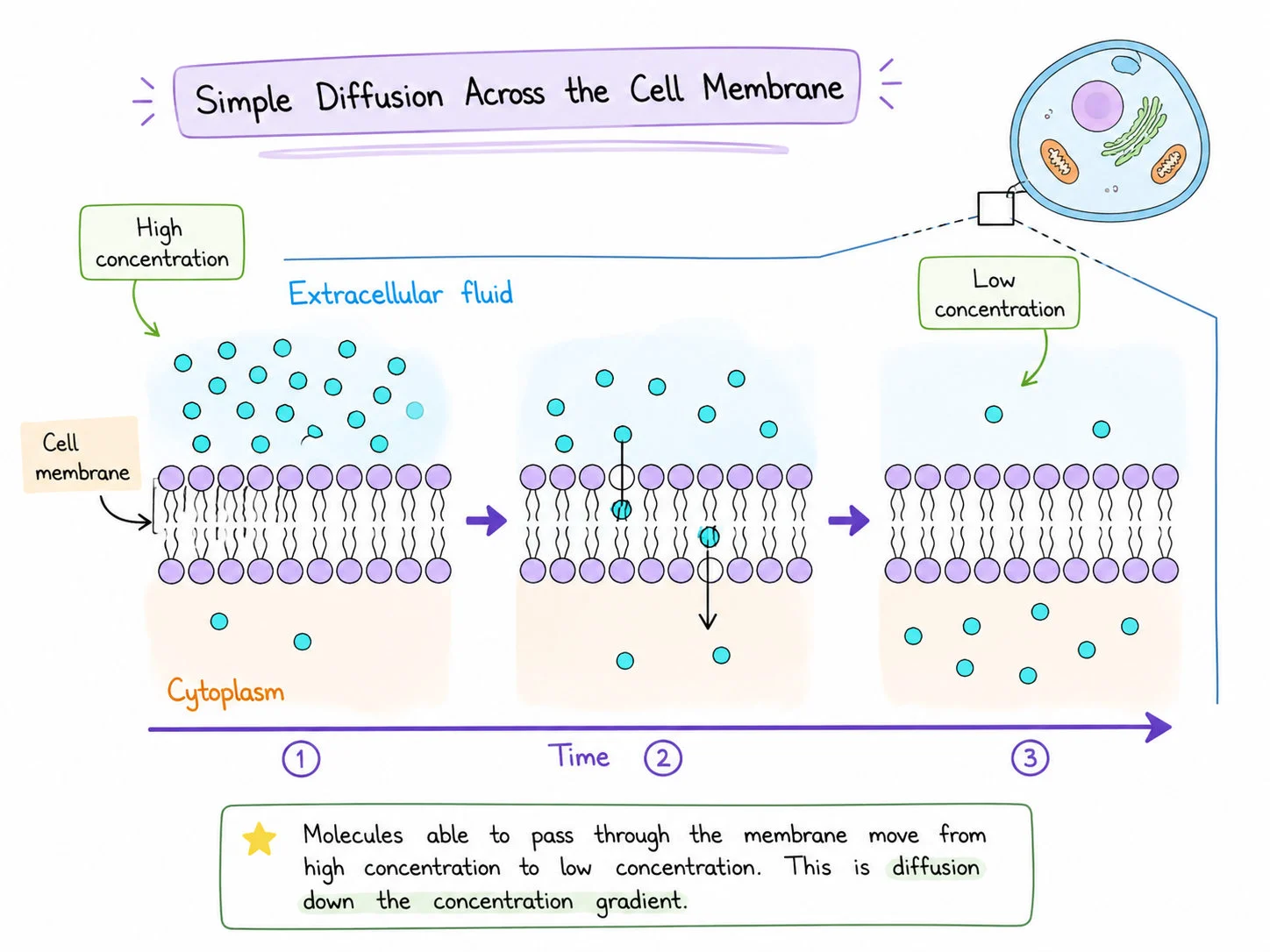
Diffusion the net movement of molecules or ions from a region of higher concentration to a region of lower concentration, caused by their random motion
- Particles move down the concentration gradient until they reach equilibrium.
- At equilibrium net movement stops although random motion continues.
Examples
- Examples oxygen diffuses into respiring cells and carbon dioxide diffuses out
Rate of diffusion
- A steeper concentration gradient gives a faster rate.
- A higher temperature gives more kinetic energy and faster movement.
- A larger surface area allows more crossing at once.
- Small, uncharged, non-polar particles diffuse fastest.
Selectivity
- Selectivity simple diffusion is selective only by size and polarity
Part 5 of 10Facilitated diffusion
Facilitated diffusion
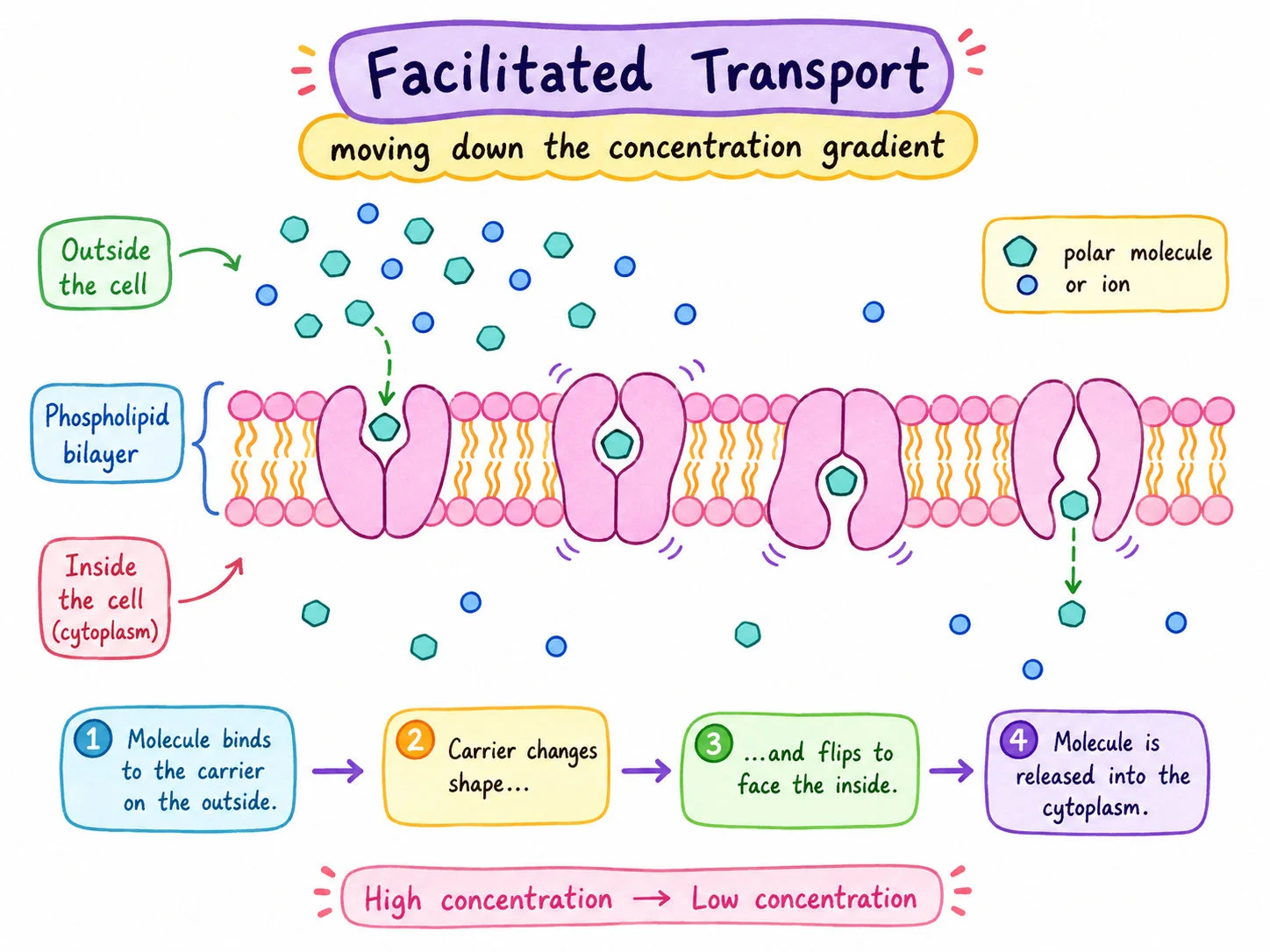
Facilitated diffusion passive movement of large molecules, polar molecules and ions through transport proteins
- It needs no energy and goes down the concentration gradient.
- Each protein is highly specific for one substance.
Channel proteins
- Channel proteins pores with a fixed shape that allow specific charged substances to pass
- Gated channels open only with a signal such as voltage or a neurotransmitter.
Carrier proteins
- Carrier proteins switch between two shapes
1
Glucose is more concentrated outside the cell.
2
Glucose binds to the open site of the carrier.
3
The carrier switches to its other shape.
4
The site now faces the cytoplasm.
5
Glucose is released inside the cell.
6
The empty carrier switches back.
Part 6 of 10Osmosis
Osmosis
Osmosis the net movement of water from a dilute solution to a more concentrated solution across a partially permeable membrane
- It is a type of diffusion down the water concentration gradient.
- It can also be described as movement from higher to lower water potential.
Aquaporins
- Aquaporins channel proteins that let water cross more freely
- Water is unusual for a polar molecule in passing directly between phospholipids.
Potato cylinder practical
1
Cut potato cylinders of the same size and place them in a range of sucrose solutions.
2
Keep the time and temperature the same.
3
Blot the cylinders dry and record the mass change.
4
Calculate percentage change = (final - initial) / initial × 100.
5
Find the isotonic point where the graph crosses zero change.
Part 7 of 10Active transport and selective permeability
Active transport
Active transport movement of molecules or ions across a membrane from lower to higher concentration using energy from respiration
- It needs carrier proteins, called pumps.
- ATP is hydrolysed to release energy that changes the shape of the pump.
- Root cells take up mineral ions from dilute soil water in this way.
Selective permeability
- Selective permeability membranes let some substances through and block others
- Facilitated diffusion and active transport give the control.
- Large or polar molecules cannot cross without transport proteins.
Part 8 of 10Transport methods compared
| Feature | Simple diffusion | Facilitated diffusion | Osmosis | Active transport |
|---|---|---|---|---|
| Energy | None | None | None | ATP required |
| Direction | Down the gradient | Down the gradient | To higher solute concentration | Against the gradient |
| Protein needed | No | Channel or carrier | Aquaporins speed it up | Pump |
| Substances | O2, CO2, small non-polar | Ions and glucose | Water | Na+, K+, minerals |
| Example | Gas exchange in alveoli | K+ channels in neurons | Water into root hair cells | Sodium-potassium pump |
Part 9 of 10Glycoproteins and glycolipids
Glycoprotein
- Glycoprotein a membrane protein with a carbohydrate chain on the extracellular side
Glycolipid
- Glycolipid a lipid with a carbohydrate chain, also on the outer surface
Functions
- Receptors for hormones and neurotransmitters that trigger signalling.
- Receptors for endocytosis.
- Adhesion that holds cells together in tissues.
- Markers (antigens) that let the immune system tell self from pathogen.
Part 10 of 10The fluid mosaic model
The fluid mosaic model
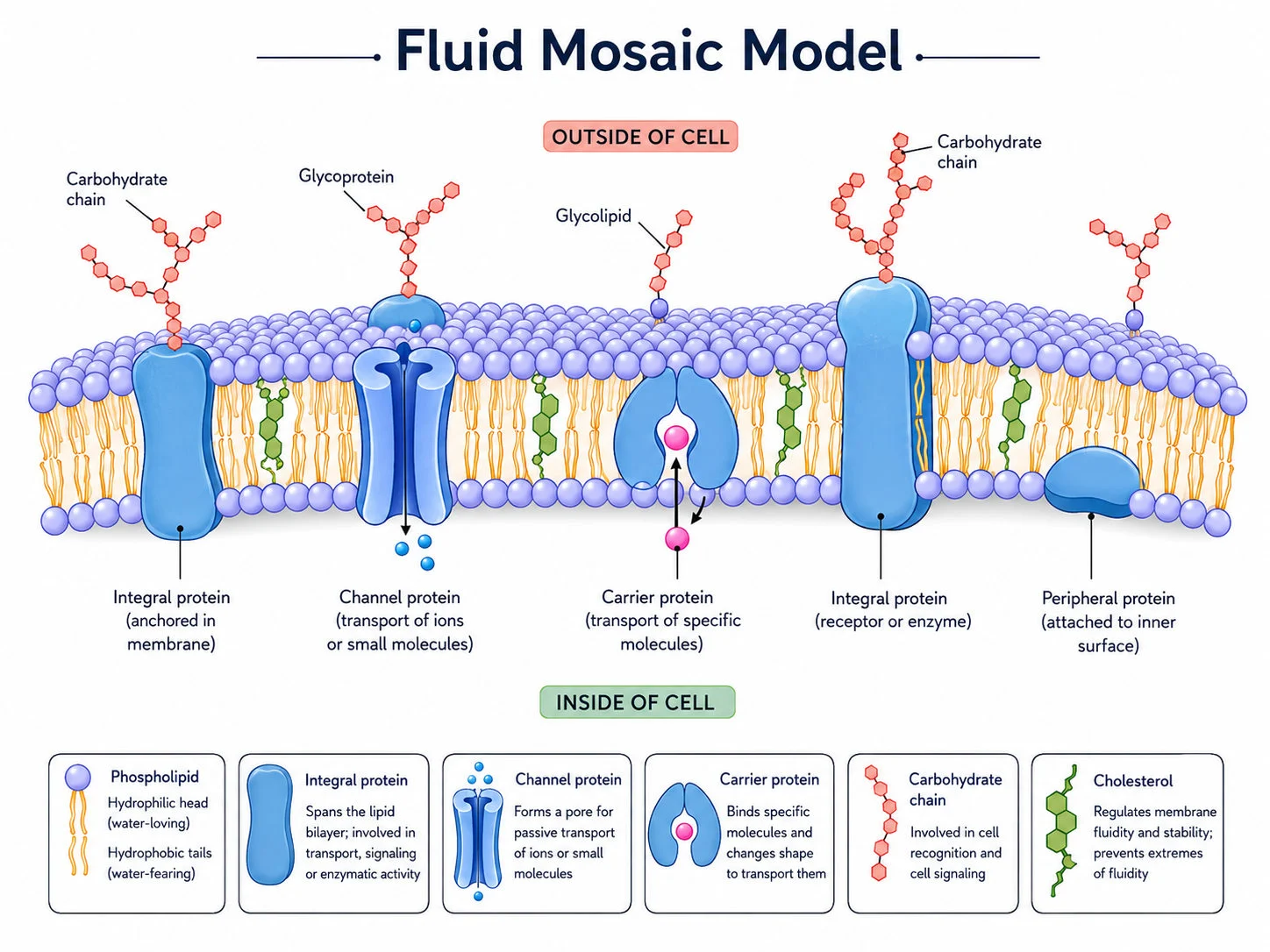
Fluid mosaic model
- Fluid mosaic model proposed by Singer and Nicolson in 1972
- Fluid, because phospholipids and proteins move within their own layers.
- Mosaic, because the scattered proteins look like a mosaic from above.
Components
- Components phospholipids, cholesterol, glycoproteins and glycolipids, and integral and peripheral proteins
Fluidity
- Fluidity unsaturated fatty acid tails increase membrane fluidity
Drawing it
1
Draw two rows of phospholipid heads facing outwards.
2
Add paired tails meeting in the middle.
3
Insert an integral protein spanning both layers.
4
Place a peripheral protein on one surface.
5
Attach a carbohydrate chain on the outer side to make a glycoprotein.
6
Add cholesterol between the tails with its OH group near the heads and label every part.
Key terms
| Term | Meaning |
|---|---|
| Amphipathic | Having both a hydrophilic region and a hydrophobic region, as phospholipids do. |
| Integral protein | A membrane protein embedded in the bilayer. |
| Peripheral protein | A hydrophilic membrane protein attached to the surface. |
| Facilitated diffusion | Passive movement down a concentration gradient through a transport protein. |
| Osmosis | The net movement of water across a partially permeable membrane from a dilute to a more concentrated solution. |
| Active transport | Movement of substances against a concentration gradient using ATP and a carrier protein. |
| Fluid mosaic model | The model of the membrane as a fluid phospholipid bilayer with scattered proteins. |
| Selective permeability | The property of letting some substances cross a membrane while blocking others. |
Avoid these mistakes
1
Saying the membrane is a single layer — the phospholipids form a bilayer
2
Saying facilitated diffusion needs ATP — it is passive and goes down the gradient
3
Saying water moves to the more dilute side in osmosis — it moves to the more concentrated solution
4
Placing carbohydrate chains on the inner surface — they are on the outer surface
Marked practiceQuizzes for this lesson
Last updated:
\n