B1.1Theme B — Form and function
Carbohydrates and lipids — IB Biology SL Revision Notes & Topical Questions
5 min read 13 parts Lesson 2 of 13 2 quizzes
Curriculum Equation Key قوانين الرقم الهيدروجيني والاتزان الأيوني - pH & Acid-Base Equilibrium FormulasFast Exam Solution
pH = -log[H⁺] | pOH = -log[OH⁻] | pH + pOH = 14 | [H⁺][OH⁻] = 10⁻¹⁴
Word Equation & Conditions: الرقم الهيدروجيني = -لوغاريتم تركيز أيون الهيدروجين | pH + pOH = 14
Location & Specifications: الاتزان الأيوني، كيمياء 3 ثانوي، التحصيلي، و AP Chemistry.
Lesson summary
B1.1 Carbohydrates and lipids — IB BIOLOGY SL notes: Relate the chemistry of carbon, carbohydrates and lipids to their structure and biological functions.Covalent bond = a shared pair of electrons, which is strong and stableCarbon — has four outer electrons, so each atom forms fo…
- Bond types
- Functional groups
- SI prefixes
- Macromolecule
- Condensation reaction
- Hydrolysis reaction
Part 1 of 11Carbon and functional groups
Carbon and functional groups
Covalent bond
Covalent bond a shared pair of electrons, which is strong and stable
Carbon
- Carbon has four outer electrons, so each atom forms four covalent bonds
- It is in carbohydrates, lipids, proteins and nucleic acids, so life is carbon based.
- Its four bonds point apart in a tetrahedral shape, which allows varied 3D molecules.
Bond types
- Bond types single bonds, as in methane, or double bonds, as in carbon dioxide
Carbon skeletons
- Long branched chains, such as glycogen.
- Long straight chains, such as cellulose.
- Single rings, such as the pyrimidines.
- Multiple rings, such as the purines.
Functional groups
- Functional groups clusters of atoms that give a molecule its reactions
- Hydroxyl (OH), amino (NH2), carboxyl (COOH) and phosphate (H2PO4).
SI prefixes
- SI prefixes agreed internationally: kilo 103, centi 10-2, milli 10-3, micro 10-6, nano 10-9
Part 2 of 11Macromolecules, condensation and hydrolysis
Monomer
Monomer a small molecule that links with others of its kind
Polymer
Polymer a chain of many monomers, formed by polymerisation
Macromolecule
Macromolecule a very large molecule of 1000 or more atoms
- Not all macromolecules are polymers, as lipids are not made of repeating monomers.
| Macromolecule | Building blocks | Bond formed | Polymer? |
|---|---|---|---|
| Polysaccharide | Monosaccharides | Glycosidic | Yes |
| Polypeptide | Amino acids | Peptide | Yes |
| Nucleic acid | Nucleotides | Phosphodiester | Yes |
| Triglyceride | Glycerol and fatty acids | Ester | No, the units are not repeating |
Condensation reaction
Condensation reaction molecules join by a covalent bond and water is removed
- Monomer + monomer gives polymer + water, and it needs energy.
Hydrolysis reaction
Hydrolysis reaction a covalent bond is broken by adding water
- It is used in digestion.
- Glycosidic bonds give monosaccharides, peptide bonds give amino acids and ester bonds give fatty acids and glycerol.
Part 3 of 11Monosaccharides and glucose
Monosaccharide
- Monosaccharide the monomer of carbohydrates, colourless, crystalline, soluble and sweet
- General formulaCnH2nOn, which applies to monosaccharides only.
- Trioses have 3 carbons, such as glyceraldehyde.
- Pentoses have 5 carbons, such as ribose.
- Hexoses have 6 carbons, such as glucose, fructose and galactose.
Disaccharide
- Disaccharide two monosaccharides joined by a glycosidic bond, such as sucrose, lactose or maltose
Glucose
- C6H12O6, the main respiratory substrate and a product of photosynthesis
- It is stable because of its strong covalent bonds.
- It is soluble because it is polar, so it is easily transported.
- Its bonds release chemical energy when broken.
Isomers
- Isomers alpha glucose has the OH on carbon 1 below the ring and beta glucose has it above
- Starch and glycogen are made of alpha glucose and cellulose of beta glucose.
Part 4 of 11Polysaccharides: energy storage
Storage polysaccharides
- Storage polysaccharides starch and glycogen are compact and insoluble
- Large amounts fit in a small space.
- Insoluble molecules do not lower the water potential, so water does not enter and burst the cell.
- They are easily added to or removed.
Starch
- Starch the plant store, in granules in chloroplasts and plastids, made of alpha glucose
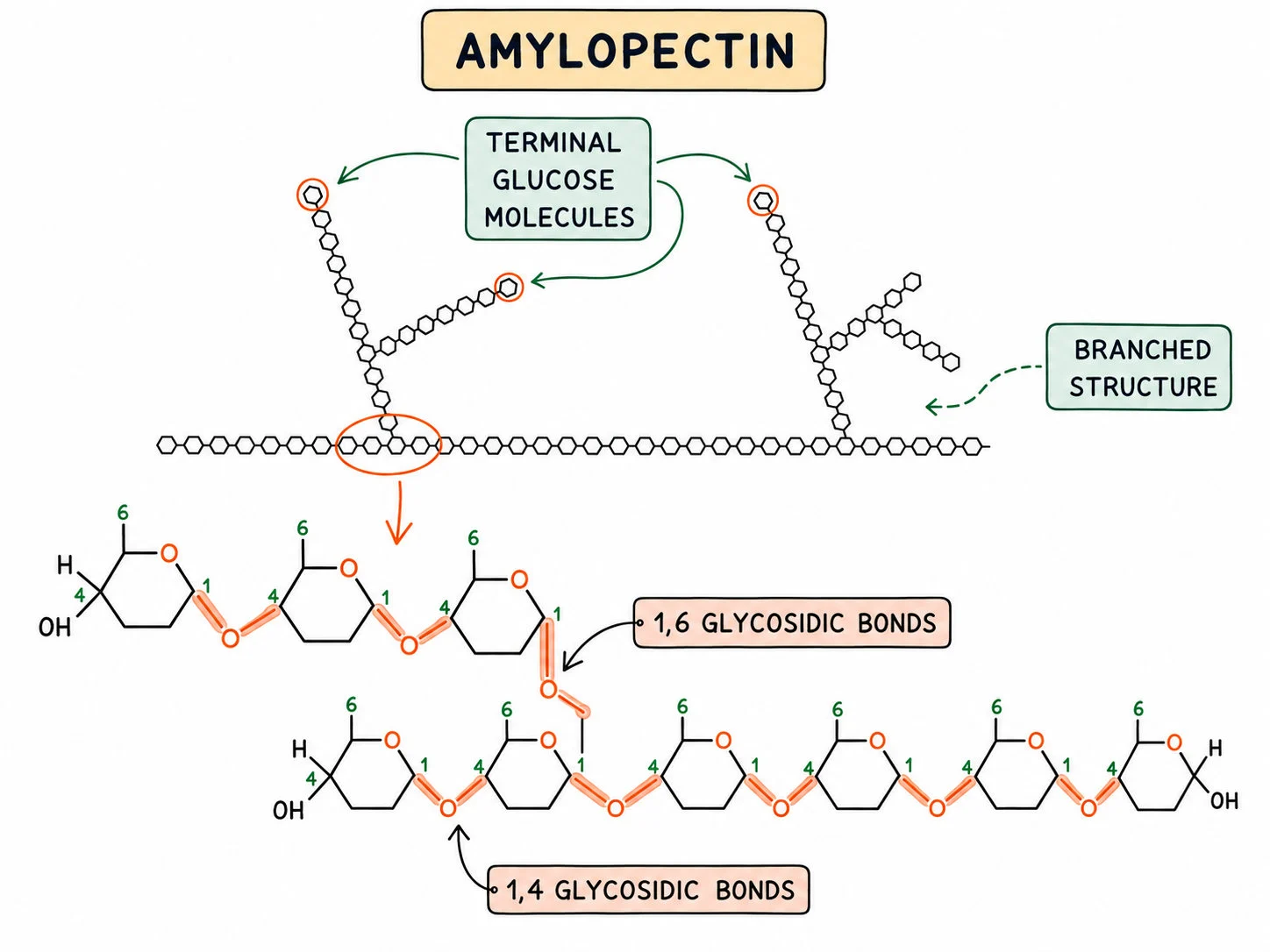
- Amylose (10-30%) is an unbranched helix with 1,4 bonds, compact and resistant to digestion.
- Amylopectin (70-90%) has 1,4 and 1,6 bonds and branches about every 20 units.
- The branches give many ends that can be hydrolysed quickly or added to.
Glycogen
- Glycogen the store in animals and fungi, with 1,4 and 1,6 bonds
- It is more branched than amylopectin, with a branch about every 10 units.
- It is broken down quickly, which suits the high metabolic needs of animals.
- It forms granules in liver and muscle cells.
Part 5 of 11Cellulose
Cellulose
Cellulose
- Cellulose a structural polysaccharide in plant cell walls, made of beta glucose
- It is strong, durable, insoluble and slightly elastic.
- It is chemically inert, as few organisms have enzymes that hydrolyse it.
Structure
- Structure every alternate beta glucose is flipped to form a 1,4 glycosidic bond, giving straight unbranched chains
- Hydrogen bonds link chains into microfibrils, which give strength.
| Feature | Starch | Glycogen | Cellulose |
|---|---|---|---|
| Monomer | α-glucose | α-glucose | β-glucose |
| Bonds | 1,4 (plus 1,6 in amylopectin) | 1,4 and many 1,6 | 1,4 only, alternate units flipped |
| Shape | Helix or branched | Highly branched and compact | Straight chains linked by hydrogen bonds |
| Found in | Plant cells | Liver and muscle | Plant cell walls |
| Role | Energy store | Quick-release energy store | Structural strength |
Part 6 of 11Glycoproteins and blood groups
Glycoproteins and blood groups
Glycoproteins
Glycoproteins carbohydrates covalently bonded to polypeptides, found on membrane surfaces with glycolipids
- Receptors for hormones and neurotransmitters.
- Cell recognition and identification.
- Endocytosis.
- Cell adhesion and stabilisation.
Antigens
- Antigens glycoproteins mark a cell as self or non-self, and non-self cells trigger an immune response
ABO blood groups
- ABO blood groups decided by the antigens on red blood cells
- A transfusion of the wrong type makes antibodies clump the donor cells and block vessels.
| Group | Antigens on red cells | Antibodies in plasma | Can receive |
|---|---|---|---|
| A | A | Anti-B | A, O |
| B | B | Anti-A | B, O |
| AB | A and B | None | A, B, AB, O |
| O | None | Anti-A and anti-B | O only |
Part 7 of 11Triglycerides and lipid properties
Lipids
- Lipids fats, oils, waxes and steroids that are rich in non-polar C-H bonds and insoluble in water
- Solubility is improved by combining them with other molecules, as in glycolipids and lipoproteins.
Triglyceride
Triglyceride glycerol joined to three fatty acids by ester bonds
- Each ester bond is formed by condensation between an OH of glycerol and the COOH of a fatty acid.
- Three water molecules are released.
1
Glycerol provides three OH groups.
2
Each fatty acid has a COOH group.
3
An OH and a COOH react.
4
A water molecule is released each time.
5
Three ester bonds link the molecule.
- Hydrolysis
- lipase adds water to each ester bond, releasing one fatty acid at a time and leaving glycerol and three fatty acids
Part 8 of 11Lipids as energy stores and insulation
Energy
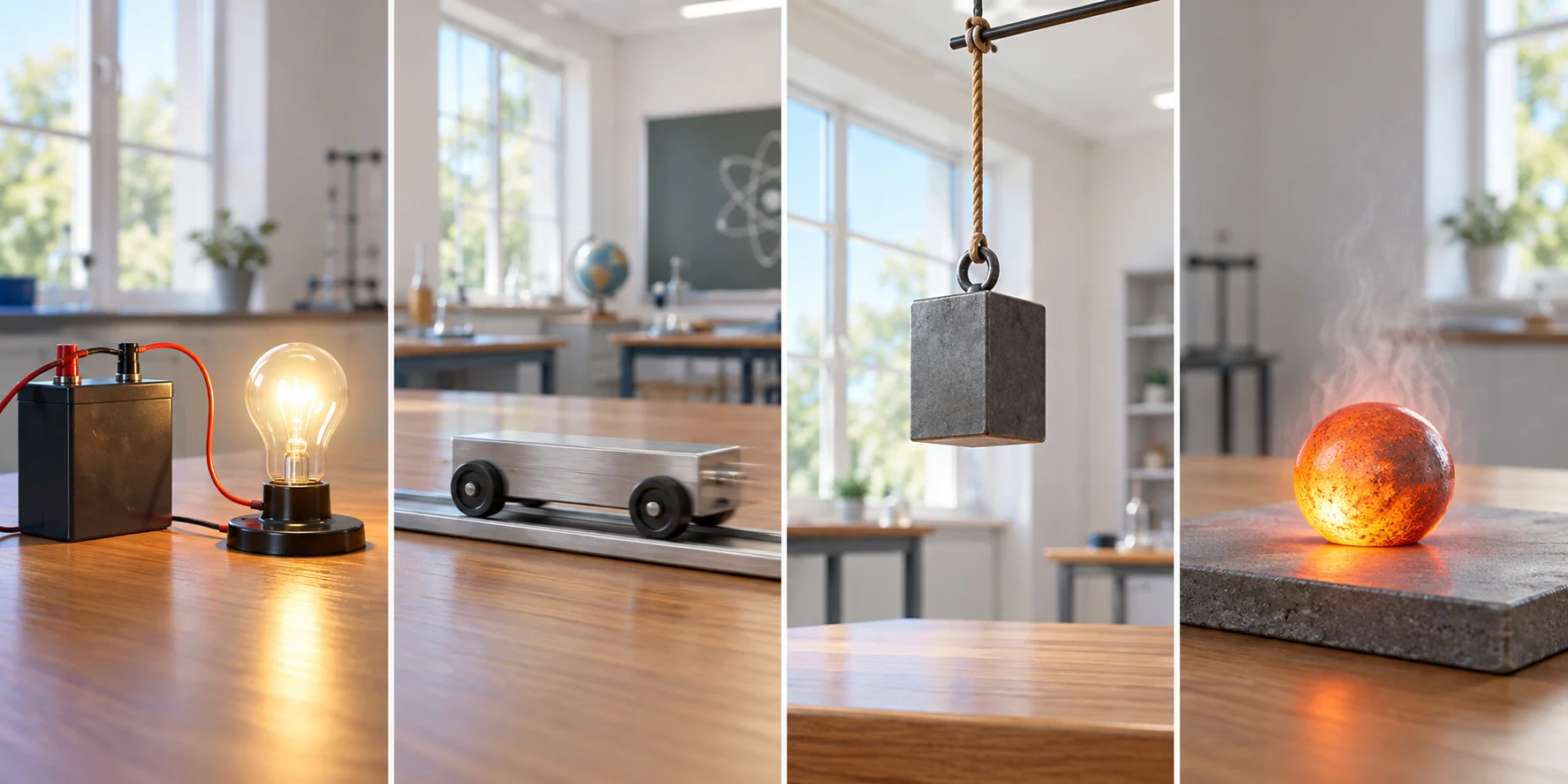
- Energy lipids release about twice as much energy per gram as carbohydrates, and they are hydrophobic so they are stored without water
Metabolic water
- Metabolic water respiring lipids produces more water than carbohydrates
- A camel's hump is a lipid store that yields metabolic water.
- A bird's egg yolk provides energy and water.
Adipose tissue
- Adipose tissue subcutaneous fat lies below the skin and visceral fat around organs
- Adipose cells shrink as fat is respired.
- Blubber in seals and walruses insulates against the cold.
Seeds
- Seeds olive, sunflower, coconut and oilseed rape store oils for seedling growth
Part 9 of 11Fatty acids
| Feature | Saturated | Cis-unsaturated | Trans-unsaturated |
|---|---|---|---|
| Double bonds | None | One or more | One or more |
| Chain shape | Straight | Kinked at the double bond | Nearly straight |
| State at room temperature | Usually solid | Usually liquid | Solid, packs tightly |
| Main source | Animal fats | Plant oils, fish | Partially hydrogenated oils |
| Health link | Higher LDL cholesterol | Generally beneficial | Strongly linked to heart disease |
Saturated
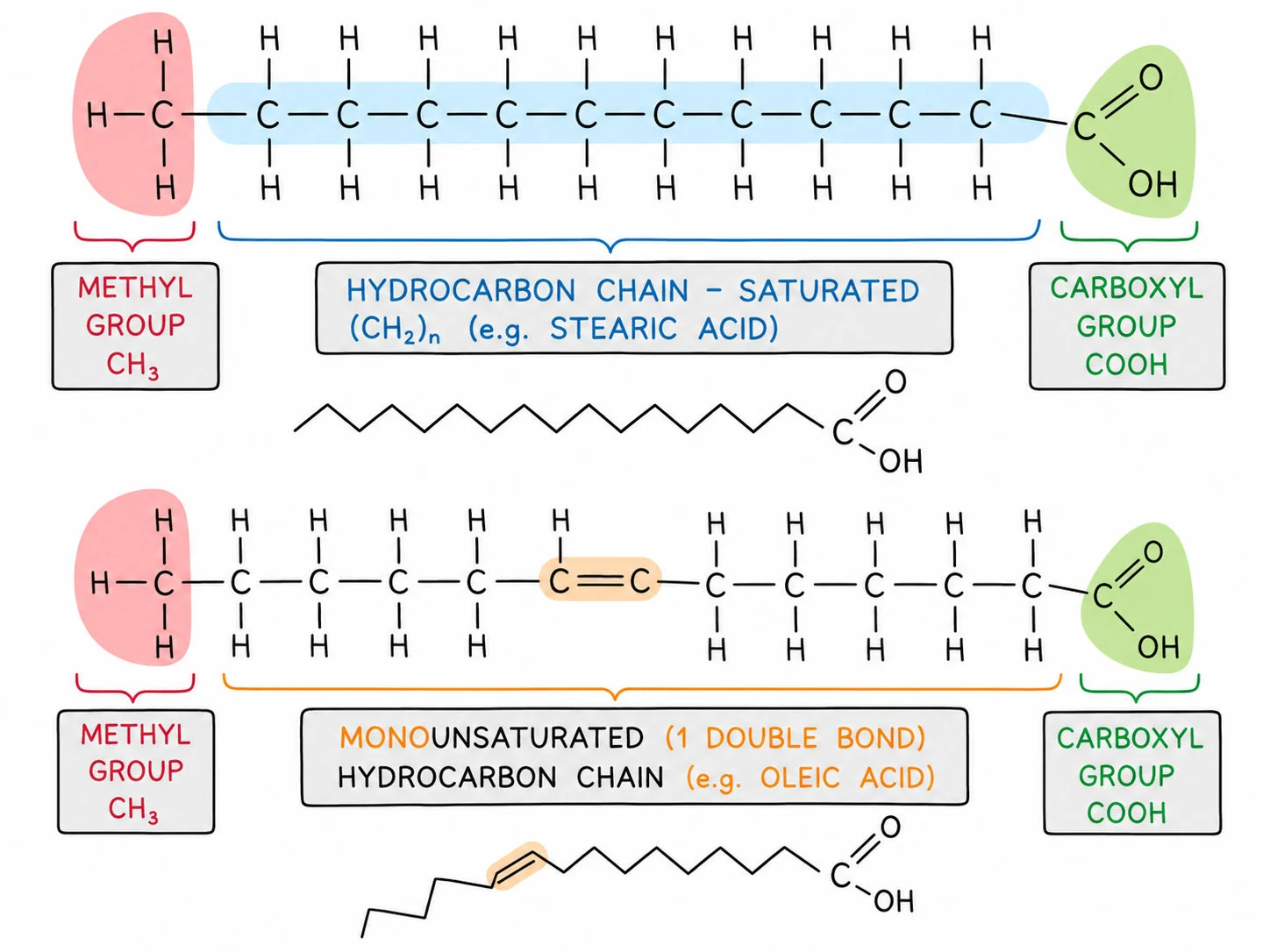
- Saturated only single C-C bonds, so straight chains pack tightly with a high melting point
Unsaturated
- Unsaturated one or more C=C double bonds, so they kink and pack loosely with a lower melting point
- One double bond is monounsaturated and several are polyunsaturated.
- More double bonds give a lower melting point and a liquid oil.
Part 10 of 11Phospholipids and steroids
Phospholipid
Phospholipid glycerol, two fatty acids and a phosphate group, which is amphipathic
- The phosphate head is polar and hydrophilic.
- The fatty acid tails are non-polar and hydrophobic.
Monolayer
- Monolayer on water the heads sit in the water and the tails point into the air
Bilayer
- Bilayer in water the heads face outwards and the tails face inwards, forming the basic structure of cell membranes
- It is a barrier to most water-soluble substances.
- Small non-polar molecules such as O2 and CO2 diffuse across without proteins.
Steroid
Steroid a lipid with four fused rings, such as cholesterol, oestradiol and testosterone
- Cholesterol stabilises membranes.
- Steroid hormones cross the bilayer and regulate transcription in the nucleus.
Part 11 of 11More from the specification
1Carbon tetravalency
- Carbon atoms contain four valence electrons, permitting the formation of four strong covalent bonds in linear, branched, or cyclic organic frameworks.
2Saturated vs unsaturated fatty acids
- Saturated fatty acids contain exclusively single C-C bonds, whereas unsaturated fatty acids contain one or more carbon-carbon double bonds (C=C).
3Triglyceride formation
- Condensation of one glycerol molecule with three fatty acid hydrocarbon chains forming three ester linkages.
4Carbohydrate monomers
- Monosaccharides are polyhydroxy aldehydes or ketones containing carbon, hydrogen, and oxygen typically in a 1:2:1 empirical ratio.
Key terms
| Term | Meaning |
|---|---|
| Monomer | A small molecule that links with others of its kind to build a polymer. |
| Condensation reaction | A reaction that joins two molecules by a covalent bond and releases water. |
| Hydrolysis | The breaking of a bond by adding water. |
| Glycosidic bond | The covalent link between two sugar units made by condensation. |
| Glycoprotein | A protein with carbohydrate chains, used in cell recognition. |
| Triglyceride | Glycerol linked to three fatty acids by ester bonds. |
| Phospholipid | Glycerol, two fatty acids and a phosphate group, which is amphipathic. |
| Steroid | A lipid with four fused carbon rings, such as cholesterol. |
Avoid these mistakes
1
Saying lipids are polymers — they are macromolecules but not made of repeating monomers
2
Saying cellulose is made of alpha glucose — it is made of beta glucose with alternate units flipped
3
Saying glucose is stored as free glucose — insoluble polymers avoid osmotic problems
4
Saying unsaturated fatty acids have no double bonds — they have at least one
Marked practiceQuizzes for this lesson
Last updated:
\n