B2.3Theme B — Form and function
Cell specialization — IB Biology SL Revision Notes & Topical Questions
5 min read 13 parts Lesson 6 of 13 2 quizzes
Curriculum Equation Key قوانين الرقم الهيدروجيني والاتزان الأيوني - pH & Acid-Base Equilibrium FormulasFast Exam Solution
pH = -log[H⁺] | pOH = -log[OH⁻] | pH + pOH = 14 | [H⁺][OH⁻] = 10⁻¹⁴
Word Equation & Conditions: الرقم الهيدروجيني = -لوغاريتم تركيز أيون الهيدروجين | pH + pOH = 14
Location & Specifications: الاتزان الأيوني، كيمياء 3 ثانوي، التحصيلي، و AP Chemistry.
Lesson summary
B2.3 Cell specialization — IB BIOLOGY SL notes: Explain how stem cells and gene expression produce specialised cells and how surface area to volume ratio limits cell size.Zygote — a diploid cell that divides by mitosis to form an embryoMorphogens — signalling chemicals that diffu…
- Early embryonic cells
- Stem cell niche
- Totipotent
- Pluripotent
- Multipotent
- Differentiation
Part 1 of 11Origin of cells in a new organism
Zygote
- Zygote a diploid cell that divides by mitosis to form an embryo
Morphogens
- Morphogens signalling chemicals that diffuse from a source
- The concentration gradient tells cells their position.
- Cells read the local concentration and so take different fates.
Early embryonic cells
- Early embryonic cells unspecialised, and later they commit to one lineage
Part 2 of 11Stem cells
Stem cell
Stem cell a cell that can divide an unlimited number of times by mitosis
- Self-renewal — it can divide repeatedly while staying unspecialised.
- Differentiation — each new cell can remain a stem cell or develop into a specialised cell such as a blood cell or muscle cell.
Uses
- Uses replacing damaged tissue, research into disease, and therapies such as bone marrow transplants
Stem cell niche
- Stem cell niche a location in the body that keeps stem cells so tissues can regenerate and repair
- Bone marrow supplies stem cells that replace red cells, white cells and platelets.
- The hair follicle niche supports continual hair growth.
- A niche must keep stem cells inactive until needed and stimulate them to divide and differentiate when required.
Part 3 of 11Potency
| Feature | Totipotent | Pluripotent | Multipotent | Unipotent |
|---|---|---|---|---|
| Range of cell types | All, including placenta | All body cell types | A few related types | Only its own type |
| Example | Zygote and early embryo | Inner cell mass of the blastocyst | Bone marrow and hair follicle | Heart muscle cells |
| Can form a whole organism? | Yes | No | No | No |
Totipotent
- Totipotent the zygote and cells up to about the 16-cell stage can also form the placenta
Pluripotent
- Pluripotent embryonic stem cells that cannot form extra-embryonic tissue
Multipotent
- Multipotent adult stem cells already partly committed, such as marrow forming all blood cell types
Unipotent
- Unipotent most animal body cells, and they can divide but give only their own type
Potency declines as development proceeds
Part 4 of 11Differentiation by gene expression
Genome
- Genome every body cell nucleus contains the full set of genes
Differentiation
Differentiation specialisation by expressing a particular set of genes
- Only a subset of genes is active and the others stay silent.
- The proteins made decide the shape and function of the cell.
- Haemoglobin genes are active only in developing red blood cells.
Permanence
- Permanence differentiation is usually permanent in the adult
Division of labour
- Division of labour specialised cells do particular jobs, so the organism works more efficiently
1
The zygote divides by mitosis.
2
Early cells are unspecialised stem cells.
3
Morphogen gradients signal position to each cell.
4
Specific genes are switched on and others off.
5
Specific proteins are made.
6
Cell structure and function become specialised.
Part 5 of 11Making a red blood cell
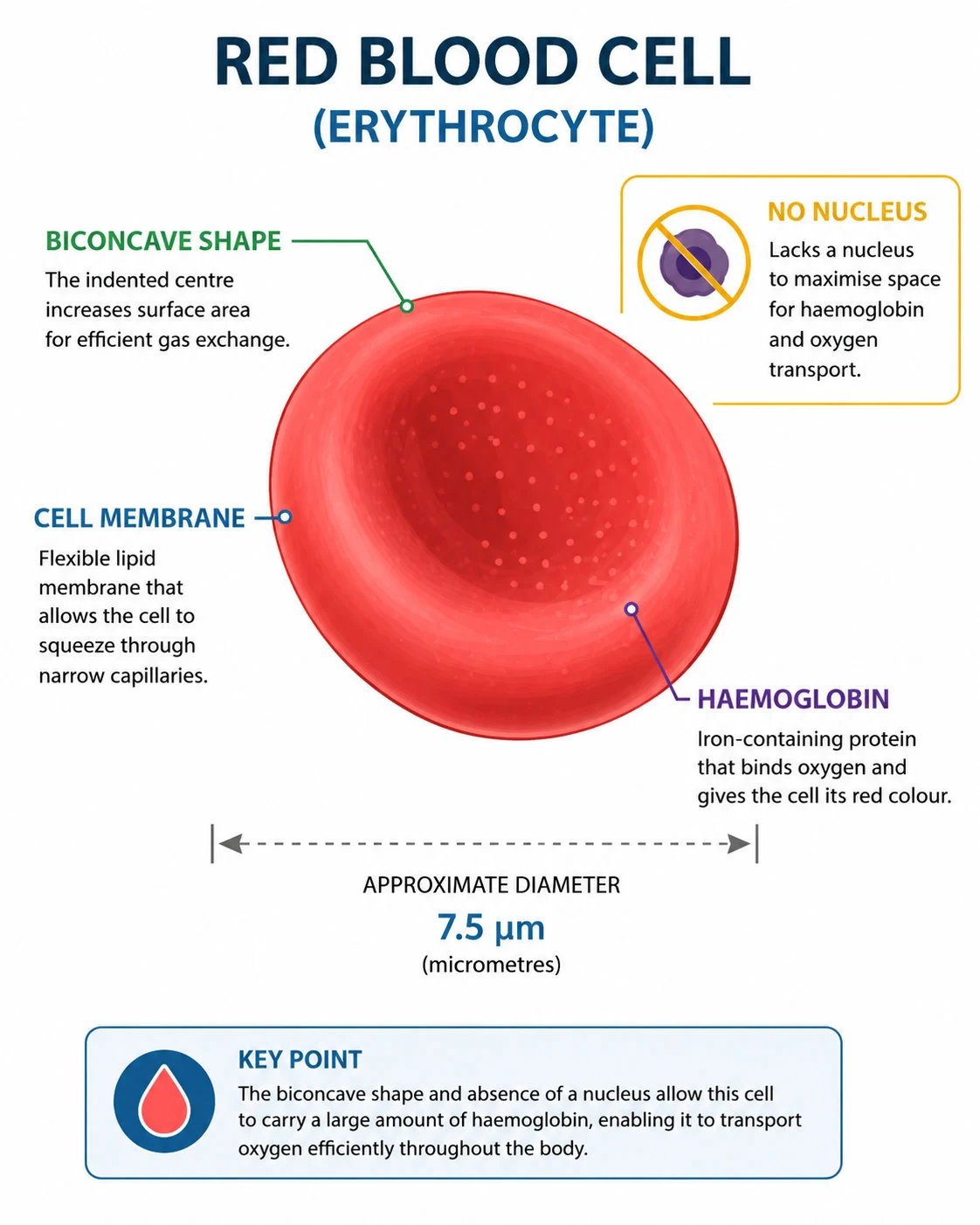
1
A stem cell divides in the bone marrow niche.
2
One daughter cell stays a stem cell.
3
The other commits to the red cell lineage.
4
Haemoglobin genes switch on.
5
The nucleus is lost as the cell matures.
6
A biconcave cell enters the blood.
Part 6 of 11Size and structure as adaptations
Size and structure as adaptations
Structure
- Structure specialised cells differ in shape and in the organelles they hold
- Cells that make a lot of protein have many ribosomes, rough ER and Golgi.
Red blood cell
- Red blood cell small enough to squeeze through capillaries
Active white blood cell
- Active white blood cell larger than a resting one, with room for rough ER and Golgi to make antibodies
Sperm
- Sperm a long tail and a narrow streamlined head that reduces resistance
Egg
- Egg the largest volume, to store food reserves for the embryo
Neuron
- Neuron a large cell body makes the proteins that maintain a very long axon, which can exceed 1 m
Muscle fibre
- Muscle fibre long and wide to generate force on contraction
Part 7 of 11Surface area to volume ratio
Metabolic rate
- Metabolic rate depends on the volume of the cell, as more cytoplasm needs more exchange
Exchange rate
- Exchange rate depends on the surface area of the membrane
Larger cells
- Larger cells volume rises faster than surface area, so SA:V falls
- Exchange becomes too slow, so wastes and heat build up.
- A cube of side 1 µm has SA:V of 6 and a cube of side 2 µm has SA:V of 3.
Division
- Division cells divide before growing too large
Single cells
- Single cells high SA:V and short diffusion distances, so simple diffusion is enough
Multicellular organisms
- Multicellular organisms large organisms evolved gas exchange, digestive and circulatory systems
Part 8 of 11Adaptations that increase SA:V
Red blood cell
- Red blood cell biconcave disc without a nucleus, thin so oxygen diffuses quickly
Proximal tubule cell
- Proximal tubule cell dense microvilli on the inner face and many mitochondria for active transport
Flattening
- Flattening shortens the diffusion distance
Folds and projections
- Folds and projections add membrane without much volume
Part 9 of 11Modelling SA:V with agar
- Nature of science
- models simplify reality but still allow predictions to be tested
1
Make agar with dilute alkali and indicator and cut it into cubes of 0.5, 1 and 2 cm sides.
2
Calculate the surface area, volume and SA:V of each cube.
3
Place each cube in an equal volume of dilute acid that is stronger than the alkali.
4
Record the time for the full colour change, or the depth of change after a fixed time.
5
Convert times to rates and plot rate against SA:V.
- Result
- the smallest cubes have the highest SA:V and change colour fastest
Part 10 of 11Applications and issues
Bone marrow transplant
- Bone marrow transplant donor multipotent cells restore blood production after leukaemia treatment
Embryonic stem cells
- Embryonic stem cells greater potency, but obtaining them destroys an embryo, which raises ethical debate
Tissue matching
- Tissue matching cells from the patient avoid rejection by the immune system
Risk
- Risk uncontrolled division could lead to tumours
Part 11 of 11More from the specification
1Stem cell therapy as a regenerative means
- Stem cell therapy as a regenerative means differentiating pluripotent embryonic stem cells provides a revolutionary biomedical means to replace damaged pancreatic or cardiac tissues.
2Cell differentiation
- The developmental process in multicellular eukaryotic cells where unspecialised stem cells express specific subsets of genes to acquire specialised structures.
3Division of labour
- Specialisation enables distinct cell types to perform specialized metabolic functions efficiently rather than carrying out every physiological task.
4Cellular adaptations
- Specialised cell types develop tailored structural adaptations.
- (e.g. biconcave shape and lack of nucleus in erythrocytes to carry oxygen)
5Metabolic surface requirements
- As cell volume increases, specialized folded membranes increase surface area to satisfy high metabolic exchange requirements.
6Adaptation
- The process by which populations become better suited to their environment.
Key terms
| Term | Meaning |
|---|---|
| Zygote | The single diploid cell formed when two gametes fuse, the start of a new organism. |
| Morphogen | A signalling chemical whose concentration gradient tells embryonic cells which genes to express. |
| Stem cell | A cell that can divide repeatedly and give rise to specialised cell types. |
| Differentiation | Specialisation of a cell by expression of a particular set of genes. |
| Stem cell niche | A location in the body where stem cells are kept and can proliferate. |
| Totipotent | Able to become any cell type, including extra-embryonic tissue. |
| Pluripotent | Able to become any body cell type but not extra-embryonic tissue. |
| Surface area to volume ratio | Surface area divided by volume, which falls as a cell grows. |
Avoid these mistakes
1
Saying specialised cells contain different genes — all cells have the same genome and differ in which genes are expressed
2
Saying a bigger cell is always better — a larger cell has a smaller SA:V and slower exchange
3
Mixing up pluripotent and totipotent — only totipotent cells can also form the placenta
4
Saying stem cells cannot divide after differentiation — a differentiated cell is no longer a stem cell
Marked practiceQuizzes for this lesson
Last updated:
Cambridge 9700 AS Biology
Core Formula
Magnification Triangle & Unit Conversion
Formula: M = I / A ⇔ A = I / M ⇔ I = M × A
Units: 1 mm = 1,000 μm = 1,000,000 nm.
Rule: Convert Image size (ruler mm) to μm by ×1,000 before dividing by Actual size.