B3.1Theme B — Form and function
Gas exchange — IB Biology SL Revision Notes & Topical Questions
10 min read 13 parts Lesson 7 of 13 2 quizzes
Curriculum Equation Key قوانين الرقم الهيدروجيني والاتزان الأيوني - pH & Acid-Base Equilibrium FormulasFast Exam Solution
pH = -log[H⁺] | pOH = -log[OH⁻] | pH + pOH = 14 | [H⁺][OH⁻] = 10⁻¹⁴
Word Equation & Conditions: الرقم الهيدروجيني = -لوغاريتم تركيز أيون الهيدروجين | pH + pOH = 14
Location & Specifications: الاتزان الأيوني، كيمياء 3 ثانوي، التحصيلي، و AP Chemistry.
Lesson summary
B3.1 Gas exchange — IB BIOLOGY SL notes: Explain how gas exchange surfaces, lungs and leaves are adapted for diffusion, and measure ventilation, transpiration and stomatal density.Gas exchange = the diffusion of oxygen and carbon dioxide between an organism and its environmentIn …
- Respiration compared with gas exchange
- Properties of a gas exchange surface
- Small unicellular organisms
- Airway order
- Blood supply
- Alveolar wall
Section 1 of 13Principles of gas exchange
1Gas exchange
Gas exchange the diffusion of oxygen and carbon dioxide between an organism and its environment
- In animals oxygen is taken in and carbon dioxide released.
- In plants carbon dioxide is absorbed and oxygen released in the day because of photosynthesis.
2Respiration compared with gas exchange
- Respiration compared with gas exchange respiration is a chemical process in all living cells and gas exchange is diffusion across a respiratory surface
3
Rate of diffusion
- It rises with a larger respiratory surface.
- It rises with a steeper concentration gradient.
- It falls as the diffusion distance increases.
4Properties of a gas exchange surface
- Properties of a gas exchange surface permeable, thin, moist and with a large surface area
- Gases must dissolve in the moisture before they diffuse.
Section 2 of 13Gas exchange in large organisms
Gas exchange in large organisms
Small unicellular organisms
- Small unicellular organisms an amoeba has a large SA:V and a short diffusion distance, so diffusion alone supplies enough oxygen
Larger organisms
- A smaller SA:V and a longer diffusion distance mean diffusion alone is not enough.
- The outer surface is built for protection and is not suitable for exchange.
- Active organisms need more oxygen per unit time.
- They need specialised gas exchange organs and transport.
Maintaining the concentration gradient
- A dense network of blood vessels gives a large surface area.
- Continuous blood flow carries oxygen away from the surface and carbon dioxide towards it.
- Ventilation with air in lungs or water in gills brings oxygen close to the surface and removes carbon dioxide.
Section 3 of 13Mammalian airways and alveoli
Airway order
- Airway order air moves through the nose and mouth, the trachea, the two bronchi, the bronchioles and then the alveoli
- The trachea has rings of cartilage that keep it open yet flexible.
- The bronchi have cartilage and smooth muscle and are lined with ciliated epithelium and mucus that remove trapped particles.
- Bronchioles have smooth muscle that dilates when more air is needed and constricts when an allergen is present.
Alveoli
- Alveoli clusters at the ends of the bronchioles, spread evenly through the lung
- Their large total area is about 70-100 m2.
- Type I pneumocytes are very flat and keep the diffusion distance short.
- Type II pneumocytes secrete surfactant, which lowers surface tension and stops the alveoli collapsing and sticking together.
- A moist lining lets gases dissolve before diffusing.
Blood supply
- Blood supply each cluster is surrounded by a capillary bed
- Deoxygenated blood arrives from a branch of the pulmonary artery.
- Oxygenated blood leaves in a branch of the pulmonary vein.
- This keeps the gradients of oxygen and carbon dioxide steep.
Alveolar wall
- Alveolar wall a single layer of epithelial cells and not a cell wall
Section 4 of 13Ventilation
Ventilation
Ventilation replacing old air in the lungs with fresh air, which maintains the concentration gradients
Pressure rule
- Pressure rule air always moves from higher to lower pressure, and a larger volume gives a lower pressure
| Feature | Inhalation | Exhalation |
|---|---|---|
| External intercostals | Contract | Relax |
| Internal intercostals | Relaxed | Contract only in forced exhalation |
| Diaphragm | Contracts and flattens | Relaxes and domes upward |
| Ribcage | Moves up and out | Moves down and in |
| Thorax volume | Increases | Decreases |
| Lung pressure | Falls below atmospheric | Rises above atmospheric |
| Abdominal muscles | Relaxed | Contract in forced exhalation |
| Elastic fibres in alveoli | Stretched | Recoil to push air out |
Antagonistic muscles
- Antagonistic muscles muscles can only pull, so pairs work in opposition
Resting exhalation
- Resting exhalation it is mostly passive because of the recoil of elastic fibres
Forced exhalation
- Forced exhalation internal intercostals pull the ribs down and in, and abdominal muscles push organs up against the diaphragm
Section 5 of 13Measuring lung volumes
1Spirometer
- Spirometer a chamber of water covered by a hinged lid that moves as the person breathes through a mouthpiece
- A chamber of air gives lung volumes in different conditions.
- A chamber of oxygen with soda lime to absorb carbon dioxide measures oxygen consumption.
- Traces are drawn on a revolving drum or by a computer.
2Tidal volume
Tidal volume the volume of air breathed in and out in normal breathing, about 0.5 dm3 at rest
3Inspiratory reserve volume
Inspiratory reserve volume maximum inspiratory level minus tidal volume
4Expiratory reserve volume
Expiratory reserve volume tidal volume minus maximum expiratory level
5Vital capacity
- VC = TV + IRV + ERV, typically 3-5 dm3 in an adult
6Ventilation rate
Ventilation rate breaths per minute
- Exercise raises both the tidal volume and the ventilation rate.
Section 6 of 13Leaf structure and gas exchange
Leaf structure and gas exchange
Epidermis
- Epidermis a single layer of tightly packed cells with a waxy cuticle
- The lower epidermis holds most stomata.
- Each stoma has two guard cells that open it when turgid and close it when flaccid.
Mesophyll
- Mesophyll parenchyma cells with chloroplasts
- Palisade mesophyll lies beneath the upper epidermis and is the main site of photosynthesis.
- Spongy mesophyll has large air spaces for gas exchange.
Vascular tissue
- Vascular tissue veins with xylem carrying water and minerals to the leaf and phloem carrying sugars away
| Tissue | Location | Role in gas exchange |
|---|---|---|
| Waxy cuticle | Covers the upper epidermis | Cuts water loss so exchange occurs through stomata |
| Palisade mesophyll | Under the upper epidermis | Main photosynthesis site that uses CO2 |
| Spongy mesophyll | Middle to lower leaf | Air spaces allow gas diffusion and increase surface area |
| Lower epidermis | Underside | Holds most stomata where it is cooler, reducing water loss |
| Guard cells | Around each stoma | Open or close the pore |
| Veins | Within the mesophyll | Xylem supplies water for photosynthesis and transpiration |
Section 7 of 13Transpiration
Transpiration
Transpiration loss of water vapour from the leaf by diffusion through open stomata
- It is the unavoidable consequence of gas exchange.
- Water vapour leaves by diffusion, not osmosis.
- Closing the stomata reduces water loss but also reduces photosynthesis.
Benefits
- Benefits evaporative cooling, uptake of mineral ions by the transpiration stream and turgor that supports leaves and stems
- Turgid leaves do not wilt, so their surface area for photosynthesis stays large.
Factors increasing the rate
- Air movement removes humid air near the stomata and steepens the gradient.
- Higher temperature gives more kinetic energy, up to a point where stomata close.
- Higher light intensity opens the stomata, until all are open and the rate levels off.
- Lower humidity gives a steeper gradient, and in saturated air there is no net water loss.
Section 8 of 13Measuring transpiration with a potometer
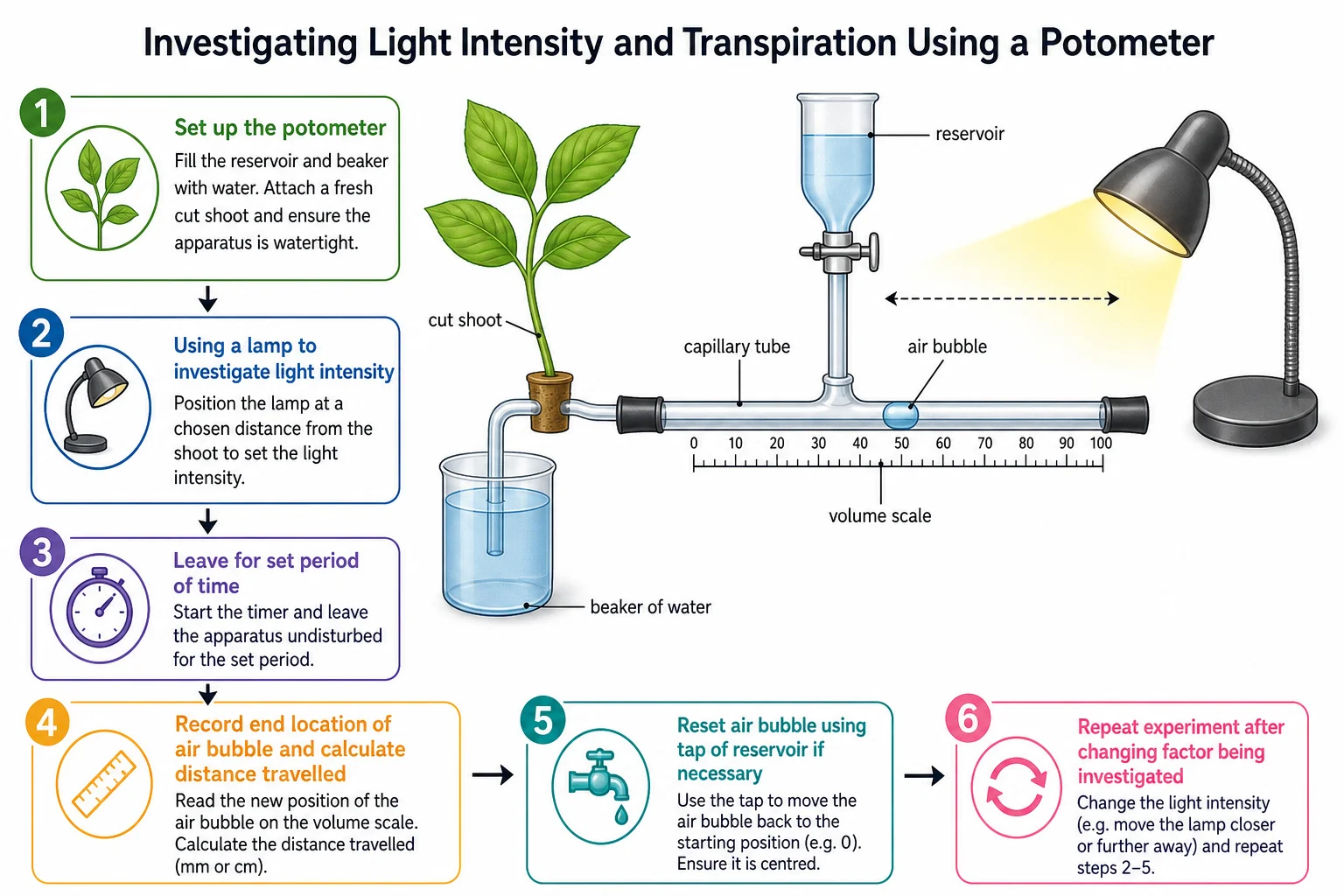
Potometer
- Potometer measures the rate of water uptake of a shoot, which stands for the rate of transpiration
- Only a tiny fraction of the water taken up is used in photosynthesis.
- A bubble potometer tracks the movement of an air bubble along a water-filled tube, or the time for it to move a set distance.
- A mass potometer records the loss of mass of a water-filled tube attached to the shoot.
Varying one factor
- Air movement by a fan on different settings.
- Humidity by a plastic bag or a humidifier.
- Light intensity by a lamp at different distances.
- Temperature by a heater or air conditioner and a probe.
Control
- Control keep every other variable constant, as a heater can also change light and humidity
Section 9 of 13Plan diagram of a leaf
Plan diagram of a leaf
Structures to identify
- Structures to identify cuticle, upper and lower epidermis, guard cells, stomata, palisade mesophyll, spongy mesophyll, air spaces, chloroplasts and vascular bundles
Drawing rules
- Draw tissue layers enclosed by lines and never individual cells.
- Use a sharp pencil and clear continuous lines with no shading.
- Make the drawing accurate, large and based on what is seen.
Labelling rules
- Use a ruler for label lines.
- No arrowheads and no crossing lines.
- Write labels horizontally.
Section 10 of 13Stomatal density
- Stomatal density = the number of stomata per unit area of leaf
- It shows the likely response to a dry spell and how the plant would behave if moved.
1
Paint clear nail varnish on the lower surface of a leaf.
2
Let it dry fully, for about 5 minutes.
3
Peel the film off with clear tape and stick it on a microscope slide.
4
Count the stomata in a field of view containing 15-100, counting partly visible ones at the edge.
5
Repeat for at least three fields and calculate the mean.
6
Measure the diameter of the field of view with a stage micrometer at the same magnification.
7
Calculate the area of the field as πr2 and the density as the mean count divided by the area.
Reliability
- Reliability repeats allow anomalies to be removed and a reliable mean to be calculated
Limitations
- Limitations solvent-based varnish can damage cells and not all species give a strong imprint
Section 11 of 13More from the specification
1Alveolar adaptations in mammalian lungs
- Extremely large surface area, thin single-cell squamous epithelium, and rich capillary networks maximize diffusion rates.
2Gas exchange vs cellular respiration
- Gas exchange is the passive physical diffusion of O2 and CO2 across respiratory surfaces, distinct from biochemical ATP generation.
3Stomatal regulation in plants
- Paired guard cells take in water molecules by osmosis to swell and open stomatal apertures, controlling transpiration and CO2 entry.
4Determining stomatal density
- Microscopic measurements using leaf epidermal impressions allow quantification of stoma count per unit surface area.
Section 12 of 13Key terms
| Term | Meaning |
|---|---|
| Gas exchange | The diffusion of oxygen and carbon dioxide between an organism and its environment. |
| Alveolus | A tiny air sac in the lung where gas exchange takes place. |
| Surfactant | A substance from type II pneumocytes that lowers surface tension in the alveoli. |
| Tidal volume | The volume of air breathed in and out during normal breathing. |
| Vital capacity | The maximum volume of air exhaled after a deep breath, equal to TV + IRV + ERV. |
| Stoma | A pore in the leaf epidermis surrounded by two guard cells. |
| Transpiration | The loss of water vapour from a leaf through open stomata. |
| Potometer | An instrument that measures the rate of water uptake by a shoot. |
Section 13 of 13Exam technique
1
Confusing respiration with gas exchange — respiration is a chemical process and gas exchange is diffusion across a surface
2
Saying transpiration is osmosis — water vapour diffuses out through the stomata
3
Saying expiration at rest needs muscle contraction — it is mostly passive recoil of elastic fibres
4
Saying the potometer measures transpiration exactly — it measures water uptake as an estimate
Marked practiceQuizzes for this lesson
Last updated:
\n