Lesson summary
Complete PDF with figures and original page layoutPage 1 OCR A Level Chemistry A Your notes Carbonyl Compounds Contents Reactions of Carbonyl Compounds Testing for Carbonyl Compounds Page 2 Reactions of Carbonyl Compounds …
Part 1 of 7Aldehydes and ketones
Aldehydes and ketones
Carbonyl group
- C=O, in both aldehydes and ketones, which differ in the groups bonded to the carbonyl carbon
Aldehydes
- Aldehydes the carbonyl group is at the end of the chain
- The carbonyl carbon is always carbon 1, so no locant is written.
- The simplest is methanal, HCHO.
Ketones
- Ketones the carbonyl group is in the middle of the chain, with an alkyl group on each side
- The simplest is propan-2-one, CH3COCH3.
Part 2 of 7Oxidation of alcohols and carbonyls

Oxidation of alcohols and carbonyls
Primary alcohol to aldehyde
- Primary alcohol to aldehyde set up to distil off the aldehyde as it forms
Primary alcohol to carboxylic acid
- Primary alcohol to carboxylic acid heat under reflux
- The aldehyde evaporates, condenses and drops back to be oxidised further.
Oxidising agent
- Oxidising agent acidified potassium dichromate, K2Cr2O7 with H2SO4, for all these oxidations
Aldehydes
- Aldehydes easily oxidised to carboxylic acids
Ketones
- Ketones resistant to oxidation, so secondary alcohols give ketones only
- Ketones have no readily available hydrogen on the carbonyl carbon.
- A very strong oxidising agent would break a C–C bond destructively.
Part 3 of 7Nucleophilic addition: the carbonyl group

Nucleophilic addition: the carbonyl group
Polarity
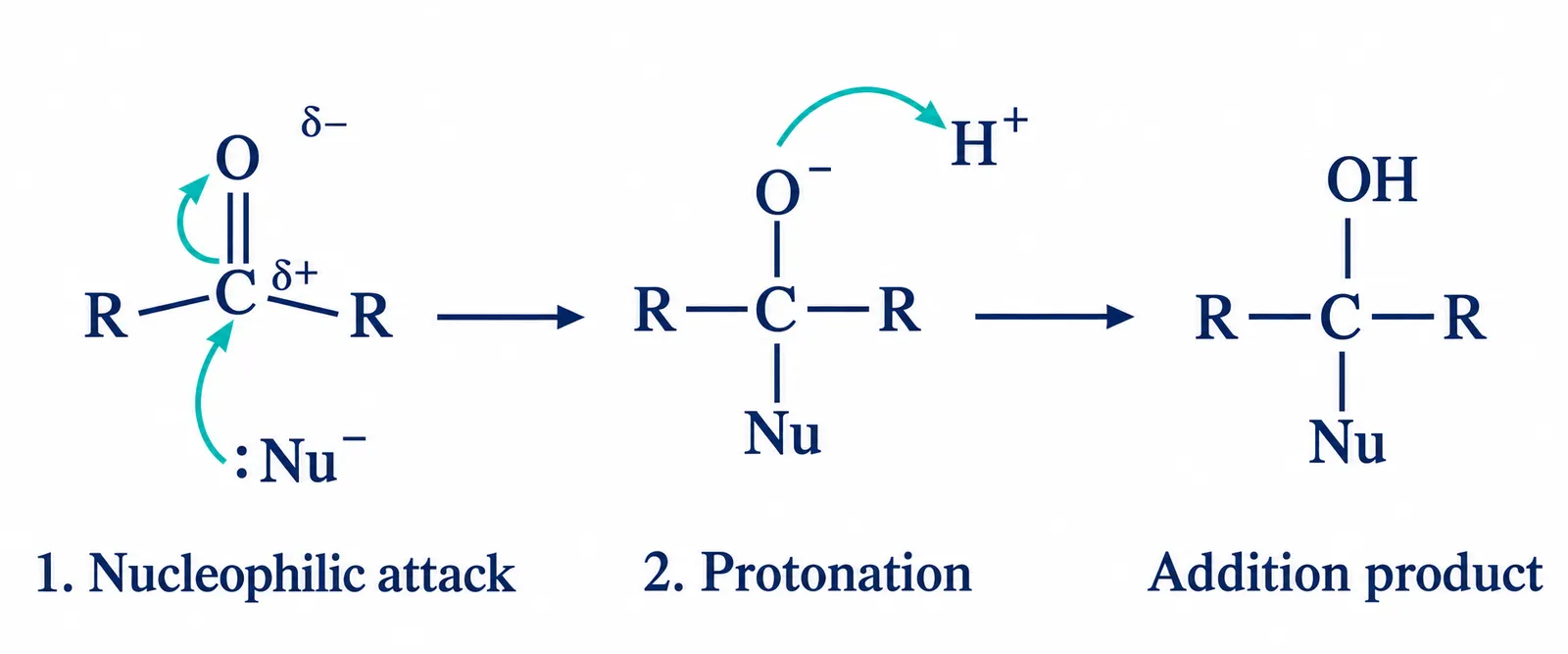
- Polarity oxygen is more electronegative than carbon, so the carbonyl carbon is δ+ and the oxygen δ−
Reactivity
- Reactivity the δ+ carbon is attacked by nucleophiles such as the cyanide ion
General mechanism
(aldehydes and ketones)
- The nucleophile attacks the carbonyl carbon, forming a negatively charged intermediate.
- The oxygen then quickly picks up a proton.
Part 4 of 7Addition of HCN
Mechanism
- Mechanism nucleophilic addition in two steps
- Step 1: the cyanide ion attacks the carbonyl carbon, forming a negatively charged intermediate.
- Step 2: the negative oxygen reacts with H+ (from HCN, water or dilute acid) to form a 2-hydroxynitrile such as 2-hydroxypropanenitrile.
Importance
- Importance it adds a carbon to the chain, increasing chain length
Naming
- Naming the nitrile is the priority group and is carbon 1
- (suffix -nitrile)
- The hydroxyl group is named with the prefix hydroxy-, not -ol.
Part 5 of 7Reduction of carbonyls
Products
- Products aldehydes are reduced to primary alcohols and ketones to secondary alcohols
Reducing agent
- Reducing agent sodium tetrahydridoborate, NaBH4 , in aqueous solution
- (sodium borohydride)
- It generates the hydride ion nucleophile, :H−, so the reaction is nucleophilic addition.
- H− is attracted to the carbonyl carbon but repelled by the electron-rich C=C, so it does not reduce C=C bonds.
Carboxylic acids
- Carboxylic acids reduced to primary alcohols
- In theory this passes through the aldehyde, but in practice the acid goes straight to the primary alcohol;
- check the wording of the question.
Part 6 of 7Testing with 2,4-DNPH


Test for carbonyls
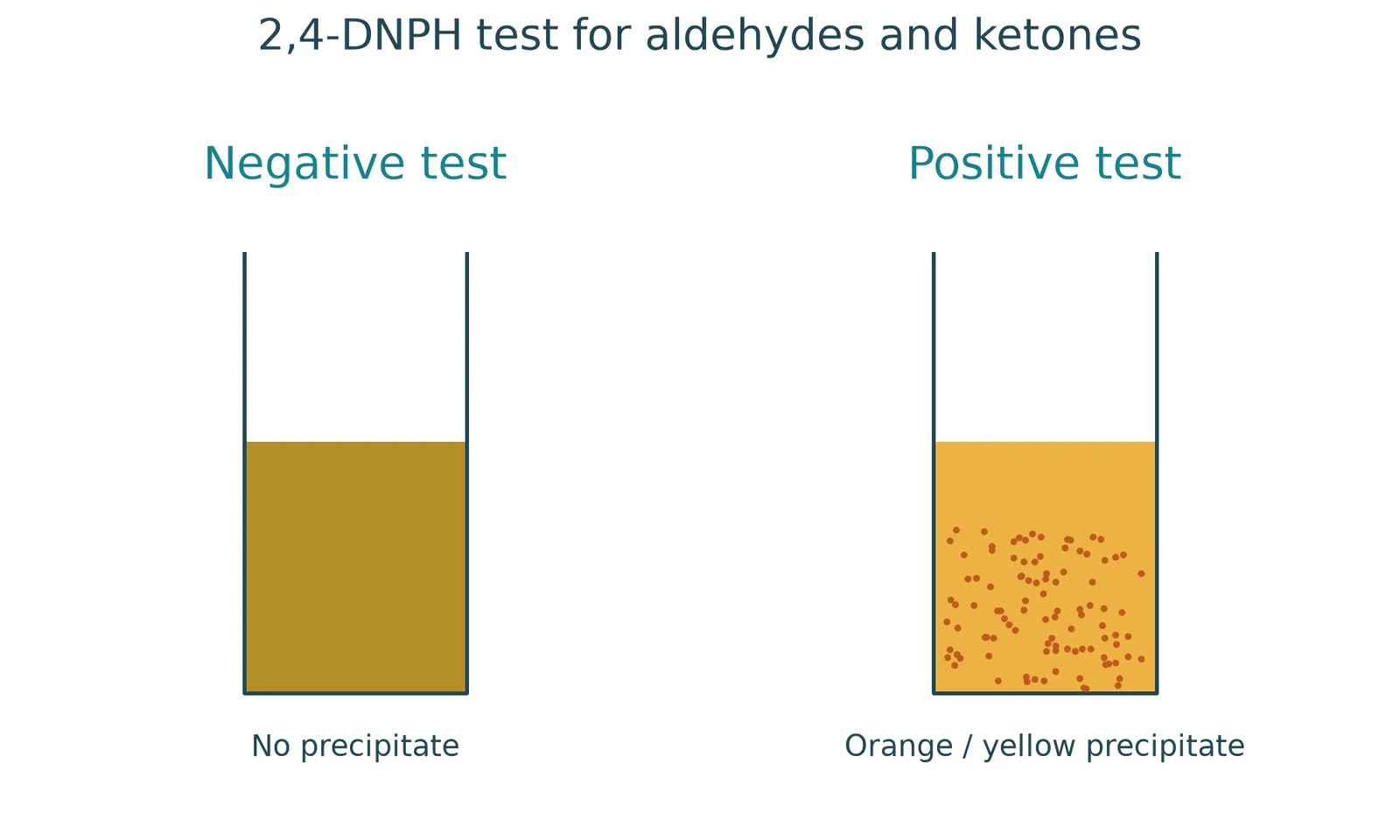
- 2,4-dinitrophenylhydrazine (2,4-DNPH) detects the C=O group in aldehydes and ketones
- The carbonyl group undergoes a condensation reaction, in which two molecules join and a small molecule such as H2O is eliminated.
Positive result
- Positive result a deep orange precipitate
- It can be purified by recrystallisation.
- Its melting point is compared with literature values to identify the specific aldehyde or ketone.
Specificity
- Specificity carboxylic acids and esters do not give a positive result
Part 7 of 7Testing with Tollens reagent


Reagent
- Tollens reagent contains the colourless silver(I) complex [Ag(NH3)2]+, formed by adding aqueous ammonia to silver nitrate
- (ammoniacal silver nitrate)
Aldehyde
- Aldehyde on gentle warming it is oxidised to a carboxylic acid
- Ag+ acts as the oxidising agent and is reduced to silver metal, forming a silver mirror, the positive result.
Ketone
- Ketone no reaction and no silver mirror, a negative result because ketones cannot be oxidised
Use together
- Use together use 2,4-DNPH to show a carbonyl is present, then Tollens reagent to distinguish aldehyde from ketone
Key terms
| Term | Meaning |
|---|---|
| Carbonyl group | The C=O functional group found in aldehydes and ketones |
| Nucleophilic addition | Attack of a nucleophile on a δ+ carbon followed by addition of H+ |
| 2,4-DNPH | A reagent giving an orange precipitate with aldehydes and ketones |
| Tollens reagent | Ammoniacal silver nitrate that forms a silver mirror with aldehydes |
| Condensation reaction | Two molecules join with elimination of a small molecule |
| Hydroxynitrile | A compound with both –OH and –CN groups |
Avoid these mistakes
1
Saying ketones are easily oxidised — they resist oxidation, unlike aldehydes
2
Saying NaBH4 reduces C=C bonds — the hydride is repelled by the C=C
3
Naming a hydroxynitrile with -ol — the hydroxy- prefix is used as nitrile has priority
4
Using 2,4-DNPH to distinguish an aldehyde from a ketone — use Tollens reagent