Curriculum
OCR A Level Chemistry A H432 — Complete Chapter Practice
1. Development of Practical Skills in Chemistry
0/18
2. Foundations in Chemistry
0/24
3. Periodic Table and Energy
0/24
4. Core Organic Chemistry
0/32
5. Physical Chemistry and Transition Elements
0/49
6. Organic Chemistry and Analysis
0/35
-
6.1 Benzene and Aromatic Compounds
 Preview
-
OCR A Level Chemistry A Notes — 6.1 Benzene and Aromatic Compounds
Preview
-
6.1.2 Electrophilic Substitution
Preview
-
6.1.3 Phenol
Preview
-
6.1.4 Directing Effects
Preview
-
6.2 Carbonyl Compounds
Preview
-
6.2.1 Reactions of Carbonyl Compounds
Preview
-
6.2.2 Testing for Carbonyl Compounds
Preview
-
6.3 Carboxylic Acids and Esters
Preview
-
6.3.3 Acyl Chlorides
Preview
-
6.4 Nitrogen Compounds
Preview
-
6.4.1 Amines
Preview
-
6.4.2 Preparing Amines
Preview
-
6.4.3 Amino Acids
Preview
-
6.4.4 Amides
Preview
-
6.5 Optical Isomerism
Preview
-
6.5.1 Optical Isomers
Preview
-
6.5.2 Identification of Chiral Centres
Preview
-
6.6 Polymers
Preview
-
6.6.1 Condensation Polymers
Preview
-
6.6.2 Polymer Repeat Units
Preview
-
6.7 Extending Carbon Chains
Preview
-
6.7.1 Nitriles
Preview
-
6.7.2 Substituted Aromatic Carbon-carbon Bond Formation
Preview
-
6.8 Organic Synthesis
Preview
-
6.8.2 Synthetic Routes
Preview
-
6.9 Analytical Techniques (Part 1)
Preview
-
6.9 Analytical Techniques (Part 2)
Preview
-
6.9 Analytical Techniques (Part 3)
Preview
-
6.9.1 Thin Layer Chromatography, TLC
Preview
-
6.9.2 Gas Chromatography, GC
Preview
-
6.9.3 Qualitative Analysis
Preview
-
6.9.4 Carbon-13 NMR
Preview
-
6.9.5 Proton NMR
Preview
-
6.9.6 Combined Techniques
Preview
Text lesson
OCR A Level Chemistry A Notes — 6.1 Benzene and Aromatic Compounds
6.1 Benzene and Aromatic Compounds — directing effects: predict where electrophilic substitution occurs on a benzene ring that already has a substituent.
Why position matters
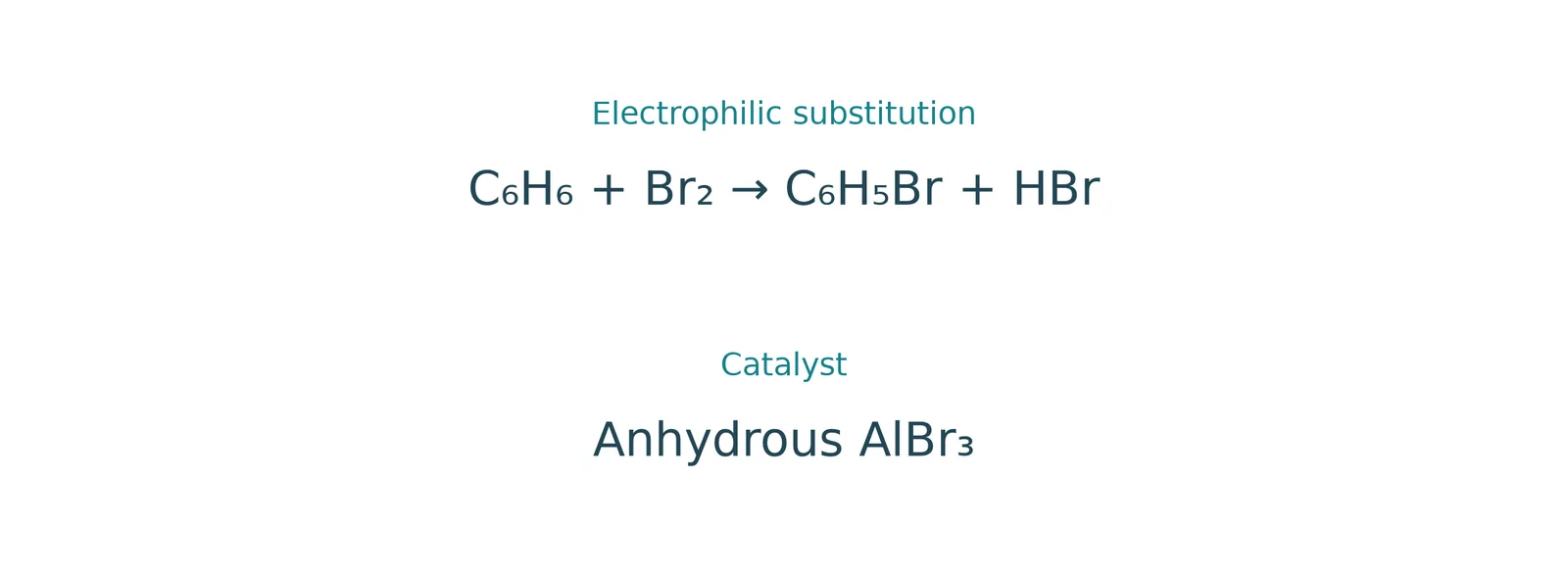
In electrophilic substitution, an electrophile replaces a hydrogen atom on an aromatic ring.
- If the ring already carries a group, the incoming electrophile can attach at different positions.
- Number the carbon bearing the original group as 1; the 2 and 4 positions are ortho and para, while the 3 position is meta.
The existing group changes electron density around the ring. It can also change how readily the ring reacts. Predicting both the reaction rate and the favoured position helps plan a synthesis.

Electron-donating groups
Electron-donating groups, such as –CH3, –OH and –NH2, increase electron density in the ring’s π system. They usually activate the ring toward electrophilic substitution and favour substitution at the 2 and 4 positions relative to the original group.
Methylbenzene example
During bromination of methylbenzene, the methyl group directs the incoming bromine mainly to positions 2 and 4. The products include 2-bromotoluene and 4-bromotoluene, with bromine on the ring at those positions. Nitration follows the same positional pattern.
Electron-withdrawing groups
An electron-withdrawing group, such as –NO2, removes electron density from the aromatic π system. The ring becomes less reactive toward electrophiles. A nitro group directs further substitution mainly to the 3 position relative to itself.
Nitrobenzene example
Bromination of nitrobenzene gives mainly 3-bromonitrobenzene. The nitro group both deactivates the ring and favours the meta position. State both effects when explaining the product distribution.
Use the directing rule
Identify the group already on the ring, decide whether it donates or withdraws electron density, then number possible substitution positions from that group. Donating groups in this lesson point to 2 and 4; the nitro group points to 3.
Directing effects indicate the major products rather than a guarantee that only one product forms. If two different directing groups are present, more detailed analysis may be needed to predict the dominant position.
-
1. Which positions are favoured by a methyl group? 2. Why does –NO2 make a benzene ring less reactive? 3. Predict the major ring position for bromination of nitrobenzene. 4. Explain why an –OH group tends to direct an electrophile to positions 2 and 4.