6.6Organic Chemistry and Analysis
Polymers — OCR A Level Chemistry A H432 Revision Notes & Topical Questions
5 min read 9 parts Lesson 19 of 33
Lesson summary
Complete PDF with figures and original page layoutPage 1 OCR A Level Chemistry A Your notes Polymers Contents Condensation Polymers Polymer Repeat Units Page 2 Condensation Polymers …
Section 1 of 9Condensation polymerisation

Addition vs condensation
- Addition vs condensation addition polymers come from C=C monomers, but condensation polymers form by repeated condensation reactions between monomers
- Each link eliminates a small molecule, which for natural condensation polymers is water.
Identification
- Identification the monomers are linked by ester or amide bonds
Monomer combinations
- Monomer combinations dicarboxylic acids with diols, dicarboxylic acids with diamines, or amino acids
Section 2 of 9Polyesters


Polyester
Polyester a polymer whose monomers are linked by ester bonds
- It forms from a diol (two –OH groups) and a dicarboxylic acid (two –COOH groups).
- The functional groups at both ends allow the chain to keep growing.
- A hydrogen from the diol and the –OH of the –COOH are lost as H2O.
Example
- Example poly, PET, also known as Terylene or Dacron
- (ethylene terephthalate)
Hydroxycarboxylic acids
- Hydroxycarboxylic acids a single monomer with an –OH at one end and a –COOH at the other can form a polyester
- Both required groups come from the same monomer.
Section 3 of 9Polyamides


Polyamide
Polyamide a polymer with repeat units joined by amide (peptide) links, –CONH–
Monomers
- Monomers a diamine (two –NH2 groups) and a dicarboxylic acid
- (two –COOH groups)
- A dioyl dichloride (two –COCl groups) can replace the acid.
- It is more reactive but more expensive.
Formation
- Formation each amide link forms with the loss of a small molecule
- (water with an acid, HCl with a dioyl chloride)
Section 4 of 9Proteins from amino acids

Proteins
Proteins vital biological polymers made of amino acid monomers with varied functions in the body
Amino acids
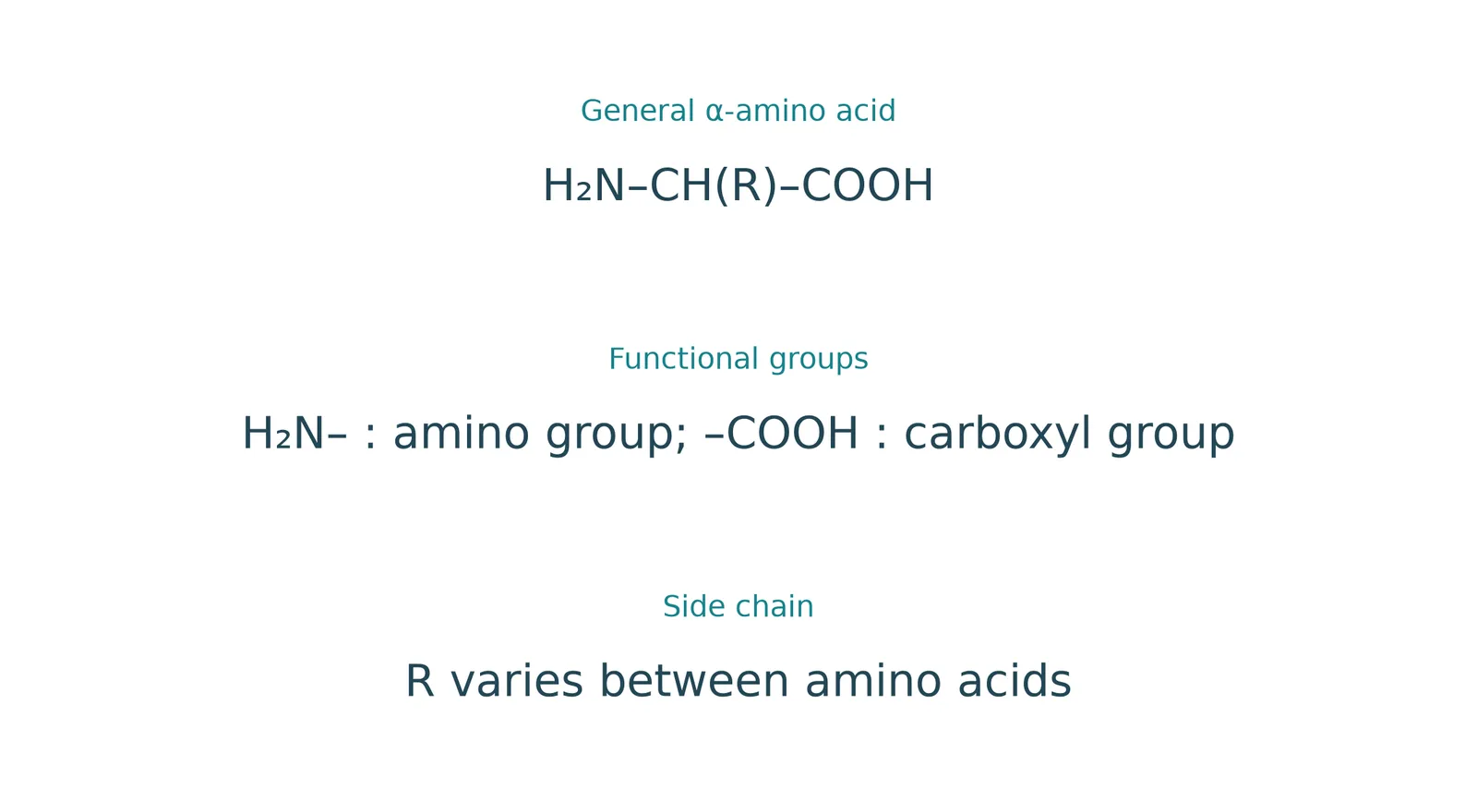
- Amino acids each has an amine group, an acid group and a unique R group
- The R group identifies each amino acid.
- Each is given a three-letter name, e.g. glutamine is Gln.
Peptides
- Peptides the –NH2 of one amino acid joins the –COOH of another
- Two amino acids form a dipeptide.
- More than two form a polypeptide.
Section 5 of 9Hydrolysis and biodegradability
Biodegradability
- Biodegradability polyesters and polyamides can be broken down by hydrolysis, a major advantage over polyalkenes
- In landfill they break down easily and the products can be used elsewhere.
Hydrolysis
Hydrolysis breakdown of a molecule using water
Polyamides
(e.g. Kevlar)
- Acid hydrolysisheating with dilute acid such as HCl as catalyst gives a dicarboxylic acid and ammonium ions.
- Alkaline hydrolysisheating with hydroxide ions such as NaOH gives the sodium salt of the dicarboxylic acid and the diamine.
Polyesters
(e.g. PET)
- Acid hydrolysis forms the diol and the dicarboxylic acid.
- Alkaline hydrolysis forms the diol and the dicarboxylic acid salt.
Section 6 of 9Repeat units of addition polymers
Repeat unit
Repeat unit the smallest group of atoms that, connected one after another, makes the polymer chain
- It is shown in square brackets.
Rule
- Rule for polymers from one alkene monomer (poly(ethene), PVC) the repeat unit equals the monomer with C=C changed to C–C
Repeat units of addition polymers
Find the repeat unit, which has two carbons in the main chain.
Change the C–C back to C=C.
Name the monomer.
- Examples
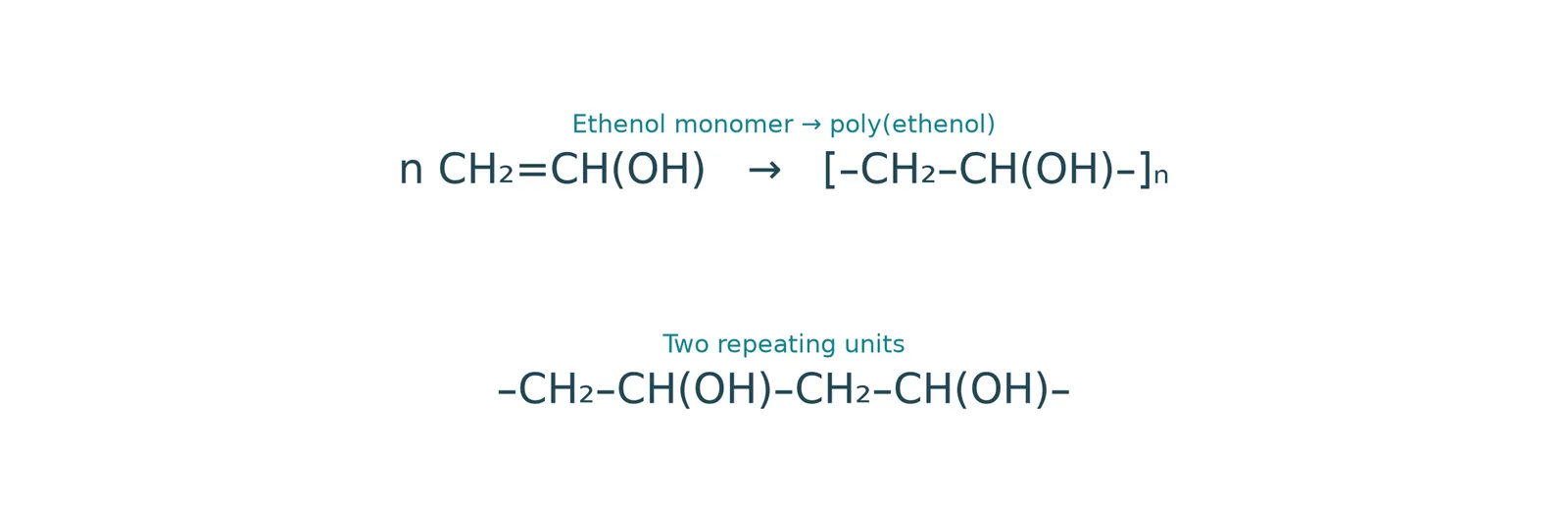
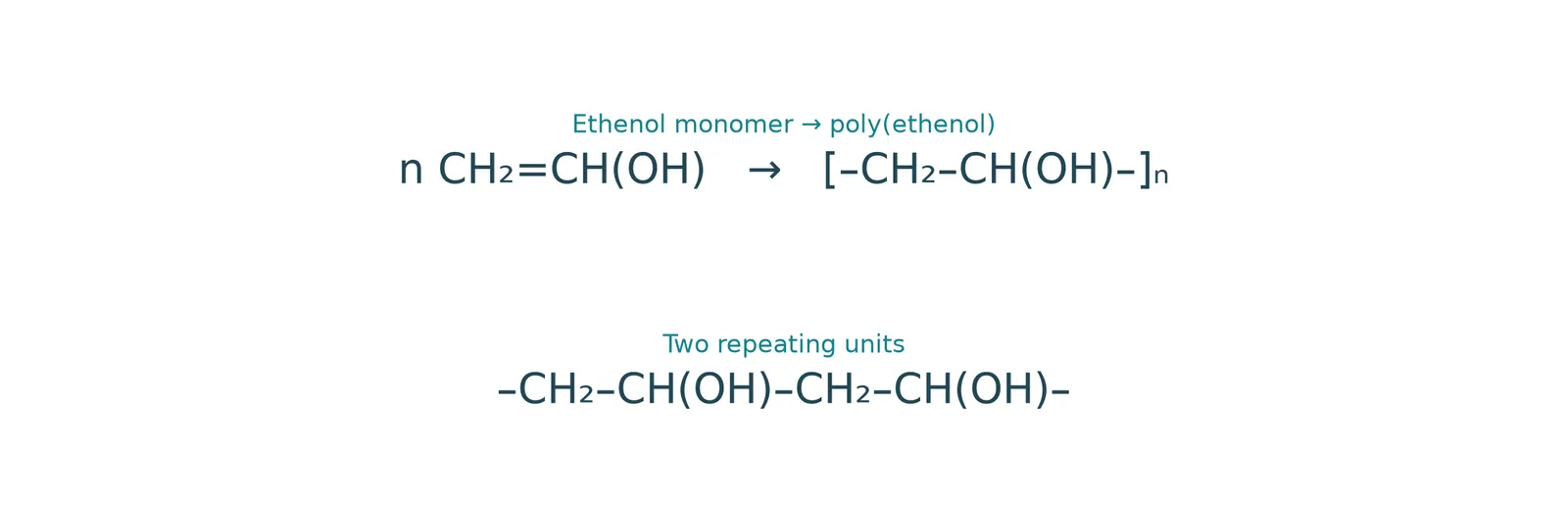
- Ethenol, CH(OH)=CH2, gives poly(ethenol) with repeat unit CH(OH)–CH2.
- A repeat unit containing a COOH substituent comes from prop-2-enoic acid.
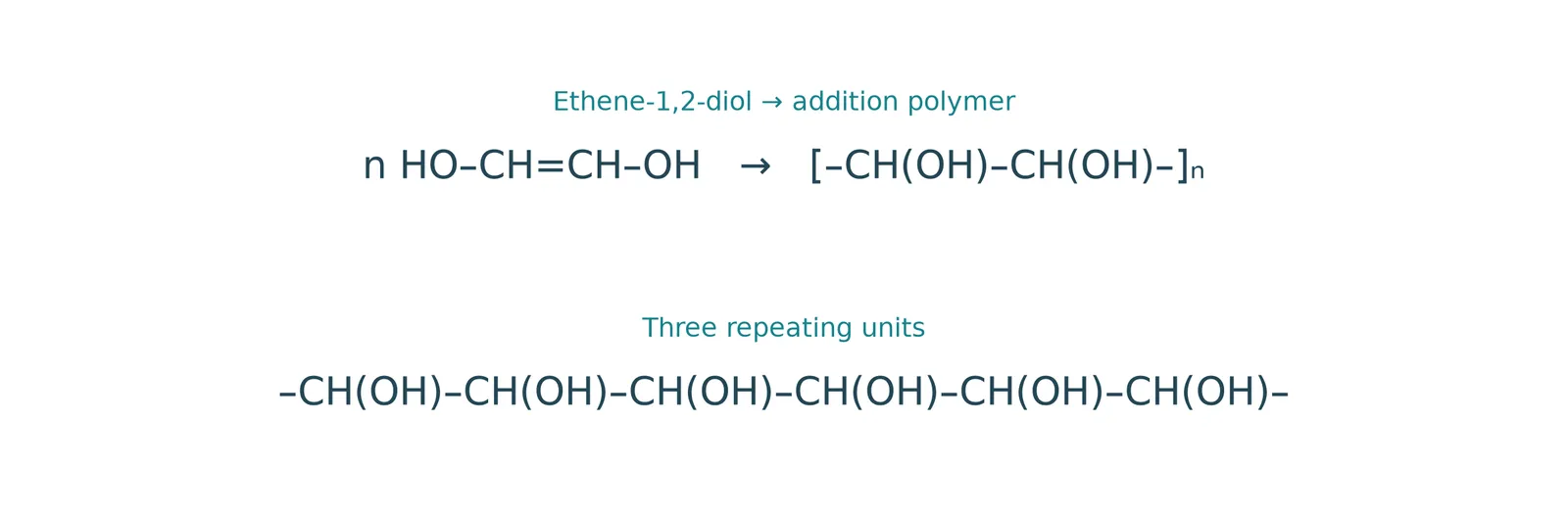
- Ethene-1,2-diol gives repeat unit CH(OH)–CH(OH).
Section 7 of 9Repeat units of condensation polymers
- Identifying the type from the link
- A chain of carbon atoms means an addition polymer.
- An ester link means a polyester, formed by condensation polymerisation.
- An amide (peptide) link means a polyamide, formed by condensation polymerisation.
Repeat units of condensation polymers
Locate the ester or amide links in the chain.
The repeat unit is the section between equivalent positions, containing one unit from each monomer.
Break each ester or amide link and add back water (or the eliminated small molecule) to restore the monomers: –COOH and –OH for esters, –COOH and –NH2 for amides.
Section 8 of 9Key terms
| Term | Meaning |
|---|---|
| Condensation polymerisation | Polymerisation in which monomers join with elimination of a small molecule |
| Polyester | A polymer with ester links, formed from a diol and a dicarboxylic acid |
| Polyamide | A polymer with amide links, formed from a diamine and a dicarboxylic acid |
| Peptide link | The amide link between amino acids |
| Dipeptide | Two amino acids joined by a peptide link |
| Repeat unit | The smallest group of atoms repeated along a polymer chain |
Section 9 of 9Exam technique
1
Giving the repeat unit with C=C bonds — it contains C–C single bonds
2
Forgetting the small molecule eliminated in condensation polymerisation
3
Saying polyamides and polyesters are non-biodegradable — hydrolysis allows them to break down
4
Confusing the monomer and repeat unit of an addition polymer
Last updated:
\n