2.1Unit 2 — Multicellular Organisms
Producing New Cells and Mitosis — SQA National 5 Biology Revision Notes & Topical Questions
5 min read 4 parts Lesson 1 of 39
Part 1 of 2The process and stages of mitosis

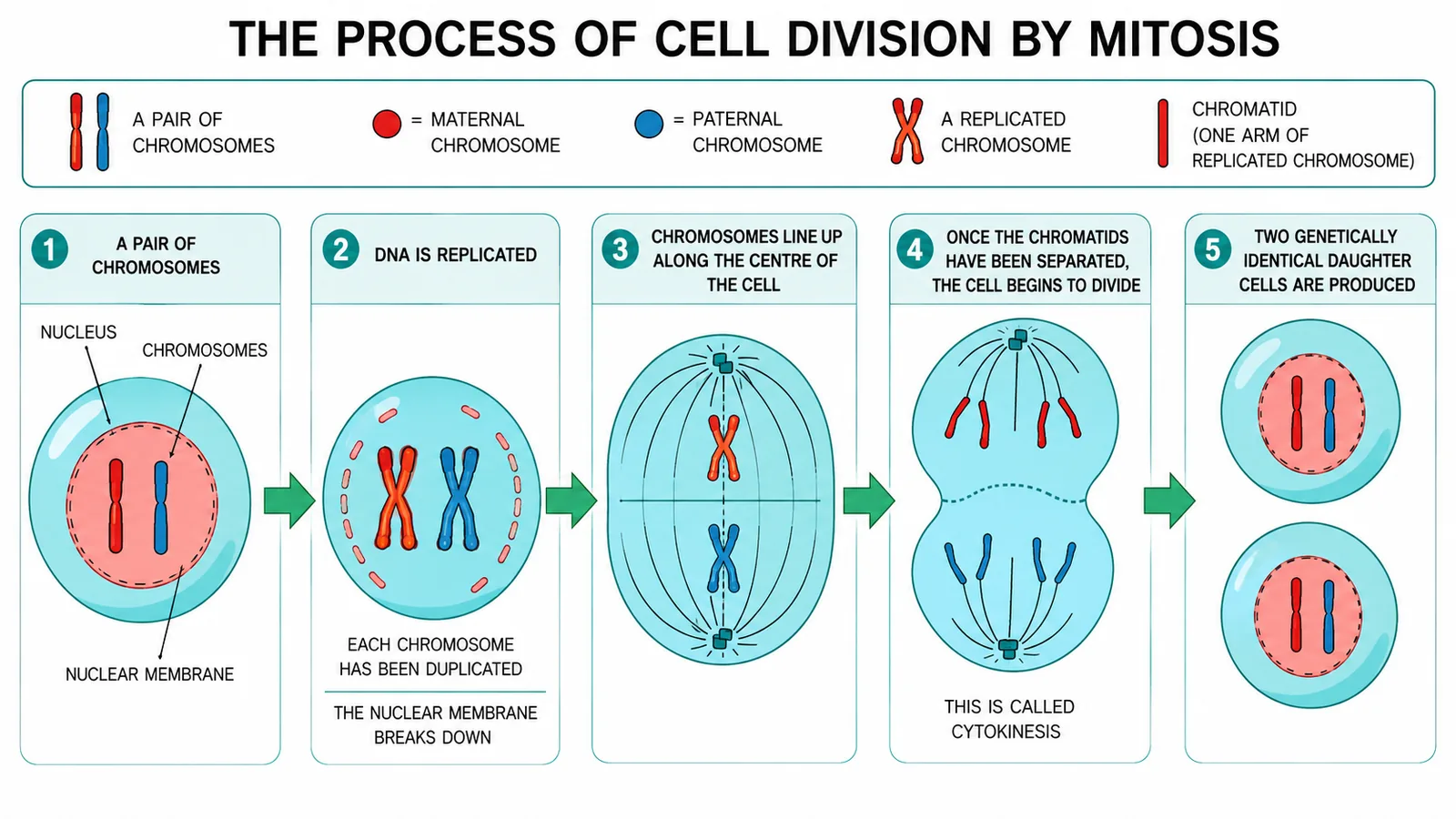


1
Purpose of mitosis
Provides new cells for growth, repair of damaged tissues, and replacement of dead cells.
2
Chromosome complement
- Most animal and plant cells are diploid (2n): they possess two matching sets of chromosomes.
- Mitosis maintains the diploid chromosome complement, ensuring each daughter cell receives an identical, complete copy of genetic information necessary for normal cellular functioning.
3
Stages of mitosis in sequence
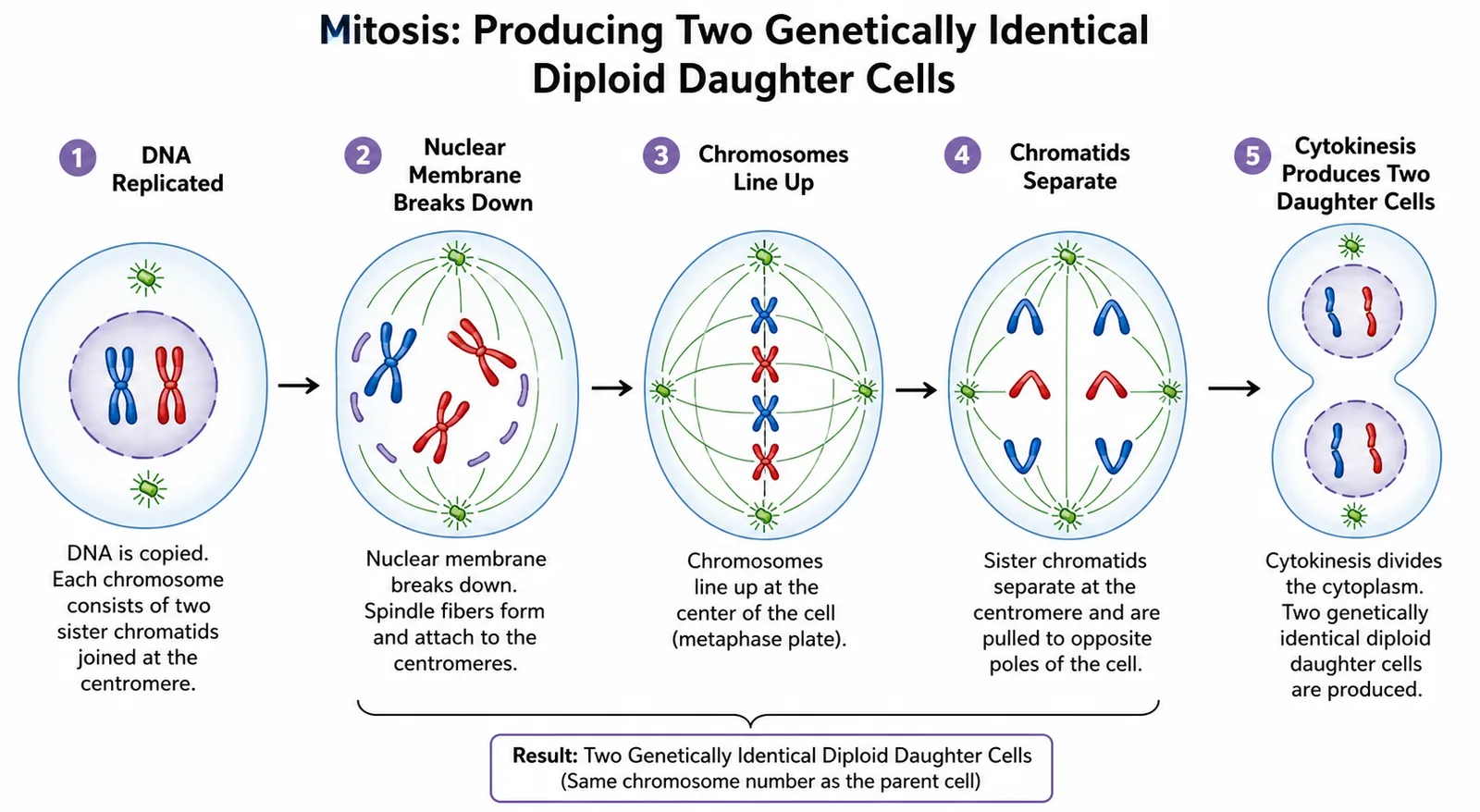
- 1. DNA ReplicationPrior to division, chromosomes replicate into two identical sister chromatids joined at a centromere.
- Chromosomes condense and become visible under a microscope.
- 2. Nuclear Membrane DisintegrationThe nuclear membrane breaks down.
- Spindle fibres form and attach to the centromere of each replicated chromosome.
- 3. Equator AlignmentChromosomes line up single-file along the equator (middle) of the dividing cell.
- 4. Chromatid SeparationSpindle fibres contract, pulling sister chromatids apart to opposite poles of the cell (now referred to as daughter chromosomes).
- 5. Nuclear Reformation & CytokinesisNuclear membranes reform around each set of separated chromosomes.
- The cytoplasm divides, producing two genetically identical diploid daughter cells.
Part 2 of 2Stem cells and cellular differentiation

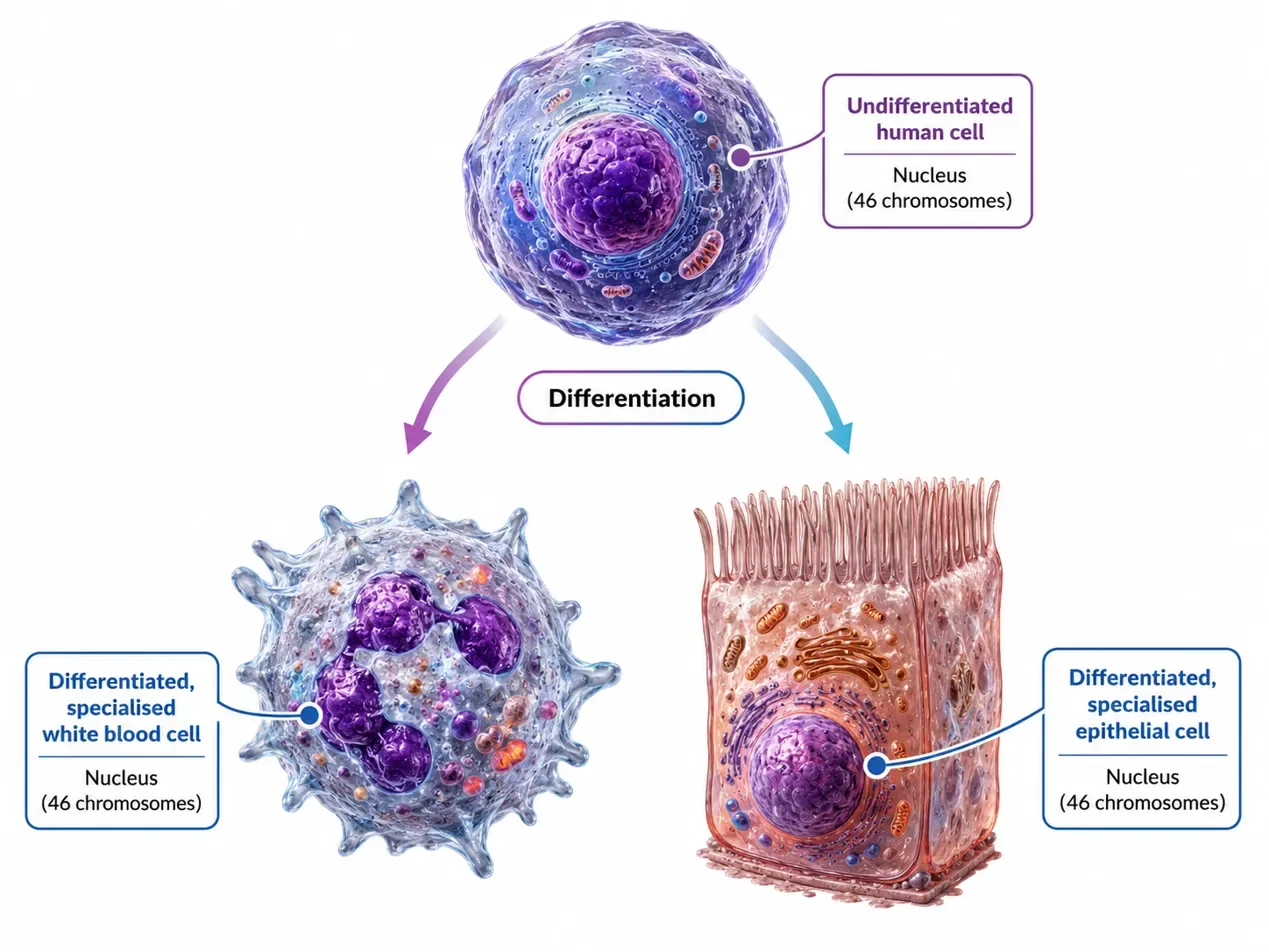

Stem cells
- Unspecialised animal cells that have the capacity to divide repeatedly by mitosis while remaining unspecialised, and can differentiate into specialised cells of one or more types.
- Involved in growth and tissue repair.
Types of stem cells
- Embryonic stem cells
- Obtained from very early embryos (blastocysts);
- capable of differentiating into all cell types in the human body (pluripotent).
- Obtained from very early embryos (blastocysts);
- Tissue (adult) stem cells
- Found in specific tissues throughout life (e.g. bone marrow, skin, brain);
- more restricted and can only differentiate into cell types from their tissue of origin (e.g. bone marrow stem cells differentiate into red blood cells, white blood cells, and platelets).
- Found in specific tissues throughout life (e.g. bone marrow, skin, brain);
Levels of cellular organisation
Cells → Tissues → Organs → Systems → Organism
Key terms
| Term | Meaning |
|---|---|
| Mitosis | Nuclear cell division producing two genetically identical diploid daughter cells. |
| Diploid | Having two complete matching sets of homologous chromosomes (2n). |
| Chromatid | One of the two identical replicated copies of a chromosome joined by a centromere. |
| Stem cell | An unspecialised animal cell with the capacity to self-renew and differentiate into specialised cell types. |
Avoid these mistakes
Avoid these mistakes
Confusing chromatids and chromosomes — before separation they are called sister chromatids; once pulled to opposite poles they are individual daughter chromosomes.
Stating adult stem cells can turn into any cell type — adult tissue stem cells can only differentiate into cell types of their specific source tissue.
Last updated:
Cambridge 9700 AS Biology
Core Formula
Magnification Triangle & Unit Conversion
Formula: M = I / A ⇔ A = I / M ⇔ I = M × A
Units: 1 mm = 1,000 μm = 1,000,000 nm.
Rule: Convert Image size (ruler mm) to μm by ×1,000 before dividing by Actual size.