Curriculum
Mathematics — Third Preparatory
Unit 1
0/20
1.11-1 The base, the exponent, and the product and quotient of powers1.21-2 The zero exponent and the negative exponent1.31-3 Power of a power, of a product and of a quotient1.41-4 Sign of a power: even and odd exponents1.51-5 Powers, square roots and fractional exponents1.61-6 Simplifying expressions that combine several laws1.71-7 Exponential equations by equalising the base1.81-8 Equations with negative exponents and fractions1.91-9 Equations solved by taking out a common factor1.101-10 Equations in which the unknown is the base1.111-11 Real-life applications1.121-12 Summary of the laws of this unit1.13Exam traps and key takeaways
Unit 2
0/12Unit 3
0/12Unit 4
0/13
Text lesson
Unit 1: Powers of Powers and Exponential Equations
Unit 1: Powers of Powers and Exponential Equations
1-1 The base, the exponent, and the product and quotient of powers
1-1 The base, the exponent, and the product and quotient of powers
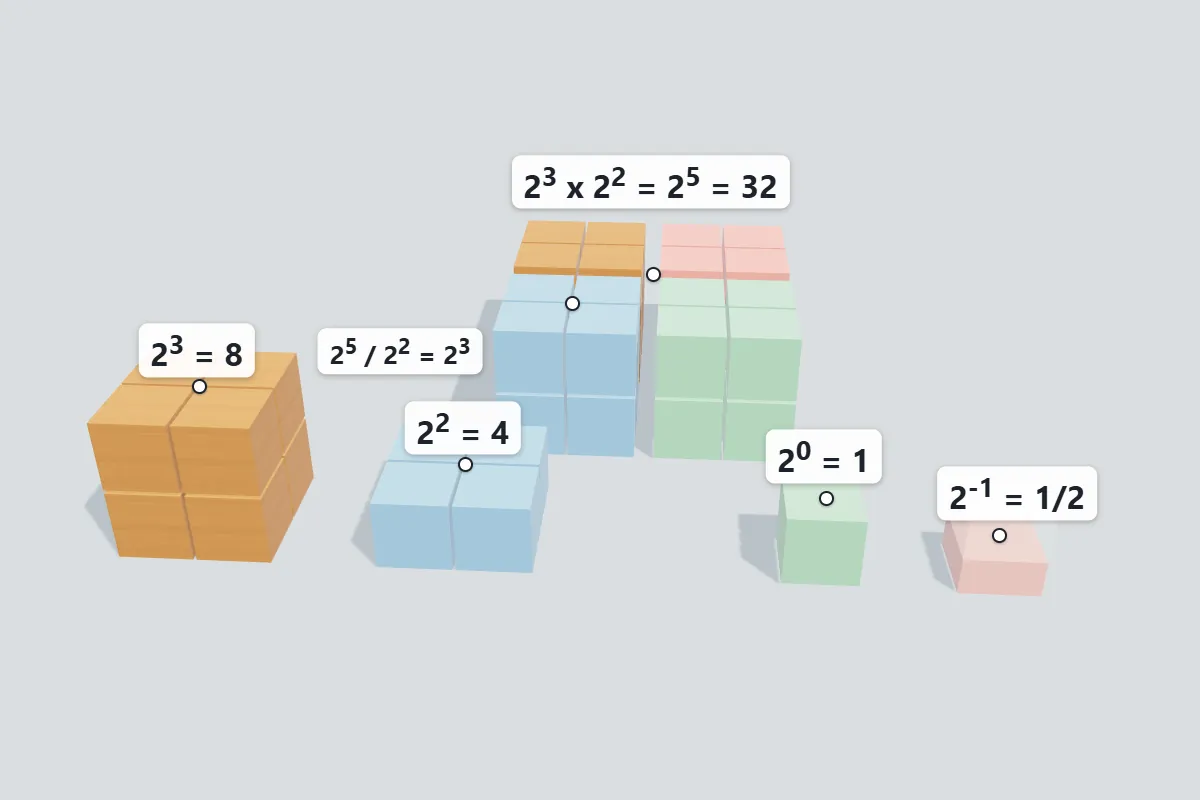
| Comparison aspect | Main idea | Keywords |
|---|---|---|
| • |
| baseexponentmeansmultiplied |
| am × an = am+n | same base multiplied: add the exponents | samebasemultipliedexponents |
| am ÷ an = am−n | same base divided: subtract the exponents (a ≠ 0) | samebasedividedsubtract |
| Write every factor with the same base first | 2 × 4n = 2 × 22n = 22n+1 | |
| • | Note the difference between −an (the negative of an) and (−a)n (the power of the negative base) | Notedifferencebetweennegative |
Unit 1: Powers of Powers and Exponential Equations · 2 / 14
Well done! You finished this lesson
What would you like to do next?