Curriculum
Mathematics — Third Preparatory
Unit 1
0/20
1.11-1 The base, the exponent, and the product and quotient of powers1.21-2 The zero exponent and the negative exponent1.31-3 Power of a power, of a product and of a quotient1.41-4 Sign of a power: even and odd exponents1.51-5 Powers, square roots and fractional exponents1.61-6 Simplifying expressions that combine several laws1.71-7 Exponential equations by equalising the base1.81-8 Equations with negative exponents and fractions1.91-9 Equations solved by taking out a common factor1.101-10 Equations in which the unknown is the base1.111-11 Real-life applications1.121-12 Summary of the laws of this unit1.13Exam traps and key takeaways
Unit 2
0/121.12-1 The quadratic function: definition, values and points1.22-2 The vertex form y = a(x − h)2 + k1.32-3 The vertex from the general form1.42-4 Sketching the parabola1.52-5 Maximum and minimum applications1.62-6 Polynomial functions and their degree1.72-7 Zeros of a polynomial function1.82-8 The rational algebraic function, its domain and simplifying1.92-9 Common domain of two functions and equality of functions1.102-10 Addition, subtraction, multiplication and division1.112-11 Additive and multiplicative inverses, and properties1.12Exam traps and key takeaways
Unit 3
0/121.13-1 The two conditions of similarity and the ratio of perimeters and areas1.23-2 Cases of similarity of triangles and the parallel line1.33-3 Real-life applications of similarity1.43-4 The dilation and its properties1.53-5 Dilation on the coordinate plane1.63-6 Sides relative to an angle, and the definitions of sin, cos and tan1.73-7 Finding side lengths and complementary angles1.83-8 Exact ratios of 30°, 45° and 60°1.93-9 Using the calculator and applications of trigonometry1.103-10 The slope of a line, parallel and perpendicular lines1.113-11 Equations of a line and the intercepts1.12Exam traps and key takeaways
Unit 4
0/131.14-1 Measures of central tendency: recap1.24-2 Why do we need measures of dispersion?1.34-3 The range1.44-4 The median recap, quartiles and the interquartile range1.54-5 The box plot (box-and-whisker)1.64-6 Deviation, variance and standard deviation of a set of values1.74-7 Standard deviation of a simple frequency distribution1.84-8 Standard deviation of a grouped (class) distribution1.94-9 Using the scientific calculator1.104-10 Comparing two data sets1.114-11 Effect of adding or multiplying every value1.124-12 Outliers and choosing the right measure1.13Exam traps and key takeaways
Text lesson
Unit 1: Powers of Powers and Exponential Equations
Unit 1: Powers of Powers and Exponential Equations
Overview
Overview
- Use the seven laws of exponents with rational bases, including zero, negative and fractional powers.
- Determine the sign of a power from the parity of the exponent.
- Solve exponential equations by equalising bases, taking out a common factor or rewriting different bases with a common prime.
- Model real-life growth, area and volume problems with exponential equations.
Powers and Exponential Equations
├── 1-1 Laws of powers
│   ├── multiplying and dividing same base
│   ├── zero exponent and negative exponent
│   ├── power of a power, of a product, of a quotient
│   ├── sign: even and odd exponents
│   ├── powers and square roots (fractional exponents)
│   └── simplifying with several laws at once
└── 1-2 Exponential equations
    ├── equalising the base
    ├── negative exponents and fractions
    ├── taking out a common factor
    ├── the unknown is the base
    ├── different bases reduced to a common prime
    ├── real-life applications
    └── equations mixing several ideas
Unit 1: Powers of Powers and Exponential Equations · 1 / 14
1-1 The base, the exponent, and the product and quotient of powers
1-1 The base, the exponent, and the product and quotient of powers
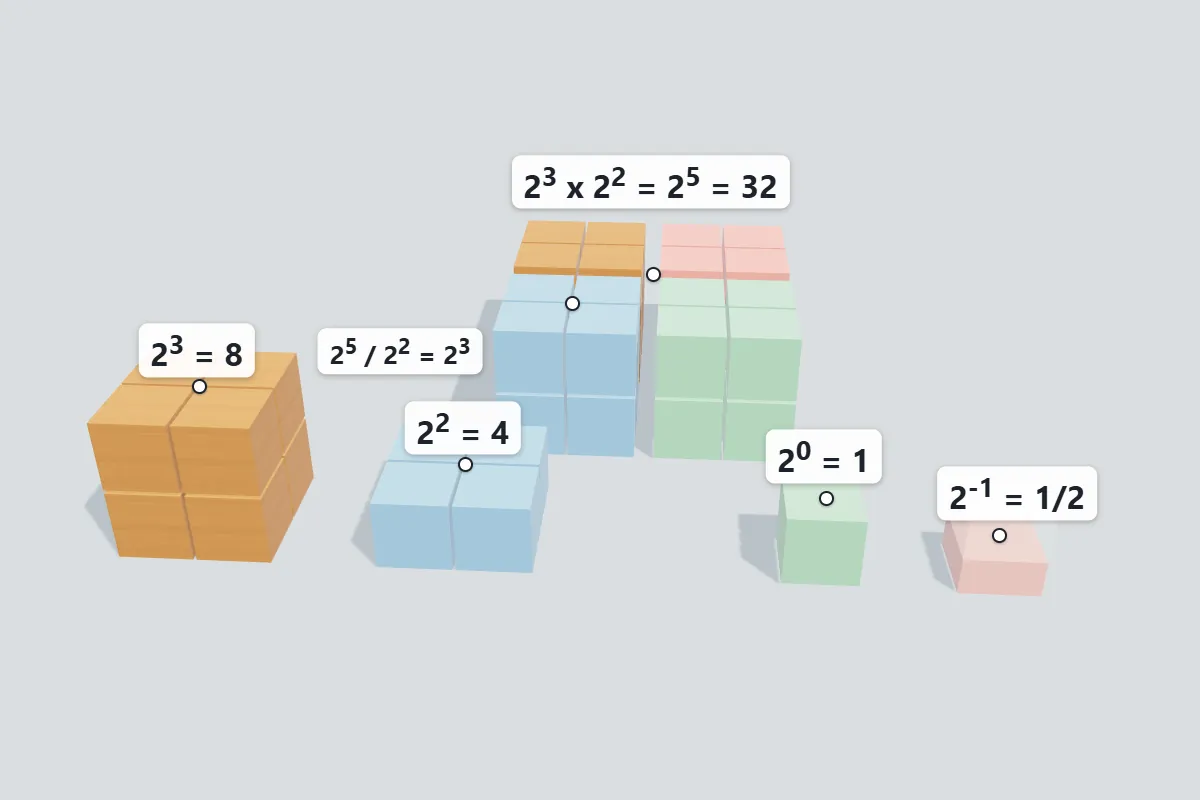
| Comparison aspect | Main idea | Keywords |
|---|---|---|
| • |
| baseexponentmeansmultiplied |
| am × an = am+n | same base multiplied: add the exponents | samebasemultipliedexponents |
| am ÷ an = am−n | same base divided: subtract the exponents (a ≠ 0) | samebasedividedsubtract |
| Write every factor with the same base first | 2 × 4n = 2 × 22n = 22n+1 | |
| • | Note the difference between −an (the negative of an) and (−a)n (the power of the negative base) | Notedifferencebetweennegative |
Unit 1: Powers of Powers and Exponential Equations · 2 / 14
1-2 The zero exponent and the negative exponent
1-2 The zero exponent and the negative exponent
| Comparison aspect | Main idea | Keywords |
|---|---|---|
| a0 = 1 |
| everyundefinedwhenever |
| a−n = 1/an |
| negativeexponentmovesfactor |
| • | (a/b)−n = (b/a)n | |
| Example |
|
Unit 1: Powers of Powers and Exponential Equations · 3 / 14
1-3 Power of a power, of a product and of a quotient
1-3 Power of a power, of a product and of a quotient
(am)n = amnmultiply the exponents.
(ab)n = an bnthe exponent distributes over a product.
(a/b)n = an/bnlikewise over a quotient (b ≠ 0).
Nested powers((23)2)4 = (26)4 = 224 — always multiply from the inside out.
Unit 1: Powers of Powers and Exponential Equations · 4 / 14
1-4 Sign of a power: even and odd exponents
1-4 Sign of a power: even and odd exponents
- (−a)n is positive when n is even and negative when n is odd.
- (−2)4 = 16 but −24 = −16; (−2)−3 = −1/8.
- Any real power of a positive base is positive, so an = −4 has no real solution when n is even.
- For comparison questions, put the numbers over a common exponent or a common base before judging which is larger.
Unit 1: Powers of Powers and Exponential Equations · 5 / 14
1-5 Powers, square roots and fractional exponents
1-5 Powers, square roots and fractional exponents
| Comparison aspect | Main idea | Example | Keywords |
|---|---|---|---|
| a1/n) = n√a |
| — | definedeven |
| • |
| — | absolutevalue |
| • |
| — | |
| Simplifying a radical | pull out the largest perfect square | √48 = √(16 × 3) = 4√3 | pulllargestperfectsquare |
| Rationalising a denominator | 1/√2 = √2/2 and 1/(√3 + 1) = (√3 − 1)/2 | — |
Unit 1: Powers of Powers and Exponential Equations · 6 / 14
1-6 Simplifying expressions that combine several laws
1-6 Simplifying expressions that combine several laws
| Comparison aspect | Main idea | Keywords |
|---|---|---|
| Order of work |
| powersfirstthenproducts |
| Example | (2x3y−2)3 / (4x2y)2 = (8x9y−6)/(16x4y2) = ½ x5 y−8 = x5 / (2y8) | 2x3y4x2y8x9y16x4y2 |
| • | Leave the answer with positive exponents unless the question asks otherwise | Leaveanswerpositiveexponents |
Unit 1: Powers of Powers and Exponential Equations · 7 / 14
1-7 Exponential equations by equalising the base
1-7 Exponential equations by equalising the base
| Comparison aspect | Main idea | Keywords |
|---|---|---|
| If ax = ay with a > 0 and a ≠ 1, then x = y | write both sides as powers of the same base and equate the exponents | writebothsidespowers |
| Example | 3x+1 = 27 → 3x+1 = 33 → x = 2 | |
| Example | 4x = 8 → 22x = 23 → x = 3/2 | |
| • |
| Checkanswersubstitutionexponential |
Unit 1: Powers of Powers and Exponential Equations · 8 / 14
1-8 Equations with negative exponents and fractions
1-8 Equations with negative exponents and fractions
- Clear negative exponents first by taking reciprocals, then equalise bases.
- Example 2−x = 1/16 → 2−x = 2−4 → x = 4.
- Example (1/3)2x) = 9 → 3−2x) = 32 → x = −1.
- Fractional exponents x3/2) = 8 → x = 82/3) = (∛8)2 = 4.
- To solve an equation with exponents, write both sides with the same base, then set the exponents equal.
- For any integer exponent n, use the rule (a/b)n = (b/a)−n, where a and b are non-zero.
- For example, (2/3)x+2 = 27/8 can be written as (2/3)x+2 = (3/2)3 = (2/3)−3, so x + 2 = −3 and x = −5.
- Another example 9x+2 = 3x. Writing 9 as 32 gives 32x+4 = 3x, so 2x + 4 = x and x = −4. In a third example, 3x+1 = 81 = 34, so x + 1 = 4 and x = 3. Always check the value of x in the original equation.
Unit 1: Powers of Powers and Exponential Equations · 9 / 14
1-9 Equations solved by taking out a common factor
1-9 Equations solved by taking out a common factor
- When powers of the same base are added, factor out the smallest power.
- Example 2x+1 + 2x = 24 → 2x (2 + 1) = 24 → 2x = 8 → x = 3.
- Example 5x+2 − 5x = 120 → 5x (25 − 1) = 120 → 5x = 5 → x = 1.
- Never “cancel” a sum of powers by subtracting exponents — that is the trap this method avoids.
Unit 1: Powers of Powers and Exponential Equations · 10 / 14
1-10 Equations in which the unknown is the base
1-10 Equations in which the unknown is the base
- xn = a → x = a1/n); for even n there are two real roots ±n√a when a > 0, and none when a < 0.
- Example x2 = 49 → x = ±7; x3 = 64 → x = 4; (2x − 1)2 = 25 → 2x − 1 = ±5 → x = 3 or x = −2.
- Even exponent with a negative right side has no real solution: x4 = −16 → ∅.
- Break each base into its prime factors 8x+1 = 16 → 23⁽x+1⁾ = 24 → 3x + 3 = 4 → x = 1/3.
- If no common prime exists the equation is out of this unit’s scope and needs logarithms.
Unit 1: Powers of Powers and Exponential Equations · 11 / 14
1-11 Real-life applications
1-11 Real-life applications
| Comparison aspect | Main idea | Keywords |
|---|---|---|
| Doubling growth |
| colonyeveryhourafter |
| Area and volume |
| squaresidecubecompare |
| Attenuation | a quantity halving each period is (½)n of its original value | quantityhalvingperiodoriginal |
| • | Always state the unit and reject a non-integer or negative value of n when the situation is a count of periods | Alwaysstateunitreject |
Unit 1: Powers of Powers and Exponential Equations · 12 / 14
1-12 Summary of the laws of this unit
1-12 Summary of the laws of this unit
- am · an = am+n ; am ÷ an = am−n ; (am)n = amn ; (ab)n = anbn ; (a/b)n = an/bn.
- a0 = 1 (a ≠ 0); a−n = 1/an ; am/n = (n√a)m.
- (−a)n > 0 for even n, (−a)n < 0 for odd n.
- ax = ay ⟹ x = y; xn = a ⟹ x = a1/n) (two signs for even n).
Unit 1: Powers of Powers and Exponential Equations · 13 / 14
Exam traps and key takeaways
Exam traps and key takeaways
💡 High-yield traps
- −24 = −16 while (−2)4 = 16 — brackets decide the sign.
- a−n is a reciprocal, not a negative number.
- a0 = 1 only for a ≠ 0; 00 is undefined.
- (a + b)2 ≠ a2 + b2; the product and quotient laws do not apply to sums.
- √(a2) = |a| — forgetting the absolute value loses the sign mark.
- Adding powers of the same base means factoring, not adding exponents: 2x + 2x = 2 · 2x = 2x+1.
- Even roots need ± when solving x2 = a.
- Equalising bases requires a common prime base; matching only the written base (like 4 and 8) is not enough.
- In word problems the exponent is a number of periods, so it must be non-negative; reject other values.
Unit 1: Powers of Powers and Exponential Equations · 14 / 14
Well done! You finished this lesson
What would you like to do next?