10.4Chapter 10: Structure, Bonding, and Properties
Inside ionic compounds — Alhussan Chemistry - Stage 9 Revision Notes & Topical Questions
5 min read 8 parts Lesson 4 of 9 3 quizzes
10.4 Inside ionic compounds — Giant Ionic Lattices and Electrostatic Bonds — Alhussan International Academy — Chemistry (Stages 7–9) notes: Define ionic bonding, ionic compound and giant ionic structure, and explain the properties of ionic compounds using the giant ionic model.Io…
- Bonds act in all directions
- Brittleness
- Stronger attraction
- Insoluble compounds
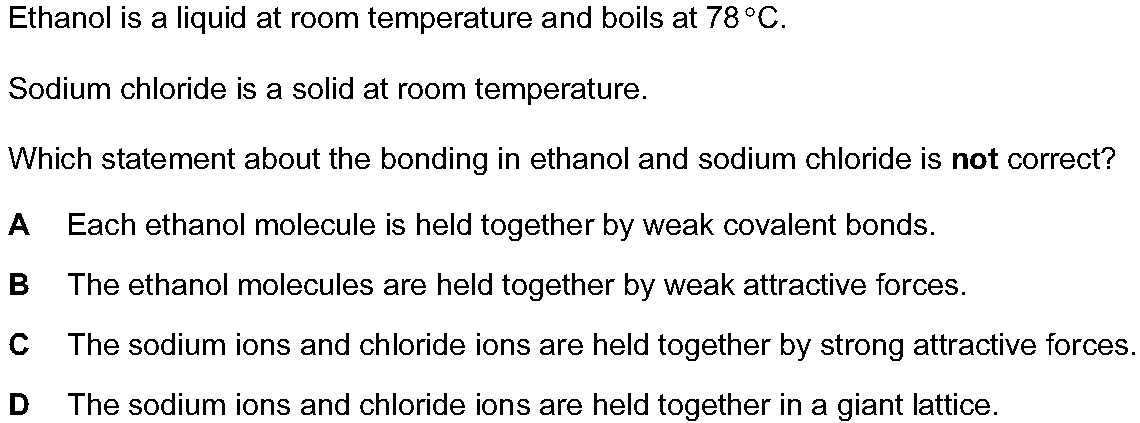
- Sodium chloride
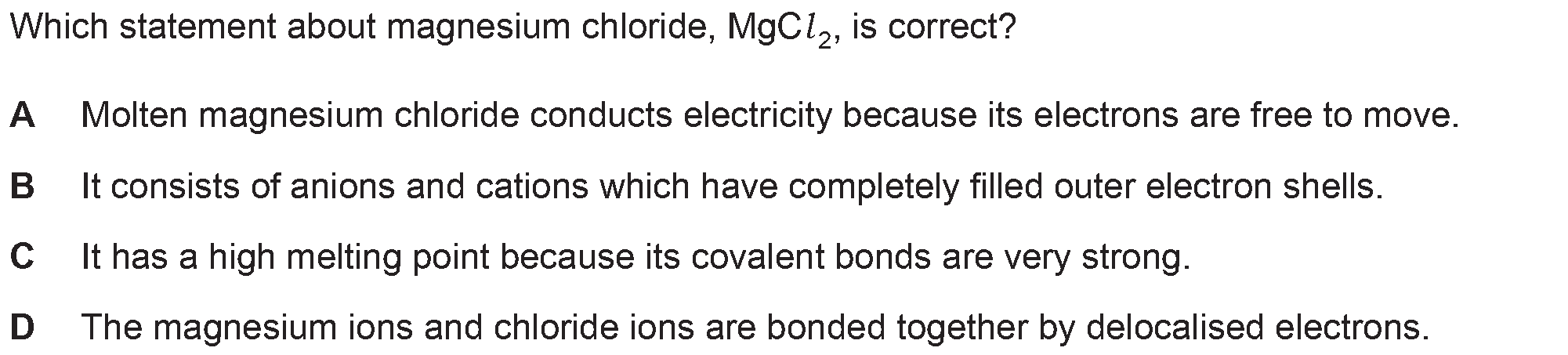
- Magnesium chloride
Section 1 of 8Ionic bonding
- A crystal of sodium chloride (NaCl) is made of millions of sodium ions and chloride ions held together this way.
- Formation an ionic bond forms when a metal atom transfers outer electrons to a non-metal atom.
- Sodium (2,8,1) gives one electron to chlorine (2,8,7), forming Na+ and Cl-, each with a full outer shell.
- Calcium oxide and nickel chloride are also ionic compounds.
Section 2 of 8Giant ionic structure
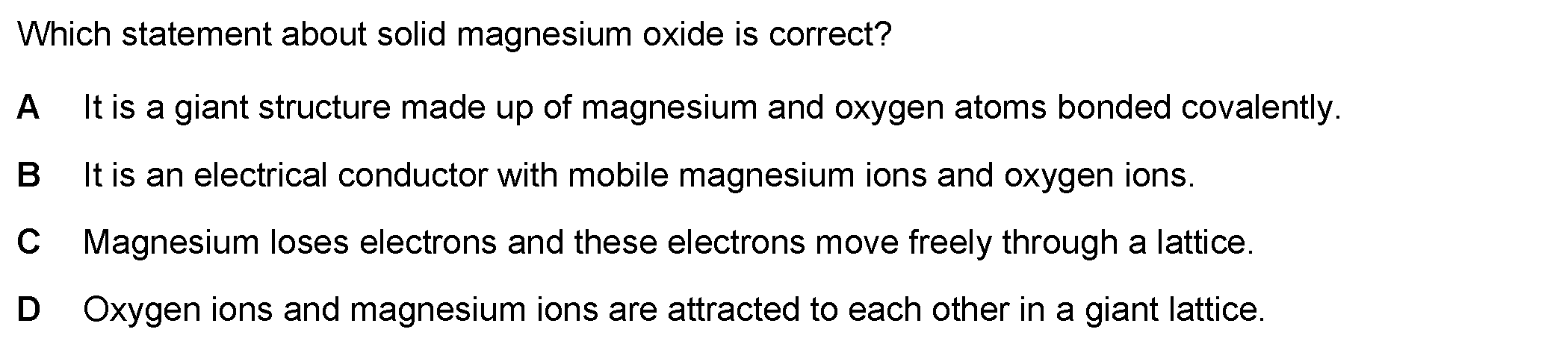
- Lattice ions pack in a regular repeating pattern called a giant ionic lattice, with each ion surrounded by ions of the opposite charge.
- Bonds act in all directions the attraction acts throughout the crystal, and ionic compounds do not form single molecules.
- Formula it shows the simplest ratio of ions, for example NaCl is 1:1 and MgCl2 is 1:2.
Section 3 of 8Properties explained by the model
| Property | Explanation |
|---|---|
| High melting and boiling points | Many strong electrostatic attractions need a lot of energy to overcome |
| Hard but brittle | Layers shift so like charges line up and repel, and the crystal splits with straight edges |
| No conduction as a solid | Ions are fixed in place |
| Conducts when molten or dissolved | Ions are free to move and carry charge |
| Often soluble in water | Water molecules attract the ions and pull them apart |
- Brittleness if a crystal is dropped it breaks between one row of ions and another, leaving pieces with straight edges.
- Stronger attraction ions with double charges, as in magnesium oxide (Mg2+ and O2-), attract more strongly than in sodium chloride.
- Magnesium oxide melts at about 2850 °C compared with 801 °C for sodium chloride.
- Insoluble compounds some ionic compounds are insoluble because the attraction in the lattice is stronger than the attraction to water molecules.
Section 4 of 8Working out formulae
- Rule the total positive charge must equal the total negative charge.
- Ca2+ and Cl- give CaCl2, and Mg2+ and O2- give MgO.
Section 5 of 8Dot-and-cross diagrams
- Sodium chloride sodium loses its outer shell and is shown as 2,8 with 1+, and chlorine has eight outer electrons and 1-.
- Magnesium chloride one magnesium atom transfers an electron to each of two chlorine atoms, giving MgCl2.
- Quick check the metal loses electrons, the non-metal gains them, and the charges balance in the formula.
Section 6 of 8Modelling ionic bonding
- Barney and Sarah used grapes to model a giant ionic structure of sodium chloride.
- Strength it shows the positions of the oppositely charged ions.
- Limitations it does not show that ions vibrate on the spot, how the attraction acts in all directions, or why ionic compounds are brittle.
Section 7 of 8Key terms
| Term | Meaning |
|---|---|
| Ionic bond | the electrostatic attraction between oppositely charged ions. |
| Ionic compound | a compound made of positive and negative ions. |
| Giant ionic structure | a three-dimensional pattern of oppositely charged ions. |
| Lattice | a regular repeating arrangement of particles. |
| Brittle | breaking easily when hit. |
| Molten | melted; in the liquid state. |
Section 8 of 8Exam technique
Marked practiceQuizzes for this lesson
?What do you want to solve now?
✓Checkpoint Quiz
7 multiple-choice + 1 written questions from real exam papers on this lesson.
Question 1 of 7 1:30
Question 2 of 7 1:30

Question 3 of 7 1:30
Question 4 of 7 1:30

Question 5 of 7 1:30

Question 6 of 7 1:30
Question 7 of 7 1:30

Answer key
1 D2 C3 A4 A5 B6 B7 A
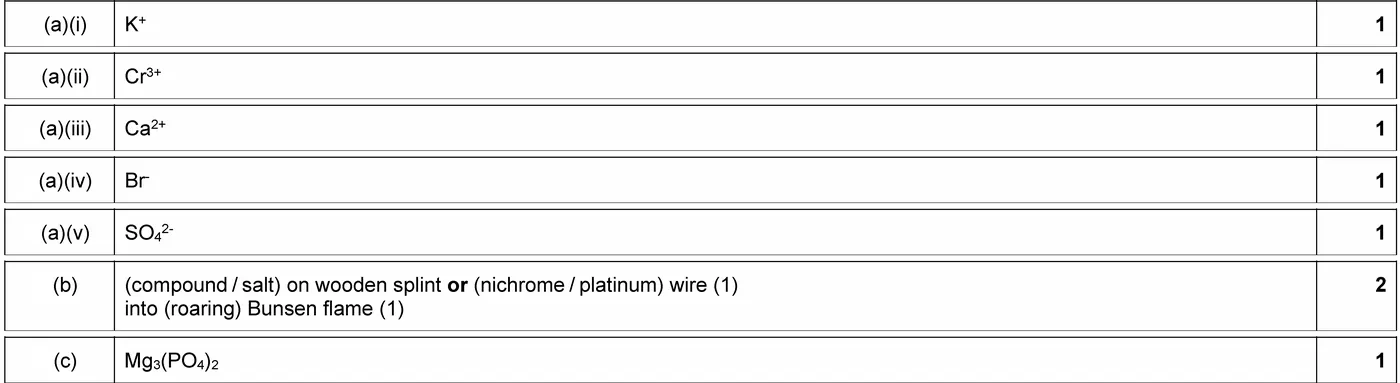
Written question 1 of 1 · part (a)(i) (1 / 7) 3:00
Show the answer
Written question 1 of 1 · part (a)(ii) (2 / 7) 3:00
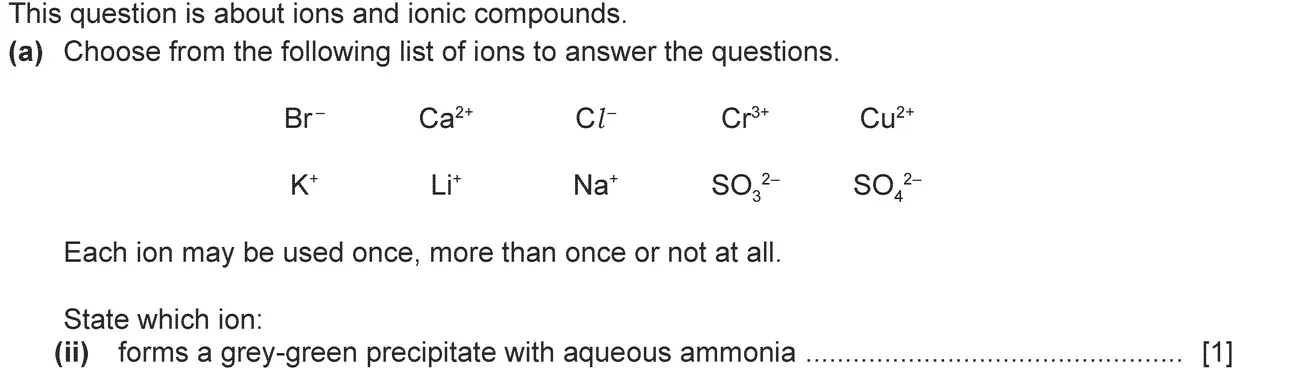
Show the answer

Written question 1 of 1 · part (a)(iii) (3 / 7) 3:00
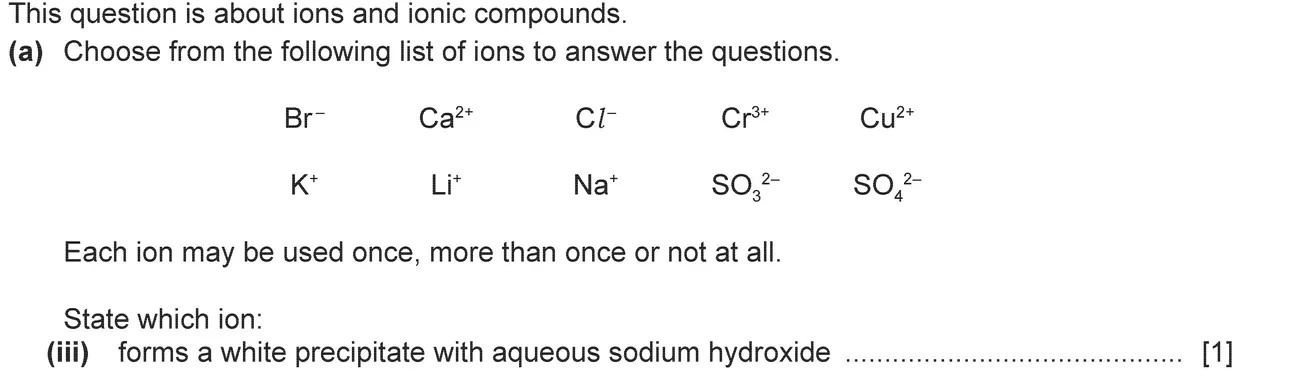
Show the answer
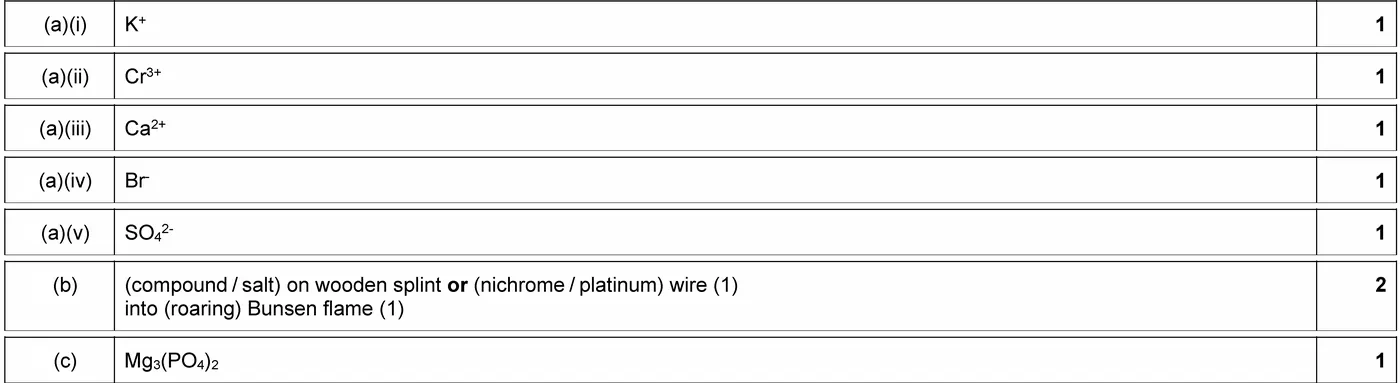
Written question 1 of 1 · part (a)(iv) (4 / 7) 3:00
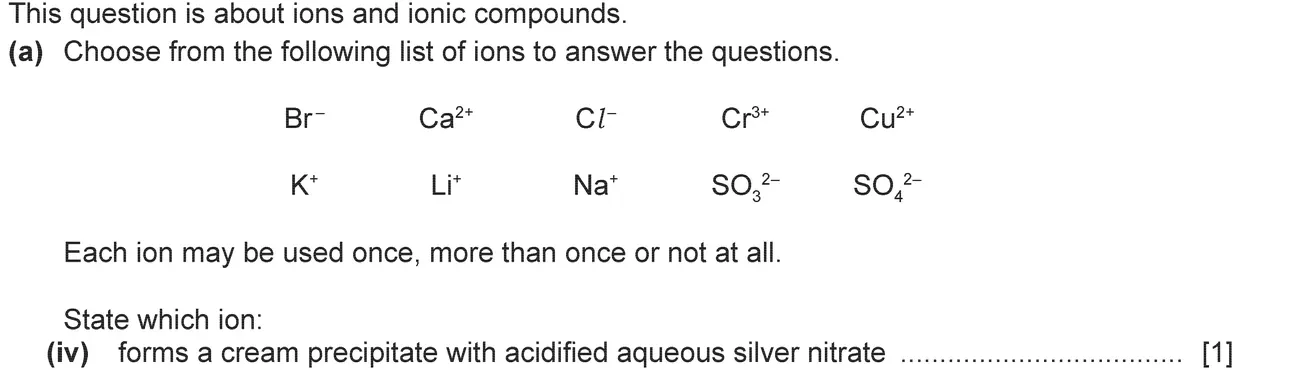
Show the answer

Written question 1 of 1 · part (a)(v) (5 / 7) 3:00
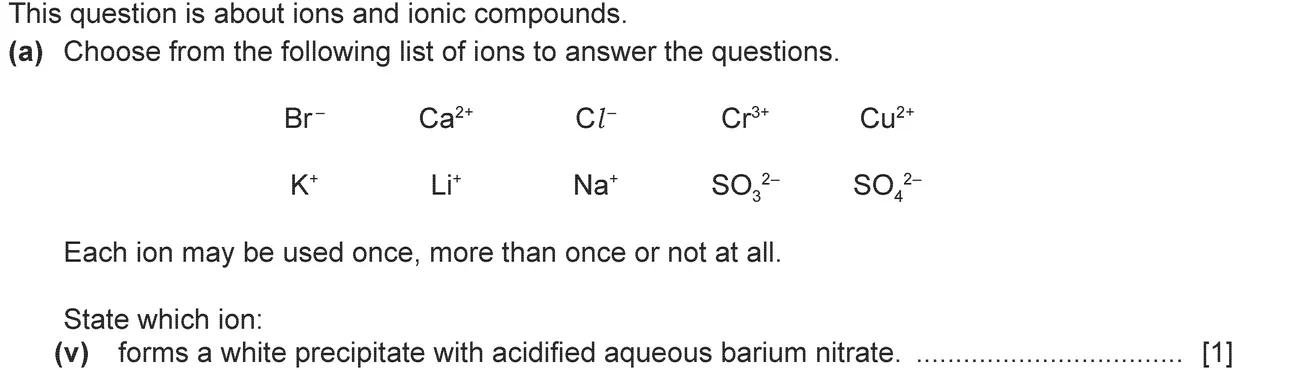
Show the answer
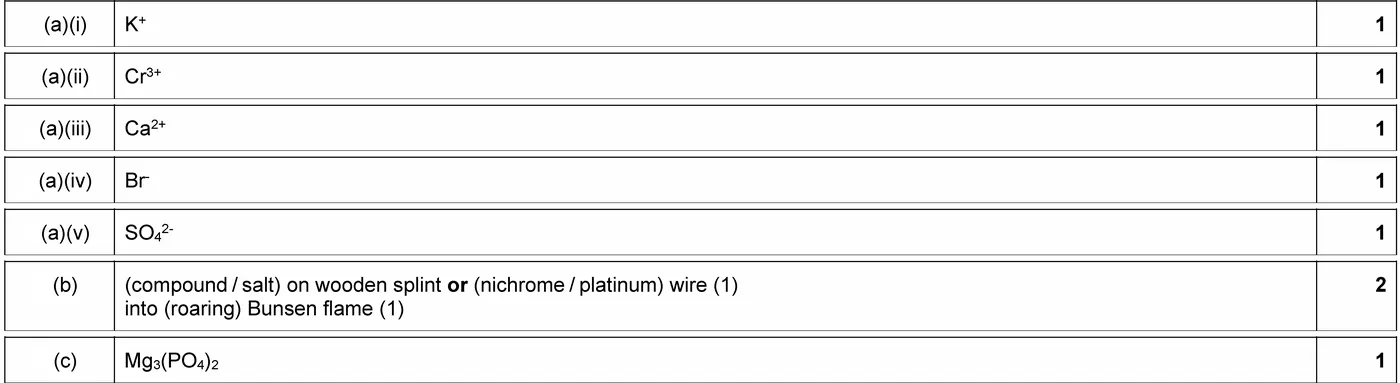
Written question 1 of 1 · part (b) (6 / 7) 3:00
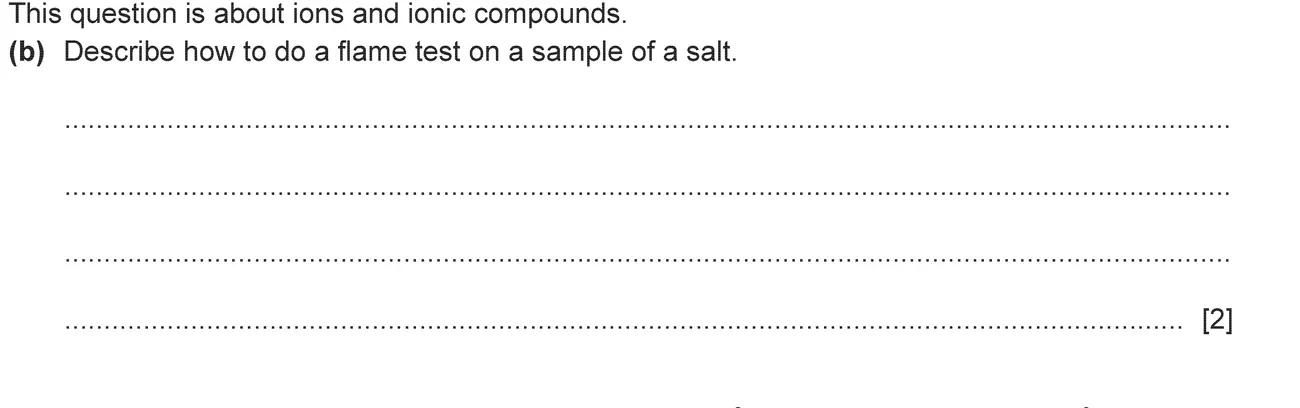
Show the answer
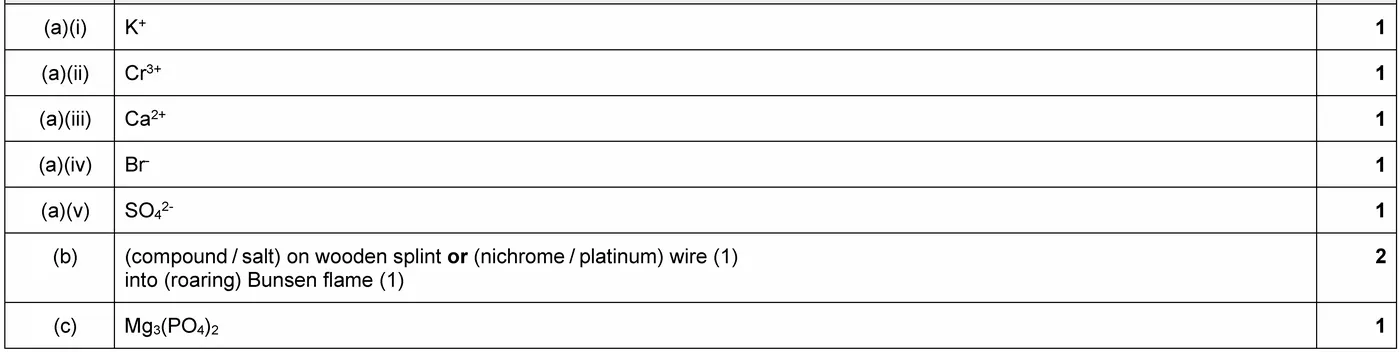
Written question 1 of 1 · part (c) (7 / 7) 3:00

Show the answer
Each part of a written question is on its own screen. Write your answer first, then open "Show the answer" to check it against the mark scheme.
Last updated: